This book explores the political aspects of China's climate change policy, focusing on the newly established carbon markets and carbon trading schemes. Lo makes a case for understanding the policy change in terms of discourse and in relation to narratives of national power and development.
- English
- ePUB (mobile friendly)
- Available on iOS & Android
eBook - ePub
About this book
Information
Print ISBN
9781137528995
Subtopic
Development Economics1
New Episode
China’s power of saying in the area of climate change is increasing. Every country and group is interested in what China is thinking about. China’s attitude also has implications for the outcomes [of international climate change meetings]. This shows the growing soft power of China.

Xie Zhenhua1
1.1 Building economic strengths
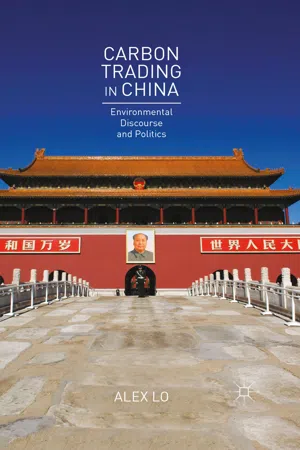
On 1 October 1949, Beijing witnessed a historic ceremony celebrating the founding of the People’s Republic of China (PRC). At a turning point in modern Chinese history, Chairman Mao Zedong stood in Tiananmen Square, right in front of the abandoned royal palace, and confidently proclaimed, ‘The Chinese people have stood up!’ Preceded by a miserable century of national humiliation at the hands of foreign powers, Mao’s proclamation vividly symbolised the people’s passionate aspirations to make the nation stronger (Shapiro, 2001, 2012). Mao advocated socialism. China’s ideological enemy, at that time, was capitalism. More than 65 years have passed, things have changed, and China has come to embrace market principles. What have not changed, however, are the nation’s aspirations anchored upon fragments of the humiliating memories. Whichever ideology dominates, these deep-seated collective aspirations and memories continue to shape the political context and influence policy change in China.
These normative forces are manifest in the political economy of China and its position on climate change. China has presented itself a special genre of market economy, but are the markets an end in itself or merely a means to an end?
British economist and senior government advisor Lord Nicholas Stern has famously described climate change as the greatest market failure the world has ever seen (Stern, 2007). Advocates of this view believe that current market mechanisms and institutions fail to pass on the social costs of using fossil fuels and generating excessive greenhouse gas (GHG) emissions to producers or consumers. To internalise these costs and correct this market failure, governments should put a price on carbon (the right to emit GHG). This can create incentives for firms and individuals to produce and consume less emissions-intensive goods and services and to undertake GHG abatement. One way of pricing carbon is to create a carbon market.
Carbon markets are the systems where allowances (or permits) to emit GHGs or credits earned by avoiding or sinking GHGs are traded (Mol, 2012). Each allowance and credit is measured by one metric tonne of carbon dioxide equivalent (tCO2e). There are two types of carbon markets. Allowance markets involve the trading of allowances or permits issued by a regulatory body under a ‘cap-and-trade’ regime, whereas in project-based markets, emissions credits are produced by emissions reductions achieved by a specific carbon offset project, which can be used to ‘offset’ an equivalent amount of emissions produced elsewhere (Bayon et al., 2009).
Globally, the carbon markets traded a total of US$176 billion worth of emissions allowances and credits in 2011 (Kossoy and Guigon, 2012). The world’s largest carbon market, the European Union (EU) Emission Trading Scheme (ETS), has entered into its Phase III (2013–2020), after a decade of operation. Since 2007, the idea of emissions trading2 has found its way beyond the European continent. In 2013, a total of eight new carbon markets opened their doors (World Bank, 2013). Outside Europe, ETSs are currently operating in New Zealand, South Korea, Kazakhstan, California, and ten Northeastern states of the United States, Tokyo (Japan), Quebec (Canada), and several Chinese cities and provinces. In less than ten years, emissions trading has become the dominant form of climate change mitigation for institutions (Ellerman et al., 2010; Grubb, 2012).
But markets fluctuate and so do the commitments governments have made. ‘The Kyoto Protocol’s grand plan is dead’, declared Michael Grubb, then Cambridge economist and an early proponent of emissions trading, in a Nature commentary published in November 2012 (Grubb, 2012, p. 667). The ‘grand plan’ was to set up a global, top-down, unified cap-and-trade system to curb GHG emissions under the auspices of the Kyoto Protocol and the leadership of developed-country governments. Yet, not all governments kept their promise, mainly due to concerns about impacts on domestic economy. For example, the Australian government managed to bring the ‘Clean Energy Future’, a policy package with a carbon pricing component (transitory carbon tax followed by emissions trading), into legislation in 2011. The selling point was the great potential for raising Australia’s gross domestic product (GDP) – as the title of a government economic report suggested: ‘Strong growth, Low pollution’ (Australian Treasury, 2011). The rhetoric articulated by the Australian government was congenial to the Stern Review (Stern, 2007), both emphasising the potential economic gains of taking timely action. But in 2014, the growth discourse jobs and the economy. Canberra revoked the carbon pricing scheme. Washington had encountered similar hurdles in 2010.
Worse still, the prospects of the international carbon markets turned bleak. Carbon trading entered an uncertain period in 2009, when the world economy stumbled and the Copenhagen conference failed to produce substantive agreements on post-2012 commitments (Perdan and Azapagic, 2011). At the United Nations (UN) conference held in December 2011, countries failed to confirm the extension of the Protocol after 2012, when the first commitment period of the Kyoto Protocol would conclude. As a consequence, the prices of emissions allowances traded under the Clean Development Mechanism (CDM)3 and EU ETS experienced sharp declines during the following year (Newell et al., 2013). In 2011, allowance markets alone recorded a trading value of US$149 billion (Kossoy and Guigon, 2012, p. 10), but in 2013, the world’s ETSs were valued at only US$30 billion (World Bank, 2013, p. 8).4 In 2014, the World Bank (2014, p. 27) warned that, without a substantial increase in the demand for Kyoto carbon credits, the international carbon markets might continue to decline.
China came on board when the markets started declining. In 2010 and early 2011, when the world economy began to recover from the financial turmoil, the Chinese government declared its interest in setting up a national cap-and-trade system to curb its growing GHG output. In October 2011, the Chinese central government approved seven pilot ETSs and declared interest in introducing a national scheme. The Chinese ETSs inaugurate the world’s second-largest carbon market after the EU ETS and are expected to mark a major step forward in creating a global carbon market. The pilot ETSs came into operation between 2013 and 2014. During this period, carbon prices in the EU and CDM markets reached historic lows (World Bank, 2013).
From a Chinese perspective, what growth prospects could carbon markets promise to deliver at that time? Markets can deliver material benefits. Market mechanisms can increase economic efficiency and reduce costs of emissions reduction, as politicians and economists in London, Brussels, Washington, and Canberra have argued. In established liberal market economies, this argument can be taken for granted. Marketisation is the way forward for China in transition to a market economy. But the timing of the Chinese government’s decision and the capacity of Chinese regulatory institutions are, in themselves no guarantee of effective delivery of material benefits. Granted these benefits, compared to China’s annual GDP (approx. US$9,600 billion in 20135), any net gain from carbon trading would be minimal. Capping national GHG emissions, however, is politically irritating. If all costs, including non-economic ones, were submitted to monetary calculation, positive gains are not likely to be self-evident.
The argument that carbon markets can contribute to economic strength warrants a critical inquiry in the Chinese context. Rather than rejecting this claim, I propose another way of interrogating this growth discourse, not from an economic perspective but from a political one. The inquiry is embedded in a fundamental question: To China, what does economic strength mean to China?
1.2 What does economic strength mean to China?
In 2012, the PRC produced 8,205.9 million tonnes of CO2 emissions, or 25.9 per cent of the world’s total (International Energy Agency, 2014, p. 38), making it the largest national source of GHGs (Figure 1.1). Emissions growth accelerated much more rapidly than in other BRIC countries,6 (Figure 1.2). During the past ten years (2003–2012), the country saw explosive growth (96 per cent) in its annual CO2 emissions (from 4,176.6 million tonnes to 8,205.9 million tonnes) (International Energy Agency, 2014).

Figure 1.1 World's top fi ve greenhouse gas emitting countries (2012)
Source: International Energy Agency (2014).

Figure 1.2 Total CO2 emissions from BRIC countries ( 1992–2012)
Source: International Energy Agency (2014).
Per capita CO2 emissions rose to 6.08 tonnes CO2 in 2012, still below the EU 28 average (6.91 tonnes) but exceeding world average (4.51 tonnes) (International Energy Agency, 2014, pp. 84–86). Carbon intensity declined over the past two decades, but this came with rapid growth in CO2 emissions per capita. Right before the 2009 United Nations Climate Change Conference at Copenhagen, China pledged to reduce carbon intensity by 40–45 per cent below 2005 levels by 2020. Although new environmental policy measures and institutions have produced positive environmental outcomes, they have not led to absolute reductions in emissions and energy use (Mol, 2009). Between 1992 and 2012, China’s carbon intensity (CO2 emissions per unit GDP) dropped by 52 per cent, but the level of CO2 emissions per capita went up by 188 per cent (Figure 1.3).

Figure 1.3 China's CO2 emissions per GDP and capita ( 1992–2012)
Source: International Energy Agency (2014).
Strong economic growth during the past decade accounts for the rise in CO2 emissions. The short-term GDP growth target specified in the Chinese government’s 12th Five-Year Plan (FYP) (2011–2015) was to achieve an average annual growth of 7 per cent. At the time of writing, the 13th FYP (2016–2020) has not been released, but speculations suggest 7 per cent as an achievable target.7 Although China’s economic growth has slowed down and emissions are expected to peak by 2030, annual GHG outputs will continue to stay at a very high level for some time. While China appears determined to mitigate climate change, the challenges ahead are enormous.
The decision to curb emissions and by what extent involves not only the persisting tension between economic growth and environmental protection, but also one of controlling social uncertainties. The nation entered into an ideological crisis after Mao’s death and the demise of Mao’s regime towards the end of the 1970s. The Communist Party of China (CPC), which has been the only ruling party since 1949, had come to realise that it would lose political legitimacy to rule the country if the socialist ideology was completely dismissed and demolished, leading people to lose faith in the regime. Mao’s successor Deng Xiaoping adopted a pragmatic strategy of retaining the political system, while reforming and opening the economy. This resulted in China formally embracing the notion of ‘socialist market economy’ in its 14th National Congress held in 1992. Although the authoritarian government has encountered difficulties in managing the unsettled Chinese society, especially on issues about laws, democracy, and social justice, it promises to offer material well-being and stability as a form of compensation. The unspoken ‘deal’ with citizens is premised upon continuing economic development and improving incomes. Promoting economic growth is therefore imperative for stabilising the society – more so than in many other countries where governments seek political legitimacy via democratic channels.
Apart from building trust in the Party’s rule, strengthening the economy is also a means to manage public expectation in the wake of economic nationalism. Chinese people are well informed of the nation’s inglorious history between the mid-19th and early 20th centuries, the so-called ‘a century of national humiliation – when Chinese territories and capital were de-possessed by foreign powers, and national pride and sovereignty were eroded (Agnew, 2010, 2012). This creates a traumatic collective memory among members of the society, including the new generations exposed to one or two decades of patriotic education promoted by the CPC (Zhao, 1998; Wang, 2008). All generations of Chinese, past and present, have a strong desire for recognition and respect from other countries in order to ‘cleanse the stains of lost honor and pride’ (Callahan, 2009, p. 171). Chinese people firmly believe that one effective way of achieving this is to scale up the domestic economy and strengthen its political-economic power, by which to acquire global influence and the power to have a say in international and regional affairs (Hughes, 2006). Mao’s landmark proclamation at Tiananmen Square is still alive. The ability to regain what had been lost crucially rests upon the power of a big and strong economy.
To China, therefore, the use of market principles to run the economy serves both economic and political ends, which are interrelated. Analysis of the adoption of market principles and mechanisms in China – in this case, carbon trading – cannot be reduced to a study of economic conditions and the language of markets (Cartier, 2011, 2013). There is no room for viewing the Chinese state as merely a reactive economic agent. Instead, the state should be seen as the manager of a bulky and fragile society that is struggling over new glories and old traumas (Wang, 2008). Hovering on the edge of a legitimacy crisis, it keeps using a combination of coercion, ‘sticks and carrots’, and rhetoric to stabilise society and contain a potential public backlash. The unsettled political ...
Table of contents
- Cover
- Title
- Copyright
- Contents
- List of Figures and Tables
- Preface
- Acknowledgements
- List of Abbreviations
- A Note on Chinese Names
- 1 New Episode
- 2 Political Economy of Carbon Trading
- 3 Political and Policy Background
- 4 Who Is Leading? State or Finance?
- 5 Policy Change, Discourse, and Storyline
- 6 The Discourse of State Power, Sovereignty, and Carbon
- 7 Historical Parallels, Recurring Storylines
- 8 The End of History?
- Appendix
- Notes
- Bibliography
- Index
Trusted by 375,005 students
Access to over 1.5 million titles for a fair monthly price.
Study more efficiently using our study tools.
Frequently asked questions
Yes, you can cancel anytime from the Subscription tab in your account settings on the Perlego website. Your subscription will stay active until the end of your current billing period. Learn how to cancel your subscription
No, books cannot be downloaded as external files, such as PDFs, for use outside of Perlego. However, you can download books within the Perlego app for offline reading on mobile or tablet. Learn how to download books offline
Perlego offers two plans: Essential and Complete
- Essential is ideal for learners and professionals who enjoy exploring a wide range of subjects. Access the Essential Library with 800,000+ trusted titles and best-sellers across business, personal growth, and the humanities. Includes unlimited reading time and Standard Read Aloud voice.
- Complete: Perfect for advanced learners and researchers needing full, unrestricted access. Unlock 1.5M+ books across hundreds of subjects, including academic and specialized titles. The Complete Plan also includes advanced features like Premium Read Aloud and Research Assistant.
We are an online textbook subscription service, where you can get access to an entire online library for less than the price of a single book per month. With over 1.5 million books across 990+ topics, we’ve got you covered! Learn about our mission
Look out for the read-aloud symbol on your next book to see if you can listen to it. The read-aloud tool reads text aloud for you, highlighting the text as it is being read. You can pause it, speed it up and slow it down. Learn more about Read Aloud
Yes! You can use the Perlego app on both iOS and Android devices to read anytime, anywhere — even offline. Perfect for commutes or when you’re on the go.
Please note we cannot support devices running on iOS 13 and Android 7 or earlier. Learn more about using the app
Please note we cannot support devices running on iOS 13 and Android 7 or earlier. Learn more about using the app
Yes, you can access Carbon Trading in China by Alex Lo in PDF and/or ePUB format. We have over 1.5 million books available in our catalogue for you to explore.