eBook - ePub
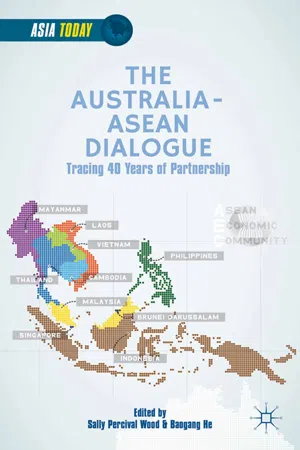
The Australia-ASEAN Dialogue
Tracing 40 Years of Partnership
- English
- ePUB (mobile friendly)
- Available on iOS & Android
eBook - ePub
The Australia-ASEAN Dialogue
Tracing 40 Years of Partnership
About this book
This book examines the Australia-ASEAN Dialogue Partnership since its inception in 1974 and looks at the networks of engagement that have shaped relations across three areas: regionalism, non-traditional security, and economic engagement.
Information
Print ISBN
9781349496648
9781137449139
Subtopic
Asian PoliticsI
Australia in Asian Regionalism
1
Australia and ASEAN: A Marriage of Convenience?
Sally Percival Wood
There is no doubt that Australia and ASEAN have developed a productive working relationship over their 40 years of Dialogue Partnership. Their many intersections of engagement—through formal ASEAN processes, free trade agreements (FTAs), memoranda of understanding, and across a range of sectors including education, tourism, cultural heritage, and the arts—have been documented over the last decade.1 After the Asian Financial Crisis (1997–98), and the formalization of processes such as the ASEAN Regional Forum (ARF, 1994), the East Asia Summit (EAS, 2004), and the ASEAN Defence Ministers Meetings-Plus (ADMM+, 2011), Australia has been keen to maximize future economic opportunities—through bilateral and multilateral FTAs, for example—and to play its part in securing peace and stability in the region—through leadership of initiatives such as the United Nations Transitional Authority in Cambodia (UNTAC) in 1992 and (though controversially) INTERFET (International Force East Timor) in 1999, plus a multitude of arrangements such as those in place with the Australian Federal Police. This expanding network of formal engagement is valuable on both a functional basis and in terms of guaranteeing Australia’s ongoing goodwill and cooperation with its region. Over 40 years these reliable and steady ties have become, a Malaysian economist observed, like “a long dependable marriage.”2 It is an image that can conjure a picture of either close mutual understanding or of a fairly dull union bound by routine and duty.
In truth, the Australia-ASEAN relationship is a mismatch, a result of geography. Almost everything about Australia and Southeast Asia is different—our histories, politics, economies, and cultures. And though our aspirations are essentially the same, they are pursued in a different style and at a different pace. Australians’ urge to prioritize relationships with their distant, yet intimate, Anglo partners is matched regionally by an emphasis on those nations that wield the greatest power—China, Japan, and India. This has resulted in an ASEAN blind spot, a point recognized by a small number of regional specialists who express frustration over Australia’s foreign policy preoccupation with major power relationships. John Blaxland, for example, believes Australia has been “mesmerised by the glittering prize of trade with China” and that “it is in Australia’s and ASEAN’s interests for closer collaboration, if not full ASEAN membership for Australia.”3 Although historian Anthony Milner does not believe Australian membership of ASEAN is appropriate, he has repeatedly argued that it would be to Australia’s benefit to nurture stronger ties with its region. He agrees with Blaxland that “ASEAN does not have a high profile in Australia, particularly in contrast with the United States, China, or India. Most Australians would not see ASEAN as critical to our geopolitical future, and ASEAN leaders seem to know this.”4
In a practical sense, the Australia-ASEAN partnership is substantive. In 2012–13, for example, two-way trade with ASEAN (as a bloc) accounted for 14.8 percent of Australia’s total trade. This places it second to China (21.1 percent) and ahead of Japan (11.2 percent)—and well ahead of the United States (8.7 percent). Furthermore, Singapore, Thailand, and Malaysia individually rank among Australia’s top ten trading partners—Singapore is only marginally behind South Korea, and Australia’s trade with Malaysia is now level with India.5 Australia’s trade relationship with ASEAN and its constituent parts is therefore much more significant than generally acknowledged. Moreover, as Southeast Asian economies grow in the twenty-first century, some may come to dwarf Australia’s. It is predicted, for instance, that by 2030, Indonesia’s economy could overtake Germany’s and the United Kingdom’s.6 And Southeast Asia more broadly “is one of the most rapidly growing regions of the global economy” with massive expansion anticipated over the next two decades.7
Does Australia’s failure to notice ASEAN, despite an obviously strong economic relationship, suggest a mere marriage of convenience? And, in an increasingly confident region of expanding economies and strategic weight, is it time—to use the marriage metaphor—to reaffirm our vows? Clearly, as this book demonstrates, the institutional apparatus are in place for a strong Australia-ASEAN partnership, and there are many new profitable avenues to explore. What, then, are the barriers to moving Australia toward stronger support for, and closer affinity with, ASEAN? This chapter turns to history to unravel the sources of Australia’s disconnect with Southeast Asia’s distinctive approach to regionalism. It is a trajectory of highs and lows, enthusiasm sometimes followed by disappointment. The chapter first traces Southeast Asia’s evolution toward ASEAN in order to understand its nature and origins, the degree to which it contrasted with Australia’s regional objectives, and how these dynamics continue to influence Australia-ASEAN engagement. It then examines some key moments since ASEAN’s founding in 1967 when Australian and Southeast Asian aspirations for regional cooperation struggled to cohere—from the Asian and Pacific Council (ASPAC) in the 1960s, through to the founding of the Asia-Pacific Economic Cooperation (APEC) in 1989, and the signing of ASEAN’s Treaty of Amity and Cooperation in 2004, which was a revelation in misaligned priorities.
Contending Regionalisms in Southeast Asia
An early vision of what Southeast Asian regionalism would look like was expressed by Jose P. Laurel, president of the Japanese-sponsored government of the Republic of the Philippines (1943–45) during the Pacific War. In 1940, Japan established the Greater East Asia Co-Prosperity Sphere, with a view to uniting Asia under the banner “Asia for the Asiatics.” As its fortunes in the war turned, and as Southeast Asians woke up to the reality of Japan’s imperial aspirations, Japan made one final attempt to instill confidence in the region. It was at the Assembly of Greater East-Asiatic Nations in November 1943, that Laurel articulated what could have been a preamble to the ASEAN Charter. The starting point of Asian regionalism, he said:
is recognition, [and] respect for the autonomy and independence of every integral unit [in Asia], so that with that recognition of political independence and territorial integrity, each nation may develop in accordance with its own institutions, without any particular member monopolizing the resulting prosperity of any given country or nation.8
Laurel’s references to autonomy, territorial integrity, and noninterference would remain the cornerstone of Southeast Asia regionalism in ASEAN thinking.
After the war, and four years after the collapse of the Greater East Asian Co-Prosperity Sphere, the leaders of independence movements in Southeast Asia met at the Asian Relations Conference in New Delhi, hosted by India’s soon-to-be prime minister Jawaharlal Nehru (1947–64). In March 1947 most Southeast Asian countries were still under European rule. The Philippines was first to achieve independence from the United States in 1946; in 1947 Burma (Myanmar) gained independence from Britain, and in 1950 Indonesia became independent from the Netherlands. Malaya (now Malaysia) and Singapore became independent from Britain in 1957, and Singapore then split from Malaysia in 1965. Of the French colonies in Asia, Laos gained independence in 1949, Cambodia in 1953, and Vietnam in 1954. The sultanate of Brunei Darussalam, a British protectorate, was last becoming an independent state in 1984. Thailand was the only ASEAN member to have escaped colonization. All ASEAN’s future members were at the Asian Relations Conference: Burma, Cambodia, Indonesia, Laos, Malaya, the Philippines, Siam (Thailand), and Vietnam.9 Having been subjected to European imperialism, followed by Japanese attempts at regional hegemony—and Chinese and Indian tilts at pan-Asian leadership in between10—the Southeast Asians at New Delhi recognized the need for unity. In particular, the economic challenges facing them would be immense, and to achieve self-sufficiency “a planned economy over the area as a whole” would support their development goals.11 During the conference, delegates from Indonesia, Burma, Siam, Vietnam, the Philippines, and Malaya discussed the notion of a Southeast Asian Association that would cooperate closely on economic and cultural matters. “Later, there could perhaps be a more closely knit political cooperation. Some of us,” Abu Hanifa from Indonesia recalled, “even dreamt of a Greater Southeast Asia, a federation.”12
Australia, under the Labor leadership of Prime Minister Ben Chifley and External Affairs Minister Herbert Vere Evatt, was also represented at the Asian Relations Conference in 1947. In 1945 the Chifley Government had favored the idea of a gradual transition to independence under trusteeships in Southeast Asia, but by 1947, as the Cold War loomed, Australia threw its support behind independence because, for Evatt, the longer it took “the more opportunity communism was given” to influence the region. 13 Two Australians went to New Delhi as observers—from the Australian Institute of International Affairs and the Australian Institu...
Table of contents
- Cover
- Title
- Introduction
- Part I Australia in Asian Regionalism
- Part II Non-Traditional Security Challenges
- Part III Economic Relationships—Old and New
- Afterword: ASEAN in Our National Imagination
- Selected Bibliography
- Notes on Contributors
- Index
Trusted by 375,005 students
Access to over 1.5 million titles for a fair monthly price.
Study more efficiently using our study tools.
Frequently asked questions
Yes, you can cancel anytime from the Subscription tab in your account settings on the Perlego website. Your subscription will stay active until the end of your current billing period. Learn how to cancel your subscription
No, books cannot be downloaded as external files, such as PDFs, for use outside of Perlego. However, you can download books within the Perlego app for offline reading on mobile or tablet. Learn how to download books offline
Perlego offers two plans: Essential and Complete
- Essential is ideal for learners and professionals who enjoy exploring a wide range of subjects. Access the Essential Library with 800,000+ trusted titles and best-sellers across business, personal growth, and the humanities. Includes unlimited reading time and Standard Read Aloud voice.
- Complete: Perfect for advanced learners and researchers needing full, unrestricted access. Unlock 1.5M+ books across hundreds of subjects, including academic and specialized titles. The Complete Plan also includes advanced features like Premium Read Aloud and Research Assistant.
We are an online textbook subscription service, where you can get access to an entire online library for less than the price of a single book per month. With over 1.5 million books across 990+ topics, we’ve got you covered! Learn about our mission
Look out for the read-aloud symbol on your next book to see if you can listen to it. The read-aloud tool reads text aloud for you, highlighting the text as it is being read. You can pause it, speed it up and slow it down. Learn more about Read Aloud
Yes! You can use the Perlego app on both iOS and Android devices to read anytime, anywhere — even offline. Perfect for commutes or when you’re on the go.
Please note we cannot support devices running on iOS 13 and Android 7 or earlier. Learn more about using the app
Please note we cannot support devices running on iOS 13 and Android 7 or earlier. Learn more about using the app
Yes, you can access The Australia-ASEAN Dialogue by S. Wood, B. He, S. Wood,B. He,Kenneth A. Loparo,Michael Leifer in PDF and/or ePUB format. We have over 1.5 million books available in our catalogue for you to explore.