- English
- ePUB (mobile friendly)
- Available on iOS & Android
eBook - ePub
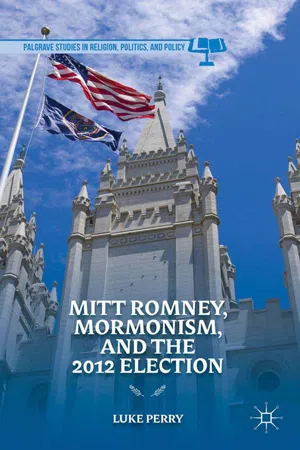
Mitt Romney, Mormonism, and the 2012 Election
About this book
This book seeks to address the question of how we should understand the impact of Mitt Romney's faith in the 2012 election. As the first Mormon to earn a presidential nomination from a major party, the book provides a comprehensive study of Romney's historic candidacy.
Information
1
Introducing the 2012 Presidential Election
The 2012 election was extraordinary in several ways even though the balance of power remained unchanged. President Barack Obama faced unprecedented economic woes despite having a remarkably active first term. The Republican field experienced the meteoric rise of multiple long-shot candidates before aligning behind an unlikely front-runner, Mitt Romney. It was a particularly long and publicized primary process modeled in part after the bruising 2008 Democratic primary that was believed to strengthen the political chops of the Democratic savior that emerged and his potential successor in 2016. The 2012 primary did not have the same effect for Republicans. Romney emerged weakened by internal and external attacks, not to mention, “the Mormon thing,” as Romney called it.
Romney is a devout member of The Church of Jesus Christ of Latter-day Saints (LDS Church). His family lineage is intertwined with the history of the church. His friends and colleagues assert that he would have been among the most religious presidents in US history. Much of this part of his life was deliberately kept out of the public eye because of nearly two centuries of Mormon persecution, intolerance, and misunderstanding that inhibited his candidacy. Undoubtedly Romney’s nomination was one of the most significant events in American politics and religion in the modern era. This book provides a comprehensive analysis of this important event.
The candidates
Barack Obama and Mitt Romney faced two different political climates in running for president. Obama was swept into office in 2008 under the banner of “change,” his campaign slogan that demonstrated acute understanding of what was on the minds of most Americans. George W. Bush left office as one of the least popular presidents in US history. Osama Bin Laden was at large. There were no weapons of mass destruction in Iraq. Neither Afghanistan, nor Iraq, was stable or democratic despite extraordinary human and financial costs. The federal government woefully underresponded to Hurricane Katrina. And worst of all, the economy was unraveling in a manner that rivaled the Great Depression. Republican candidate John McCain did not appear up to the task of solving these problems or providing a new direction for the country. His “maverick” days as an upstart senator were ancient history. The political climate was ripe for a Democratic rising star to break the racial barrier to the presidency.
Four years later, President Obama’s campaign slogan asked the country to move “forward” with him. He completed an accomplished but controversial first term. The war in Iraq was over. Bin Laden was dead. A depression was avoided. Still, America faced unparalleled debt. The economy was growing at an infuriatingly slow pace. Unemployment was in double digits. And the president’s signature policy achievement, healthcare reform, turned sausage making into a public spectacle. Democrats were disappointed by countless concessions. Republicans played along until it came time to vote, and then bailed, in order to preserve uniform opposition, and claim, as they did in 2013, that they knew it was going to be a disaster. Republicans were so infuriated that Obamacare fueled the rise of the Tea Party movement, which helped thump the Democrats in the 2010 midterm. This was far from an ideal climate for a president to be reelected.
Obama’s reelection campaign revealed how much had changed and how much had stayed the same in 2012. Partisanship runs deep. Campaigning is different from governing. America’s Center-Right political orientation and political culture impede progressive policy change. Diversity is simultaneously a virtue and a source of suspicion and fear for a sizeable portion of the population. The second terms of modern presidents seldom match the productivity of the first. Obama narrowly won, but little changed. The government shut down a year later. Congressional Republicans were blamed and battered. By the end of the year, these same folks were optimistic about not only holding the House, but also taking control of the Senate. The implementation of Obamacare went awry with the ineffective launching of the new federal exchange website. Obama was publicly contrite in a manner never seen before in his presidency. Likeability, a consistent strength of the president, was under fire. Obama had told Americans that they could keep their health insurance if they liked it, but insurance companies were dropping plans and people were unhappy. Obama’s two policy priorities, gun control and immigration, were stalled. There was little for Democrats to campaign on heading into the midterms. Again, basic truisms remained. Divided government contributes to gridlock. The lack of broad ideological consensus in the post-Reagan era perpetuates political polarization, governing by crisis, and increasing disenchantment with American politics.
Mitt Romney sought to unseat President Obama by running a disciplined campaign heavily focused on the economy. Romney’s background could hardly be more different than Obama’s. The two differed significantly in terms of upbringing, family, class, race, religion, occupation, and government experience. Obama grew up in Hawaii and Indonesia as part of a multiracial family, primarily under the care of his grandmother. Romney was raised in the white affluent suburbia of Detroit during the heyday of the automobile industry. His father was a business leader turned governor. His mother was an actress turned homemaker. Both candidates were gifted academically, attended prep schools, and earned advanced degrees from Harvard. After school, Obama worked as a community organizer, author, and teacher. Romney worked as a venture capitalist and ran the Olympic organizing committee for Salt Lake City. Both had limited political experience, but in different political realms in different parts of the country. Obama served in the Illinois state legislature and US Senate. Romney was elected governor of Massachusetts. Both were fathers, but Obama has two daughters, Romney five sons. In nearly every conceivable way, the two candidates were different. It is not surprising the two often did not understand each other or care for one another.
Despite all these differences, the 2012 election exhibited a remarkable commonality between the two candidates: both came from minority groups that experienced extraordinary persecution and discrimination. The White House, once built by African slaves, now housed the first black president. Americans were aware of the significance of Obama’s election. The same could not be said about Romney and the tribulations of his faith. Romney was the first Mormon to earn a presidential nomination from a major party. The Mormon people are the most persecuted religion in American history. Mormons have experienced extermination orders, federally mandated changes to their religious doctrine, and the murder of their founding prophet, Joseph Smith, who was a presidential candidate at the time of his death. Remarkably, two Mormons sought the Republican nomination in 2012, Romney and Jon Huntsman. Romney’s primary victory made him a serious contender to break a historic religious barrier to the presidency.
Romney came from a long lineage of Mormons dating back to Parley Pratt, one of the first Mormon converts. His descendants were present during every major moment of Mormon development. He has been a faithful Mormon throughout his life. Like many Mormon men, Romney attended Brigham Young University (BYU), served a two-year mission, got married, fathered several children, and held numerous leadership positions with the church. He has donated an extraordinary amount of time and money to the church, well beyond the norms of the religiously devout in America. Unfortunately for Romney, his religious behavior was not an asset because his faith did not conform to the general standard of a widely accepted Protestant sect.
Whereas race relations have been the most contentious issue in US political history, there has been little awareness regarding the persecution of Mormons. Few Americans are informed about the LDS religion and even fewer are aware of its past struggles. In 2012 Romney’s faith was publicly labeled several unflattering things, including cultish, unchristian, weird, foreign, suspicious, ignorant, racist, and greedy. This was an upgrade from the public treatment of Mormonism four years prior during Romney’s first presidential bid. These labels reflected long held perceptions in American society. For over 50 years, when Gallup first starting polling this question, over 20 percent of Americans have consistently expressed unwillingness to vote for a qualified presidential candidate who was Mormon. Americans are not as forthright in stating their unwillingness to vote for an African-American candidate and racial attitudes have shifted significantly in recent decades. The same cannot be said for public perceptions of Mormons. The purpose of this book is to explore and analyze issues, challenges, and responses surrounding Romney’s faith and the 2012 election.
Understanding Romney
The outcome of the 2012 election demonstrated that many Americans could not relate to Mitt Romney. Why was that? Several explanations have been provided. The Obama campaign and super-PACs made the case that Romney’s wealth was a major factor. Like President Bush in 2004, Obama took his opponent’s perceived strength, economic management, and turned it into a political liability, by casting him as wealthy and out of touch with Americans at large. This strategy worked brilliantly for Bush when he delegitimized John Kerry’s military service by casting doubts on the merit of his post-service awards and statements. The Obama campaign vilified Romney’s venture capitalist past, as Ted Kennedy had successfully done when Romney contested his Senate seat, and cast Romney as part of the “1 percent” who did not understand or care about the other “99 percent.” The timing and content of this approach were impactful. The campaign launched these attacks in the summer while the primary was still in progress, rather than the fall. Romney was unable to respond in a timely and effective manner.
There is no doubt Obama’s campaign was successful, but candidates and context matter too. As good a campaign team may be, the goods they are selling have to hold up to extraordinary scrutiny. Romney lamented the nature of long and well-documented presidential campaigns. Specific comments haunted him. Romney appeared elite, insensitive, and poorly equipped to represent middle-class and low-income Americans. Most of these folks, particularly racial and ethnic minorities, wanted greater educational and employment opportunities, not handouts, and to be uniformly dismissed in the “47 percent” comment disturbingly confirmed their fears that Romney could not relate to them. Things might have been different if this was the only controversial comment of the campaign and Romney swiftly addressed it. Instead, Romney made several comments along these lines. The phrases “self-deport,” “binders full of women,” and “corporations are people” accentuated unfavorable connotations associated with his status as white, male, and wealthy. Proposing $10,000 bets with primary rivals to express confidence in the correctness of his view and mentioning how many Cadillac’s his wife owned in appealing to automobile employees was not helpful either.
To be fair, presidential campaigns are excruciatingly difficult and the margin of error is quite small. The 47 percent comment was a specific response to a specific question that in hindsight Romney wished he had not answered. He certainly did not expect or desire this remark to emerge from a private fundraiser and saturate mass media. Everyone misspeaks from time to time, even President Obama, who in 2008 was publicly criticized for privately claiming that rural folks cling to “guns” and “religion.” There was also, of course, Obama’s controversial former preacher Jeremiah Wright’s incendiary comments that plagued his 2008 campaign. Either presidential candidates find ways to overcome damaging statements or they become defined by them. Romney was defined by them.
Though national elections are framed as candidate centered, partisan behavior remains crucial. In a two party system, candidates that better mobilize their fellow partisans win because most independents lean one way or the other. Romney faced challenges here as well. Some of this resistance was religious and some was not. Evangelical Christians, the base of the party, had long been skeptical of Mormons. This contributed to an uneasy relationship between the LDS Church and the Christian Right. Evangelical preachers denounced his faith. Some called it a “cult.” Diminished willingness on behalf of Evangelicals to recognize Mormonism as Christian correlated with diminished political support for Romney in the primary. The ironic thing is that Mormons crave Evangelical acceptance. Evangelicals are central to modern Christianity and a major political force in conservative politics. Mormons strongly reject the notion that they are not Christian and have worked hard to improve relations with Evangelicals in recent years.
Republican elite were also skeptical of granting Romney front-runner status heading into the primary. They viewed him as distant and robotic. His political behavior lacked conviction and was not sufficiently conservative. Romney differed from other previously unsuccessful Republican presidential hopefuls, like John McCain or Bob Dole, who were senior members in the party with considerable standing. There was a sense that each had put in their dues and was deserving of his turn. The same could not be said about Romney. He secured the nomination without establishment ties and without a mass public following cultivated through holding elected office or FOX News. This was remarkable. Haley Barbour, Mike Huckabee, Jeb Bush, Mitch Daniels, and Chris Christie were all courted by various party elites, but decided not to run. Even nonestablishment figures with substantial public followings, such as Donald Trump and Sarah Palin, opted out as well.
In the end, Romney earned the vote of over 1,500 Republican delegates. Second place finisher Rick Santorum received less than 300. Romney was clearly the choice of his party, but it would be hard to argue that he was the resounding choice. Still, Romney won 47 percent of the vote in the general election. Over 59 million people voted for him. He won 24 states and 3 times more counties than President Obama. Romney thought it would be a toss-up down the stretch. Though the electoral vote was decidedly lost, the election was in many ways closer than it appeared. Though Romney lost the swing states, the margins of defeat were close in pivotal races, including Ohio and Florida, both less than 2 percent.
Approach
This book focuses on the unique faith-based challenge Romney faced in 2012. Romney’s personality and political views are much more a product of his faith than his wealth. The former received a lot of the attention, the latter has not. This suggests a significant need to better understand Mormonism, its relationship over time with American society and politics, and how these things influenced the 2012 campaign and election. This book addresses these topics from the premise that Romney was not a footnote to history. Romney made history and experienced certain obstacles in a very unique way because of his faith. In doing so, this book seeks to answer three fundamental questions. What does Romney’s nomination mean for America, for Latter-day Saints, and for the relationship between religion and politics in America? My thesis contends that understandings of Romney’s electoral defeat would benefit from greater explanation and insight about “the Mormon thing.” Mormons are no longer considered a great social menace, as they were from their origins well into the twentieth century, yet Romney had to overcome an array of public perceptions, including being unchristian, vapid, heartless, sinister, lacking conviction, unrelatable, hiding something, and having ulterior motives. These cannot be solely written off as the result of Romney’s personal and political shortcomings. That would imprudently ignore history and culture. Though impactful, these perceptions should also not be used as a full explanation of why Romney lost. They are one poorly understood and often-overlooked part of his loss.
Interest in Mormonism and Mormon studies has grown in recent years, but there is little scholarship specifically focused on Mormons and politics. Relevant works are much more common in the fields of religious studies, history, and sociology. This is remarkable considering that several individual Mormons are currently high-profile political elites, including Romney, Harry Reid, and Orrin Hatch. Furthermore, the LDS Church has been instrumentally involved with the issue of same-sex marriage for over 20 years, the civil rights issue of this generation. Mormons are included in several comparative studies on politics and religion, but rarely focused on as the centerpiece of analysis, particularly in the field of political science. This book seeks to make a small contribution toward changing this.
This work also seeks to address a disjuncture between scholars of Mormonism who are Mormon and those who are not. I am not a member of the LDS Church and have never been. My interest in the religion developed during three years of working in the Department of Criminal Justice and Political Science at Southern Utah University. The university is Harry Reid’s alma mater, when it was a two-year college, and houses the Michael O. Leavitt Center for Politics and Public Service. Leavitt is a Cedar City native who served as the governor of Utah from 1993 to 2003 before becoming a cabinet appointee in the Bush administration as Administrator of the Environmental Protection Agency and then Secretary of Health and Human Services. Southern Utah is the large, rural, and sparsely populated portion of the state, which has among the highest concentration of Mormons in America. The area is known primarily for its national parks, such as Zion and Bryce Canyon. The two major towns in southwestern Utah are Cedar City and St. George. The hot, dry climate of St. George served as Brigham Young’s winter home in an effort to help manage the pain caused by his arthritis.
My interest in Mormons and politics began when I was speaking with my colleagues in American politics about why my students appeared to revere the Constitution in a way that differed from what I had experienced teaching in Nebraska and Massachusetts. A Mormon colleague nicely shared with me that some Mormons have a unique view of the Constitution premised on the belief that the spirits of the framers appeared to Wilford Woodruff, the St. George temple president, and asked to be baptized. As I researched this more, I further learned how Joseph Smith lauded the Constitution in his efforts to overcome religious persecution and that many Mormons believe their religious tradition could only have unfolded in a political society with a Constitution like America’s that protected religious freedom and minority rights. I became more interested in this topic and others out of desire to better serve my students. These experiences and scholarly demand prompted Mormons and politics to become the exclusive focus of my current research.
This effort seeks to present an informed, comprehensive, accurate, fair, and thought-provoking assessment of the topic at hand. The findings were derived from primary sources and secondary sources. I conducted several interviews with LDS scholars, such as Richard Bushman, Patrick Mason, and Joanna Brooks, and prominent Mormons in national politics, including Michael Leavitt, Orrin Hatch, and Mike Lee. Secondary sources included books, scholarly articles, interviews, news accounts, and blogs related to the study of American politics and religion. The book consciously blends scholarship composed by Mormons and non-Mormons to incorporate perspectives from within and outside of the LDS Church. I believe my experiences as a non-Mormon social scientist immersed in a prominent Mormon subculture have uniquely enhanced my ability to engage this subject matter thoughtfully, respectfully, and objectively. The work is fundamentally interested in sharing knowledge, raising awareness, generating questions, and bringing divergent perspectives together regarding the 2012 election, Mormonism, and American politics. I do not personally provide answers to questions surrounding religious truth. My assumption is that faith matters in America society and politics. Thus, it is worth studying in relation to presidential elections and many other aspects of American politics and society. There is no other American faith and religious culture ...
Table of contents
- Cover
- Title
- 1 Introducing the 2012 Presidential Election
- 2 Basic Elements of Mormonism
- 3 Born in the U.S.A.
- 4 The Mormon Moment
- 5 The Rise of Romney
- 6 Prophets and Presidents
- 7 LDS Political Advocacy
- 8 Who Won and Why
- 9 Forward
- Notes
Trusted by 375,005 students
Access to over 1.5 million titles for a fair monthly price.
Study more efficiently using our study tools.
Frequently asked questions
Yes, you can cancel anytime from the Subscription tab in your account settings on the Perlego website. Your subscription will stay active until the end of your current billing period. Learn how to cancel your subscription
No, books cannot be downloaded as external files, such as PDFs, for use outside of Perlego. However, you can download books within the Perlego app for offline reading on mobile or tablet. Learn how to download books offline
Perlego offers two plans: Essential and Complete
- Essential is ideal for learners and professionals who enjoy exploring a wide range of subjects. Access the Essential Library with 800,000+ trusted titles and best-sellers across business, personal growth, and the humanities. Includes unlimited reading time and Standard Read Aloud voice.
- Complete: Perfect for advanced learners and researchers needing full, unrestricted access. Unlock 1.5M+ books across hundreds of subjects, including academic and specialized titles. The Complete Plan also includes advanced features like Premium Read Aloud and Research Assistant.
We are an online textbook subscription service, where you can get access to an entire online library for less than the price of a single book per month. With over 1.5 million books across 990+ topics, we’ve got you covered! Learn about our mission
Look out for the read-aloud symbol on your next book to see if you can listen to it. The read-aloud tool reads text aloud for you, highlighting the text as it is being read. You can pause it, speed it up and slow it down. Learn more about Read Aloud
Yes! You can use the Perlego app on both iOS and Android devices to read anytime, anywhere — even offline. Perfect for commutes or when you’re on the go.
Please note we cannot support devices running on iOS 13 and Android 7 or earlier. Learn more about using the app
Please note we cannot support devices running on iOS 13 and Android 7 or earlier. Learn more about using the app
Yes, you can access Mitt Romney, Mormonism, and the 2012 Election by L. Perry in PDF and/or ePUB format, as well as other popular books in Social Sciences & Political Philosophy. We have over 1.5 million books available in our catalogue for you to explore.