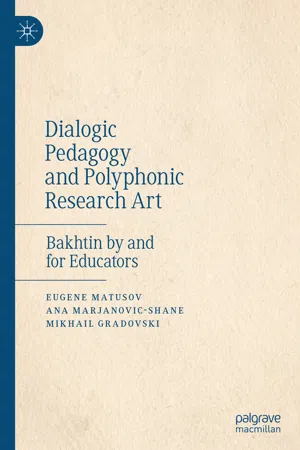
This book presents voices of educators describing their pedagogical practices inspired by the ethical ontological dialogism of Mikhail M. Bakhtin. It is a book of educational practitioners, by educational practitioners, and primarily for educational practitioners. The authors provide a dialogic analysis of teaching events in Bakhtin-inspired classrooms and emerging issues, including: prevailing educational relationships of power, desires to create a so-called educational vortex in which all students can experience ontological engagement, and struggles of innovative pedagogy in conventional educational institutions. Matusov, Marjanovic-Shane, and Gradovski define a dialogic research art, in which the original pedagogical dialogues are approached through continuing dialogues about the original issues, and where the researchers enter into them with their mind and heart.
eBook - ePub
Dialogic Pedagogy and Polyphonic Research Art
Bakhtin by and for Educators
- English
- ePUB (mobile friendly)
- Available on iOS & Android
eBook - ePub
Dialogic Pedagogy and Polyphonic Research Art
Bakhtin by and for Educators
About this book
Information
Topic
EducationSubtopic
Education Theory & PracticePart I
Teaching Cases and Their Online Discussion
This part includes 16 teaching cases out of the total of 30. Due to the limitations of the book page count, we could not publish all teaching cases. For the same reason, only two teaching cases are presented with their complete online discussion (#9 and #11). We selected these two edited online forum discussions as representing the diversity of online discussions. We combined two teaching cases (#15 and #18) by the Russian Bakhtinian educator Alexander Lobok into one because we felt that they were deeply connected.
In the process of selecting teaching cases for publication, we were guided by the following criteria: to capture as many levels of education, subject areas, diversity of Bakhtinian pedagogy issues, potential interests by readers (educational practitioners interested in Bakhtinian pedagogy), clarity of the cases, and interesting online forum discussions. Below, we de-anonymized Bakhtinian educators, the authors of the presented teaching cases in the online forum discussions, as they wanted to be known. In some cases, we tried to preserve the orality of the interviews, but we also corrected English when it was difficult to make sense of the participants’ errors (many of them were not native English speakers).
© The Author(s) 2019
Eugene Matusov, Ana Marjanovic-Shane and Mikhail GradovskiDialogic Pedagogy and Polyphonic Research Arthttps://doi.org/10.1057/978-1-137-58057-3_2Chapter 1.1: Two Teaching Cases with Online Forum Discussions
Eugene Matusov1 , Ana Marjanovic-Shane2 and Mikhail Gradovski3
(1)
School of Education, University of Delaware, Newark, DE, USA
(2)
Independent Scholar, Philadelphia, PA, USA
(3)
University of Stavanger, Stavanger, Norway
Case#11: Bakhtinian Teaching as Unfinalized Dialogues Between the Consciousnesses of Equal Minds, Tara Ratnam, India, Interviewed by Ana Marjanovic-Shane on 2015-12-10
Bakhtinian Educator, Tara Ratnam: [Bakhtinian pedagogy] is about teachers and learners engaging in a process of meaning making in and through dialogue. In this dialogue both teachers and students are active contributors and, as Bakhtin says, consciousnesses with equal rights “to ask questions, to heed, to respond, to agree” and also disagree (Bakhtin, 1999, p. 293). It is in this interaction among multiple voices that there is this potential to produce new meaning. This I think is the basic … Bakhtinian aspect of education.
Interviewer: Do you remember any particular example from your teaching when you felt that you’re doing what you wanted to achieve?
Tara Ratnam: Oh, yes. I do. I’ll tell you about that. My intention was to establish a more horizontal relationship with students in contrast to the hierarchical kind of relationship seen in conventional education. A hierarchical relationship, where the teacher, “the knower,” gives knowledge to the student to adopt. It eliminates the possibility of creativity.
So, I’ll give you an example now. I’ll illustrate it with comparison of two classes. The first one was [taught by] my colleague in those days, and then the other one was inspired by Bakhtin’s pedagogy. We were both teaching the same poem (in classes of English as a Second Language in a pre-university college in India). I’m not sure if you’re familiar with this Edwin Brock’s “Five ways to kill a man.”1 Have you ever come across this?
Brock is talking about five ways of killing, right from the beginning of the crucifixion of Jesus Christ and then through the Middle Ages, and then how it progresses during the two World Wars and finally in the twentieth century. So, it’s like giving … it’s like a manual, it’s reading like a manual [for different ways of killing]. He’s just giving a lot of illustrations, just hints [of ways of killing], and you have to figure out what he’s talking about.
So, I went into my colleague’s class for observation because we were part of a classroom investigation group. We had an informal teaching club, where I mentored teachers. And so, I went into his class and he was getting students to answer the comprehension questions after explaining the poem point by point. This is the interaction that I recorded. Can I just read one stanza for you? So that you get an idea of what we are talking about?
Interviewer: Okay.
Tara Ratnam: In an age of aeroplanes, you may fly
miles above your victim and dispose of him by
pressing one small switch. All you then
require is an ocean to separate you, two
systems of government, a nation’s scientists,
several factories, a psychopath and
land that no-one needs for several years. (Brock, 1990)
Obviously, Brock was talking about the World War.
And then, in my colleague’s class there was this question. He was doing this multiple-choice question, and this is how it goes in class:
The teacher: “Question number 19: In this poem, Psychopath refers to: a) The man who manufactured the bomb, b) the scientist who gave the formula, c) the man who ordered the dropping of the bomb, d) the man who actually pressed the switch? So, now tell me, which one is the right answer?”
One of the students says, “B,” and then the teacher looks around. “Anyone else?” Some students in the corner say, “A,” and then there’s one student who said, “C.” Then teacher points to that person who said “C” and says, “Yes?” And the student repeats, “C.” “Yes. C is the correct answer.” And that’s the end of the episode.
All of the options provided in the question could be seen as a possibility. But then, he didn’t ask them why they chose the option that they chose nor did he ask them how they could justify what they had chosen. So, what happened was this whole episode closed there. He finalized the whole poem, and the students’ utterances. There was no more potential for meaning making, and it closed off.
But, this worked very differently in my class. What I did was the following: I began with a question which was within the students’ threshold level of experience, a question that they could answer subjectively, something like, “What are some of the ways in which … people use for killing? Which one of them do you think is very gruesome and why?”
So, with that I used the poem, actually, to bring in other perspectives, and then to interact with what they had said. And so, the students had to find out other ways of killing that were mentioned in the poem. Now, this was not a very straightforward task as the poem was full of allusions and this went beyond the background knowledge of the students. So, they said they couldn’t answer it immediately, that they needed a little time to find out and find out more resources. So, on their own, they formed groups and they said each group will focus on one stanza and they’ll pull out the references … find out and come back.
One of students told me later that day it was like solving a cryptic puzzle, [chuckle] because from the allusions in the poem they had to figure out what these allusions meant. So now with the meaning that they had pulled out from the past, the cultural past from the age of Christ up till now … All that knowledge then became the basis with which they went back into the poem to look for a new meaning there, and what meaning they could figure out.
Yeah. So, the discussion went on.
And then when we came to this multiple-choice question—that’s because we’re comparing our classes on that questionnaire—one of the students, he said, “Scientist is not the answer. He is not a psychopath because, scientists work under duress. There will be a reason to do things, and so, you can’t blame the scientists.”
And then, another student said, “No, no, it is the scientist because …,” and his reason was, he said, “Einstein recommended to Roosevelt to give a go to this project of manufacturing the atom bomb.” So then, another student, he asked him a question which became really … about his personal ethics … personal ethics also came into the question. He says, “Oh, if the situation was like that, for Einstein to sign that letter,” he says, “There was a threat from Hitler! And what would you do, if you were forced with that kind of a situation?” he asked. So, they had no immediate answer.
And then, I was also not spared. My morality also came to question because one of the students asked me, “Miss, do you consider Einstein a pacifist?” he asked. I was stumped by this sticky kind of question because I had never thought about it before. So, I had to think on my feet and then answer. Then I pointed out, “Einstein regretted his action later” and also, I said, “Some people, when they are under fear, it makes them do that. And he was afraid that Hitler would destroy this whole world …” Immediately, one of the students stood up, “But Miss, what happened afterwards? The Americans bombed Japan,” he said. And so, he said, “Isn’t that equally bad?” So, he was kind of trying to question, Is it okay for America to drop a bomb and not for Hitler to do it? And yes, so, “It’s as bad as if Hitler had dropped the bomb,” he said.
So, then someone pointed out, “But Japan provoked America.” Yet another student, he said, “But that’s no reason! What about all the people who died, if that’s a justification?” And then the topic reverted to the ethics of scientists, like their ethical thinking. I asked them, “What would you do?” because these were all science graduates and many of them might even become scientists. I asked them, “What would you do if you were under pressure? Would you give in or would you protest?” So, a majority of the students, they were thinking kind of idealistic, said, “No, no, we won’t give in to pressure.”
And then one of the students, he asked another, he said, “Even if your life was threatened, even if your family is threatened, then also?” That made another student falter, he said, “No. I think it’s difficult.” And then one more student adds, “Yes. A difficult dilemma, this is a difficult dilemma.” And after this kind of conversation one of the girls who had asserted very clearly that she will never give in, she changed her mind. She said, “Actually, I’m not so sure.” She says, “There are so many things to see, it depends on the circumstances I think,” she said at that point.
So, when the class was over, we really hadn’t arrived at a right answer, the right answer that was expected. Yes, but still everything was meaningful. The dialogue was “unfinalized” and there was a lot of potential to bring out more meaning. … It’s like each of us was carrying a dialogue inside us and we were still trying to figure out among these many perspectives, what is right. Like Einstein’s position, [it] became a very ambivalent kind of thing. Meaning was still emerging for all of us, but it was not really closed. And later on, a few months down the line, actually, a topic on the social responsibilities of the scientists emerged again, and this dialogue became a reference point … It became a reference point to continue that exploration.
It’s not like the lessons are compartmentalized, you finish this, finishing this, etc. … Everything kind of flows into each other … And so, if I should analyze this class from a Bakhtinian point of view, then what it feels like, [as] Bakhtin points out, [is] that our thinking, our ideas are not something that stand alone, but are always in association with other ideas, “as a link in the chain of meaning” (1986, p. 146), or as Emerson and Holquist (1991, p. 426) put it, “as a part of a greater whole.”2
The dialogue in class achieved this kind of, what Bakhtin would say, “fullness in time” (1986, p. 34), because it linked the student’s past, the cultural past, to a present and it also had a future orientation. In making sense of the poem in the present, they had to delve into the past, and together this past and present giving a direction to their future actions, how actions follow from the way we see the world, this is what opened up the future. And then the points of view that students put forward did not stand alone. It was not as if each individual was talking in spite of others, in response to some textbook question. There was a connection: each student was responding to somebody else and was anticipating a response from somebody. Continuity was there and also there were all these diverse points of view th...
Table of contents
- Cover
- Front Matter
- Introduction: Inspired by Bakhtin—The Aim, Focus, and History Behind This Research Project
- Part I
- Part II
- Part III
- Part IV
- Back Matter
Trusted by 375,005 students
Access to over 1.5 million titles for a fair monthly price.
Study more efficiently using our study tools.
Frequently asked questions
Yes, you can cancel anytime from the Subscription tab in your account settings on the Perlego website. Your subscription will stay active until the end of your current billing period. Learn how to cancel your subscription
No, books cannot be downloaded as external files, such as PDFs, for use outside of Perlego. However, you can download books within the Perlego app for offline reading on mobile or tablet. Learn how to download books offline
Perlego offers two plans: Essential and Complete
- Essential is ideal for learners and professionals who enjoy exploring a wide range of subjects. Access the Essential Library with 800,000+ trusted titles and best-sellers across business, personal growth, and the humanities. Includes unlimited reading time and Standard Read Aloud voice.
- Complete: Perfect for advanced learners and researchers needing full, unrestricted access. Unlock 1.5M+ books across hundreds of subjects, including academic and specialized titles. The Complete Plan also includes advanced features like Premium Read Aloud and Research Assistant.
We are an online textbook subscription service, where you can get access to an entire online library for less than the price of a single book per month. With over 1.5 million books across 990+ topics, we’ve got you covered! Learn about our mission
Look out for the read-aloud symbol on your next book to see if you can listen to it. The read-aloud tool reads text aloud for you, highlighting the text as it is being read. You can pause it, speed it up and slow it down. Learn more about Read Aloud
Yes! You can use the Perlego app on both iOS and Android devices to read anytime, anywhere — even offline. Perfect for commutes or when you’re on the go.
Please note we cannot support devices running on iOS 13 and Android 7 or earlier. Learn more about using the app
Please note we cannot support devices running on iOS 13 and Android 7 or earlier. Learn more about using the app
Yes, you can access Dialogic Pedagogy and Polyphonic Research Art by Eugene Matusov,Ana Marjanovic-Shane,Mikhail Gradovski in PDF and/or ePUB format, as well as other popular books in Education & Education Theory & Practice. We have over 1.5 million books available in our catalogue for you to explore.