- English
- ePUB (mobile friendly)
- Available on iOS & Android
eBook - ePub
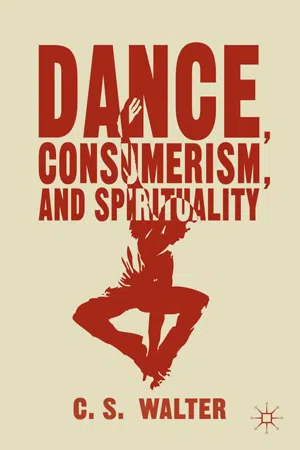
Dance, Consumerism, and Spirituality
About this book
Dance has proliferated in movies, television, Internet, and retail spaces while the spiritual power of dance has also been linked with mass consumption. Walter marries the cultural studies of dance and the religious aspects of dance in an exploration of consumption rituals, including rituals of being persuaded to buy products that include dance.
Information
Chapter 1
On the Spiritual Motivations for Dance Consumption
In my adult ballet class recently, I overheard a woman say that “the flying attitude derriere” being given in class as part of a center floor combination reminded her of a commercial where she was free to consume what she wanted.
Framing Consumption
What is consumption? Do we consume because we are socialized to consume? Or is it because we are consuming to produce—our livelihoods, our identities, or our personalities? Is consumption need or want based? How has consumption occurred in societies over time? Where does the dance of consumption fit within our capitalist and spiritual/religious world? Are we doomed to consume to the beat of the material world? Or is there more at stake? How deeply does consumption touch our spiritual natures? Is there a link between the consumption function and dance?
Consumption in the marketplace and within anthropology has become a metaphor derived from the need to eat, having evolved from the concept of something being destroyed or destructive. Nowadays, the idea of consumption has grown to include everything that is associated with buying, using, giving, and disposing of goods, services, and ideas. In short, it is what we do when we are not sleeping or working;1 from a marketing perspective, consumption by humans in Western society is tacitly connected with self-actualization.
If you have encountered promotional materials from marketing campaigns within the last 20 years, you know you deserve the best of everything—and much, if not all of it—and most product marketing messages promise to instantly soothe your concerns, wash away your stains, make life easier, cast your worries aside, and make you feel brand new. Products’ advertisements (ads) ranging from computers to home making make these kinds of assertions, and over the years many of them have used dance to deliver these assertions, messages, and meanings directly to you—silently. Watch carefully the next time you see an ad with a dance. True, messages often focus on a consumer’s cost savings, such as when we’re told that a particular store has the lowest prices everyday, a viewpoint that emphasizes the money we will save if we use a brand or shop at a location, either because it is cheaper or better than the competitor’s brands, or because we will save time or money on something else as a result. But that message is not the only one being delivered because when dance is used in the promotion, the message and its meanings can be relayed somatoviscerally.
At issue is that many of us consume purposely and for processes utilitarian, expressive, or contemplative, out of satisfying needs in practicing rituals. As Alan Warde explains in his article, “Consumption and Theories of Practice” published in the Journal of Consumer Culture in 2005,2 we’ve arrived at a stage such that consumption, in particular, as I argue, dance consumption, has evolved into a spiritual practice, unbeknownst to most of us. If we review the promises given in the examples of marketing phrases I pointed to a moment ago, it is easy to see that such messages are very clever in providing an illusion of transcendence. In chapter 5, research will expose this very point. However, right now I’d like to remain with the topic at hand.
Though we have increasingly become practicing consumers, many have moved en masse away from organized religions toward the self-defining concept of spiritual but not religious3 and have increased their consumption of dance and dance-related products and programming. Is this a mere coincidence? Are the decreases in religious associations, increases of buying stuff as a spiritual practice, and increases in dance consumption related at all? In what ways do these phenomena work their way through ads and popular culture? And I think we need ask if it’s not a coincidence, and what, if anything, does it mean for us?
There has been recent discussion and research by a variety of thinkers on the topics of business and spirituality, spirituality and the self, and the consumption of spiritual products. In addition, there are some scholars who have broached the subject of popular culture, in particular music, and its association with satisfaction of human spiritual stirrings. However, while there is a great deal of work published on consumption tagged with a myriad of subtexts, there remains an opportunity to consider an exploration of consumption and spirituality itself and how dance as a spiritual phenomenon’s trajectory from the past into our current society fits into it.
One of the major factors that may have made such explorations a bit difficult is the lack of agreed upon definitions of “spirituality,” “religion,” and “dance” among the people who write about and study these topics, that is, clergy, psychologists, sociologists, anthropologists, marketers, and dance scholars. Another barrier to exploring dance in this vein may be due to its long-standing unrecognized capabilities in Western society, particularly since the Enlightenment.
In order to work out the value that dance consumption holds for our spirituality in secular and nonsecular contexts, in this chapter, I give an overview of business and spirituality, spirituality and the self, and consumption of spiritual products. Importantly, I derive working definitions for spiritual, religious, and, what I consider more useful in terms of consumption, mystical. In concert with this, I define what I mean by “dance,” and support the notion that dance does makes us feel good—the reason why we consume it and why it is used in product promotion.
Business and Spirituality
The business of religion in a capitalist society like ours in the United States has always been big, because it provides hope in a force majeure and a continued labor supply for underexplained or class-justified circumstances of resource distribution. In advanced Western societies, we have witnessed the expansive growth and development of capitalism, in the somewhat globally regulated exchange of goods, services, and ideas for profit, in parallel to the decline in attendance within organized religions. The mixture of capital, labor, and other inputs has resulted in the dynamic growth of wealth and well-being in the United States, and as a result, we have enjoyed living in relative comfort in comparison with many other societies around the globe. This is not to deny that there aren’t people who are disadvantaged and living in poverty, which we definitely have as a negative externality. The point that I am making is that at the time of this writing, immediately after the Great Recession, we find ourselves living in a world where increasingly employees question the purpose of their lives and why they should exchange their time on Earth for production. Is there another way of living that would be more fulfilling? No doubt, such soul searching would make Marx happy at first glance. However, at the same time, people spend more time at work. Many are addicted to their digital devices: being unable to have idle time while waiting at a bus stop or for a light to change while they sit behind the wheel of their cars, they are driven to check email and voice mail, to post to social media, and so forth. Companies, in fact, have us believe that if we are remiss in such activities, we will miss some key turn of events that will change the course of our lives permanently and for the worst. Moreover, there is decreasing separation between work life and home life. Indeed, many company executives want their employees to feel that work associates are like family and the facilities where work is done are arranged so that employees feel more at home. Of course, this is not to diminish the social and community aspect for trying to ensure employees encounter supportive environments and we need to note that not all businesses operate this way.
Rather, some leading companies set their foundations on scriptures by actions such as printing biblical text references on their food containers, displaying religious images on their ads, or being closed on their Sabbath, for example, so that their owners feel as if they are doing morally higher-level work, and are therefore not merely responding to a capitalist desire for profit. In this vein, business leaders adopt business as a calling or a vocation, and in some ways this is endearing them to their market segments. It is difficult though to ascertain the degree to which people see their work in business as a vocation, in much the same way as it is difficult to understand the motivations behind company spokespeople who talk a good green environmental game in the name of sustainability and social responsibility.
In reality, product producers often try to reach into both our sacred and our profane spaces by manipulating our needs and connecting to them in ways that develop unhealthy dependencies. This can be seen not only in the consumer as an individual, but also in the organizational consumption process as well. Company leaders believe they have to do this if they expect to grow their services, products, and profits, because growth is the mainstay of a capitalist society.
A Fantasy
I ask you to pause here for a moment, and to go with me into an imaginary space.
Can you imagine a world without consumption as a mantra? No keeping up with the Jones, no buying houses we can’t afford, no shame in working at a passion, no need for “making money” on Wall Street, and a more balanced compensation for vocations that include caring for children and the elderly and corporate executives, teachers and basketball stars, fire fighters and rock stars, soldiers and CEOs, and other professions I’m sure you can come up with that have insane income disparities. The sense of entitlement is erased and the sense of shortage doesn’t exist. There is more than enough for everyone.
Why do we not have this “fantasy” as our reality when we can? Why don’t we use a different system of resource allocation in a global culture that honors all humanity?
Because, instead of practicing improving our abilities to understand each other, or our abilities to provide a service or product that fulfills needs in a real way without destroying the Earth and the Heavens, business and spirituality are inappropriately intertwined and enmeshed on purpose because if there is consumption and production for only the needs that we really have, then the capitalist machine has fewer new investments and without new investments there is nowhere for capital to flow. When investors no longer have a financial incentive to divert their attention and consumers are willing to solve their longing for fulfillment that is otherwise done through buying things, there may come a moment of clarity when they start looking internally rather than externally for fulfillment. This mirrors Paul Tillich’s ultimate concern, a point I will address later in the book. What we have now is soul dissatisfaction, a spiritual need that had been fulfilled when we were grounded, as William Irwin Thompson describes in The Time Falling Bodies Take to Light: Mythology, Sexuality and the Origins of Culture, in a prereligious world.
Consumption is not purely an exercise in economic rationality or support for our human endeavors. If economic rationality or sociological purposes for consumption were true, then the marketer couldn’t convince us, for example, to eat foods that are not real foods, or to buy clothing based on fads, and made from plastic, which in turn is derived from petroleum, which, of course, is connected to an unbalancing of the environmental gases that sustain us. So where do we go to understand consumption?
The Hierarchy of Needs
The hierarchy of needs, as Abraham Maslow explained it, provides us with a way to examine the levels of human and corporate needs. These ideas are found in multiple marketing texts, and of course, within the consumer behavior and psychology fields. Simply stated, the human being has a hierarchy of needs that once satisfied, progressively allows one to look at fulfilling higher needs. Whether these higher needs are instinctual or they are needs that have been created as part of the evolution of consumption is hotly debated elsewhere by sociologists. Moreover, organizational behaviorists also suggest that companies, when understood as living organisms, are also living with this hierarchy. Let me explain.
First, we, human beings, have physiological needs, where we meet the basic body needs of eating, sleeping, washing, covering, and reproducing ourselves. It is clear that as human beings we must meet this need level, especially in the case of eating and reproducing, or else we perish individually and as a species. We are told by the economists that we choose products and services to fit these needs based on income and tastes. But with a company, the relationship may not immediately seem so clear. In the case of a company, it needs break-even revenue, that is, sells a minimum amount of products or services to keep its operations moving and its doors open, a location from which to do business, and a way to replicate their processes to provide a consistent quality related to their product or service.
Next, we have the safety need, where we feel that our existence is not threatened. It is easy to see that humans have this fulfilled in homes that can be locked closed, possessions not stolen, and human protection being insured and assured, from loved ones to colleagues, by police and security systems. With companies, the safety aspect comes into play along with the need for security, such as, its products are not sold in black markets or pirated and their places of business are not broken into and subject to vandals. It is easy to see that many of the security and insurance companies, from life to bond, stake their advertising campaigns on this need.
Coming after the safety needs, we have the social needs where we have to feel loved, as if we belong and fit in, and be in contact with other people, or we risk losing our minds—the connectedness needs to be created and established for us to thrive. Here I am reminded of the movie starring Tom Hanks, when he was stranded on an island, with no signs of civilization, and no way to communicate with anyone. One thing he did was to somehow draw a face onto a soccer ball he found, in order to keep himself company while waiting to be rescued. In short, we need faces to look at, people to talk to, and hopefully, real people who will talk back in a loving way! This is also the reason why company leaders form and join associations and hold networking events—to facilitate the social function. It is the reason company leaders want their employees to participate in corporate picnics, holiday parties, and other corporate rituals—to keep the social connections strong and growing.
Similarly, we have needs for self-esteem and acknowledgment, from people outside of ourselves, for example, praising our good work, getting social status and attention, and providing meaning for what we have done. These lead to the internal feelings of need satisfaction of pride in our accomplishments and earning self-respect, in relation to the community’s whole. Again, these needs hold true for companies, where a company has needs to be recognized by external sources as a provider of quality goods and services, such as making it to the top of the lists for their industry, and as a company with positive work environment for employees. At the same time, having that kind of external recognition is good for the internal motivation of stakeholders.
The self-esteem needs are followed by the need for self-actualization, which is where people enjoy peak experiences, contentment, and happiness; it’s the same ideology as spiritual fulfillment or enlightenment—transcendence. Many people expend enormous energy in trying to achieve this state, through many different mediums, though some people would not be aware, consciously, that this is what they seek. Companies try to live in this kind of space as well when they hold themselves out as seeking to fulfill a morally higher place in the business landscape or not giving in to a pro...
Table of contents
- Cover
- Title
- Introduction An Opening
- Chapter 1 On the Spiritual Motivations for Dance Consumption
- Chapter 2 Womanist Transmodern Dance Metaphors of Mystical Consumption
- Chapter 3 Value Creation and the Inner Mystic Dancer
- Chapter 4 On Valuing Mystical Dance Experiences
- Chapter 5 The Power of Dance in Cyberity
- Chapter 6 Womanist Ideology in Service of a Mystical Worldview
- Conclusion A Continuing Passage
- Notes
- Bibliography
- Index
Trusted by 375,005 students
Access to over 1.5 million titles for a fair monthly price.
Study more efficiently using our study tools.
Frequently asked questions
Yes, you can cancel anytime from the Subscription tab in your account settings on the Perlego website. Your subscription will stay active until the end of your current billing period. Learn how to cancel your subscription
No, books cannot be downloaded as external files, such as PDFs, for use outside of Perlego. However, you can download books within the Perlego app for offline reading on mobile or tablet. Learn how to download books offline
Perlego offers two plans: Essential and Complete
- Essential is ideal for learners and professionals who enjoy exploring a wide range of subjects. Access the Essential Library with 800,000+ trusted titles and best-sellers across business, personal growth, and the humanities. Includes unlimited reading time and Standard Read Aloud voice.
- Complete: Perfect for advanced learners and researchers needing full, unrestricted access. Unlock 1.5M+ books across hundreds of subjects, including academic and specialized titles. The Complete Plan also includes advanced features like Premium Read Aloud and Research Assistant.
We are an online textbook subscription service, where you can get access to an entire online library for less than the price of a single book per month. With over 1.5 million books across 990+ topics, we’ve got you covered! Learn about our mission
Look out for the read-aloud symbol on your next book to see if you can listen to it. The read-aloud tool reads text aloud for you, highlighting the text as it is being read. You can pause it, speed it up and slow it down. Learn more about Read Aloud
Yes! You can use the Perlego app on both iOS and Android devices to read anytime, anywhere — even offline. Perfect for commutes or when you’re on the go.
Please note we cannot support devices running on iOS 13 and Android 7 or earlier. Learn more about using the app
Please note we cannot support devices running on iOS 13 and Android 7 or earlier. Learn more about using the app
Yes, you can access Dance, Consumerism, and Spirituality by C. Walter in PDF and/or ePUB format, as well as other popular books in Social Sciences & Art General. We have over 1.5 million books available in our catalogue for you to explore.