The contributors investigate policy paradigms and their ability to explain the policy process actors, ideas, discourses and strategies employed to provide readers with a better understanding of public policy and its dynamics.
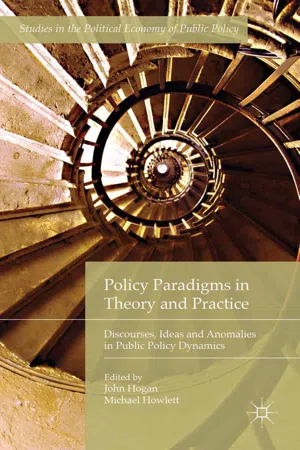
eBook - ePub
Policy Paradigms in Theory and Practice
Discourses, Ideas and Anomalies in Public Policy Dynamics
- English
- ePUB (mobile friendly)
- Available on iOS & Android
eBook - ePub
Policy Paradigms in Theory and Practice
Discourses, Ideas and Anomalies in Public Policy Dynamics
About this book
Information
Part I
1
Reflections on Our Understanding of Policy Paradigms and Policy Change
John Hogan and Michael Howlett
Introduction
This volume seeks to contribute to the ongoing conversation among policy scholars on the subject of policy paradigms. It provides a window into the research frontier of policy dynamics and a re-evaluation of the precision and utility of existing policy paradigm orthodoxy. A ‘policy paradigm’ constitutes a theoretical tool to specify and understand the guiding principles, or ideas, for creating public policy, why the various actors involved are involved, and why they pursue the strategies they do. The book provides unique and varied insights into the current state of the art regarding how a range of scholars understand such paradigms, and public policy ideas, both conceptually and empirically. It does this by drawing together contributions from leading political science and social science researchers, to provide a multidimensional set of perspectives on how paradigm-related elements such as policy ideas, coalitions, discourses, interests, crises, anomalies and routines contribute to policy development and our understanding of that process. As academics, we are conscious that, by presenting a variety of perspectives in one book, we and our readers can learn from each other.
Although a variety of books look at the topic of ideas and their impact on policy making, we have placed policy paradigms at the centre of our focus in this volume, and use the policy making/policy change process lenses to perfect our understanding of these phenomena. We provide a critical analysis of what is currently taking place at the nexus of discourses, ideas and discussions of policy anomalies that has resulted in the extant iterations of the policy paradigm concept and its application to policy studies. Readers will see both the commonalities and differences across the concepts of policy paradigms used in the book and how these concepts are evolving and changing.
The chapters are grouped into related sections, but each contribution is also a self-contained unit. In this way, readers can, by examining just one chapter, gain an insight into specific aspects of contemporary thinking about policy paradigms, how that thinking has evolved and how it is likely to develop in future. Students of public policy are also provided with the opportunity to familiarize themselves with a more comprehensive appreciation of policy paradigms, as the book presents multiple examples of the application and critique of paradigms in theory and in their practical application to policy developments.
In summation, our hope is that readers will find this a useful volume in assisting them gain a more comprehensive appreciation of the concept and application of the policy paradigm notion in contemporary policy studies. In providing the readers with a varied set of studies we hope to encourage them to investigate further those aspects of the paradigm idea that interest them, or that they find useful in comprehending aspects of policy-making, and in so doing help push forward the research frontier on this subject.
This chapter seeks to place the volume and its aims in context and provide the reader with a guide to the wide-ranging, diverse and thought-provoking contributions on policy paradigms made by its contributors. Here we will show how the other chapters in the book link together and emphasize the importance of better defining paradigms, their origins and diversity. As the book looks at how paradigm-based theoretical frameworks tie cognitive ideas, discourses and coalitions to policies and to the norms and values of the wider society, the chapter aims to show how understanding policy in such a paradigmatic manner can provide a better appreciation of why and how policies change and evolve as they do. Such insights can help us appreciate how polities develop their unique and sometimes confusing characteristics and policies.
The chapter is structured in four main sections. The first section looks at the broader academic context within which the book is set and at the origins and development of the policy paradigm concept. The second section looks at how policy paradigms, ideas and discourses are intertwined. The other two sections provide the reader with an introduction to several outstanding research questions in the field and an overview of the book’s structure and objectives, highlighting how each of the chapters help us to better understand policy paradigms and policy change.
Policy paradigms and the study of policy change
According to Carson (2004, p. 38) ‘a policy paradigm is a cognitive model shared by a particular community of actors, and which facilitates problem solving’. Similarly, Baumgartner (2013, p. 252) states that ‘when ideas are widely shared by an entire policy community, they can be called a paradigm’. ‘Ideas on steroids’ is how Baumgartner (2014, p. 476) has referred to policy paradigms’ significance in the context of all policy ideas. It is ‘a set of coherent and well-established policy ideas’ capable of having an impact on the content of public policy (Daigneault, 2014, p. 482).
In talking about policy paradigms we are talking about policy dynamics, as the idea of a policy paradigm is one of an ideational construct that provides some continuity to policy content and discourse over time. But, although the term policy change is something that is often spoken of, written about and considered, our understanding of policy change processes remains limited. As Capano (2009, p. 7) noted, due to the multidimensional nature of policy dynamics, ‘policy change is a very ambiguous area of academic study, and one full of pitfalls’. This is because recognizing how public policy develops is complex and difficult. Policy change is a multifaceted process that must be understood in the context of larger societal/political change, but is not limited to it (Feldstein, 1994). The complex dynamics of policy change constitute a significant obstacle to further progress in our understanding of policy making. However, the study, development and evolution of the idea of policy paradigms is one which has promised to help resolve this problem and enable us to better comprehend policy change by understanding how ideational factors can structure, or limit, policy debate and action. This is important because comprehending the policy change process, how policies evolve and develop over time, is vitally important in gaining deeper insights into how societies develop.
Not surprisingly, efforts to comprehend policy change have fostered a variety of theoretical frameworks. The theoretical, and accompanying empirical, literature has developed through the efforts of researchers to examine the spectrum of public policies from a variety of perspectives, which has provided a rich diversity of comparative and single-case examinations at various levels of governance – international, national and subnational. The frameworks used in policy studies are myriad and have included, but are not limited to, the multiple stream approach, the punctuated equilibrium framework, the advocacy coalition framework, the path dependency framework, notions of layering, exogenous shocks, focusing events, displacement, critical junctures, and drift, as well as the study of epistemic communities, policy entrepreneurs and barriers to change (Birkland, 1997; Cohen, March, & Olsen, 1972; Garrett & Lange, 1995; Haas, 1992, 2004; Howlett, 2009; Jenkins-Smith, 1990; Jones & Baumgartner, 2005; Jones & Jenkins-Smith, 2009; Kleistra & Mayer, 2001; Legro, 2000; Meijerink, 2005; Mintrom & Norman, 2009; Nohrstedt, 2011; Sabatier, 1988; Streeck & Thelen, 2005; True, Jones, & Baumgartner, 2007; Weible et al., 2011; Zahariadis, 1999). These frameworks each seek to provide glimpses into the mechanics of policy development, windows of understanding, but approach the problem from slightly different angles.
The result has seen the creation of a variety of competing ontological perspectives on the subject of policy change. For instance, policy change has been studied from the perspective of exogenous shocks, incremental changes and uncertainties as well as the perspective of groups and coalitions who have a vision of how policies can change. As Howlett (2009, p. 241) pointed out, ‘most attention to date has focused upon homeostatic models in which exogenously-driven shocks undermine institutionally entrenched policy equilibria’. But, as Blyth (2011, p. 86) noted, ‘what’s actually exogenous and what is endogenous to the social world is oftentimes analytically, not empirically, adjudicated’ and, moreover, such institutionally based conceptions fail to take into account the key role played by policy ideas in affecting the substance of policy content and change. As Blyth (1997) also argued, ideas are important objects in the investigation of the context and content of policy dynamics which cannot be ignored.
The study of policy paradigms begins from the recognition that ideas are important, underlying processes of policy change and stability and a key to appreciating patterns and processes of policy dynamics (Lewis & Steinmo, 2010). To attempt to understand policy change also serves to shine another, and much needed, light into the black box of policy making which Heclo (1974, pp. 305–6) described as a form of collective puzzlement on society’s behalf, providing greater transparency for the wider society as to how choices are made and decision arrived at. Investigating the complexities and nuances of policy ideas is thus expected to provide us with a window into our own society, how it seeks to solve problems and how the solutions it generates often have unforeseen consequences, as they are frequently constrained by earlier policy decisions as well as exogenous factors. Béland (2009) has encouraged this growing interest in ideas, as he regards them as central to our understanding of public policy.
Some of the most significant works of the last century developed the concept of a paradigm while trying to understand large-scale policy change. This includes Weir and Skocpol’s (1985) examination of Keynesian responses to the great depression and Hall’s (1989) seminal work on the spread of Keynesian ideas. For Hall (1993) the spread of the Keynesian paradigm relied on extant arrangements aligning with new ideas. But, empirical failure was also necessary for Hall (1993) as were sociological and discursive factors (Blyth, 2013, p. 204). In this case, paradigm change was episodic, as in the Kuhn (1962) model.
There have been many definitions of ‘paradigms’ put forward in this work, from Kuhn (1962) onwards, but we are particularly interested in the policy paradigms concept as developed by Hall (1990, 1993). In his path-breaking work, Hall (1993) sought to overcome the problems that led to questioning of how the basic ideas behind extant and new policies are related, change and transform. In t...
Table of contents
- Cover Page
- Title Page
- Copyright
- Contents
- List of Tables and Figures
- Acknowledgments
- Notes on Contributors
- List of Abbreviations
- Part I
- Part II
- Part III
- Conclusion
- Index
Trusted by 375,005 students
Access to over 1.5 million titles for a fair monthly price.
Study more efficiently using our study tools.
Frequently asked questions
Yes, you can cancel anytime from the Subscription tab in your account settings on the Perlego website. Your subscription will stay active until the end of your current billing period. Learn how to cancel your subscription
No, books cannot be downloaded as external files, such as PDFs, for use outside of Perlego. However, you can download books within the Perlego app for offline reading on mobile or tablet. Learn how to download books offline
Perlego offers two plans: Essential and Complete
- Essential is ideal for learners and professionals who enjoy exploring a wide range of subjects. Access the Essential Library with 800,000+ trusted titles and best-sellers across business, personal growth, and the humanities. Includes unlimited reading time and Standard Read Aloud voice.
- Complete: Perfect for advanced learners and researchers needing full, unrestricted access. Unlock 1.5M+ books across hundreds of subjects, including academic and specialized titles. The Complete Plan also includes advanced features like Premium Read Aloud and Research Assistant.
We are an online textbook subscription service, where you can get access to an entire online library for less than the price of a single book per month. With over 1.5 million books across 990+ topics, we’ve got you covered! Learn about our mission
Look out for the read-aloud symbol on your next book to see if you can listen to it. The read-aloud tool reads text aloud for you, highlighting the text as it is being read. You can pause it, speed it up and slow it down. Learn more about Read Aloud
Yes! You can use the Perlego app on both iOS and Android devices to read anytime, anywhere — even offline. Perfect for commutes or when you’re on the go.
Please note we cannot support devices running on iOS 13 and Android 7 or earlier. Learn more about using the app
Please note we cannot support devices running on iOS 13 and Android 7 or earlier. Learn more about using the app
Yes, you can access Policy Paradigms in Theory and Practice by John Hogan, Michael Howlett, John Hogan,Michael Howlett in PDF and/or ePUB format, as well as other popular books in Politics & International Relations & Development Economics. We have over 1.5 million books available in our catalogue for you to explore.