eBook - ePub
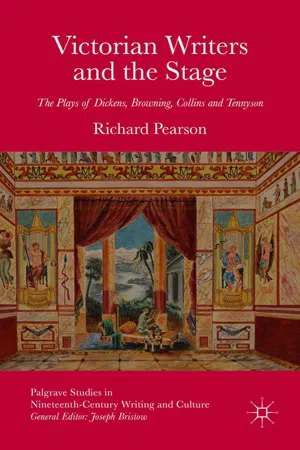
Victorian Writers and the Stage
The Plays of Dickens, Browning, Collins and Tennyson
- English
- ePUB (mobile friendly)
- Available on iOS & Android
eBook - ePub
About this book
This book examines the dramatic work of Dickens, Browning, Collins, and Tennyson, their interaction with the theatrical world, and their attempts to develop their reputations as playwrights. These major Victorian writers each authored several professional plays, but why has their achievement been overlooked?
Information
Comedy and Tragedy, Before the Theatres Act of 1843
1
Farce, family and the minor theatres: Dickens as a legitimate playwright
Charles Dickens’ early plays sit closer to The Pickwick Papers (1836–37) than to Sketches by Boz (1833–36), and are not directly concerned with the city and the urban, except insofar as they symbolically structure the city as Other or oppositional to the setting of the play. As such, they seek to create a distance between his theatre work and his street-journalism, despite contemporary comments about the farcical nature of the Sketches. All three of his professionally performed plays were rural plays, based around some form of escape into a seemingly simpler world which then collided chaotically with the new values brought to it. Thus, The Strange Gentleman (29 September 1836) takes place in a country inn, at which various characters stop on their route to illicit liaisons or intended elopements. The Village Coquettes (6 December 1836) is set in a rural village and Squire’s country-seat, into which the experienced city gents penetrate in order to seduce the country girls they find there. Is She His Wife? (6 March 1837) takes place at the spacious rural villa of a recently relocated married couple who turned their backs on the city, and into which arrives the single man, an urbane traveller, who becomes entangled in the relationships of the married couples in the farce. None of these plays invoke the oriental exoticism of many productions of the period; all are resolutely English. But they all make use of the trope of penetration and create a sexualized space in which the normal monogamous patterns of marital relations are disturbed and transgressed by the interloping force. If we consider the threat identified in the Minors to the moral values of the established middle-classes – the sexual fascination of the actress, or the vulgar animalism of the masses – we might see Dickens’ dramas as symbolic representations of these forces.
Moreover, Dickens’ depiction of the rural might be taken as a disarming one, an attempt to defuse moral threat by limiting the chaos to a clearly defined space, of place (inn, farm, country-seat) and of form (farce, burletta), that permits the re-establishment of correct moral order in the end. The complicated city landscape Dickens inhabited, of mixed districts and confused class boundaries, is not present here. In addition, Dickens’ plays, like many of the time (and especially in the genre of farce), appealed directly to the audience in the final speech, asking for generous judgement to be expressed in applause, and identifying the space of the play with the physical building of the theatre. Hence, in The Strange Gentleman, we are given a final apology: ‘I fear I have given a great deal of trouble here to-night – permit me to inquire whether you will view my mistakes and perils with an indulgent eye, and consent to receive “The Strange Gentleman” again to-morrow’.1 Similarly, Tapkins’ final lines in Is She His Wife?; or, Something Singular: ‘Here, it’s all arranged. The key to the whole matter is that I’ve been mistaken, which is something singular. If I have made another mistake in calculating on your kind and lenient reception of our last half-hour’s misunderstanding (to the audience), I shall have done something more singular still. Do you forbid me committing any more mistakes, or may I announce my intention of doing something singular again?’2 Strangeness and singularity (and being single) become equated with transgression and, rather than shocking its witnesses and being morally condemned, must be treated as simple youthful erring: ‘mistakes’ and ‘perils’ and ‘singularity’, due to the one aberration not the many or communal failings. In The Village Coquettes, Martin addresses the audience on behalf of Squire Norton (who has been one of the moral offenders): ‘My very particular friend, Mr. Norton, wishes me to ask my other particular friends here, whether there’s – anything wrong? We are delighted to hear your approving opinion in the old way. You can’t do better. It’s a capital custom’ before a finale of dance and song.3 The action is a defensive one, asking for applause but also reassurance that the audience thinks there is nothing ‘wrong’. The ‘hereness’ of the moment returns the otherness of the drama to the situation of the theatre, to the present fabrication as play and building. The Minor genres of farce and burletta seek approbation, acceptance, and try to insinuate their self-regulation and permissability with an uncertain or cautionary audience. The real audience, of Dickens’ clerks, apprentices, and young newly-weds, have no reservations about the enjoyment of their theatre; but the final lines appeal to the Lord Chamberlain, the periodical critics, and the disapproving eyes of The Strange Gentleman’s Mrs. Noakes, and ask them, ‘what is there to complain about?’, ‘is it okay?’, ‘look, everyone here is happy.’ The plays engage directly with a perceived threat to dignified morality by the illegitimate Minor theatres.
Before Dickens’ first theatrical production, he was already a presence on the London stage, but the ‘invisibility’ of the author, the difficulty of defining a coherent writerly identity in the context of the nineteenth-century stage, was to preoccupy Dickens’ early associations with the Minor and Major theatres. A pirated adaptation of his Monthly Magazine tale, ‘The Bloomsbury Christening’ (April 1834), a one-act farce entitled ‘The Christening’ by J.B. Buckstone, appeared at the Adelphi from 13 October 1834. Dickens wrote a sardonic letter to the editor of his journal which was published on 1st November:
I celebrated a christening a few months ago in the Monthly, and I find that Mr. Buckstone has officiated as self-elected godfather, and carried off my child to the Adelphi, for the purpose, probably, of fulfilling one of his sponsorial duties, viz., of teaching it the vulgar tongue.
Now, as I claim an entire right to do “what I like with my own”, and as I contemplated a dramatic destination for my offspring, I must enter my protest against the kidnapping process.
It is very little consolation to me to know, when my handkerchief is gone, that I may see it flaunting with renovated beauty in Field-lane; and if Mr. Buckstone has too many irons in the fire to permit him to get up his own “things”, I don’t think he ought to be permitted to apply to my chest of drawers.4
The Editor’s accompaniment to Dickens’ correspondence also notes that Dickens ‘has already prepared a farce on the subject, which Mr. Buckstone has so unceremoniously appropriated…’5
There are problems with this exchange. To begin with, Buckstone’s farce is entirely different to Dickens’ piece. In ‘The Bloomsbury Christening’, a misogynistic uncle reluctantly agrees to be godfather to his nephew’s son, and spends the whole piece ensuring no-one has a good time and bemoaning his own miserable existence. He finally ruins the celebration by delivering an after-dinner speech on the probable early death of the infant. Buckstone’s farce only parallels Dickens’ in the grumpiness of the central male ‘godfather’, who here is a lodger in the house, co-opted after the illness of the selected godfather. His good-nature, however, is finally revealed by the over-bearing godmother. The play then moves on to a complicated series of errors, deriving from a second christening, a mistake about fatherhood, and a cheerful resolving of the confusions. The main baby is not christened at the end of the play, but the happy father comes forward to the audience and asks to be able to repeat ‘this little production, the youngest of my family’ in a future performance.6 This metaphor Dickens picks up in his letter to the Editor. Buckstone had certainly read Dickens’ story; there are four or five jokes that derive from it: references to a pin in the baby’s leg, a barley-sugar fountain, a pink shirt that looks like a white shirt ruled with red ink, are directly from Dickens. But it is difficult to see that Dickens could genuinely assert his copyright to the subject of a christening, or that any adaptation of the actual story would not have found a place on the stage had Dickens have written one. The letter to the Editor executes a more complex intention.
Dickens’ first performed play, The Strange Gentleman, appeared on 29 September 1836, two years after the staging of ‘The Christening’, but the theatrical possibilities of his work were in the air for much longer. Paul Schlicke’s succinct discussion of the periodical reviewers’ interest in Sketches by Boz and the rapid success of Dickens’ early comic writing, identifies a degree of affinity with the contemporary stage as a reason for its popularity. For example, the tale of ‘Horatio Sparkins’ was described as ‘a good subject for a one-act farce’ (Morning Advertiser, 13 February 1834), while ‘The Steam Excursion’, the Sun notes (4 October 1834), was ‘a piece of broad rich farce, that would tickle the lean ribs of Envy herself into laughter. If Grimaldi, of clownish memory, could write, this is just the sort of thing we would expect from him…’7 The comments also indicate how closely Dickens’ decision to edit the Memoirs of Joseph Grimaldi in 1838 was bound up with the theatrical geography of his literary persona. The Strange Gentleman was based on a story called ‘The Great Winglebury Duel’, which had been written in October 1835 and was destined for the Monthly Magazine in December, but did not appear until the first volume of Sketches by Boz in February 1836. Dickens’ decision to write the farce was not a statement of literary intent to translate his fiction to the stage; its origins lay in the delays to the completion of what became his second play, an original burletta, The Village Coquettes, which appeared on 6 December 1836, sharing the bill with the final production of the Gentleman. In other words, Dickens ‘got up’ his adaptation to fill the void in the theatre programme due to the production difficulties of his more considered work.
What does this tell us about Dickens’ authorial identity and his relationship with the theatre? Dickens did not like adaptations. The Strange Gentleman is the only adaptation of one of his works that Dickens ever attempted. The identification of his stories as potential dramatic farces, however, may have provided him with thought of another opportunity, or it may have helped him to draw more distinctly the lines of difference between his fiction and the drama on the contemporary stage. Buckstone was an actor and theatre manager, not an ‘author’, and his production was to be seen in the light of the theft of intellectual property. Dickens’ letter refers to a play of his own, but his real objection is to the betrayal of, or indifference towards, the author. Dickens had first used the pen-name ‘Boz’ for a tale in August 1834, and the letter to the press might be seen as a more personal identification of the pseudonym with the author. Pen-names were frequently used in the period, and writers who worked for the periodicals often developed several. Dickens’ assertion of his pen-name as an actual corporeal author, with rights and feelings, defines his identity as a writer in relation to a corpus of works that even at this early stage he was beginning to shape. Dickens found the process of adaptation abhorrent and an undermining of authorial integrity. His tirade in Nicholas Nickleby (1838–39), spoken by Nicholas as an authorial surrogate, set the tone of his views on adaptations of novels throughout his career:
… you take the uncompleted books of living authors, fresh from their hands, wet from the press, cut, hack, and carve them to the powers and capacities of your actors, and the capability of your theatres, finish unfinished works, hastily and crudely vamp up ideas not yet worked out by their original projector, but which have doubtless cost him many thoughtful days and sleepless nights; by a comparison of incidents and dialogue, down to the very last word he might have written a fortnight before, do your utmost to anticipate his plot – all this without his permission, and against his will… Now, show me the distinction between such pilfering as this, and picking a man’s pocket in the street...8
For Dickens, adaptation raised questions of ownership: of creative originality, moral right and correctness, and commercial success, the principles that defined authorial legitimacy for him. The pickpocket (figuring in Oliver Twist (1837–39) and the theft of a handkerchief in the letter against Buckstone) is for Dickens a suitable metaphor for the commercial exploitation of his intellectual property. Inherent in this image is an issue of class: the respectable gentlemanly author, going about his profession, being robbed by the impoverished (in mind) hack-dramatist. The language of butchery: ‘cut, hack, and carve’, establishes a further hierarchy between the tradesman-adaptor and the ‘thoughtful days and sleepless nights’ of the originality, hard-work and effort of the legitimate writer. To offset some authorial frustration, as Bratton notes, Dickens eventually became involved in rehearsals for approved adaptations of his plays at the Lyceum and Adelphi.9 Yet Dickens’ perception of the lack of control an author had over the exploitation of his work in the theatre industry introduced a tension between his love of the dynamism and inventiveness of the Minor theatres with the sense that they were not defenders of legitimacy.
The Tottenham-street Theatre
Dickens’ interest in the Minor theatres was bound up initially with his youthful experiences of the literary world prior to his emergence as an author. On this cusp, the theatres hold an ambiguous status as both an illicit and flirtatious transgression from the hardening pre-Victorian moral attitudes of the 1830s, and an exciting, innovative and potentially family space. This contradiction – a combining of the illegitimate and the respectable – produced in Dickens a fascination for the Minor theatre that stimulated his ambition to become an author and remained with him for his whole life. Whether as a reader, a member of the audience, or an aspiring writer, Dickens adhered to the popular as a significant resource for modern forms of expression. Jane Moody has argued that the Minor theatrical genres of the melodrama and the pantomime contain a radical political element related to the call for increased democratization, and effectively represent a conscious rejection of legitimate forms of authority: ‘dramatic genres became categories of major ideological dispute’.10 One has to be cautious of this, particularly as melodrama and pantomime were also the progeny of...
Table of contents
- Cover
- Title
- Copyright
- Dedication
- Contents
- List of Figures
- Acknowledgements
- Chronology
- Introduction: legitimacy and playwriting
- Part I Comedy and Tragedy, Before the Theatres Act of 1843
- Part II Collaborations at Mid-Century, 1845–1868
- Part III Dramatic Identities, 1870–1883
- Notes
- Select Bibliography
- Index
Trusted by 375,005 students
Access to over 1.5 million titles for a fair monthly price.
Study more efficiently using our study tools.
Frequently asked questions
Yes, you can cancel anytime from the Subscription tab in your account settings on the Perlego website. Your subscription will stay active until the end of your current billing period. Learn how to cancel your subscription
No, books cannot be downloaded as external files, such as PDFs, for use outside of Perlego. However, you can download books within the Perlego app for offline reading on mobile or tablet. Learn how to download books offline
Perlego offers two plans: Essential and Complete
- Essential is ideal for learners and professionals who enjoy exploring a wide range of subjects. Access the Essential Library with 800,000+ trusted titles and best-sellers across business, personal growth, and the humanities. Includes unlimited reading time and Standard Read Aloud voice.
- Complete: Perfect for advanced learners and researchers needing full, unrestricted access. Unlock 1.5M+ books across hundreds of subjects, including academic and specialized titles. The Complete Plan also includes advanced features like Premium Read Aloud and Research Assistant.
We are an online textbook subscription service, where you can get access to an entire online library for less than the price of a single book per month. With over 1.5 million books across 990+ topics, we’ve got you covered! Learn about our mission
Look out for the read-aloud symbol on your next book to see if you can listen to it. The read-aloud tool reads text aloud for you, highlighting the text as it is being read. You can pause it, speed it up and slow it down. Learn more about Read Aloud
Yes! You can use the Perlego app on both iOS and Android devices to read anytime, anywhere — even offline. Perfect for commutes or when you’re on the go.
Please note we cannot support devices running on iOS 13 and Android 7 or earlier. Learn more about using the app
Please note we cannot support devices running on iOS 13 and Android 7 or earlier. Learn more about using the app
Yes, you can access Victorian Writers and the Stage by R. Pearson in PDF and/or ePUB format, as well as other popular books in Literature & Literature General. We have over 1.5 million books available in our catalogue for you to explore.