This book seeks to comprehensively analyze and document U.S. foreign policy toward a strategic Cold War ally that posed a stark challenge to the traditionally-stated U.S. preference for democracy and political freedom. It details the complex ways in which the U.S. reacted to that challenge and went about crafting policies of longer-term accommodation with a regime it wished to retain as a close ally in a strategically important part of the world.
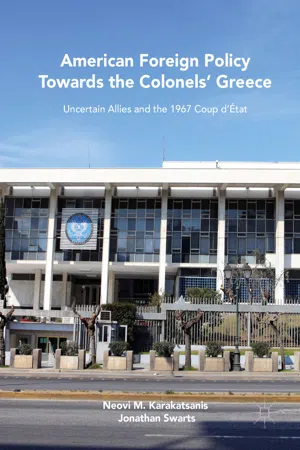
eBook - ePub
American Foreign Policy Towards the Colonels' Greece
Uncertain Allies and the 1967 Coup d’État
- English
- ePUB (mobile friendly)
- Available on iOS & Android
eBook - ePub
American Foreign Policy Towards the Colonels' Greece
Uncertain Allies and the 1967 Coup d’État
About this book
Information
© The Author(s) 2018
Neovi M. Karakatsanis and Jonathan SwartsAmerican Foreign Policy Towards the Colonels' Greecehttps://doi.org/10.1057/978-1-137-52318-1_11. Political Instability and Breakdown: The Historical Context
Neovi M. Karakatsanis1 and Jonathan Swarts2
(1)
Indiana University South Bend, South Bend, IN, USA
(2)
Purdue University Northwest, Hammond and Westville, IN, USA
Public opinion polls confirm that Greeks are one of the most anti-American publics in Europe, with roughly over ninety percent of its people holding critical views of the United States . One reason for the pervasive anti-Americanism is the commonly held belief that the United States was actively involved in launching and maintaining in power the military regime that ruled the country from 1967 to 1974. For half a century, this perception of American complicity has been common both in the public imagination and in the popular and more scholarly literature on the topic.1 The view is also nearly universally held by many of the country’s political and military elites. The words of several former members of the Greek parliament, nearly thirty years after the launching of the coup, are illustrative of Greek public opinion:
[We] know that the coup in Greece was launched with the help of the Americans, and we know that, without US assistance, the coup would not have been successful. … [A]s I said, the dictatorship happened for US political interests.2
Another Greek parliamentarian summed up the view thus: “the dictatorship … was one hundred percent American. … There was nothing Greek about it.”3 Indeed, such views have been so widespread in Greece that even US President Bill Clinton , recognizing that Greeks take American complicity as fact, echoed this prevailing perception when he virtually apologized for America’s role on a 1999 visit to Athens:
When the junta took over in 1967 here, the United States allowed its interests in prosecuting the Cold War to prevail over its interests—I should say its obligation—to support democracy, which was, after all, the cause for which we fought the cold war . It is important that we acknowledge that.4
Given the close historical relationship between the US government, the Greek right and the Greek military establishment during the 1950s and 1960s, and particularly the conduct of US foreign policy during the years of dictatorship, one can easily understand the origin and plausibility of such beliefs. However, despite nearly universal Greek acceptance of US involvement in the coup, and while much has been alleged regarding American involvement in the colonels’ regime, there has heretofore been relatively scant documentation from the historical record. This book seeks to provide such an analysis. Utilizing official US government and other sources—with a heavy emphasis on US State Department records—we analyze the evolution of US foreign policy toward Greece beginning with the emergence of deep political instability there in the mid-1960s, to the overthrow of democracy in April 1967, to the collapse of the military regime itself in July 1974.
The goal of our analysis is to arrive at a fuller understanding of what exactly US policy toward Greece was in this period and, by extension, to contribute to a more nuanced answer to the vexed question of actual US involvement in the overthrow of democracy there. We do this fully aware of the potential pitfalls and shortcomings—the most important of which is that an analysis of State Department documents may tell only part of the story and perhaps not even the most important part at that. If, for instance, as many Greeks believe, the Central Intelligence Agency (CIA) was the prime mover behind the coup, still classified CIA documents may contain the real “smoking gun” of US involvement. For this reason, our analysis cannot by itself be taken as the final word on the matter. However, the story that emerges from these documents is relatively clear and substantiated to a large degree by others who have examined not only US documents, but also those from the foreign ministries of Britain , Germany, and Greece .5 It shows that consecutive US administrations of the early to mid-1960s were concerned about the maintenance of political stability in Greece as a critically important part of the North Atlantic Treaty Organization’s (NATO) defensive position in the southeastern corner of Europe. However, as political stability began to break down in Greece —particularly after 1964—and as rumors of potential or imagined coups began to swirl in Athens, official documents show that the US Department of State consistently opposed “extra-parliamentary solutions” to Greece ’s problems and communicated this opposition to an overthrow of democracy to those closest to the embassy in Athens. As we illustrate, despite the Greek right’s warnings of a “communist takeover,” while concerned, the US seemed remarkably unconvinced and regularly discounted such a possibility.
Perhaps for that reason, the military coup of 21 April 1967 came as a surprise to the United States who was, we argue, opposed to the overthrow of democracy. While the US was often told that certain circles within the military were plotting coups—ones which, as we will illustrate, the US consistently warned Greek elites against—the 1967 coup by a group of colonels acting outside the normal chain of command came as a surprise and even as an embarrassment to the United States . In the end, it was domestic Greek actors, reflecting their deep anxiety over the Greek political reality of the time and acting on their own, who took the decisive steps to overthrow the country’s constitutional order.
This book not only examines the prelude to the coup, but also details the US policy response to it, focusing on aspects of that policy as it developed over the next seven years. Specifically, we focus on how, surprised by the overthrow of democracy and uncertain about how likely the regime was to last, the United States initially reacted cautiously, unsure of what its response should be. However, once it became clear that the regime’s hold on power had consolidated—and that very little active opposition existed to threaten the regime and bring about a quick return to democracy—the US made a strategic decision to settle into a two-pronged approach. On the one hand, it made repeated calls—both publicly, but more often privately—for the colonels to put the country on a track back to democratic rule. As a result, the regime was encouraged to release political prisoners, lift martial law, reinstate suspended articles of the constitution, and move toward the holding of democratic elections . On the other hand, however, these calls for a path back to constitutional rule were carefully and strategically balanced by an overriding US concern to maintain the security integrity of NATO on its southeast flank at a time of growing Soviet presence and influence in the region. The “democratic problem” posed by the Greek colonels was thus balanced by the “security problem” posed by the perceived Soviet threat. Indeed, as we will show, over time, the security problem not only underpinned the US position, but also came to fully predominate. As the realpolitik of the Nixon administration —and Henry Kissinger in particular—came to set the contours of US foreign policy , the security importance of maintaining a loyal strategic ally in Greece would overshadow democratic concerns entirely. What had begun as an attempt to balance two contradictory positions was largely resolved in favor of prioritizing the security concern above all else.
This chapter begins by detailing the growing instability of Greek politics in the 1960s—as the seemingly stable, yet defective, democracy of the 1950s and early 1960s gave way after 1964 to a period of political turmoil that ended with the April 1967 coup. It discusses the US’s approach to the key events of this period, showing how the US—while largely supportive of the conservative Greek political, royal, and military establishment—also recognized (perhaps reluctantly) the emergence of an invigorated center and moderate left as a natural part of the development of Greek democracy and one that the US—unlike its strong allies on the Greek right—did not particularly fear. It also shows how the US consistently counseled Greek interlocutors against the execution of a constitutional deviation and how, as the coup rumors became increasingly common and plausible, the US warned about how damaging such an event would be to Greece , arguing that the Greek public would not support such a “solution.”
Succeeding chapters then consider the US response to the coup that did eventually come and how that policy changed over time. In Chapter 2, we analyze the US rea...
Table of contents
- Cover
- Front Matter
- 1. Political Instability and Breakdown: The Historical Context
- 2. A Fait Accompli: The US Reaction to the Greek Military Coup of 1967
- 3. Johnson, Nixon, and Athens: Changing Foreign Policy Toward the Greek Military Dictatorship
- 4. Internal Divides: The White House, State Department, and the Athens Embassy
- 5. A View of the Colonels from the US Congress: Supporters and Opponents of the Greek Regime
- 6. US Diplomacy Within Europe and NATO on the Greek Question
- 7. Agency in Athens: The Greek Colonels’ Strategy Toward the US
- 8. Assessing US Foreign Policy in the Junta Era
- Back Matter
Trusted by 375,005 students
Access to over 1.5 million titles for a fair monthly price.
Study more efficiently using our study tools.
Frequently asked questions
Yes, you can cancel anytime from the Subscription tab in your account settings on the Perlego website. Your subscription will stay active until the end of your current billing period. Learn how to cancel your subscription
No, books cannot be downloaded as external files, such as PDFs, for use outside of Perlego. However, you can download books within the Perlego app for offline reading on mobile or tablet. Learn how to download books offline
Perlego offers two plans: Essential and Complete
- Essential is ideal for learners and professionals who enjoy exploring a wide range of subjects. Access the Essential Library with 800,000+ trusted titles and best-sellers across business, personal growth, and the humanities. Includes unlimited reading time and Standard Read Aloud voice.
- Complete: Perfect for advanced learners and researchers needing full, unrestricted access. Unlock 1.5M+ books across hundreds of subjects, including academic and specialized titles. The Complete Plan also includes advanced features like Premium Read Aloud and Research Assistant.
We are an online textbook subscription service, where you can get access to an entire online library for less than the price of a single book per month. With over 1.5 million books across 990+ topics, we’ve got you covered! Learn about our mission
Look out for the read-aloud symbol on your next book to see if you can listen to it. The read-aloud tool reads text aloud for you, highlighting the text as it is being read. You can pause it, speed it up and slow it down. Learn more about Read Aloud
Yes! You can use the Perlego app on both iOS and Android devices to read anytime, anywhere — even offline. Perfect for commutes or when you’re on the go.
Please note we cannot support devices running on iOS 13 and Android 7 or earlier. Learn more about using the app
Please note we cannot support devices running on iOS 13 and Android 7 or earlier. Learn more about using the app
Yes, you can access American Foreign Policy Towards the Colonels' Greece by Neovi M. Karakatsanis,Jonathan Swarts in PDF and/or ePUB format, as well as other popular books in Politics & International Relations & Public Policy. We have over 1.5 million books available in our catalogue for you to explore.