eBook - ePub
Responding to Conflict in Africa
The United Nations and Regional Organizations
- English
- ePUB (mobile friendly)
- Available on iOS & Android
eBook - ePub
About this book
Using nine case studies and an overview of recent changes at the institutional level, the purpose of this book is to examine the issues and experiences associated with the increased level of activity between the United Nations and regional organizations in their efforts to address conflict in Africa.
Information
Part I

The UN and African Regional Organizations
Chapter 1
The United Nations Security Council and Conflict in Africa
Jane Boulden
Introduction
Two distinct and linked trends are evident in post–Cold War Security Council politics. The first is a drive, from inside and outside the Council, toward greater cooperation and interaction with regional actors and organizations in dealing with international peace and security. The second is a steady increase, with a few ebbs and flows, in Council discussion, debate, and actions on conflict in Africa. Africa is the source of some of the United Nations’ (UN) most devastating experiences and most precious triumphs. That backdrop is the foundation of all of the analyses in this book. It is also the backdrop for this chapter, which focuses specifically on Security Council thinking and practice at the thematic level on the role of regional organizations and on conflict in Africa generally.
While the Security Council is the starting point, any examination of its activities involves other actors in the UN system. This is very much the case when it comes to these issues. The Security Council does not work in isolation, especially not on these issues. As the chapter indicates, the Secretary-General and the Secretariat play a vital role in providing information, moving Council thinking forward, and generating new ideas. Their work also links to that of the General Assembly and a wide range of ad hoc groups and panels established by UN actors to work on specific issues. Council activity is only one part of an extensive web of activity on regional and African issues but it provides the threads on which the rest of the activity rests.
The purpose of this chapter is not to establish a detailed outline of all of the various ideas and proposals that make their way to and through Council deliberations on conflict in Africa and cooperation with regional organizations. Rather, the goal is to outline and evaluate Security Council debate and actions in order to determine the trends in the Council’s thinking on these questions as general or thematic issues. The chapter is thus intended as a complement to the case studies in the second section of the volume. In the first edition of this book, Dealing with Conflict in Africa, the overarching question addressed in this chapter was whether and how increased attention to cooperation with regional organizations might establish itself as a trend in Security Council work. Ten years later, the question is not whether that trend has taken hold—that is now clearly evident. The question is what the nature of that trend and the speed of its entrenchment mean for the Council, for the ways in which conflict in Africa is and should be addressed, and for global–regional relations more generally.
The first section of the chapter will outline and discuss in broad terms the practice of the Security Council in dealing with African conflict situations. The second section of the chapter will examine the debate that has occurred within the Security Council on this issue as part of a general increase in attention to thematic or general issues on the part of the Security Council in the post–Cold War period. It covers the linked but separate themes of conflict in Africa and greater cooperation in the UN–regional organization relationship. In the first edition of this book, one of the goals of this chapter was to determine if and in what way the Security Council was turning to regional organizations to deal with conflict in Africa. The answer then was yes. The ten years since then have not only confirmed this trend but have seen it substantially increase in just about every way. As a result, the discussion covered in this chapter reveals the Council working to manage the nature of the relationship while simultaneously being driven by external developments, such as the creation of the African Union (AU), and events on the ground, including the significantly increased level of activity on the part of regional organizations in response to conflict situations, especially in Africa.
UN Operations in Africa
General Characteristics
As of October 2012, of the sixty-seven total Security Council–authorized peace support operations,1 thirty-one, or 46 percent, have occurred in Africa. Taking into account the fact that some conflict situations have been the subject of multiple operations, the thirty-one UN peace support operations carried out in Africa have addressed 16 conflict situations.2 These figures correspond with other measures of Security Council attention to conflict in Africa. An analysis of Security Council meetings since 1994, outlined in Figure 1.1, shows that the percentage of Council meetings focused on African issues varies from a low of 29 percent in 1990 to a high of 56 percent in 2011, with a rough average of 45 percent over time.
Security Council resolutions tell a similar story, depicted graphically in Figure 1.2. From 1989 to 2011, the number of Security Council resolutions dealing with conflict issues in Africa has ranged from a low of 0.5 percent in the years 1990 and 1991 to a high of 66 percent in 2011, with a rough average of 50 percent over time.
Of all of the sixty-seven UN operations in Africa, only one operation occurred during the Cold War. This was not for a lack of situations that could have used a UN response, but is an indication of the degree to which both Africa and the UN Security Council were permeated by the effects of the Cold War. The exception to the UN’s abstinence from Africa during the Cold War was the first UN operation in the Congo from 1960 to 1964. The Congo was one of the few places in Africa at that time that, until independence, remained outside of the Cold War struggle for influence in Africa. This fact contributed to the Soviet and US willingness to accept a UN operation there, if only as a way of buying time to ensure that the other side did not get a foothold there first.
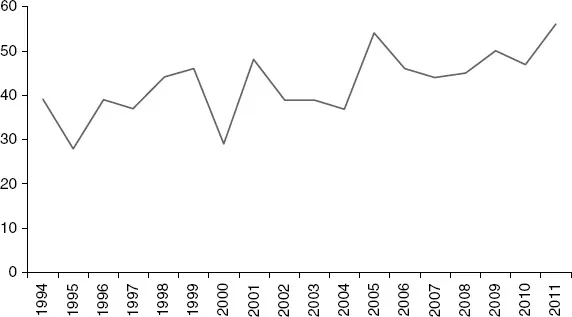
Figure 1.1 Security Council Meetings on African Conflict Issues as a Percentage of Total Meetings
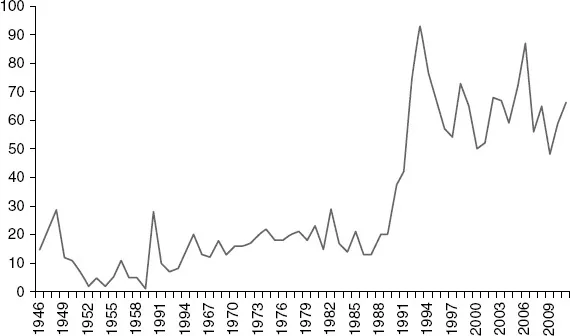
Figure 1.2 Security Council Resolutions on African Conflict Issues as a Percentage of Total Resolution Numbers
While almost thirty years separate United Nations Force in the Congo (ONUC) from all of the later UN operations in Africa, the overall characteristics of the operation and the situation it sought to address are remarkably consistent with the operations that came later. With few exceptions, UN operations in Africa have been associated with tasks related to some form of peace or ceasefire agreement.3 The agreement is often but not always the result of UN efforts to facilitate a peaceful resolution to the crisis. As a consequence, UN involvement may be part and parcel of the agreement itself or it may be requested after an agreement has been achieved to help facilitate implementation. Because of their association with peace and ceasefire agreements, these operations generally include any combination of the following tasks: monitoring the withdrawal of troops from a given area; monitoring a ceasefire; overseeing and implementing disarmament, demobilization, and reintegration of forces; the protection of civilian populations, including refugees or internally displaced peoples; and overseeing elections.
One of the interesting trends in Security Council decision making in the post–Cold War period is the extent to which the Council has been willing to invoke Chapter VII. As Patrik Johansson establishes, there is a definite trend upward in the Council’s use of Chapter VII after the Cold War.4 The Council’s response to Africa makes up a large share of that trend. Of the thirty-four conflict situations addressed by the Council between 1946 and 2008 using Chapter VII of the Charter, seventeen, or half, are African.5 This is in keeping with the general trends in Security Council responses to conflict in Africa described in the foregoing, indicating that the Council’s use of Chapter VII in Africa fits with the general pattern of its increased use in the post–Cold War period and does not indicate any greater propensity to use Chapter VII in Africa over other regions.
Background to UN–Regional Organization Relationships
The framework for the relationship between regional organizations and the UN is found in Chapter VIII of the UN Charter. Chapter VIII outlines a system that provides for regional arrangements to settle disputes before submitting them to the Security Council. Regional entities are, however, required to keep the Security Council fully informed of activities “undertaken or in contemplation” relating to international peace and security. For its part, the Security Council may use regional arrangements for enforcement action “where appropriate” but “no enforcement action shall be taken under regional arrangements . . . without the authorization of the Security Council” (Article 53). Together, these articles suggest quite an active and cooperative relationship between regional arrangements and the UN. In practice, however, until the end of the Cold War, virtually no formal activity took place under Chapter VIII auspices.6
The idea of greater cooperation between regional organizations and the UN was revived by the UN Secretary-General’s report, An Agenda for Peace, in 1992. An Agenda for Peace placed emphasis on the idea that regional organizations might be used to support UN peace efforts across the spectrum of operations from preventive diplomacy to post-conflict peace-building. The Secretary-General indicated that using regional organizations would not take away from the Council’s “primary” responsibility in dealing with international peace and security, “but regional action as a matter of decentralization, delegation and cooperation with UN efforts could not only lighten the burden of the Council but also contribute to a deeper sense of participation, consensus and democratization in international affairs.”7
In theory, the model of cooperation with regional organizations sees the Security Council authorizing an operation and then, either as part of that authorization or in a separate decision, asking a regional arrangement to undertake the authorized tasks. This theoretical model is based on the primacy of the UN Charter provisions and the role of the Security Council as the only entity with the power to authorize the use of force. In practice, events have rarely followed this sequence.
Two years prior to the appearance of An Agenda for Peace, an African regional organization had already taken the initiative in conflict management. In August 1990, the Economic Community of West African States (ECOWAS) established the ECOWAS monitoring group (ECOMOG) in response to the crisis in Liberia. Later that month, on 24 August 1990, ECOMOG was deployed in Liberia and began a sustained military oper...
Table of contents
- Cover
- Title Page
- Copyright
- Contents
- List of Illustrations
- Acknowledgments
- Introduction
- Part I The UN and African Regional Organizations
- Part II Case Studies
- About the Authors
- Index
- Index of UNSCR
Trusted by 375,005 students
Access to over 1.5 million titles for a fair monthly price.
Study more efficiently using our study tools.
Frequently asked questions
Yes, you can cancel anytime from the Subscription tab in your account settings on the Perlego website. Your subscription will stay active until the end of your current billing period. Learn how to cancel your subscription
No, books cannot be downloaded as external files, such as PDFs, for use outside of Perlego. However, you can download books within the Perlego app for offline reading on mobile or tablet. Learn how to download books offline
Perlego offers two plans: Essential and Complete
- Essential is ideal for learners and professionals who enjoy exploring a wide range of subjects. Access the Essential Library with 800,000+ trusted titles and best-sellers across business, personal growth, and the humanities. Includes unlimited reading time and Standard Read Aloud voice.
- Complete: Perfect for advanced learners and researchers needing full, unrestricted access. Unlock 1.5M+ books across hundreds of subjects, including academic and specialized titles. The Complete Plan also includes advanced features like Premium Read Aloud and Research Assistant.
We are an online textbook subscription service, where you can get access to an entire online library for less than the price of a single book per month. With over 1.5 million books across 990+ topics, we’ve got you covered! Learn about our mission
Look out for the read-aloud symbol on your next book to see if you can listen to it. The read-aloud tool reads text aloud for you, highlighting the text as it is being read. You can pause it, speed it up and slow it down. Learn more about Read Aloud
Yes! You can use the Perlego app on both iOS and Android devices to read anytime, anywhere — even offline. Perfect for commutes or when you’re on the go.
Please note we cannot support devices running on iOS 13 and Android 7 or earlier. Learn more about using the app
Please note we cannot support devices running on iOS 13 and Android 7 or earlier. Learn more about using the app
Yes, you can access Responding to Conflict in Africa by J. Boulden in PDF and/or ePUB format, as well as other popular books in Politica e relazioni internazionali & Politica africana. We have over 1.5 million books available in our catalogue for you to explore.