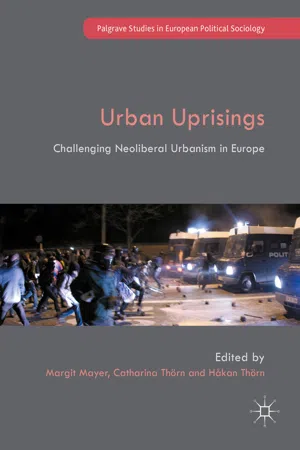
Margit Mayer, Catharina Thörn and Håkan Thörn (eds.)Urban UprisingsPalgrave Studies in European Political Sociology10.1057/978-1-137-50509-5_1
Begin Abstract
1. Re-Thinking Urban Social Movements, ‘Riots’ and Uprisings: An Introduction
Håkan Thörn1 , Margit Mayer2 and Catharina Thörn1
(1)
Gothenburg University, Göteborg, Sweden
(2)
Center for Metropolitan Studies, Berlin, Germany
End Abstract
Whatever the intellectual sources of error, the effect of equating movements with movement organizations—and thus requiring that protests have a leader, a constitution, a legislative program, or at least a banner before they are recognized as such—is to divert attention from many forms of political unrest and to consign them by definition to the more shadowy realms of social problems and deviant behavior…. Having decided by definitional fiat that nothing political has occurred, nothing has to be explained, at least not in the terms of political protest. (Piven & Cloward, 1977, p. 5)
Urban Uprisings in Contemporary Europe
During the last decade, European cities have been shaken by a wave of urban collective action. In this book, we argue that this wave needs to be understood in connection with the structural context of neoliberal urbanism, and that it can be analysed using the concept of ‘urban social movement’. This means that we go against conventional approaches to some of these collective acts, which researchers and media have labelled ‘riots’. Considering the intensity, spread, duration and social dimensions of the ‘rioting’ that occurred in a number of Europe’s major cities in this period, we prefer to describe them as ‘urban uprisings’, referring to a moment of rapid spread of collective action in an urban context, from district to district and/or city to city, which may or may not include violence, looting and torching. Consider the scale of the urban uprisings in the following brief introduction of the cases dealt with in this book, and the difficulty of making a conventional distinction between (disorganised) ‘riots’ and (organised) movement protest:
In October 2005, an urban uprising began in a Parisian poor suburb (banlieue) after police had chased boys with immigrant backgrounds into an electrical substation, where two of them died. The uprising spread to more than 300 cities and in the process hundreds of public and commercial buildings were destroyed and more than 9000 vehicles torched. In November, a state of emergency was declared and was extended for three months by parliament (Dikeç in this volume). In March 2007, an uprising turned central Copenhagen into a battleground between police and protesters for four days, after a combined military and police-force action against the Youth House, an autonomous cultural centre. Solidarity actions were performed in 13 Danish cities and in at least 46 cities in 22 other countries (Karpantschof & Lindblom, 2009, p. 15; Karpantschof & Lund Hansen in this book). In December 2008, an uprising began in Athens after a police shot a student in the Excarcheia district (Vradis in this volume). It lasted for three weeks, and included repeated violent clashes between police and protesters and the torching of public and private buildings. During the first week, a one-day strike against the government’s economic policies involved 2.5 million workers. In Athens and Thessalonica, universities were occupied. The uprising spread to all major Greek cities and solidarity actions took place in at least 26 other countries. Two years later, a major national uprising began in Greek cities, involving a series of general strikes, demonstrations and violent clashes with the police. On 12 February 2011, buildings all over Athens were burning (Vradis & Dalakoglou, 2011).
In May of the same year, a massive demonstration against the Spanish government’s austerity policies took place simultaneously in 57 Spanish cities—with Madrid and Barcelona being the nodes—and introducing the Indignados movement, which would have a strong presence in the public squares of Spanish cities in the years to come. It did involve some occasions of rioting and violent clashes with the police, but in general the movement was committed to peaceful direct action, such as major labour strikes and the occupation of public spaces with tents, sit-ins and public assemblies (Martinez in this volume). The Indignados were inspired by the Arab Spring that same year, and, in turn, they inspired the Occupy movement beginning in autumn 2011, and eventually spreading to 951 cities in 82 countries (Castells, 2012, p. 4). At the same time, in August that year, a major uprising started in London after police shot and killed a man in Tottenham (Slater in this volume). Lasting six nights, it spread to a number of poor districts in London and was described by Kawalerowicz and Biggs (2015, pp. 2–3) as ‘the most widespread and prolonged breakdown of order in London’s history since the Gordon riot of 1780’. The uprising, which spread to eight other major cities in England, included looting of shops, torching of public and private buildings and violent clashes with the police, who eventually took 3100 people to court. In May 2013, an uprising began in a poor suburb of Stockholm after police shot and killed a man of immigrant background. More than 100 cars were burnt during the first night, and the uprising continued for five more nights, spreading to other poor Stockholm suburbs and eight smaller cities around Sweden (Sernhede, Thörn and Thörn in this volume; Schierup, Ålund, & Kings, 2014; Thörn, 2013). A few days later, another uprising broke out in Istanbul, beginning as a small Right to the City demonstration against the planned demolition of Gezi Park. After the police responded with harsh repression, the demonstration grew into a major urban uprising. Six days of violent clashes between police and protesters followed, spreading to all major cities of Turkey. On 2 June, 235 protests were held in 67 cities across Turkey (Lelandais in this volume, Farro & Demirhisar, 2014, p. 12). In December of the same year, a three-week long uprising began in Hamburg after the police attacked a demonstration. The uprising was primarily about the impending eviction of the autonomous cultural centre Rote Flora, but also involved the broader Right to the City movement formed in Hamburg in 2009. In response to the uprising, the municipality declared a curfew and the police established a ‘danger zone’, enforcing ‘stop-and-frisk’ rules (Birke in this volume).
Fig. 1.1
The 2013 urban uprising in Hamburg in 2013 began after the threat of an eviction of Rote Flora, a squatted building that had functioned as a centre for urban activism for more than two decades. Photo: Håkan Thörn
In all of the cases in which ‘rioting’, i.e., violent clashes, looting and torching, occurred, it was triggered by violent police action that in four cases involved deaths as a consequence. But there are also other and more significant similarities between these cases, providing a more thorough explanation of events and processes. The uprisings in Paris, London and Stockholm share a racial dimension, which played a role in the deaths that ignited the uprisings, as those killed were black and/or had an immigrant background. In all cases, the killings occurred in urban areas subject to territorial stigmatization (Wacquant, 1999), i.e., districts where a majority of the inhabitants belong to the working class or the precariat, and are poor and non-white. While these uprisings were reminiscent of events in Britain in the 1980s, most notably in the London district Brixton in 1981 (Gilroy, 1987), but also in Parisian banlieues in the same year (Duprez, 2009), the scale and intensity of the 2000s uprisings make them, in a Western context, comparable only to similar events in the US: the so-called ‘race riots’ from the 1960s to Ferguson in 2014 (Abu-Lughod, 2007; Schneider, 2014).
Contemporary urban segregation, however, also involves, and is driven by, urban restructuring processes such as gentrification. A number of collective actions occurring in Europe during the last decade address the social effects of inner city ‘upgrading’. This was the case with Gezi Park, where the initial demonstration involved activists from the Right to the City movement, which has also during the last decade developed a strong presence in German cities such as Hamburg and Berlin. The Copenhagen municipality’s decision to sell off the centrally located Youth House, culminating years of clashes between police and activists around the issue, is also related to inner-city upgrading. Anti-gentrification action has also been an important element in urban movements emerging in Eastern Europe, where a wave of urban movements has emerged during the last decade (Jacobsson, 2015). While our book mainly focuses on Western Europe, Polanska’s chapter provides insight into how an alliance of squatters and tenant associations has challenged Polish urban policies (Polanska in this volume). If these collective actions were clearly driven by activists with an articulated political agenda, this was also true of the uprisings in Athens, Barcelona and Madrid. The 2008 uprising in Athens may be seen as the first major manifestation of the emerging anti-austerity movement (Flesher Fominaya, & Cox, 2013; Mayer, 2016), escalating into Greece and Spain in 2010–2011, and spreading to a number of other European countries in the years to follow.
While there are many crucial differences between the collective actions just mentioned, primarily related to their differing national and local political contexts and socio-economic conditions, the links between them are equally important. In exploring such links, we have found the conventional distinction between ‘riots’ and movement action unhelpful. This is related to the emphasis the chapters of this book place on how collective actions that may look different on the surface share an urban dimension: They are all in different ways reactions to the developments and effects of neoliberal urbanism. While this urban dimension does not exhaust these phenomena analytically, as they also involve elements of structural processes that go beyond the urban dimension, it is an important and revealing one. Therefore, we first and foremost analyse how the different forms of collective action articulate and resist spatialised social inequalities produced by processes of segregation and gentrification. The production and deepening of such spatialised inequalities is a key dimension of contemporary neoliberalism worldwide (Brenner, 2014), and also of urban collective action (Mayer, 2013a).
The empirical case studies and analyses in this book address three inadequacies in contemporary research that have been made particularly apparent by urban developments in the 2000s. First, considering the wave of urban collective action recounted above, it is curious that research on contentious politics and social movements rarely addresses the urban dimension (as highlighted by Hamel, 2014; Jacobsson, 2015; Nicholls et al. 2013; Pickvance, 2003). Second, the distinction made in contemporary research between urban riots and urban social movements, which may even be said to represent different research fields, is unsatisfactory for an adequate analysis of contemporary urban collective action. The fact that there are two entries relating to riots in the recent Encyclopedia of Social and Political Movements (Snow et al 2013) may seem to contradict our claim that such separation exists. However, on the topic of ‘Urban riots in Europe, post 2000’, leading riot researcher David Waddington draws the following conclusion from the events in Paris, Athens and London mentioned above:
Though unquestionably driven by profound political grievance, they did not constitute the type of ‘insurrection’, ‘uprising’, or ‘upheaval’ that is generally more synonymous with enduring, bona fide social movements. (Waddington, 2013, p. 3)
Third, while contemporary analyses of neoliberal urbanism have begun to take an interest in urban collective action (e.g. Harvey, 2012), such analyses rarely draw on social movement research. Against this background, this book constitutes an attempt to bridge the gap between these relatively separate bodies of research by providing a structural analysis of urban uprising that focuses on processes of large-scale urban transformation in the shape of what has been called ‘neoliberal urbanism’—and explores to what extent, and how, these developments involve the formation of new urban social movements in Europe. It contributes to a rethinking of the relations between social movements, ‘riots’ and neoliberalism, a rethinking that has been made urgent by urban developments since the 2000s. In the following sections, we will discuss key themes in these three research areas, further developing our own points and conceptualisations.
We begin by recapitulating the debate between those who emphasise macro- and micro-perspectives on riots because, in contrast to the 1960s and 1970s, micro-approaches today dominate research in the field. However, the recent developments discussed in this book seem to us to call for revisiting structural theories, and particularly Marxist-oriented perspectiv...
Table of contents
Cover
Frontmatter
1. Urban Uprisings, Social Movements and Neoliberal Urbanism
2. Challenging Neoliberal Urbanism in Europe
Backmatter
Trusted by 375,005 students
Access to over 1.5 million titles for a fair monthly price.
Study more efficiently using our study tools.
Frequently asked questions
Yes, you can cancel anytime from the Subscription tab in your account settings on the Perlego website. Your subscription will stay active until the end of your current billing period. Learn how to cancel your subscription
No, books cannot be downloaded as external files, such as PDFs, for use outside of Perlego. However, you can download books within the Perlego app for offline reading on mobile or tablet. Learn how to download books offline
Perlego offers two plans: Essential and Complete
Essential is ideal for learners and professionals who enjoy exploring a wide range of subjects. Access the Essential Library with 800,000+ trusted titles and best-sellers across business, personal growth, and the humanities. Includes unlimited reading time and Standard Read Aloud voice.
Complete: Perfect for advanced learners and researchers needing full, unrestricted access. Unlock 1.5M+ books across hundreds of subjects, including academic and specialized titles. The Complete Plan also includes advanced features like Premium Read Aloud and Research Assistant.
Both plans are available with monthly, semester, or annual billing cycles.
We are an online textbook subscription service, where you can get access to an entire online library for less than the price of a single book per month. With over 1.5 million books across 990+ topics, we’ve got you covered! Learn about our mission
Look out for the read-aloud symbol on your next book to see if you can listen to it. The read-aloud tool reads text aloud for you, highlighting the text as it is being read. You can pause it, speed it up and slow it down. Learn more about Read Aloud
Yes! You can use the Perlego app on both iOS and Android devices to read anytime, anywhere — even offline. Perfect for commutes or when you’re on the go. Please note we cannot support devices running on iOS 13 and Android 7 or earlier. Learn more about using the app
Yes, you can access Urban Uprisings by Margit Mayer, Catharina Thörn, Håkan Thörn, Margit Mayer,Catharina Thörn,Håkan Thörn in PDF and/or ePUB format, as well as other popular books in Social Sciences & European Politics. We have over 1.5 million books available in our catalogue for you to explore.