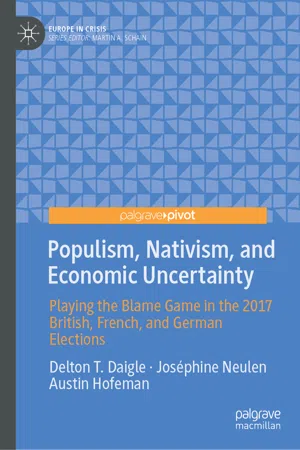
This project offers an in-depth look at the three 2017 elections held in Western Europe: France, Germany, and the UK. With events like Brexit and a general rise in right-wing populism across highly industrialized nations, understanding the underlying causes of increasingly extreme electoral behavior is both valuable and prescient. A highly theoretically-focused and current project, it provides a consistent methodological and analytic approach that uses election study data and primary sources to offer a complete and cogent picture of this complex phenomenon as can only found by examining the attitudes and behaviors of the most powerful of democratic participants: the voters.
eBook - ePub
Populism, Nativism, and Economic Uncertainty
Playing the Blame Game in the 2017 British, French, and German Elections
- English
- ePUB (mobile friendly)
- Available on iOS & Android
eBook - ePub
Populism, Nativism, and Economic Uncertainty
Playing the Blame Game in the 2017 British, French, and German Elections
About this book
Information
© The Author(s) 2019
Delton T. Daigle, Joséphine Neulen and Austin HofemanPopulism, Nativism, and Economic UncertaintyEurope in Crisishttps://doi.org/10.1007/978-3-030-02435-2_11. Introduction
Delton T. Daigle1 , Joséphine Neulen2 and Austin Hofeman3
(1)
Schar School of Policy and Government, George Mason University, Fairfax, VA, USA
(2)
Schar School of Policy and Government, George Mason University, Fairfax, VA, USA
(3)
George Mason University, Fairfax, VA, USA
Abstract
The latter half of the 2010s has seen a remarkable resurgence for a type of politics that had long been considered pushed to the edges of acceptable (or electable) political thought and behavior. The success of parties and candidates described as nativist, populist, right wing, or some combination thereof has renewed both academic and popular interest in developing an understanding of what drives support for these types of parties and candidates, a crucial question if one hopes to understand not only the current global political stage but the actors and scenery that may populate it in the future. By examining three cases where these parties have made significant inroads toward political influence and power, this study helps update previous and develop new understandings of what shapes a populace’s feelings toward immigration as well as a more generalized conclusion regarding what does (and does not) influence a voter’s likelihood of choosing an extremist political party or candidate.
Keywords
Election studiesEuropean electionsNativismPopulismRight-wing votingAnti-immigrant sentimentThe latter half of the 2010s has seen a remarkable resurgence for a type of politics that had long been considered pushed to the edges of acceptable (or electable) political thought and behavior. The success of parties and candidates described as nativist, populist, right wing, or some combination thereof has renewed both academic and popular interest in developing an understanding of what drives support for these types of parties and candidates, a crucial question if one hopes to understand not only the current global political stage but the actors and scenery that may populate it in the future.
What makes the current resurgence of extreme political thought more stunning is the geographical distribution of its successes. In Great Britain , a populist campaign advocating for a withdrawal from the European Union pulled off a stunning victory, promising to affect British politics and government for the considerable future. In the USA , a populist and nativist campaign launched a former television star, businessman, and political neophyte to the most important political position in the country and arguably the world. In France, a nativist and populist presidential candidate ascended to the second round of voting, and while her campaign was ultimately unsuccessful, this by no means precludes either her candidacy or political philosophy from being a recurrent force in French politics going forward. In Germany , a right-wing party has been seated in the legislature for the first time since 1945; as with France , this (marginal) success is a portent for future political relevance and influence. Similar recent successes by right-wing parties in the Italian parliament, the rise of Viktor Orban and nationalist parties in Hungary , gains by nationalist parties in Slovenia , and a persistent parliamentary presence by nationalist, populist, or right-wing parties in Austria , Denmark , Finland , Norway , and the Netherlands demonstrate that these successes are not anomalies but rather a growing trend. The fact that these trends are occurring in what had been seemingly immovable cornerstones of the global liberal democratic order only further suggests the importance of studying and understanding what has driven these current successes and what may shape their political fortunes going forward.
These contemporary successes also present a useful opportunity for a review of the extant research on what influences support for populist or nativist parties , as well as what shapes nativist opinions in a country’s population. The centrality of immigration in the messaging of many of these candidates and parties necessitates a further exploration of what affects opinions in this area, as it is likely that a populace’s perceptions of the utility of immigrants and immigration will continue to be a source of possible support for these parties. While having anti-immigrant or anti-immigration opinions by no means guarantees a vote for a populist or nativist party , there is little doubt that the messaging from these parties will likely find a receptive audience among those who view immigration as a threat rather than a benefit. Understanding what shapes opinion in this area, then, is a critical step in understanding where the support base for these candidates and parties has been and will be in the future.
Overall, the literature has provided a plethora of explanations regarding what affects anti-immigrant sentiment, populist sentiment and appeals, and nativist sentiment and appeals. The overlap between these types of sentiment and appeals has allowed researchers to begin to present a cohesive picture of the questions explored here, but the inconsistency of many of the findings in the literature requires a re-examination and a different approach.
One of the primary theories regarding anti-immigration opinions looks to the perceived (or real) threat immigration poses to a native population; this threat can be multifaceted, and this complexity demonstrates both the strengths and weaknesses of the existing literature. The two main pillars of threat—economic threat and cultural threat —have been examined in great detail, with some studies working to include both measures simultaneously in order to present a clearer understanding of how native populations perceive and internalize immigrants as a threatening force. This simultaneity approach is a better depiction of how citizens generally approach forming their opinions about immigration , but the threat literature is still somewhat nebulous on how these forces work as isolated factors shaping anti-immigrant sentiments . Measuring threat , particularly economic threat , has often demonstrated the importance of subjective rather than objective measures, making the importance of threat more of an exercise in how survey respondents perceive themselves individually and their situation rather than simply relying on objective or macro-level economic indicators. Cultural threat is similarly subjective and therefore difficult to separate as an individual influence. More importantly for the purposes of the current research here, how these forces contribute to electoral decisions (whether they are a factor inasmuch as they shape anti-immigrant opinions or if feelings of cultural or economic uncertainty operate above and beyond anti-immigrant sentiment) is often left undiscussed in these studies.
Complicating the threat-based models presented by economically minded authors is the overlapping threat that shapes nativist explanations for anti-immigration and anti-immigrant sentiments and behavior. Fears of an out-group or fears regarding the takeover of one’s culture and/or country by those who look and act differently are pillars of the nativist school of thought; how one defines one’s identity, the threat one perceives to that identity , and how one responds to that threat , then, are all critical forces shaping one’s attitudes toward immigration . However, what particularly complicates the divide between economic and purely nativist explanations is that nativist theories often contain some measure of economic or competitive threat on their own. A tribal view of the world contains within itself concerns over economic depredation from outside groups, meaning that economic threat may not function as an independent factor but rather simply be reframing or more specifically defining what are, in effect, entirely nativist views regarding immigration . If nativism is the true cause, then attributing specifics can become difficult; underlying cultural threats may not be easily articulated or even directly perceived by citizens, and the backlash may be driven more by a general dissatisfaction with changes in cultural norms rather than a specific change driven by immigration (i.e., anti-immigration may be an outgrowth of a general reactionary attitude rather than an independently racist attitude, with immigrants being an easy scapegoat rather than a true source of animus). This abstractness presents a further complication with a third major school, populism.
Populism as a source of anti-immigrant behavior is less of a theoretical mainstay but rather has grown out of current political discourse in a number of countries. The development of a “heritage populism ” (Reynié 2016) that presents voters with an attempted apolitical appeal that directs their attention to the way “elites” and outsiders are undermining both individual and national vitality highlights the need to understand populism as an independent source for anti-immigrant appeals. However, as with the two schools already discussed, deriving this independent influence is not particularly easy. The overlap in appeal ...
Table of contents
- Cover
- Front Matter
- 1. Introduction
- 2. Literature Review
- 3. Methods
- 4. France 2017
- 5. Great Britain 2017
- 6. Germany 2017
- 7. Comparing Across the 2017 Elections in Britain, France, and Germany
- 8. Discussion/Conclusion
- Back Matter
Trusted by 375,005 students
Access to over 1.5 million titles for a fair monthly price.
Study more efficiently using our study tools.
Frequently asked questions
Yes, you can cancel anytime from the Subscription tab in your account settings on the Perlego website. Your subscription will stay active until the end of your current billing period. Learn how to cancel your subscription
No, books cannot be downloaded as external files, such as PDFs, for use outside of Perlego. However, you can download books within the Perlego app for offline reading on mobile or tablet. Learn how to download books offline
Perlego offers two plans: Essential and Complete
- Essential is ideal for learners and professionals who enjoy exploring a wide range of subjects. Access the Essential Library with 800,000+ trusted titles and best-sellers across business, personal growth, and the humanities. Includes unlimited reading time and Standard Read Aloud voice.
- Complete: Perfect for advanced learners and researchers needing full, unrestricted access. Unlock 1.5M+ books across hundreds of subjects, including academic and specialized titles. The Complete Plan also includes advanced features like Premium Read Aloud and Research Assistant.
We are an online textbook subscription service, where you can get access to an entire online library for less than the price of a single book per month. With over 1.5 million books across 990+ topics, we’ve got you covered! Learn about our mission
Look out for the read-aloud symbol on your next book to see if you can listen to it. The read-aloud tool reads text aloud for you, highlighting the text as it is being read. You can pause it, speed it up and slow it down. Learn more about Read Aloud
Yes! You can use the Perlego app on both iOS and Android devices to read anytime, anywhere — even offline. Perfect for commutes or when you’re on the go.
Please note we cannot support devices running on iOS 13 and Android 7 or earlier. Learn more about using the app
Please note we cannot support devices running on iOS 13 and Android 7 or earlier. Learn more about using the app
Yes, you can access Populism, Nativism, and Economic Uncertainty by Delton T. Daigle,Joséphine Neulen,Austin Hofeman in PDF and/or ePUB format, as well as other popular books in Politics & International Relations & Comparative Politics. We have over 1.5 million books available in our catalogue for you to explore.