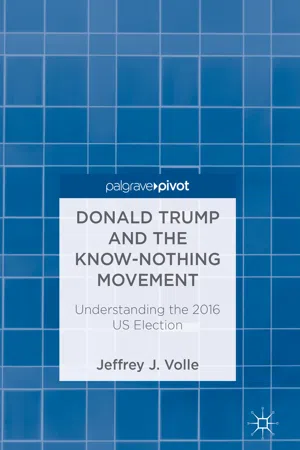
Historically, segments of white Americans have let racist paranoia supersede judicious reasoning throughout our history. The 2016 Presidential election in the United States brought the Know-Nothing's back from the hidden depths of our history books. This book provides a historical account of the Know-Nothing Party in the 1850s through their reemergence in the 21st century with the election of Donald Trump. Analyzing the anti-immigration and anti-Catholic rhetoric of the Know-Nothing movement and tracing that same rhetoric in George Wallace's American Independent Party in the '60s, up into its appearance in the Trump movement, this book provides a guide for understanding the 2016 Republican Party agenda through its inheritance from the Know-Nothing Movement.
eBook - ePub
Donald Trump and the Know-Nothing Movement
Understanding the 2016 US Election
- English
- ePUB (mobile friendly)
- Available on iOS & Android
eBook - ePub
About this book
Information
© The Author(s) 2019
Jeffrey J. VolleDonald Trump and the Know-Nothing Movementhttps://doi.org/10.1007/978-3-319-78334-5_11. Introduction
Jeffrey J. Volle1
(1)
Olmsted Falls, OH, USA
Abstract
From the Chinese, to the Irish, to Jewish and to the Japanese, Americans have let their paranoia supersede judicious reasoning. Not to be outdone by the aforementioned examples of historical hysteria, the 2016 presidential election in the United States brought the Know-Nothings back from the depths of history. This book examines the background of the Know-Nothing movement in the 1850s and those parts of the movement that have re-emerged in the twenty-first century with the election of Donald Trump.
Keywords
2016 presidential electionKnow-NothingPrejudiceDonald TrumpAlmost two centuries ago a large part of the population of the United States was anti-immigration and anti-Catholic. Most of the population was concentrated in the northern states. After gaining a substantial share of the presidential vote in 1856 the American Party, as it was officially named, splintered, with some of its members joining the Republican Party by 1860. The Know-Nothing Party, as the American Party is known to most Americans today, represented a small fragment of political thinking, but only lasted a short period of time. Although anti-Catholic sentiment has dissipated since the 1850s in the United States, anti-immigration attitudes have continued to target certain groups ever since.
From the Chinese, to the Irish, to the Jews and to the Japanese, Americans have let their paranoia supersede judicious reasoning. Not to be outdone by the aforementioned examples of historical hysteria, the 2016 presidential election in the United States brought the Know-Nothings back from the depths of history. This book examines the background of the Know-Nothing movement in the 1850s and those parts of the movement that have re-emerged in the twenty-first century with the election of Donald Trump.
The Know-Nothing movement was not the only political group integrated into the Trump coalition. Governor George Wallace’s American Independent Party, at its apex during the 1968 presidential election, was reborn in 2016 as a reaction to the development of movements such as Black Lives Matter and the loss of blue-collar jobs in the Midwest, blamed in part on the NAFTA agreement signed in 1993 under President Bill Clinton. Of course, the era of Bill Clinton continued with his wife’s nomination in 2016 as the Democratic candidate for president.
There will be an avalanche of academic books written about the 2016 presidential election, as well as books written to provide the “red meat” so many partisans desire in today’s age of Google. The academic field of politics is rapidly becoming substituted, or at least challenged, by Google, partisan news networks and political websites that feed the appetites of the left and the right. This book seeks to answer the question, “Has the United States electorate learned from past third-party political movements?”
Presidential elections in the United States are a narrative of the time in which they are held. As presidential historians and political scientists examine past eras and presidents who were considered able and honorable for much of the past century, some, such as Andrew Jackson, the seventh President of the United States, are now being criticized for their policies of discrimination. Our ancestors face judgment today due to the evolution of ideas of human dignity.
However much information the American voter can access via a Google search in a matter of minutes, presidential historians and political scientist have examined all fifty-seven presidential elections with fervor and expertise. It is in terms of the fifty-eighth presidential election that the field of psephology will be severely tested and extensively debated. Donald Trump won the 2016 presidential election in the Electoral College, but lost the popular vote to former Senator and Secretary of State Hillary Clinton by three million votes—a feat only occurring three times in the nineteenth century (1824, 1876, 1888), zero times in the twentieth century and already two times in the twenty-first century, in 2000 with Al Gore and George W. Bush and, of course, in 2016.
The American people are now beyond a functional divide that has been the norm since the founding fathers debated the structure of the new government. The decades-long tradition of compromise between political parties to achieve grand accomplishments has been eroded in the last decade since the election of George W. Bush, leading to the election of President Donald Trump and the renaissance of the anti-establishment voter.
Of course, both political parties’ leaders point the finger at one another as the reason for this dysfunction. This book won’t change that view. However, the presidential election of 2016 inspires those who revel in psephology to once again examine the 1856 and 1968 presidential elections. Perhaps by re-examining these two elections the nation will be able to prepare for what is to come over the next ten years and beyond in the U.S. government.
Violence has been a part of American political culture since before the Age of the Internet and will remain so generations from now. The 2016 presidential election has driven the anger of the American voter to heights not seen since the dark days of the Vietnam War and only surpassed during the American Civil War. Anger has now resulted in more than fistfights at presidential rallies. The shooting of Republican Congressman and majority whip Steve Scalise and three others outside a baseball field in Virginia was politically motivated, as an anti-Trump person took his anger about a presidential election loss to new and despicable lengths.
A rally in Charlottesville, North Carolina, in support of keeping a statue of Confederate General Robert E. Lee standing, and the counter-protests that came out in force, resulted in a violent clash that led to the death of one of the counter-protesters. Americans are crossing a line that could gradually begin to erode the basic fundamentals of democracy—compromise and the decency of discussion.
At one time a presidential candidate addressed the following words to the delegates listening in the Miami Beach Convention Center and to the American voter able to stay up very late:
Together we will call America home to the ideals that nourished us from the beginning. From secrecy and deception in high places: come home, America.From military spending so wasteful that it weakens our nation: come home, America.From the entrenchment of special privileges in tax favoritism; from the waste of idle lands to the joy of useful labor; from the prejudice based on race and sex; from the loneliness of the aging poor and the despair of the neglected sick: come home, America.Come home to the affirmation that we have a dream. Come home to the conviction that we can move our country forward.
The candidate was Democrat Senator George McGovern, who went on to lose the 1972 election in a landslide to President Richard Nixon, only winning Massachusetts and the District of Columbia. Weren’t the Trump campaign and its supporters, in many ways, all about “American Coming Home?” Perhaps this slogan may fit today, but do President Trump and his supporters want to go back to past decades of suspicion, discrimination and obstinate behavior? Angry voters are not something new to our democracy, and leaders will exploit that anger by forming political parties ready to fight for their particular cause. All this effort is made in the name of democracy, no matter if their cause is for the short term or the long term.
The American Party, as they called themselves in 1856 to soften their “anti” image, better known to most as the Know-Nothing Party, steadily grew from the previous decade. This growing bloc of voters were anxious about the influx of immigrants who were not Anglo-Saxon nor Protestant. Anti-immigration was the key issue rallying the Know-Nothings to form a legitimate party challenging the Democratic and Whig parties (to be known as the newly formed Republican Party by the 1856 presidential election). Adding legitimacy to the Know-Nothing cause was the acceptance by Millard Fillmore, who had served as the thirteenth President of the United States, to be their presidential candidate in 1856. Recruiting a past president to run on another political party’s ticket other than one of the two major parties is an almost inconceivable idea to contemplate today! The Know-Nothing Party simply added its anti-immigrant, anti-Catholic cause to the mountain of sectional schism already formed between north and south. But the division in America was not over. The decade of the 1960s started with a “New Frontier” and ended with the Democratic Party trying to justify a growing federal government aimed at giving back African Americans a stolen innocence and identity.
The year 1968 witnessed the greatest number of events that changed the United States since the end of the World War II in 1945. The list is staggering, including the Tet Offensive in South Vietnam, President Lyndon Johnson declaring he would not run for re-election, Martin Luther King Jr.’s assassination, Senator Robert F. Kennedy’s assassination, the strong showing of segregationist Governor George Wallace in the 1968 presidential election and the subsequent election of Richard Nixon in that election. Even fifty years later, the implications of 1968 and the perseverance of democracy never ceases to amaze those who study this era.
Besides the Nixon presidency, the one lasting figure from 1968 was George C. Wallace. The confrontational, segregationist and brash Governor of Alabama was the symbol and leader of a new movement of not only southern nationalism, but also northern blue-collar pragmatism. Wallace picked up where Strom Thurmond left off as a southern Democrat running as the candidate of the States’ Rights Party (or Dixiecrats) in 1948. By 1968, the civil rights movement and the Vietnam War protests brought to the forefront angry young white and black youths rioting, a scene unsettling to most in predominantly white middle-class America.
The Wallace coalition began to show its strength once again in the 1972 Democratic primaries as George Wallace won the Florida primary and came in second in the state of Pennsylvania. However, Arthur Bremer’s sick mind and snub-nosed. 38 revolver stopped Wallace’s momentum and paralyzed the Governor for life as he campaigned in a Maryland grocery store parking lot. Wallace would go on to win the Maryland and Michigan primaries the next day on May 16—a victory lost in human anguish.
With the Wallace coalition now lacking its leader, the “New Left” under George McGovern moved its “political army” of millions into strategic position and took over the Democratic Party along with the 1972 nomination. Wallace’s southern nationalists and blue-collar pragmatists were now without a party. Even the election of a southerner, Georgia Governor Jimmy Carter, in 1976 over President Gerald Ford did not fully satisfy the Wallace followers. The election of Ronald Reagan in 1980 filled the void for many of these Wallace supporters for the following twelve years.
As the Democratic Party was reeling from losing five of the six presidential elections from 1968 to 1988, Bill Clinton stopped the political hemorrhaging with a victory in 1992 followed by another in 1996. George W. Bush won the 2000 election, with help from the United States Supreme Court, over Vice President Al Gore. This controversial election brought partisanship to a new high by 2008 with the arrival of a young Senator from Illinois, Barack Obama. The divisions in the country were not only found in Washington, D.C., but among the American people across all regions of America. The acceleration of partisanship reached its climax with the passage of the Patient Protection and Affordable Care Act in 2010 by a democratically elected Democrat majority, as conservative Republicans used this act as a rallying cry for their supporters.
One evening in 2009, American political civility disappeared in the sacred halls of democracy when Representative Joe Wilson, Republican from South Carolina, yelled “You Lie!” in response to President Obama’s statement that the health care reform he was proposing to a joint session of Congress would not insure illegal immigrants. A line was crossed. When Sarah Palin said the same health care reform proposed by President Obama would contain government “Death Panels” to determine whether the disabled or sick elderly would qualify for coverage, the opposition to the Affordable Care Act had their spokesperson. And then, when Donald Trump challenged the President of the United States, Barack Obama, to produce a birth certificate on March 23, 2011, the line that Joe Wilson had crossed was no longer in sight. The war of “hidden debate” has now replaced newspapers and magazines that gave voice to open thought. An individual’s right to tweet, blog and post on Facebook is not creating the next Benjamin Franklin or Thomas Paine. These platforms are now the way democracy communicates political thought.
So here we are today. The man who hounded the forty-fourth President of the United States to produce his birth certificate has now been elected President of the United States through the same democratic process that elected Barack Obama. The election of Donald Trump has further split the already divided electorate, and this divide will last a long time. The political division that has deeply scarred the United States has the fingerprints of the American voters all over it.
The Women’s March on Washington, a 500,000-strong event held the day after the Trump inauguration, reinforces this statement. Of course, there were 500,000 female supporters of Trump across America who thought this outpouring of defiance and protest was unwarra...
Table of contents
- Cover
- Front Matter
- 1. Introduction
- 2. The Original Know-Nothings
- 3. Our Thirteenth President Now a Know-Nothing!
- 4. Trump ’68
- 5. Obama and the Resurrection of the Know-Nothing
- 6. The World Is Watching—Again!
- 7. Conclusions
- Back Matter
Trusted by 375,005 students
Access to over 1.5 million titles for a fair monthly price.
Study more efficiently using our study tools.
Frequently asked questions
Yes, you can cancel anytime from the Subscription tab in your account settings on the Perlego website. Your subscription will stay active until the end of your current billing period. Learn how to cancel your subscription
No, books cannot be downloaded as external files, such as PDFs, for use outside of Perlego. However, you can download books within the Perlego app for offline reading on mobile or tablet. Learn how to download books offline
Perlego offers two plans: Essential and Complete
- Essential is ideal for learners and professionals who enjoy exploring a wide range of subjects. Access the Essential Library with 800,000+ trusted titles and best-sellers across business, personal growth, and the humanities. Includes unlimited reading time and Standard Read Aloud voice.
- Complete: Perfect for advanced learners and researchers needing full, unrestricted access. Unlock 1.5M+ books across hundreds of subjects, including academic and specialized titles. The Complete Plan also includes advanced features like Premium Read Aloud and Research Assistant.
We are an online textbook subscription service, where you can get access to an entire online library for less than the price of a single book per month. With over 1.5 million books across 990+ topics, we’ve got you covered! Learn about our mission
Look out for the read-aloud symbol on your next book to see if you can listen to it. The read-aloud tool reads text aloud for you, highlighting the text as it is being read. You can pause it, speed it up and slow it down. Learn more about Read Aloud
Yes! You can use the Perlego app on both iOS and Android devices to read anytime, anywhere — even offline. Perfect for commutes or when you’re on the go.
Please note we cannot support devices running on iOS 13 and Android 7 or earlier. Learn more about using the app
Please note we cannot support devices running on iOS 13 and Android 7 or earlier. Learn more about using the app
Yes, you can access Donald Trump and the Know-Nothing Movement by Jeffrey J. Volle in PDF and/or ePUB format, as well as other popular books in Politics & International Relations & American Government. We have over 1.5 million books available in our catalogue for you to explore.