This book examines the connection between two major developments in the world: state-formation and democratization. Since 1946, the number of states has increased from 66 to almost 200 independent states, but our knowledge of these state-formation processes is limited. The authors present a new database on state-formation and democratization, which enables novel classifications and analyses of these processes on the global level. They argue that the form of state-formation affects the probability for democratization in new states and that the initial regime that state-formation establishes at the time of independence has long-term effects on new states' democratization.
Thomas Denk and Sarah LehtinenState-Formation and DemocratizationChallenges to Democracy in the 21st Centuryhttps://doi.org/10.1007/978-3-319-91749-8_1
Begin Abstract
1. Introduction
Thomas Denk1 and Sarah Lehtinen2
(1)
Department of Political Science, Örebro University, Örebro, Sweden
(2)
The Swedish National Council for Crime Prevention, Stockholm, Sweden
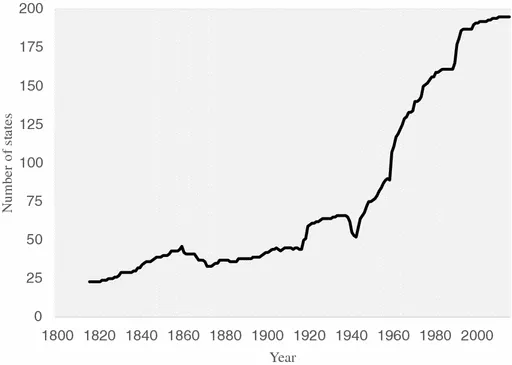
A clear trend in the international state system during the last 200 years is the increasing number of states. As Fig. 1.1 illustrates, in 1816, the international state system consisted of 25 states. One hundred years later, after a period when the nation-states replaced emperies and city-states (Wimmer and Feinstein 2010), the number of states had doubled to 50 states. However, since the end of the First World War, the international state system has expanded, and today it has almost 200 states as members. The number of states has increased in four waves (Coggins 2014; Gleditsch and Ward 1999; Griffiths 2016; Griffiths and Butcher 2013). The first wave occurred after the First World War when the dissolution of empires (Habsburg, Ottoman, and Tsar-Russian empires) created new states. Before this period, the emergence of new states was more rare and state deaths more common when states dissolved after annexation, conquest, and occupation after they acted as buffers between two rivals (Fazal 2004, 2011).1 A second wave occurred immediately after the Second World War, when the allies reinstated previous occupied states and started decolonization in some cases. However, most colonies become independent states during the third wave that occurred more gradually from the 1940s to 1980. Mostly British and French colonies, but also Dutch, Belgian, and Portuguese colonies, became independent during this period. Finally, the more than 20 states that the collapse of the Soviet Union and Yugoslavia created constitute the main part of the fourth wave. These events reshaped the international state system during a few years, and some of the states that emerged in the first wave raised again after decades as part of the communist federations. As Coggins (2014) and Griffiths (2015) conclude in their studies, this creation of new states during two centuries has not only transformed and fragmentized the international state system but also influenced the social and political life in several countries. The creation of new states has shaped the lives of generations and restructured societies in ways that affect contemporary politics.
Fig. 1.1
The number of states in the international state system 1816–2016
The emergence of new states is the outcome of processes. Although the increase of new states has been a significant development at the global level, we lack a systematic classification of the processes that create new states, which this study refers to as state formation. Studies have described the development in the international state system (Coggins 2014; Gleditsch and Ward 1999; Griffiths 2015, 2016; Griffiths and Butcher 2013), examined state formation in single cases or small groups of cases (Pavković 2007; Premdas 1990), explained the struggle of independence movements (Cunningham 2014; Sorens 2012), and how states respond to demands for independence (Coggins 2014; Griffiths 2016). These studies have increased our knowledge about various aspects of independence movements and state formation. However, previous studies have not provided a systematic classification that describes how processes have created new state and that offers options to compare cases of state formation. Therefore, this book attempts to classify and compare state formations by answering the following question: In what ways have processes of state formation created new states?
This book aims to increase our knowledge about the processes that result in new states. To reach this aim, the book focuses on four objectives. First, the book presents a comparative framework to categorize the processes that create a new state. This categorization makes systematic comparisons of state formations possible. Second, based on the comparative framework, the book introduces a comparative database, which consists of materials that measure aspects of the comparative framework in 132 cases of state formation from 1946 to 2015. Third, the book presents classifications of the 132 cases of state formation. These classifications identify different paths to independence, which clarify how new states since 1946 have been created. Fourth, the book focuses also on the fact that the outcome of state formations —the establishment of a new state—includes the establishment of a political regime. The political regime at the time of independence is the initial regime of the new state. This study explores whether the democratization of initial regimes is connected to specific paths to independence as well as if the democratization of initial regimes affects the democratization in new states in the long term.
1.2 Perspectives on State Formation as a Process
To examine state formations since 1946, the study presents empirical analyses about the creation of new states based on a process-approach . According to this approach, state formation is a process consisting of social interactions between actors that together create new states. Based on conceptual inspiration from comparative system theory, we assume that actors convert political demands and support into political decisions and outputs through political interactions that constitute the political processes. According to this assumption, we regard state formation as a set of political interactions that convert different demands and support for independence into a new state. Furthermore, we assume that the political interactions have different functions in the processes and that we can divide the political interactions—at least on an analytical level—based on the functions they serve in the process. Based on these functions, we can also describe the state formation as a process with distinct phases that together create new states, where the phases represent interactions that fulfill specific functions in the process.
According to comparative system theory (Almond 1956, 1960; Almond and Powell 1966; Easton 1965), political processes start when actors articulate political demands or political support. The demands and support may concern political decisions, political structures, or political actors. For example, demands of independence concern the basic structures in political systems (the unit of the political system), while a voter who expresses support for a political candidate in an election exemplifies support for a political actor. Organizations or actors aggregate these political demands and support into political proposals, which become significant depending on the availability of resources or actors. This phase creates a political agenda with issues and proposals for solutions to the issues. In the next phase, actors decide which proposal will become a law or decision. When the actors reach a decision, the process needs to realize the decision by implementation; otherwise, the process will not produce an output (politics or policy). In sum, the comparative system theory assumes that the political processes consist of four main phases: articulation, aggregation, decision-making, and implementation. We assume that these phases also occur during state formation, which is an assumption that the next chapter develops further in a model of state formation as five phases: demand phase, response phase, reaction phase, decisive phase, and implementation phase .2
Although our process-based model with five phases is novel, previous research has also regarded state formation as a process with phases or stages, and the few studies that have focused on how processes create new states have presented a phase-approach that focuses on processes as phases (or stages). For example, Hechter (1992) introduced a framework that regards the processes as four phases: the development of regional identification, the creation of a regional organization, social support for secession, and the response of the host state to the demand of independence. James Wood (1981) presents another model of secession that emphasizes the dynamic interactions and the cumulative effects of conditions that may result in a new state. This model consists of five processual phases: (a) the prec...
Table of contents
Cover
Front Matter
1. Introduction
2. A Comparative Framework of State Formation
3. Paths to Independence
4. Paths to Independence and Democracy
5. The Legacy of Initial Regimes and Democratization in New States
6. Conclusion
Back Matter
Trusted by 375,005 students
Access to over 1.5 million titles for a fair monthly price.
Study more efficiently using our study tools.
Frequently asked questions
Yes, you can cancel anytime from the Subscription tab in your account settings on the Perlego website. Your subscription will stay active until the end of your current billing period. Learn how to cancel your subscription
No, books cannot be downloaded as external files, such as PDFs, for use outside of Perlego. However, you can download books within the Perlego app for offline reading on mobile or tablet. Learn how to download books offline
Perlego offers two plans: Essential and Complete
Essential is ideal for learners and professionals who enjoy exploring a wide range of subjects. Access the Essential Library with 800,000+ trusted titles and best-sellers across business, personal growth, and the humanities. Includes unlimited reading time and Standard Read Aloud voice.
Complete: Perfect for advanced learners and researchers needing full, unrestricted access. Unlock 1.5M+ books across hundreds of subjects, including academic and specialized titles. The Complete Plan also includes advanced features like Premium Read Aloud and Research Assistant.
Both plans are available with monthly, semester, or annual billing cycles.
We are an online textbook subscription service, where you can get access to an entire online library for less than the price of a single book per month. With over 1.5 million books across 990+ topics, we’ve got you covered! Learn about our mission
Look out for the read-aloud symbol on your next book to see if you can listen to it. The read-aloud tool reads text aloud for you, highlighting the text as it is being read. You can pause it, speed it up and slow it down. Learn more about Read Aloud
Yes! You can use the Perlego app on both iOS and Android devices to read anytime, anywhere — even offline. Perfect for commutes or when you’re on the go. Please note we cannot support devices running on iOS 13 and Android 7 or earlier. Learn more about using the app
Yes, you can access State-Formation and Democratization by Thomas Denk,Sarah Lehtinen in PDF and/or ePUB format, as well as other popular books in Politica e relazioni internazionali & Politica comparata. We have over 1.5 million books available in our catalogue for you to explore.