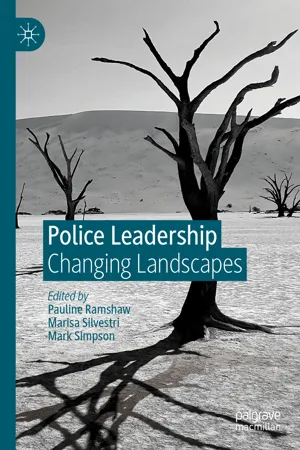
This book draws upon a range of theoretical and empirical research to explore contemporary debates about police leadership. Focusing upon leadership styles, ethics, integrity and professionalism, workforce diversity, legitimacy and accountability, it reviews the changing context and nature of leadership over time and explores the gains, losses, tensions and challenges that different leadership models bring to policing. Leadership is present at various levels within the police service and this collection reflects upon appropriate leadership qualities and requirements for different roles and at different ranks. The book also considers the difference between leadership and management in an attempt to capture fuller debates within police leadership. Part one surmises the contextual backdrop to current thinking and the primary challenges facing leadership in the police service. Part two highlights the changing face of leadership through an exploration of the call for greater diversity within the ranks of police leadership, and the final section examines police leadership beyond England and Wales. Through this, Police Leadership explores how the challenges facing police leadership in England and Wales share similarities with those in Scotland, Northern Ireland, Greece, North America, and Australia in the face of the pressures of political and economic uncertainty.
Crisis is a word that is all too familiar to police leaders. Indeed, viewed from the Chief’s office, policing must often seem to be permanently oscillating between periods of scandal or crisis and periodsof reform (Sherman 1978; Neyroud and Beckley 2001). On both sides of the Atlantic, the early twenty-first century has proved particularly challenging for the institution of policing. In the USA, Rosenbaum has argued that “policing is facing a major crisis of legitimacy”, characterised by the disproportionate use of lethal force and over policing of Black communities (2016, p. 1). In the UK, in a different context, framed by a decade of stringent fiscal austerity, “the current situation—with the police facing rising demand alongside shrinking budgets—risks creating a crisis of legitimacy for policing” (Hadjipavlou et al. 2018, p. 3). For the USA, police leadership has been faced with the reform of the core strategies and tactics deployed in frontline policing. For the UK, the central challenge is how to ration police services, whilst at the same time meeting the increasing expectations for public protection and preventing rising levels of violent crime.
The police leadership within the UK or the USA is not alone in the twenty-first century in facing what are fundamentally existential challenges about the nature and effectiveness of public policing. Post the 9/11 terrorist attack, a combination of a heightened terrorist threat, the impact of globalisation and the internet on transnational organised crime and cyber-enabled crime have faced police forces across the world with a need to commit increasing resources to terrorism, organised crime and cybercrime (College of Policing 2015). Added to this, the police have faced increased demands to tackle domestic abuse, investigate sexual crimes for “public safety, welfare and the protection of the vulnerable” (Hadjipavlou et al. 2018, p. 8).
The effect of these combined pressures has been to squeeze the resources available for 24-hour response, volume crime investigation and local patrol or community policing (HMICFRS 2018) for the UK and to reconsider proactive not to say aggressive, enforcement strategies such as stop and search that had been reined back, because of political pressures and concerns about the impact on legitimacy (Meares and Neyroud 2015).
This chapter focuses on the implications of these dilemmas for the approach and philosophy of police leadership. In particular, given the stark ethical choices posed for the priorities, style, strategies and tactics of policing, we will explore the extent to which an ethical leadership approach might be appropriate or fitted for the future. The chapter will start by setting out the developing literature on ethical leadership. There has been much discussion about transformational and transactional leadership in policing (Cockcroft 2014), but relatively little around ethical leadership. Whilst there has been extensive debate about police ethics, this has tended to focus on corruption and misconduct rather more than normative frameworks for leadership. On the other hand, there has also been a growing debate about a new professional model for policing, framed by ethics and supported by evidence-basedpractices (Neyroud and Sherman 2012). The chapter will seek to overview and compare these two strands of police literature to ethical leadership before exploring the emerging themes through the debate over the most controversial of all police tactics—stop and search or stop and frisk.
Ethical Leadership
Although not extensively explored in policing, Bedi et al. (2014) found nearly 150 studies for their meta-analysis of ethical leadership. Their study relied on the ethical leadership scale (ELS) developed by Brown and Trevino (2006). This, in turn drew on the most widely accepted definition of ethical leadership which had been set out earlier by Brown et al. (2005, p. 120):
the demonstration of normatively appropriate conduct through personal actions and interpersonal relationships and the promotion of such conduct to followers through two-way communication, reinforcement and decision-making.
Brown and Trevino (2006) argued that this new model is important and distinctive because although leadership researchers were agreed on the importance of ethical behaviour, none of the previous models—transformational, authentic, servant or spiritual—could provide a convincing explanation for the mechanisms linking ethical leadership behaviour with follower behaviour. Brown and Trevino proposed that a combination of social learning theory (Bandura 1977) and social exchange theory (Blau 1964) could provide such an explanation. In respect of the former, Bandura (1977) argued that people learn the norms of appropriate behaviour by a combination of experience and observation, particularly of key role models. Brown and Trevino (2006) suggest that ethical leaders who exhibit high standards of integrity may provide particularly compelling and motivational exemplars. In the second half of the model, they suggested that this is combined with social exchange theory which proposes that the leader’s care for followers is reciprocated by loyalty and trust (Blau 1964).
Brown and Trevino’s hypotheses are given support by Bedi et al. (2014), who found that, across the studies they analysed, ethical leadership was associated with increased job satisfaction and psychological well-being. It also appeared to be linked to positive attitudes towards the leadership. On the other hand, they found that ethical leadership presented substantial overlaps with concepts central to both transactionalandtransformational leadership. In particular, they highlighted the overlap withtransformational leadership’s emphasis on idealised influence and a very similar focus on followers. However, Bedi et al. (2014) drew primarily on studies using surveys of those that were being led. Therefore, they explored ethical leadership primarily from a follower rather than an organisational perspective. This tended to neglect one key aspect of ethical leadership: the process and nature of decision-making. If there is a distinctive core to ethical leadership compared to other leadership styles, Heres and Lasthuizen (2012) suggest that the core objective of ethical leadership is to “cultivate ethical decision-making and behaviour among followers” (p. 442). They identified that ethical leadership was also context specific with significant differences between the private and public sector respondents’ views and their public service motivation. Heres and Lasthuizen’s study appears to mirror the direction that debates and research evidence around police ethical practice have been following.
Police Ethics, Legitimacy and Decision-Making
Since the Patten report (1999) recommended the introduction of a Code of Ethics for the new Police Service of Northern Ireland, there has been increased interest in police ethics and their application to police practice in the UK. Patten’s proposals linked a Code of Ethics to training and oversight with a view to supporting behavioural change in favour of a more consistent implementation of human rights standards. From an analysis of the reports of the oversight bodies, Fallon concluded that “the Code is effective, in that police are given an outline for procedure and a constant reminder of their duty to uphold human rights for all” (p. 111) but added the caveat that this was dependent on a continuing attention to training and ethical leadership.
Drawing on the Patten report, the Neyroud Review (2011) recommended that a Code of Ethics should be developed and implemented in England and Wales as part of a wider reform of the police service. Central to this, moving beyond Patten’s specific focus on human rights compliance, was the adoption of a new professional framework for policing, including the creation of a professional body for policing; a new professional qualification for entry to policing; and an evidence-based approach to professional standards of practice, tactics and strategy.
For the new professional body that emerged from the Neyroud Review recommendations, the College of Policing, securing agreement for a Code of Ethics was an early priority. In order to operationalise the Code, the College also adopted and developed for general use, a National Decision Model (NDM) (College of Policing 2018). The latter had originally been developed for decision-making in fast-time operational use of force scenarios. The College of Policing, broadening the application to operational and strategic decision-making in general, declared that:
The model has at its centre the Code of Ethics, as the touchstone for all decision making. Using the model encourages officers and staff to act in accordance with the Code and use their discretion where appropriate. College of Policing (2018, p. 1)
As in Brown and Trevino’s model of ethical leadership, the College of Policing, in setting out its NDM (Fig. 1.1), asserted an explicit connection between ethical behaviours and ethical decision-making.
Fig. 1.1
The National Decision Model for policing in England and Wales (https://www.app.college.police.uk/app-content/national-decision-model/the-national-decision-model/)
To date, neither the effectiveness nor the operation of the NDM has been evaluated, nor, indeed, has the impact of the Code of Ethics. However, there is a growing body of international research on the connected and increasingly prominent area of police legitimacy. Much of this research has explored the extent to which procedural justice—the quality of decision-making procedures and the fairness in the way that citizens are treated by the police—can create the conditions for law abiding behaviour (Tyler 2003).
A broader conception of legitimacy has, as we have already set out, been used to describe the perceived crisis in USA and UK policing. Bottoms and Tankebe (2012) have provided a compelling argument that legitimacy needs to be framed beyond procedural justice.
Supporting this position, Skitka et al. (2008) have also argued that perceptions of outcome fairness and decision acceptance are shaped as much, if not more, by the aud...
Table of contents
Cover
Front Matter
Part I. Thinking Critically About Police Leadership
Part II. The Changing Face of Police Leadership: New Directions
Part III. Looking Beyond England and Wales
13. Postscript: Former Chief Constable Sara Thornton
Back Matter
Trusted by 375,005 students
Access to over 1.5 million titles for a fair monthly price.
Study more efficiently using our study tools.
Frequently asked questions
Yes, you can cancel anytime from the Subscription tab in your account settings on the Perlego website. Your subscription will stay active until the end of your current billing period. Learn how to cancel your subscription
No, books cannot be downloaded as external files, such as PDFs, for use outside of Perlego. However, you can download books within the Perlego app for offline reading on mobile or tablet. Learn how to download books offline
Perlego offers two plans: Essential and Complete
Essential is ideal for learners and professionals who enjoy exploring a wide range of subjects. Access the Essential Library with 800,000+ trusted titles and best-sellers across business, personal growth, and the humanities. Includes unlimited reading time and Standard Read Aloud voice.
Complete: Perfect for advanced learners and researchers needing full, unrestricted access. Unlock 1.5M+ books across hundreds of subjects, including academic and specialized titles. The Complete Plan also includes advanced features like Premium Read Aloud and Research Assistant.
Both plans are available with monthly, semester, or annual billing cycles.
We are an online textbook subscription service, where you can get access to an entire online library for less than the price of a single book per month. With over 1.5 million books across 990+ topics, we’ve got you covered! Learn about our mission
Look out for the read-aloud symbol on your next book to see if you can listen to it. The read-aloud tool reads text aloud for you, highlighting the text as it is being read. You can pause it, speed it up and slow it down. Learn more about Read Aloud
Yes! You can use the Perlego app on both iOS and Android devices to read anytime, anywhere — even offline. Perfect for commutes or when you’re on the go. Please note we cannot support devices running on iOS 13 and Android 7 or earlier. Learn more about using the app
Yes, you can access Police Leadership by Pauline Ramshaw, Marisa Silvestri, Mark Simpson, Pauline Ramshaw,Marisa Silvestri,Mark Simpson in PDF and/or ePUB format, as well as other popular books in Social Sciences & Business Strategy. We have over 1.5 million books available in our catalogue for you to explore.