eBook - ePub
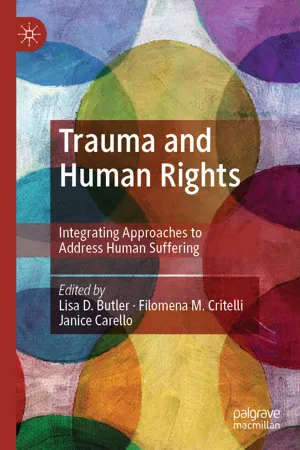
Trauma and Human Rights
Integrating Approaches to Address Human Suffering
- English
- ePUB (mobile friendly)
- Available on iOS & Android
eBook - ePub
Trauma and Human Rights
Integrating Approaches to Address Human Suffering
About this book
Human rights violations and traumatic events often comingle in victims' experiences; however, the human rights framework and trauma theory are rarely deployed together to illuminate such experiences. This edited volume explores the intersection of trauma and human rights by presenting the development and current status of each of these frameworks, examining traumatic experiences and human rights violations across a range of populations and describing efforts to remediate them. Individual chapters address these topics among Native Americans, African Americans, children, women, lesbian/gay/bisexual/transgender individuals, those with mental disabilities, refugees and asylees, and older adults, and also in the context of social policy and truth and reconciliation commissions. The authors demonstrate that the trauma and human rights frameworks each contribute invaluable and complementary insights, and that their integration can help us fully appreciate and address human suffering at both individual and collective levels.
Information
© The Author(s) 2019
Lisa D. Butler, Filomena M. Critelli and Janice Carello (eds.)Trauma and Human Rights https://doi.org/10.1007/978-3-030-16395-2_11. Introduction to Trauma and Human Rights: Context and Content
Janice Carello1 , Lisa D. Butler2 and Filomena M. Critelli2
(1)
Department of Social Work, Edinboro University, Edinboro, PA, USA
(2)
School of Social Work, University at Buffalo, Buffalo, NY, USA
The impulse to save the world is both grandiose and mundane. Odds are, as a person reading this book, you are someone who strives to make a positive difference in the world and to do what you can to help alleviate human suffering. It is obviously unrealistic to believe that we, as individuals, possess the power to save the world, but it is fatalistic—for ourselves and our species—to believe that we, as individuals, are powerless. Needless to say, humans are capable of committing atrocities. This book will not disconfirm that fact. Hopefully, though, it will reaffirm what is also true but seems hard to discern sometimes: that humans are capable of great compassion and that they can and do accomplish remarkable things when they work collaboratively.
In her seminal text, Trauma and Recovery , Judith Herman (1997) observed:
Psychological trauma is an affliction of the powerless. At the moment of trauma, the victim is rendered helpless by overwhelming force. When the force is that of nature, we speak of disasters. When the force is that of other human beings, we speak of atrocities. Traumatic events overwhelm the ordinary systems of care that give people a sense of control, connection, and meaning. (p. 33)
In many ways, the wellspring of the twentieth-century movements to delineate and affirm universal human rights and to grasp and remedy the lingering effects of traumatic experience has been the compassion of those deeply unsettled by the suffering they saw throughout much of that and previous centuries. Emergent understandings of the causes and consequences of warfare, colonial expansion, tribalism, bigotry, and oppressive social conditions—and of the suffering they create—amplified these traditions into separate frameworks: the human rights framework and the trauma framework . As described in Chapter 2 (Butler & Critelli, this volume), the human rights framework codifies the conditions necessary to promote and ensure dignity, fairness, respect, diversity, and equality among humans, while the trauma framework offers a vocabulary and methodology for describing aspects of human suffering and approaches to intervene in that suffering. More recent observations by those intervening with victims of trauma have prompted a paradigm shift in the general approach to treatment of trauma-related conditions, that being: trauma-informed care (TIC; Harris & Fallot, 2001) and principles to guide its implementation (Fallot & Harris, 2009). This volume seeks to weave these three conceptual strands into a fabric of understanding that can help to illuminate and inform professional approaches with a variety of populations and across multiple settings and levels of practice.
In the first sections of the present chapter, we introduce the concepts of the trauma and human rights (THR) frameworks and then trace the origins of TIC for readers who may be unfamiliar with the concept or the movement toward integration of trauma-informed approaches in behavioral health, child welfare, and educational settings. Following that, we describe the book’s origins as background for the chapters that follow by introducing the context in which the book was conceived. These sections are followed by a description of how the book is organized and the book’s goals.
Trauma-Informed Care: At the Intersection of Trauma and Human Rights
As Becker-Blease (2017) points out, “the term trauma-informed is trending” (p. 131). A quick Google search will produce millions of results. Despite the growing popularity of the term, however, many people—including trauma educators, researchers, and therapists—have not developed a clear understanding of what it means to be trauma-informed and often conflate TIC with trauma-specific services. To be trauma-informed in any context means to understand the ways in which violence, victimization, and other forms of trauma have affected individuals, families, and communities, and also to use that understanding to implement practices and policies that seek to prevent further harm and to promote healing and recovery (Harris & Fallot, 2001). In other words, TIC means accommodating individual trauma through changes in approach at both the client and the system levels.
It is important to remember that TIC differs from trauma-specific services in that the former refers to direct service and an organizational change process built on a set of principles (Bowen & Murshid, 2016), while the latter refers to individual and group interventions designed to directly treat symptoms and syndromes resulting from trauma exposure (Harris & Fallot, 2001). Examples of trauma-specific services include trauma-focused cognitive behavioral therapy (TF-CBT; Cohen, Mannarino, & Deblinger, 2006), cognitive processing therapy (CPT; APA, 2017), eye-movement desensitization reprocessing (EMDR; Shapiro, 1995), Progressive Counting (Greenwald, 2013), and Seeking Safety (Najavits, 2002). An organization can, therefore, be trauma-informed without providing trauma-specific services; likewise, an organization can provide trauma-specific services without being trauma-informed.
It is also important to remember that trauma-informed approaches were developed as an alternative to coercive medical models of service provision (Harris & Fallot, 2001); Lewis, Kusmaul, Elze, & Butler, 2016). These alternative models began to emerge in the late 1990s in response to the growing awareness of the prevalence and impact of trauma among consumers of behavioral health services. Sandra Bloom’s (1997) Creating Sanctuary: Toward the Evolution of Sane Societies explored the intergenerational effects of trauma on individuals and institutions and compelled us to start thinking about trauma as a public health issue. Maxine Harris and Roger Fallot’s (2001) seminal text, Using Trauma Theory to Design Service Systems , provided an argument for and concrete examples of how to integrate trauma theory into assessment and treatment policies and practices in order to avoid unintentional reproduction of abusive relationship dynamics that often bring individuals into treatment in the first place.
Around the same time that Harris and Fallot coined the term trauma-informed and Bloom began building the Sanctuary Model, the first findings of the groundbreaking Adverse Childhood Experiences (ACE) Study were published (Felitti et al., 1998), establishing links between childhood trauma and long-term social, emotional, and health problems in adulthood. The ACE Study also provided evidence that adverse experiences in childhood are not uncommon, as was widely believed. Another influential study from around the same time was the Women, Co-Occurring Disorders and Violence Study and Children’s Subset Study, which was sponsored by the Substance Abuse and Mental Health Services Administration (SAMHSA, 2007). The study implemented and evaluated numerous programs designed to help ...
Table of contents
- Cover
- Front Matter
- 1. Introduction to Trauma and Human Rights: Context and Content
- 2. Traumatic Experience, Human Rights Violations, and Their Intersection
- 3. Moving Toward Trauma-Informed and Human Rights-Based Social Policy: The Role of the Helping Professions
- 4. Enhancing Indigenous Well-Being: Applying Human Rights and Trauma-Informed Perspectives with Native Americans
- 5. Black Trauma in the US and the Pursuit of Human Rights: A Brief History
- 6. Children’s Experiences of Trauma and Human Rights Violations Around the World
- 7. Women, Trauma, and Human Rights
- 8. The Lives of Lesbian, Gay, Bisexual, and Transgender People: A Trauma-Informed and Human Rights Perspective
- 9. Mental Disability, Trauma, and Human Rights
- 10. Refugees and Asylum Seekers
- 11. The Interrelationship Between Aging, Trauma, and the End of Life
- 12. Truth and Reconciliation Commissions, Human Rights, and Trauma
- 13. Afterword: Human Rights and the Science of Suffering
- Back Matter
Trusted by 375,005 students
Access to over 1.5 million titles for a fair monthly price.
Study more efficiently using our study tools.
Frequently asked questions
Yes, you can cancel anytime from the Subscription tab in your account settings on the Perlego website. Your subscription will stay active until the end of your current billing period. Learn how to cancel your subscription
No, books cannot be downloaded as external files, such as PDFs, for use outside of Perlego. However, you can download books within the Perlego app for offline reading on mobile or tablet. Learn how to download books offline
Perlego offers two plans: Essential and Complete
- Essential is ideal for learners and professionals who enjoy exploring a wide range of subjects. Access the Essential Library with 800,000+ trusted titles and best-sellers across business, personal growth, and the humanities. Includes unlimited reading time and Standard Read Aloud voice.
- Complete: Perfect for advanced learners and researchers needing full, unrestricted access. Unlock 1.5M+ books across hundreds of subjects, including academic and specialized titles. The Complete Plan also includes advanced features like Premium Read Aloud and Research Assistant.
We are an online textbook subscription service, where you can get access to an entire online library for less than the price of a single book per month. With over 1.5 million books across 990+ topics, we’ve got you covered! Learn about our mission
Look out for the read-aloud symbol on your next book to see if you can listen to it. The read-aloud tool reads text aloud for you, highlighting the text as it is being read. You can pause it, speed it up and slow it down. Learn more about Read Aloud
Yes! You can use the Perlego app on both iOS and Android devices to read anytime, anywhere — even offline. Perfect for commutes or when you’re on the go.
Please note we cannot support devices running on iOS 13 and Android 7 or earlier. Learn more about using the app
Please note we cannot support devices running on iOS 13 and Android 7 or earlier. Learn more about using the app
Yes, you can access Trauma and Human Rights by Lisa D. Butler, Filomena M. Critelli, Janice Carello, Lisa D. Butler,Filomena M. Critelli,Janice Carello in PDF and/or ePUB format, as well as other popular books in Psychology & Civil Rights in Law. We have over 1.5 million books available in our catalogue for you to explore.