This book examines the role played by two popular private newspapers in the struggle for democracy in Zimbabwe, one case from colonial Rhodesia and the other from the post-colonial era. It argues that, operating under oppressive political regimes and in the dearth of credible opposition political parties or as a platform for opposition political parties, the African Daily News, between 1956-1964, and the Daily News, between 1999-2003, played an essential role in opening up spaces for political freedom in the country. Both newspapers were ultimately shut down by the respective government of the time. The newspapers allowed reading publics the opportunity to participate in politics by providing a daily analytical alternative, to that offered by the government and the state media, in relation to the respective political crises that unfolded in each of these periods. The book further examines both the information policies pursued by the different governments and the way these affected the functioning of private media in their quest to provide an "ideal" public sphere. It explores issues of ownership, funding and editorial policies in reference to each case and how these affected the production of news and issue coverage. It considers issues of class and geography in shaping public response. It also focuses on state reactions to the activities of these newspapers and how these, in turn, affected the activities of private media actors. Finally, it considers the cases together to consider the meanings of the closing down of these newspapers during the two eras under discussion and contributes to the debates about print media vis-à-vis the new forms of media that have come to the fore.
eBook - ePub
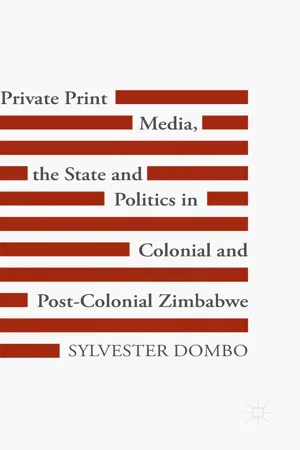
Private Print Media, the State and Politics in Colonial and Post-Colonial Zimbabwe
- English
- ePUB (mobile friendly)
- Available on iOS & Android
eBook - ePub
Private Print Media, the State and Politics in Colonial and Post-Colonial Zimbabwe
About this book
Information
© The Author(s) 2018
Sylvester DomboPrivate Print Media, the State and Politics in Colonial and Post-Colonial Zimbabwehttps://doi.org/10.1007/978-3-319-61890-6_11. Introduction
Sylvester Dombo1
(1)
Simon Muzenda School of Arts, Culture and Heritage Studies, Department of History, Archaeology and Development Studies, Mashava Campus, Great Zimbabwe University, Box 1235, Masvingo, Zimbabwe
This book takes a look at the lives, experiences and times of two privately owned daily newspapers in a southern African country to judge the relationship between the state and the private press in two different periods of political crisis. It focuses on the interface between the state and the private owned newspapers in colonial Rhodesia and post-independence Zimbabwe: the African Daily News (1956–1964) and the Daily News (1999–2003) respectively. The historical account presented helps to explain the lack of trust and a continued enmity between the state and the independent press, especially in situations where state legitimacy is questioned. It discusses the challenges of operating an independent press in a restrictive environment under both colonial and post-colonial regimes. Such challenges are, in the case of the African Daily News and the Daily News, closely related to the democratic aspirations of the country’s citizens. Broadly, this book analyses what happens to a newspaper when it resists and opposes state power, as well as the reasons behind such opposition, and what happens to state power when it suppresses the voice of the fourth estate. Such a study helps to round out historical understandings of the struggle for democracy
in Southern Rhodesia/Zimbabwe before and after independence respectively, and helps our understanding of how the media shapes and is shaped by the struggle. The two dailies, belonging to two distinct historical epochs, with seemingly differing aspirations, and operating with different business models and ownership structures, share the same fate: They got into serious troubles with the state which culminated in their closures.
In pre-independence Zimbabwe the African Daily News ran afoul of the colonial government, particularly under the premiership of Ian Smith
. Then in independent Zimbabwe, the Daily News was forced to close by Smith’s one-time nemesis and new head of state, Robert Mugabe. Through comparing the experiences of these newspapers, this thesis looks at the political debates that took centre-stage during the so called “multiple crisis” in Zimbabwean history.
1
Though in different periods, the crises the two newspapers experienced and presented were commonly centred on constitutionalism, the land issue, multi-partyism, segregation, popular actions by trade union organisations and, most importantly, political leadership in the country. Focusing on these issues extends our understanding of how democracy
is negotiated during the two epochs.
The book is divided into eleven chapters, the first one being this introduction. Chapter 2 looks at the impact of colonialism on the development of the press in Southern Rhodesia. Here we see the missionaries playing a pivotal role in setting up an African oriented press. It was this press that was later bought by African Newspapers Limited, a company formed in South Africa. This forms the subject of Chap. 3, where I argue that with better funding African newspapers
grew firstly from weeklies such as the
Native Mirror
,
Bantu Mirror
and
African Weekly
. These were published in English as well as the vernacular (Shona, Ndebele and even Chinyanja (a language from Malawi).
Chapters 4 and 5 focus on the African Daily News and its impact on both territorial and federal politics. It argues that when it started, the African Daily News as the sole daily newspaper for Africans was pro-established as it clashed trade unions and African middle class. It effectively supported the idea of federation
, looking down upon Africans as inexperienced politicians. This would change as the tide of nationalism rose in the country, coupled with the radicalisation of white politics. As a result, the newspaper became radical and a mouthpiece of African nationalism, a stance which resulted in its closure in 1964.
Chapter 6 looks at the developments within the press at independence up to 1999 when the Daily News was formed. It argues that during this period, the independent government effectively pursued developmental journalism whereby the press had to support the state in every endeavour. Chapters 7 and 8 discuss the impact of the Daily News on post-independent politics. It argues using case studies such as constitutional referendum, elections, violence
and the land question to show that the independent press had dropped all pretence to developmental journalism. It had taken a confrontational stance. As such, laws were crafted to curtail the activities of journalists and eventually, the press was bombed and closed down.
In Chap. 9 I compare the closures of these two newspapers and the reactions that followed. I argue that in spite of the harsh response from politicians, activists and the international community, the newspapers were shut down, effectively silencing all dissenting voices. However, there was a rise in the alternative press, which I discuss in Chap. 10. Pirate radios, online newspapers as well as underground newspapers attempted to fill the void left by the closure of the two newspapers. I conclude with Chap. 11 in which I discuss the impact of the press in politics. Although I argue that it is difficult to calculate this, I deploy a number of cases to show that indeed the press is necessary in a democracy
. As such I argue that it is necessary to safeguard and guarantee the freedom of the press.
Note
- 1Amanda Hammer and Brian Raftopoulos, Zimbabwe’s Unfinished Business: Rethinking Land, State and Nation in the Context of Crisis, Weaver Press, Harare, 2003.
© The Author(s) 2018
Sylvester DomboPrivate Print Media, the State and Politics in Colonial and Post-Colonial Zimbabwehttps://doi.org/10.1007/978-3-319-61890-6_22. Colonialism and the Development of the Press in Zimbabwe
Sylvester Dombo1
(1)
Simon Muzenda School of Arts, Culture and Heritage Studies, Department of History, Archaeology and Development Studies, Mashava Campus, Great Zimbabwe University, Box 1235, Masvingo, Zimbabwe
Abstract
This chapter traces the development of the press during the early days of colonialism up to the birth of the African Daily News. It acts as an overview to the factors that promoted or hindered the development of the press in the country. It argues that the development of the press in the country cannot be looked at in isolation with the growth of colonialism in the region. The main actors in colonialism are the same actors in the development of the press. This also in a way shows the motives of this press and its attitude to the Africans.
Introduction
This chapter maps out a history of the private press in colonial Rhodesia. It does this by identifying and elaborating four different phases and domains of activity in the development of the African press. The first phase was dominated by missionary press and a few newspapers the colonial government established. The second phase is contextualized by events in South Africa and was shaped by how major benefactors, Bertram and Cedric Paver, became involved in the press in Rhodesia by buying off government stake in early newspapers for Africans. I discuss their ideological groundings and modus operandi in South Africa, and how this influenced the organisation they were to run in Southern Rhodesia. The third phase focuses on the birth of African newspapers in Rhodesia in 1936, when the Paver Brothers purchased the weekly Native Mirror and renamed it the Bantu Mirror . This phase is important as it offers a rich background to the financiers of the newspapers, the political temperatures obtaining in the country that in the long run had a bearing on the performance of the Central African Daily News. Finally, the fourth phase identifies key personalities who helped transform African newspapers into a force with which to be reckoned. Prominent figures include the Paver brothers, journalists and editors like Lawrence Vambe, Jaspar Savanhu, Nathan Shamuyarira and Bill Saidi . These African journalists would, in a later period, also be vital agents in the country’s struggle for independence. How they shaped and were themselves shaped by African newspapers is a significant part of my account. The fourth phase was a period of consolidation and preparation towards the launch of a daily newspaper.
In all these phases I am interested in mapping out an overall understanding of how the private media shaped politics and how politics in turn shaped the media. I argue that the missionaries laid a strong foundation for the birth of an African press by encouraging Africans to attend schools that they had founded. This saw the emergence of Africans who were eager to read and write, and to consume and disseminate information about what was happening in a racially divided but nationalising geographical space. It was the missionaries in collaboration with the government in the late 1920s who started a newspaper specifically for Africans. The government offered an annual subsidy that contributed to expenses...
Table of contents
- Cover
- Frontmatter
- 1. Introduction
- 2. Colonialism and the Development of the Press in Zimbabwe
- 3. African Newspapers and the Development of the Private Press in Rhodesia
- 4. African Daily News and Early African Politics in Rhodesia
- 5. ‘We Are at a Political Crossroad’: Press and Politics in Rhodesia, 1958–1964
- 6. Press and Politics in Independent Zimbabwe to 1999
- 7. “Telling It Like It Is?”: The Daily News and Zimbabwean Political Crisis to 2000
- 8. ‘Uneasy Bedfellows’: The Daily News and The State 1999–2003
- 9. Predictable and Unavoidable: The Closure of the African Daily News and Daily News
- 10. The Rise of the Alternative Media
- 11. Press and Politics in Zimbabwe: Concluding Remarks
- Backmatter
Trusted by 375,005 students
Access to over 1.5 million titles for a fair monthly price.
Study more efficiently using our study tools.
Frequently asked questions
Yes, you can cancel anytime from the Subscription tab in your account settings on the Perlego website. Your subscription will stay active until the end of your current billing period. Learn how to cancel your subscription
No, books cannot be downloaded as external files, such as PDFs, for use outside of Perlego. However, you can download books within the Perlego app for offline reading on mobile or tablet. Learn how to download books offline
Perlego offers two plans: Essential and Complete
- Essential is ideal for learners and professionals who enjoy exploring a wide range of subjects. Access the Essential Library with 800,000+ trusted titles and best-sellers across business, personal growth, and the humanities. Includes unlimited reading time and Standard Read Aloud voice.
- Complete: Perfect for advanced learners and researchers needing full, unrestricted access. Unlock 1.5M+ books across hundreds of subjects, including academic and specialized titles. The Complete Plan also includes advanced features like Premium Read Aloud and Research Assistant.
We are an online textbook subscription service, where you can get access to an entire online library for less than the price of a single book per month. With over 1.5 million books across 990+ topics, we’ve got you covered! Learn about our mission
Look out for the read-aloud symbol on your next book to see if you can listen to it. The read-aloud tool reads text aloud for you, highlighting the text as it is being read. You can pause it, speed it up and slow it down. Learn more about Read Aloud
Yes! You can use the Perlego app on both iOS and Android devices to read anytime, anywhere — even offline. Perfect for commutes or when you’re on the go.
Please note we cannot support devices running on iOS 13 and Android 7 or earlier. Learn more about using the app
Please note we cannot support devices running on iOS 13 and Android 7 or earlier. Learn more about using the app
Yes, you can access Private Print Media, the State and Politics in Colonial and Post-Colonial Zimbabwe by Sylvester Dombo in PDF and/or ePUB format, as well as other popular books in Languages & Linguistics & Journalism. We have over 1.5 million books available in our catalogue for you to explore.