eBook - ePub
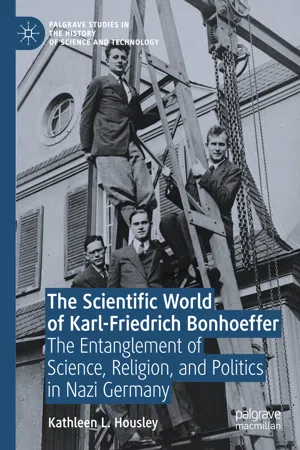
The Scientific World of Karl-Friedrich Bonhoeffer
The Entanglement of Science, Religion, and Politics in Nazi Germany
- English
- ePUB (mobile friendly)
- Available on iOS & Android
eBook - ePub
The Scientific World of Karl-Friedrich Bonhoeffer
The Entanglement of Science, Religion, and Politics in Nazi Germany
About this book
In twentieth-century Germany, Karl-Friedrich Bonhoeffer rose to prominence as a brilliant physical chemist, even as several of his relatives—Dietrich Bonhoeffer among them—became involved in the resistance to Hitler, leading to their executions. This book traces the entanglement of science, religion, and politics in the Third Reich and in the lives of Karl-Friedrich, his family and his colleagues, including Fritz Haber and Werner Heisenberg. Nominated for the Nobel Prize, Karl-Friedrich was an expert on heavy water, a component of the atomic bomb. During the war, he was caught in the middle between relatives who were trying to kill Hitler and friends who were helping Hitler build a nuclear weapon. Karl-Friedrich emerges as a complex figure—an agnostic whose brother was a renowned theologian, and a chemist who both reluctantly advised German nuclear scientists and collaborated with Paul Rosbaud, a spy for the British. Illuminating the uneasy position of science in twentieth-century Germany, The Scientific World of Karl-Friedrich Bonhoeffer is the story of a man in love with chemistry, his family, and his nation, trying to do right by all of them in the midst of chaos.
Information
© The Author(s) 2019
Kathleen L. HousleyThe Scientific World of Karl-Friedrich BonhoefferPalgrave Studies in the History of Science and Technologyhttps://doi.org/10.1007/978-3-319-95801-9_11. Introduction
Karl-Friedrich Bonhoeffer seemed to stand apart from his family’s intense resolve to bring the brutality of Nazism to an end. A distinguished scientist who was nominated five times for the Nobel Prize, he was chair of the department of physical chemistry at the University of Leipzig from 1934 until 1946. Besides being physically distant from the center of the resistance movement in Berlin, he was intellectually distant from his family due to the complexity of his research, combining the apparent insubstantiality of quantum mechanics with the substantiality of classical physics and chemistry. Few people had the requisite brilliance to understand his work other than his colleagues. What Karl-Friedrich shared with all the Bonhoeffers was the quality of being steadfast. After the war, using what strength he had left, he helped rebuild the shattered field of physical chemistry in Germany, brick by brick, element by element.
In quantum mechanics , the word entanglement means that while the states of particles are uncertain, nonetheless, there is a correlation even though the particles can be far apart. As Albert Einstein put it with incredulity, there is “spooky action at a distance.” Entanglement appears literally in Karl-Friedrich’s work on spin and anti-spin in hydrogen isotopes. Entanglement is also an apt metaphor for his life. No matter how remote he appeared from his family’s involvement in the resistance, he was not remote. Throughout the evidentiary record, there are photon flashes of his compassionate awareness. However, these can be easily missed in the steady glow of the light cast by his brother, Dietrich, whose powerful theological writings and death by hanging in Flossenbürg concentration camp led to his being proclaimed a Christian martyr.
For Karl-Friedrich, there was the world of pure science and then there was the rest of the world, but that does not mean the rest of the world was the lesser. In fact, he was very close to all his siblings with whom he corresponded frequently. An agnostic, he sometimes took issue with Dietrich’s theological views but never to the point of snapping their brotherly bond. During Dietrich’s incarceration in Tegel prison in Berlin, Karl-Friedrich wrote him warm letters, often accompanied by carefully selected books and food packages to supplement his sparse prison diet. In a letter dated May 30, 1943, less than two months after Dietrich’s arrest, Karl-Friedrich wrote from Leipzig that he had not yet told his children what had occurred, adding on a light note, “I think they consider me somewhat peculiar since I always ask for homemade cookies and candies when I travel to Berlin.”
In the catastrophic closing months of the war, when it was clear that his two brothers and two brothers-in-law would be executed along with many other friends and relatives, Karl-Friedrich tried desperately to visit them all in prison. At the same time, he was attempting to take care of his family, his brothers’ families, and his elderly parents—some of them burned out and bombed out, some scattered, all traumatized, especially the children. It is no surprise that Karl-Friedrich suffered a severe heart attack not long after the war ended. On meeting him after many years of separation, his sister Sabine, who was Dietrich’s twin, was astonished at the change in his appearance. “He had become very haggard, and as he looked at me, he had my mother’s eyes.” 1
Karl-Friedrich did not speak publicly about what had happened. He had no choice but to remain silent because in postwar Germany the Bonhoeffers were not considered heroes but traitors for attempting to kill Hitler, who was still venerated by many people. Eventually, Germany would grapple with the truth, but Karl-Friedrich would not live to see it. He died of a second heart attack in 1957.
Karl-Friedrich was aware of his family’s role in the resistance, although he did not know the degree. Besides Dietrich, his sister Christel and brother Klaus were involved as were his two brothers-in-law Hans Dohnanyi (married to Christel) and Rüdiger Schleicher (married to Ursula). In a letter to Sabine, who had gone into exile in England in 1938 because her husband was of Jewish descent, Karl-Friedrich wrote on August 3, 1945, that the family had received word of the executions of Dietrich, Klaus, and Rüdiger. The fate of Hans was still unknown, but Karl-Friedrich strongly suspected that he was dead as well. Then, Karl-Friedrich wrote movingly about the family’s involvement:
You can not imagine how much courage, prudence, caution and endurance was necessary, how often we all expected the imminent breakdown of this criminal tyranny. (I have since heard that no less than five attempts were made on Hitler’s life), or how often we were disappointed. Our parents were aware of what they were doing, approved of it, and gave them assistance. I believe there can have been very few families in Germany during the past twelve years in which there was such complete agreement on political matters, and there is no doubt that this spirit gave them strength to continue their plans. 2
Karl-Friedrich was also aware that some of his close scientific friends, including Werner Heisenberg, winner of the Nobel Prize for his seminal work on quantum mechanics, and Paul Harteck, who had worked with Karl-Friedrich on molecular hydrogen, were researching how to build an atomic bomb for Hitler. In fact, Karl-Friedrich’s research on heavy water during the 1930s had been a crucial precursor step to the work being carried out by the Uranium Club —a euphemism evoking a group of colleagues sharing schnapps after a productive day spent in the laboratory.
Eberhard Bethge, Dietrich Bonhoeffer’s friend and biographer, wrote that Karl-Friedrich “abandoned his earlier field of research into nuclear hydrogen, parahydrogen and heavy hydrogen in favour of electro-chemistry and the kinetics of electrode processes, in order to clarify the question of biological processes and basic electro-physical principles in nervous stimulation. He made this change so that he could avoid having to cooperate in the development of nuclear armaments.” 3 That is only partially correct. Bethge did not know that during the war Karl-Friedrich was consulted several times by members of the Uranium Club about issues pertaining to heavy water on which their bomb research was reliant. Karl-Friedrich tried to distance himself by shifting the focus of his research and deflecting questions. However, his position at the University of Leipzig as well as his friendships with the Uranium Club members meant that he was privy to top secret information.
It would appear that Karl-Friedrich found himself in a monstrous ethical dilemma, caught between men trying to kill Hitler and men trying to provide him with a weapon of mass destruction that would guarantee Nazi domination of the world, or what was left of it. Tottering between them, Karl-Friedrich chose a third way: What he knew about nuclear research, he passed on to Paul Rosbaud , a scientific advisor to the publisher Springer Verlag. Rosbaud was also a master spy for the British known by the code name The Griffin . Following the war, Rosbaud wrote in a letter to the American intelligence expert Samuel A. Goudsmit that Karl-Friedrich was not only his “ally” but also one of his “best friends.” 4 Lending credence to Karl-Friedrich’s passing on information to the British is a report written after the war by Franz (Francis) Simon to Michael Perrin , one of the leaders of the British atomic bomb program, in which he related a conversation with Karl-Friedrich on heavy water that undercut protestations of innocence by the members of the Uranium Club. 5 There are also letters written after the war to Karl-Friedrich from several exiled Jewish scientists. This was not a group disposed to compassion for their “Aryan” colleagues in Germany, no matter how dire their circumstances. Yet, they offered Karl-Friedrich help as the Soviet Union took over East Germany and the University of Leipzig disappeared behind the iron curtain. Despite the evidence that will be presented in this book, there is no certainty of Karl-Friedrich’s link to British espionage , one reason being that Britain’s Secret Intelligence Service (commonly known as MI6) has never released the World War II files of Paul Rosbaud . Another reason is that much was destroyed, pages were ripped out of diaries, codes were lost, material in archives disappeared.
To this must be added the significant problem of long-standing obfuscation. Many German scientists tried very hard for decades to obscure their roles in research that benefited the Nazis. They devised numerous stratagems to present themselves and their work in a positive light, for example, Werner Heizenberg’s oft-repeated claim that he was building an atomic reactor for civilian purposes, not a bomb. Probably, most notorious was the disingenuous argument that German scientists were more ethical than American scientists because they knew how to build an atomic bomb but did not do it, intentionally sabotaging the research, whereas the Americans pushed ahead, built the bombs, and dropped them on Japan. This would be a devastating argument if true. However, the Germans knew full well what they were doing and were committed to it. The reasons they failed have to do with the extreme difficulty of the science, lack of organizational unity, and insufficient financial resources—resources that were available in the USA but not in Germany. 6
Yet, another difficulty in unearthing the truth is almost too obvious to mention: People who were passing on secrets or who were part of the resistance had to appear other than who they were, even taking on the guise of Nazis when it was essential. Dietrich Bonhoeffer had to do that repeatedly and in different ways, for example, when he told Bethge to give the Heil Hitler salute when they were sitting in the garden of a cafe and the surrender of France was announced over the loudspeaker. As people cheered wildly, jumping up on the chairs, Dietrich raised his arm in the salute while Bethge sat there dazed. “Raise your arm! Are you crazy?” he whispered to Bethge , later telling him, “We shall have to run risks for very different things now, but not for that salute.” 7
The title The Scientific World of Karl-Friedrich Bonhoeffer: the Entanglement of Science, Religion, and Politics in Nazi Germany points to the book’s scope. This is not a straightforward biography of a single man. For example, Karl-Friedrich’s belief in pure science was shared by almost all his colleagues. Einstein described pure science as a temple unsullied by connections to home, culture, and politics, dedicated solely to the pursuit of objective knowledge. Karl Bonhoeffer, the patriarch of the family and one of the leading physicians in Germany, also believed in pure science, which led him to remain detached from the political problems swirling around him. To understand that belief, it is essential to look at the extreme changes in German science from its glory days at the beginning of the century to its utter degradation after 1933. By holding fast to pure science, German scientists became dangerously vulnerable to manipulation. Yet, some men were beginning to scrutinize the nature of scientific autonomy and the effects of governmental and ideological control—among them was Michael Polanyi, Karl-Friedrich’s colleague and close friend.
On one level, The Scientific World of Karl-Friedrich Bonhoeffer is the story of a compassionate man in love with chemistry, his family, and his nation, trying in the midst of chaos to do right by all of them. On another level, it raises ethical issues about the interaction of science, religion, and politics that are still relevant today. To tell that multi-level story requires me to step away from quantum mechanical entanglement and retur...
Table of contents
- Cover
- Front Matter
- 1. Introduction
- 2. The Father’s Scientific World
- 3. The First World War
- 4. The Promise of Pure Science
- 5. Traveling with Polanyi
- 6. Turbulence and Conformity
- 7. Seizing the Wheel
- 8. The Beginning of Resistance
- 9. Heavy Water and the Atomic Bomb
- 10. The Summer of Decision
- 11. The Uranium Club
- 12. Steadfast to the End
- 13. Rebuilding the World
- Back Matter
Trusted by 375,005 students
Access to over 1.5 million titles for a fair monthly price.
Study more efficiently using our study tools.
Frequently asked questions
Yes, you can cancel anytime from the Subscription tab in your account settings on the Perlego website. Your subscription will stay active until the end of your current billing period. Learn how to cancel your subscription
No, books cannot be downloaded as external files, such as PDFs, for use outside of Perlego. However, you can download books within the Perlego app for offline reading on mobile or tablet. Learn how to download books offline
Perlego offers two plans: Essential and Complete
- Essential is ideal for learners and professionals who enjoy exploring a wide range of subjects. Access the Essential Library with 800,000+ trusted titles and best-sellers across business, personal growth, and the humanities. Includes unlimited reading time and Standard Read Aloud voice.
- Complete: Perfect for advanced learners and researchers needing full, unrestricted access. Unlock 1.5M+ books across hundreds of subjects, including academic and specialized titles. The Complete Plan also includes advanced features like Premium Read Aloud and Research Assistant.
We are an online textbook subscription service, where you can get access to an entire online library for less than the price of a single book per month. With over 1.5 million books across 990+ topics, we’ve got you covered! Learn about our mission
Look out for the read-aloud symbol on your next book to see if you can listen to it. The read-aloud tool reads text aloud for you, highlighting the text as it is being read. You can pause it, speed it up and slow it down. Learn more about Read Aloud
Yes! You can use the Perlego app on both iOS and Android devices to read anytime, anywhere — even offline. Perfect for commutes or when you’re on the go.
Please note we cannot support devices running on iOS 13 and Android 7 or earlier. Learn more about using the app
Please note we cannot support devices running on iOS 13 and Android 7 or earlier. Learn more about using the app
Yes, you can access The Scientific World of Karl-Friedrich Bonhoeffer by Kathleen L. Housley in PDF and/or ePUB format, as well as other popular books in History & European History. We have over 1.5 million books available in our catalogue for you to explore.