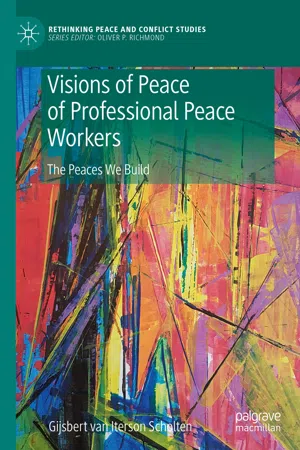
This book explores the meaning of peace according to (some of) the people who make it. Based on some 200 interviews, it empirically studies the visions of peace that professional peaceworkers from the Netherlands, Lebanon and Mindanao (Philippines) are working on. As such, it seeks to add a strong empirical element to the debate on liberal peacebuilding. The main argument of the book is that amongst practitioners, there is no liberal peace consensus at all. Rather, peace professionals work on a distinct set of peaces, that differ along four dimensions. In five case study chapters, the operational visions of peace held by Dutch military officers, diplomats and civil society peace workers, as well as civil society peace workers from Lebanon and the Philippines are explored and compared to each other. Differences are observed along both geographical and professional lines, but also within each group.
eBook - ePub
Visions of Peace of Professional Peace Workers
The Peaces We Build
- English
- ePUB (mobile friendly)
- Available on iOS & Android
eBook - ePub
About this book
Information
© The Author(s) 2020
G. M. van Iterson ScholtenVisions of Peace of Professional Peace WorkersRethinking Peace and Conflict Studieshttps://doi.org/10.1007/978-3-030-27975-2_11. Introduction
Gijsbert M. van Iterson Scholten1
(1)
University of Amsterdam, Amsterdam, The Netherlands
I was working for peace before I knew it had a name. It was just a work to make things fair, to make things just. But then all of a sudden I was a peaceworker, or a peace ‘advocate’. And now everyone comes up with their own definitions of peace. And then they argue over them.
(Interview Aveen Acuña-Gulo (independent peacebuilding consultant, Mindanao))
End AbstractThere have always been people, like the Filipino peace advocate quoted above, working ‘for peace’, without giving it much thought.1 Some incidentally: participating in a rally, signing a petition or, in our present media age, expressing solidarity with the victims of armed conflict through social media. Others are more structurally engaged, including many who could be called professional peace workers. They work for civil society organizations (CSOs), for intergovernmental organizations or for national governments, either as civil servants or—though some other peace workers might dispute this—as members of the armed forces.
With this professional engagement, a new set of questions arises. The question is no longer simply what one can do to ‘make things fair’, but rather what should be the mission of my organization, how can we most effectively contribute to peace and how do we delimit our activities from what other actors do? Demonstrating against an imminent war or signing a petition not to sell arms to a country engaged in civil war are small but undeniable acts of peace. But what about projects aimed at spreading awareness of human rights? Projects supporting sustainable development? Environmental awareness programmes? Calling for humanitarian intervention? Organizing or supervising elections? Organizing elections in which nationalist or fundamentalist candidates are also allowed to run? The lines between working for peace and working for development, human rights or even against peace can become blurred.
In a case study of Nicaraguan peace commissions, French peace researcher Cécile Mouly describes how they changed their activities from the protection of civilians during the war to disarmament and demobilization after the signing of a peace agreement, then to human rights and conflict resolution workshops, and finally to development activities and environmental protection, all still under the heading of working ‘for peace’ (Mouly 2013: 51–55).
In itself, the question whether or not these activities contribute to ‘peace’ might seem rather academic. There is an apparent demand for those activities, and the ‘peace commissions’ are just organizations that are there and can meet that demand. Why should we care whether what they do is called peace work, development work or simply ‘work’?
There are three reasons we should. First of all, the very tactic of shifting the focus of one’s activities leads to complaints that CSOs are donor-driven, opportunistic or part of a ‘peacebuilding industry’ that merely serves its own interest, rather than contributing to peace (Zaidi 1999: 263; Fisher and Zimina 2008; Jad 2007: 628). The strongest version of this critique is that ‘peacebuilding does not build peace’ (Denskus 2007). Whether or not this is true, partly depends on what exactly one means by ‘peace’. If peace includes living in harmony with the natural environment,2 working on environmental protection is definitely a contribution to peace.3 This means that for their own legitimacy organizations will need to develop some vision on the kind of peace they are working on and how their activities contribute to that.
Secondly, different organizations, but also different kinds of peacebuilders (e.g. local and international ones) sometimes have to cooperate to achieve their long-term goals (i.e. peace). Lacking a shared vision on what constitutes peace, or, perhaps even worse, failing to have an open discussion on what they think constitutes peace and thus assuming that the other has a similar vision, makes this cooperation much more difficult. From my own experience as a civil society peace worker, I noticed how difficult it was to cooperate with other Dutch CSOs working on the Israeli-Palestinian conflict. Half of them did not agree with the visions of peace of the other half, and accusations of ‘legitimizing the occupation’ or ‘funding terrorist organizations’ were a regular part of the discussions. Similar problems of working on different goals might occur when pursuing a ‘comprehensive approach’ in peacebuilding missions, where national armies have to cooperate with diplomats and local or international CSOs (see e.g. De Coning and Friis 2011; van der Lijn 2015).
Finally, there are calls to improve the effectiveness of peace work (Fortna 2008; Anderson and Olson 2003: 8–10; Paris 2004; Tardy 2017; Diehl and Druckman 2010). However, as the introduction to a practitioners’ evaluation of civil society peacebuilding efforts points out, ‘to talk about improving effectiveness, we need first to know where we want to get’ (Anderson and Olson 2003: 11). Different definitions of what peace is will lead to different evaluations of the success of (international) efforts to promote it (Newman 2009: 27; see also Paris 2010: 247). By explicitly researching where peace workers ‘want to get’, as this study aims to do, the literature evaluating their efforts stands to gain a much more nuanced set of concepts to judge various kinds of peacebuilding by their own standards.
The topic of ‘where we want to get’, or what the different visions of peace are that professional peace workers subscribe to, is an understudied area in peace studies. Although it is widely recognized that peace means different things to different people, often only very little attention is given to the exact nature of the differences. For instance, in Thania Paffenholz’s seminal edited volume on civil society and peacebuilding (Paffenholz 2010), almost every case study mentions that different actors in the case have a different idea of what constitutes peace. However, only a few of the studies go into any detail about what these differences exactly are (Kurtenbach 2010: 88; Belloni 2010: 109; Belloni and Hemmer 2010: 134; Çelik 2010: 155–156; Çuhadar and Kotelis 2010: 183; Çuhadar and Hanafi 2010: 209; Borchgrevink and Harpviken 2010: 238; Orjuela 2010: 297–298).
Not that the academic community is not interested in peace ‘as a phenomenon in and of itself’ (Rasmussen 2010: 177). Recent years have seen an increase in attention for peace that is more than just the absence of violent conflict (e.g. Höglund and Kovacs 2010; Kühn 2012; Regan 2014; Diehl 2016). This renewed interest in what Johan Galtung once labelled ‘positive peace’ (Galtung 1964, 1969) has enriched the academic literature on peace with concepts like ‘liberal peace’ (Richmond 2006) ‘hybrid peace’ (Mac Ginty 2011) ‘post-liberal peace’ (Richmond 2011) ‘quality peace’ (Wallensteen 2015a) ‘agonistic peace’ (Shinko 2008; Aggestam et al. 2015) ‘everyday peace’ (Mac Ginty 2014; Berents and McEvoy-Levy 2015; Firchow 2018) and, most recently, ‘sustaining peace’ (De Coning 2018b; Tschirgi and De Coning 2018; Advisory Group of Experts 2015; Mahmoud and Makoond 2017).
All of these concepts somehow try to convey the message that ‘peace’ is not one single self-evident objective, but that it needs some qualification. Even though it is a word that does not have a plural (though Dietrich and Sützl 1997: argue that it should), apparently there are many kinds of peace that national and international actors (try to) bring about. The ensuing academic debate is mostly concerned with which of these concepts is best suited to describe the situation in ‘post-conflict’ countries.4 None of these concepts is entirely without merit, but it is not always clear how they relate to peacebuilding practice and the self-images of peace workers, either in conflict areas or in the global West. Various authors have, for example, pointed out that the concept of liberal peace might be no more than a ‘fictional policy narrative’ created by critical academics but bearing little relation to actual policy practice (Chandler 2010: 138; Selby 2013: 58–59; Heathershaw 2013: 275–276).5
This study seeks to explicitly make that connection. Rather than adding yet another qualified concept of peace to the academic debate, it inductively explores the concepts, or visions, of peace that professional peace workers themselves say they are working on. Studying these peaces adds an empirical dimension to the, often rather normative, debates on what constitutes peace and thus whether or not (inter...
Table of contents
- Cover
- Front Matter
- 1. Introduction
- 2. Peace in Peace Studies: Beyond the ‘Negative/Positive’ Divide
- 3. Western Dissensus, Non-Western Consensus: A Q Study Into the Meanings of Peace
- 4. Military Visions of Peace
- 5. Diplomats: Peace as Governance
- 6. Dutch Civil Society: Peace Writ Large
- 7. Lebanon: Civil Peace
- 8. Mindanao: Justice, Harmony and Peace of Mind
- 9. Conclusion: Visions, Divisions, Tensions and Solutions
- Back Matter
Trusted by 375,005 students
Access to over 1.5 million titles for a fair monthly price.
Study more efficiently using our study tools.
Frequently asked questions
Yes, you can cancel anytime from the Subscription tab in your account settings on the Perlego website. Your subscription will stay active until the end of your current billing period. Learn how to cancel your subscription
No, books cannot be downloaded as external files, such as PDFs, for use outside of Perlego. However, you can download books within the Perlego app for offline reading on mobile or tablet. Learn how to download books offline
Perlego offers two plans: Essential and Complete
- Essential is ideal for learners and professionals who enjoy exploring a wide range of subjects. Access the Essential Library with 800,000+ trusted titles and best-sellers across business, personal growth, and the humanities. Includes unlimited reading time and Standard Read Aloud voice.
- Complete: Perfect for advanced learners and researchers needing full, unrestricted access. Unlock 1.5M+ books across hundreds of subjects, including academic and specialized titles. The Complete Plan also includes advanced features like Premium Read Aloud and Research Assistant.
We are an online textbook subscription service, where you can get access to an entire online library for less than the price of a single book per month. With over 1.5 million books across 990+ topics, we’ve got you covered! Learn about our mission
Look out for the read-aloud symbol on your next book to see if you can listen to it. The read-aloud tool reads text aloud for you, highlighting the text as it is being read. You can pause it, speed it up and slow it down. Learn more about Read Aloud
Yes! You can use the Perlego app on both iOS and Android devices to read anytime, anywhere — even offline. Perfect for commutes or when you’re on the go.
Please note we cannot support devices running on iOS 13 and Android 7 or earlier. Learn more about using the app
Please note we cannot support devices running on iOS 13 and Android 7 or earlier. Learn more about using the app
Yes, you can access Visions of Peace of Professional Peace Workers by Gijsbert M. van Iterson Scholten in PDF and/or ePUB format, as well as other popular books in Politics & International Relations & Diplomacy & Treaties. We have over 1.5 million books available in our catalogue for you to explore.