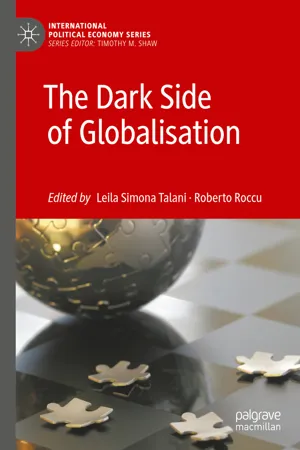
Firmly rooted in the International Political Economy (IPE) tradition, this book addresses the negative consequences of globalisation, what is termed here the 'dark side of globalisation'. It explores different definitions of globalisation, whether the globalisation we have seen since the 1970s is substantially new, and to what extent it can be governed. Building on these foundations, the work assesses the prospects for de-globalisation. By focusing on this dark side of globalistion, the authors show how the global economic crisis, and its various local and sectorial manifestations, intensified – rather than generated – existing trends. This scholarship provides an account of the current predicament that is both more complex and more persuasive than the opposition between globalisation and de-globalisation.
eBook - ePub
The Dark Side of Globalisation
- English
- ePUB (mobile friendly)
- Available on iOS & Android
eBook - ePub
The Dark Side of Globalisation
About this book
Information
© The Author(s) 2019
Leila Simona Talani and Roberto Roccu (eds.)The Dark Side of GlobalisationInternational Political Economy Serieshttps://doi.org/10.1007/978-3-030-05117-4_11. Introduction: The Globalisation Debate—From De-Globalisation to the Dark Side of Globalisation
Roberto Roccu1 and Leila Simona Talani1
(1)
King’s College London, London, UK
Gone are the days when globalisation was almost universally heralded as an economic and social flattener (Friedman 2005), ushering in a “borderless world” (Ohmae 1991) and becoming the ultimate signifier of progress (Friedman 1999). Following the long tail of the global financial and economic crisis of 2007–2008, globalisation is increasingly targeted as part of the problem by supposedly anti-establishment figures of all stripes. Major electoral shocks in the advanced countries, most notably with reference to Brexit following the result of the EU membership referendum in the United Kingdom and Trump’s victory in the 2016 US presidential elections, have been interpreted as part of a backlash against globalisation (Barbieri 2016; James 2017). These authors appear worried that we may be past “peak globalisation”, as witnessed by the inability of financial flows to reach the pre-2008 levels and by trade growth being outpaced by production growth in 2014 for the first time since World War II. Some commentary has even focused on the possibility of de-globalisation (Kaminska 2015), that is, a rolling back of the trends towards integration that have characterised the global economy over the past half-century.
Firmly rooted in the International Political Economy (IPE) tradition, this book takes a different view in addressing the question of the negative consequences of globalisation, what is termed “the dark side of globalisation”. Directly answering those authors pointing out the vagueness with which globalisation is often used (Rosenberg 2005), engagement with IPE debates enables us to discuss different definitions of globalisation, whether the globalisation we have seen since the 1970s is substantially new, and to what extent it can be governed. Building on these foundations, it will be easier for us to address current discussions on the prospects for de-globalisation.
To forefront our key argument, this book adopts a transnationalist approach, which provides a qualitative definition of globalisation (Dicken 2003; Overbeek 2000; Talani 2014; Mittelman 2000). According to this tradition, globalisation is characterised by structural transformations deriving from technological innovations that are to a large extent external to human agency, and indeed tend to shape it. As a result, globalisation might be put into question or might disappear only if the technological transformations underpinning it are reversed or repurposed. Based on these considerations, this edited volume discards the view that the world economy might be experiencing sustained de-globalisation, insofar as many of the technological innovations brought about by globalisation have not been rolled back.
Importantly, the transnationalist approach has another defining feature, which is crucial for the way in which the dark side of globalisation is understood in this volume. Globalisation is not only seen as technologically driven, but also as a highly uneven process, which creates geographical marginalisation and social inequalities (Talani 2014). This uneven and unequal nature of globalisation suggests that it is a Janus-faced process, where advancements brought about by greater integration have always gone side by side with negative consequences. By focusing on this dark side of globalisation and showing how the global economic crisis, and its various local and sectorial manifestations, only intensified—rather than generated—existing trends, this book provides an account of the current predicament that is both more complex and more persuasive than the opposition between globalisation and de-globalisation.
The negative consequences of globalisation addressed in this volume range from extreme forms of exploitation in the labour market (see Rolf on China in the context of post-crisis economic rebalancing, Chap. 3) to the marginalisation of some regions which produce mass migration of an irregular nature (see Rosina on deterrence, Chap. 4, and Talani on the underground economy, Chap. 7) or exacerbate food crises through interaction with trends in finance (see Baines and Ravensbergen, Chap. 2). Such marginalisation is not only characteristic of the Global South but increasingly interests also the periphery of Europe (see Fouskas on Greece, Chap. 6). Finally, the highly technological content of this definition of globalisation impacts also on the modalities of action of organised crime, more and more global in nature although keeping its local roots (see Sergi on ‘ndrangheta, Chap. 5, and Strazzari on state formation, Chap. 8).
Coming to Terms with Globalisation
The notion of globalisation is not without controversy both within the academic debate and in the wider public discourse. Despite the great success of this concept in recent decades, there is still some degree of confusion about its definition, and the discussion is still open about precisely how globalisation transforms international political and economic relations, and more specifically how it modifies the capacity of the state to intervene in the domestic and in the global economy (Busch 2008: 5).
However, it is possible to classify positions adopted by IPE scholars into three broad groups, alongside the three traditional approaches to International Relations (IR)/International Political Economy (IPE) (Dicken 1999: 5): first, those who at the very least minimise the significance of globalisation and at times even deny its very existence (Hirst and Thompson 1995, 1999); second, those who recognise it but tend to give only a quantitative definition of globalisation (Held et al. 1999; Holm and Sørensen 1995); and third, those who adopt a qualitative definition (Mittelman 2000; Hay and Marsh 2000; Dicken 1999, 2003).
The denial of globalisation is typical of the realist theory and rests on considerations about the historical recurrence of periods of increased international and cross-border interactions. Those who adopt this perspective accept this trend, but deny the “originality” of globalisation and its characterisation as a “new phenomenon”. In some instances, proponents of this theory go so far as to deny that in the current phase of the world’s economic development, any “global”, “globalized” or “globalizing” features exist (Hirst and Thompson 1999).
The denial of globalisation stems from the failure to identify its distinctive characteristics due to the adoption of a quantitative definition of the phenomenon. From a quantitative point of view, globalisation has for instance been defined as:
The intensification of economic, political, social and cultural relations across borders. (Holm and Sørensen 1995: 12)
An institutionalist interpretation of globalisation also exists, and is one that similarly originates from a quantitative definition of the phenomenon, while stressing on the “transformation” of the nation state within globalisation and the necessity for international institutions to take over many of the responsibilities previously allocated to the state (Cerny 1995).
The transnationalist approach instead adopts a distinctive qualitative definition of globalisation (Mittelman 2000) which identifies the process of globalisation as a qualitatively new phenomenon, characterised by the dramatic increase of foreign direct investment (FDI), the transnationalisation of production and the social groups involved in it (especially labour and business) and an unprecedented interdependence of financial markets (Overbeek 2000). While enabled by specific policies, technological innovations eventually take a life of their own and indeed become “shapers” of the environment within which political and economic actors make their choices (Dicken 1999). As a result, within the transnationalist tradition, technological transformations are considered an exogenous component of the qualitative definition of globalisation, and indeed it is the one factor that brings about transformation in terms of financial transactions and production.
The transnationalist approach differs from the other IPE approaches in the emphasis put on the definition of globalisation as a structural phenomenon, comprising a number of qualitative transformations, which in turn define the current phase of capitalist development (Mittelman 2000; Overbeek 2000; Dicken 1999, 2003). In contrast to quantitative definitions of globalisation, this qualitative one avoids the reduction of globalisation to the amount of flows in the capital, goods, services and people it generates, insofar as it shows how globalisation has its own “ontology”, dependent on the compresence, interaction and overlap of a series of structural transformations. In the words of Peter Dicken:
Globalisation processes are qualitatively different from internationalization processes. They involve not merely the geographical extension of economic activity across national boundaries but also, more importantly, the functional integration of such internationally dispersed activities. (Dicken 1999: 5)
In a similar vein, James Mittelman (2000) understands globalisation as a “syndrome” composed of a number of phenomena, which acquire their meaning by their relation with each other and by their co-existen...
Table of contents
- Cover
- Front Matter
- 1. Introduction: The Globalisation Debate—From De-Globalisation to the Dark Side of Globalisation
- Part I. The Dark Side in the Global Economy
- Part II. Europe and the Dark Side of Globalisation
- Back Matter
Trusted by 375,005 students
Access to over 1.5 million titles for a fair monthly price.
Study more efficiently using our study tools.
Frequently asked questions
Yes, you can cancel anytime from the Subscription tab in your account settings on the Perlego website. Your subscription will stay active until the end of your current billing period. Learn how to cancel your subscription
No, books cannot be downloaded as external files, such as PDFs, for use outside of Perlego. However, you can download books within the Perlego app for offline reading on mobile or tablet. Learn how to download books offline
Perlego offers two plans: Essential and Complete
- Essential is ideal for learners and professionals who enjoy exploring a wide range of subjects. Access the Essential Library with 800,000+ trusted titles and best-sellers across business, personal growth, and the humanities. Includes unlimited reading time and Standard Read Aloud voice.
- Complete: Perfect for advanced learners and researchers needing full, unrestricted access. Unlock 1.5M+ books across hundreds of subjects, including academic and specialized titles. The Complete Plan also includes advanced features like Premium Read Aloud and Research Assistant.
We are an online textbook subscription service, where you can get access to an entire online library for less than the price of a single book per month. With over 1.5 million books across 990+ topics, we’ve got you covered! Learn about our mission
Look out for the read-aloud symbol on your next book to see if you can listen to it. The read-aloud tool reads text aloud for you, highlighting the text as it is being read. You can pause it, speed it up and slow it down. Learn more about Read Aloud
Yes! You can use the Perlego app on both iOS and Android devices to read anytime, anywhere — even offline. Perfect for commutes or when you’re on the go.
Please note we cannot support devices running on iOS 13 and Android 7 or earlier. Learn more about using the app
Please note we cannot support devices running on iOS 13 and Android 7 or earlier. Learn more about using the app
Yes, you can access The Dark Side of Globalisation by Leila Simona Talani, Roberto Roccu, Leila Simona Talani,Roberto Roccu in PDF and/or ePUB format, as well as other popular books in Politics & International Relations & Business General. We have over 1.5 million books available in our catalogue for you to explore.