This edited volume explores the context in which the Spanish party Podemos operates as both an agent and product of political cycles. It provides an account of the party's genealogy, ideological environment and relation to other political initiatives in Latin America and Western Europe. The contributors address the multiples dynamics generated by Podemos as a new party developed out of the economic crisis, the structural crisis concerning social democracy and the incarnation of the welfare state project, and, more generally, out of the Left. It will appeal to upper-level students and scholars interested in Spanish politics, history, culture and sociology.
eBook - ePub
Podemos and the New Political Cycle
Left-Wing Populism and Anti-Establishment Politics
- English
- ePUB (mobile friendly)
- Available on iOS & Android
eBook - ePub
Podemos and the New Political Cycle
Left-Wing Populism and Anti-Establishment Politics
About this book
Information
Introduction
© The Author(s) 2018
Óscar García Agustín and Marco Briziarelli (eds.)Podemos and the New Political Cyclehttps://doi.org/10.1007/978-3-319-63432-6_11. Introduction: Wind of Change: Podemos, Its Dreams and Its Politics
Óscar García Agustín1 and Marco Briziarelli2
(1)
Aalborg University, Aalborg, DK, Denmark
(2)
University of New Mexico, Albuquerque, NM, USA
Óscar García Agustín (Corresponding author)
Marco Briziarelli
On January 22, 2015, Podemos leader Pablo Iglesias joined the Greek candidate Alexis Tsipras on stage in Athens and talked at the rally of the Coalition of the Radical Left (Syriza). Other Leftish European leaders were also in attendance, including Cayo Lara, the general secretary of the Spanish party United Left (UL). However, the attention was focused on the two young leaders, both around thirty-five to forty years old, dressed in casual clothes, cheering the forthcoming victory of Syriza and possibly the next step to turn European politics to the Left. Both grew up politically during the Global Justice Movement in the 2000s, and represented at that moment a new generation of Left politicians. In fact, while the economic crisis had not led to a stronger presence of the radical Left on the political stage, the prominence acquired by Iglesias made his presence particularly significant, as he was representing a party that had been founded barely a year earlier.
The days prior to the rally, Pablo Iglesias had carefully pondered the relevance of Syriza’s triumph: it would have proven that governments could not rule for their people while being controlled by other economic and political interests, alien to national ones, which, in the European case, was incarnated by the German Chancellor Angela Merkel. Developing the dichotomization between democracy as people’s power and neoliberalism representing imposed economic and political interests, a group of well-known Left-wing intellectuals—Étienne Balibar, Susan George, and Francis Wurt—considered the possibilities opened by Syriza’s victory and how it could affect other European progressive governments or parties in their fight against austerity, particularly in the defense of a new Europe as an alternative against nationalism and radical Right populism.
This sense of the possibility of change was captured by Pablo Iglesias in his speech at Syriza’s rally. Before his brief intervention, the multitude chanted “Venceremos [We will win], Syriza, Podemos.” Iglesias, in Greek, said: “The wind of change is blowing in Europe. In Greece it is called Syriza; in Spain, it is called Podemos.” Such a message of another Europe, “united in diversity,” pointed to a new wave of political change, and possibly a new political cycle, in which reinforced “radical” Left parties and renewed social democratic parties would be capable of concluding the era of austerity and the (non-)ideological coexistence of conservative-liberals and social democrats in their fight to occupy the political center. Finally, greeting the Greek Syriza supporters, Tsipras and Iglesias embraced each other and captured the image of that possibility of change. Two projects with different backgrounds and, thus far, different results: Syriza, on the one hand, a party in government, started as a renewed radical Left coalition, which was built up while the social democratic Panhellenic Socialist Movement (PASOK) was free-falling; Podemos, on the other hand, grounded in the massive social mobilizations in Spain called 15M (May 15, 2011), developed a process of organizational and ideological definition in an attempt to forge a way of doing politics differently compared to the dominant parties of the establishment.
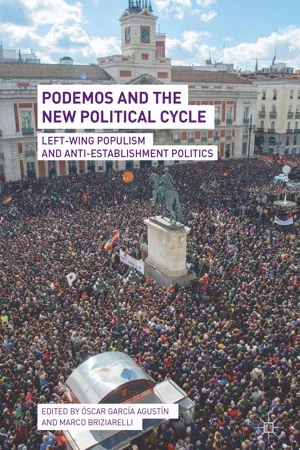
Back in Madrid, Pablo Iglesias talked to 100,000 Podemos sympathizers gathered in the Puerta del Sol on the occasion of the so-called “Marcha por el Cambio” (Rally for Change), whose goal was to celebrate the “joy of being together” and the possibility of political change in Spain. Iglesias emphasized the first measures taken by the new Greek government as an example of new politics. Most importantly, he used his speech to connect the different social struggles and movements opposed to the dominant powers, which culminated with the massive 15M demonstrations. The emphasis on popular power as a real political alternative was articulated in the statement: “It is necessary to dream. But we dream, taking our dream very seriously.” For Podemos that meant taking up the challenge of developing a new political project, whose final goal was to gain governmental power, combining “the dreams” of social and popular power; as well as “taking the dreams seriously,” that is, ensuring the construction of a political party capable of playing the political game without putting people’s dreams aside.
In order for such a new political cycle to materialize, it must be receptive and reflective with regard to several key issues. Accordingly, in the following sections we examine some of those issues, which also allows us to review key themes of this volume. Accordingly, in the first section we review Podemos’ genealogy and its current development in relation to the social historical context of Spain. In the second section, we broaden the reflection to a larger geopolitical scenario with particular reference to Syriza, by reflecting on the tension between the “moment of madness” and the moment of “institutionalization” of a given political initiative. By that, we refer to the potential and constraints of the cycle of social protests applied to the political cycle, and the kind of synergies and contradictions emerging from the development of Podemos as a party–movement, that is, between the appeal to emerging social forces and the limitations imposed by the institutional framework. Third, we consider the necessity of (re)thinking the Left in the context of austerity and as a political project beyond political categories such as “social democracy.” Finally, we believe it is important to contextualize Podemos in the particular intersection between theoretical debates and political praxis that gravitates around competing understandings of the concept of hegemony, populism, and the social laboratory provided by the Latin American experience.
1.1 Podemos’ Genealogy: The Social and Political Definition of a Project
By the end of 2013, the enthusiasm and the social and political energies that put under siege the so-called Regime of ‘78—the political order that transitioned from the end of Franco’s dictatorship to Spain’s Second Republic and the consequent approval of its Constitution—seemed to be experiencing a dangerous impasse. Such a stall made increasingly more manifest the contradictory productivity of crises deriving from the tensions between socially productive and socially conservative/reproductive predispositions: on the one hand, the segments more affected by the crisis could produce organized responses that in turn could potentially bring about significantly new configurations of the social and the political; on the other, a failed progressive attempt could cause a reactionary response by the ruling group, which would lead to new configurations of the old, in other words, a passive revolution in a Gramscian sense.
In this sense, when Podemos was launched in early January 2014, many saw in it that needed and awaited strong political initiative to conjure substantial political change and prevent the ruling forces of the country from reorganizing. It was not by accident that Podemos entered the political arena with a rhetoric marked by the necessity of conveying a twofold program: simultaneously marked by common sense and “dream.” Common sense was considered a practical consciousness that demanded a renegotiation of the social pact between the people and the institutions in the name of social solidarity, social justice, the defense of the decommodifying functions of the welfare state (i.e. redistributing wealth, offering public services), a more democratized and transparent political system, and, last but not the least, a genuine involvement of the people in the political process. At the same time, the organization was also propelled by the power of “dreaming” a potential consciousness, a genuinely new “good sense” driven by sociological imagination and the determination to go beyond the rhetoric of inevitability of neoliberalism.
Such a dual consciousness possibly reflects the compound nature of Podemos (and the transition that, later on, we describe from the ‘moment of madness’ to the ‘moment of institutionalization’): a pragmatic element that tries to boldly answer the question of power for the Left and is prone to “elevate” the struggle to the institutional level of political society; and a more movement-oriented element prone to operate at the level of civil society, the combination of political and civil society that, for Gramsci, defines the so-called “integral state.” There is indeed a dialectical and constructive tension between the two, which can be in part explained by Podemos’ particular genealogy. As a matter of fact, Podemos emerged from the convergence of 15M militancy, from the Trotskyist organization Izquierda Anticapitalista, which was composed from parts of the fragmented political party Izquierda Unida and a group of Political Science professors at the Universidad Complutense in Madrid, such as Juan Carlos Monedero, Pablo Iglesias, and Íñigo Errejón, who drew important lessons from the Latin American experiences known as the Pink Tide governments, and intended to translate those populist responses into pressure against neoliberal globalization in the European context.
After its initial presentation, in March 2014, Podemos constituted itself as a political party, with the goal of catalyzing the mixed and productive emotions stirred up in previous years into a political project. The chosen name, Podemos (We can), signals a willingness to capitalize on the sense of popular empowerment emerging from virtual and physical plazas as a way to promote action in the Spanish parliamentary system. The party also reached its audience through careful and intensive use of media. In fact, another particularity of Podemos consisted in that while the typical Leftist movement had been traditionally skeptical of mediated political communication, Podemos took advantage of one of its media savvy founders, Pablo Iglesias, and his usage of TV, to broadcast political information and trigger discussion through TV programs and social media campaigns.
After an initial very positive electoral endorsement, Podemos has been dealing with the never-ending campaign that started in fall 2015 and still goes on as we write this introduction. During the December 2015 national election, Podemos gained 20% of the vote, triumphing over the socialist party in several key regions. At the municipal level, Podemos led joint candidacies—with citizen platforms that allowed it to win municipal elections in the country’s biggest cities, Madrid, Barcelona, and Valencia. Then,after the partial disappointment of the joint venture with Izquierda Unida in June 26, 2016, Podemos is currently transitioning toward what Iglesias, drawing on Gramsci, defined as “trench warfare.” That is a position aimed at consolidating parliamentary representation, but also at providing a stable organization for the party, and an equally consistent involvement of local círculos in the decision-making. The succesive internal contestation against Iglesias has led to the emergence of an opposition wing around the figure of Íñigo Errejón, cofounder and close friend of Iglesias, responsible for translating Laclau’s theory into the discourse and strategy of Podemos. It is likely that the tensions—ideological, strategic, territorial, or personal—will continue in the coming years.
As we write this introductory chapter, the window of opportunity created by the crisis of Regime of ‘78 is not necessarily closing, but its navigation has certainly become more complex and presents important challenges for Podemos. First of all, the sense of emergency triggered by the economic and legitimation crisis is being currently dispersed by the emergent rhetoric of an economic recovery and return to normalization. Despite the fact that most of the population have not enjoyed the alleged recovery—as unemployment still approaches 20% and the few employed experience salary contractions, erosion of their working rights, and a permanent condition of precarity, thus contradicting any sense of recuperation —Podemos must still decide whether it wants to keep tying itself to a narrative of contingent urgency and a progressive kind of reactionarism triggered by the crisis, or instead promote itself as a long-term project of social change.
Second, Podemos has to deal with its strategic alliances both in the national and international contexts. For instance, Podemos’ position with regard to the Catalan independentist project presents an ideological dilemma that can potentially problematize its ideal of Left transversality. Third, as we will mention later on when analyzing in more detail the discursive approach to hegemony, Podemos needs to disambiguate even further its discourse about ‘new politics’ from that of other emergent parties, such as Ciudadanos. Equally important, in a turbulent context of self-reflection for the Spanish Socialist Workers’ Party (PSOE), Podemos will probably be obliged to define its relation with the party either in antagonistic or agonist terms, as Mouffe would put it. Finally, Podemos has yet to define its relation to labor, by taking a clear stance in relation to workers, who have become increasingly skeptical of political mobilization and, in turn, of trade union organizations such as the General Workers’ Union of Spain (UGT) and Workers’ Commissions (CCOO). In fact, in the last few decades, they have played a marginal role in Spanish politics and have taken a “soft” position against the neoliberal government ruled by the Popular Party (PP). In this sense, the fundamental question of whether Podemos can embrace concrete labor and class issues without compromising its middle-class-centered transversalism remains unanswered.
Summing up, it is unclear whether or not Podemos aspires to renew social democracy or if the introduction of new components (e.g. populism, transversality) is sufficient to renew the Left, specifically overcoming the marginality into which the radical Left has traditionally been pushed. The conceptualization of Podemos as a winner, in a similar way to Syriza in Greece, entails a new way of thinking about progressive politics: that it can play a major role in office and is not limited to supporting or influencing a government led by the social democratic party. Not without contradiction, Podemos assumes gaining an electoral majority is necessary to make that step possible. In the next section, we make sense of this ambiguity by framing it in the internal tension of the political cycle between two distinct moments: madness and institutionalization.
1.2 The Political Cycle: Moments of Madness and Institutionalization
Reflecting on the post-crisis challenges for the Left, Luke March (2013) used the words of Francis Fukuyama about the absence of a “Tea Party of the Left,” which could put grassroots representatives in establishment positions. Both during the Global Justice Movement in the 2000s and, more recently, after 2011 with the Occupy and 15M Movements, Leftist parties, or what March calls “radical Left parties,” have faced serious difficulties in strengthening links to social movements, and have revealed their incapacity to be embedded in politics from below. However, recent events make us reconsider such possibilities as we witness a stronger convergence through different modalities: the reinforcement of radical Left parties, such as Syriza, winning the general elections twice in Greece; the establishment of a Left Bloc becoming part of the coalition government in Portugal; the emergence of new parties capitalizing on strong social movements, such as Podemos in Spain or Initiative for Democratic Socialism in Slovenia; the formation of movement forms of participation within mainstream parties, like the case of OccupyPD within the Democratic Party in Italy and Momentum within the Labour Party in UK. In this context it is convenient to explore the connection between the cycle of protest initiated in 2011 and the possibilities of a new political cycle.
In his development of the concept of “cycle of protest,” Sidney Tarrow (1993) refers to the idea of “moments of madness,” formulated originally by Aristide Zolberg, as the moments when “all is possible” (1993: 281). Despite their later evolution and the risk of provoking disappointment (because of not meeting their expectations), such moments are necessary for the political transformations of societies and for new actors to challenge existing political constraints. Tarrow identifies these moments with the beginning of the protest cycle, when collective action starts to be shaped. Besides, the explosion of creativity contrasts with the slow historic development of the repertoire of contention. In this sense, the moments of madness are “tempered into the permanent tools of a society’s repertoire of contention” (1993: 284), since they contribute to the evolution of that repertoire of contestation rather than transform it immediately.
The cycle of protest from 2011 onwards, particularly in Southern Europe, emerged in the context of the 2007–2008 economic crisis, which was characterized by a global systemic downturn, debt, and austerity policies (Vivas 2013). As in every protest cycle, a window of political opportunity is opened. When some mobilizations put the focus on the need for more “democracy” and questioned the role played by political parties and the economic system, they revealed a major problem to be the crisis of representativeness. This frontal opposition against institutions makes it difficult to think of political opportunities that could strengthen the links between the party system and social movements. On the other hand, the openness provoked by the “moment of madness,” despite the unclearness on how to gain institutional influence, paves the possibility for more radical social and political change.
Thus, the appearance and renewal of Left political parties can be interpreted within the context of evolution of the cycle of protest and how, in turn, it intertwines with the political cycle. The double crisis, in terms of economic and political systems, is contested at the political level as Left parties try to redefine their projects and ideologies by striving to connect more firmly with social movements and approach grassroots politics. Therefore, mobilizations developed in multiple directions and the receptiveness of political parties incorporated part of the dynamics, demands, and possibilities previously undertaken by social movements during the protest cycle. We understand this evolution as a shift from the “moment of madness” to a “moment of institutionalization.” In this case, institutionalization does not necessarily mean the only possible way of resolving the moment of madness, since it is also being developed during the cycle protest, but rather its incorporation into the institutional political realm. Furthermore, institutionalization goes beyond becoming part of institutions, as it implies the questioning and transformation of existing institutions, or even the creation of new ones, applying some of the social creativity of the moment of madness to reform political parties constrained by existing norms and rules. Donatella Della Porta (2015), looking at this moment as ‘windows of political opportunity,’ emphasizes the emergence of party–movements when the protest cycle is declining, arising from those mobilizations and aiming to create new modes of doing politics.
Understood through this framework, Podemos could be considered as a party–movement navigating the transition from a moment of madness to one of institutionalization: rooted in the activities of the 15M Movement in 2011; made up of a remarkable number of activists who participated in the demonstrations; and experim...
Table of contents
- Cover
- Frontmatter
- 1. Introduction
- 2. Genealogy
- 3. Concepts
- 4. Comparative Perspectives
- 5. Conclusion
- Backmatter
Trusted by 375,005 students
Access to over 1.5 million titles for a fair monthly price.
Study more efficiently using our study tools.
Frequently asked questions
Yes, you can cancel anytime from the Subscription tab in your account settings on the Perlego website. Your subscription will stay active until the end of your current billing period. Learn how to cancel your subscription
No, books cannot be downloaded as external files, such as PDFs, for use outside of Perlego. However, you can download books within the Perlego app for offline reading on mobile or tablet. Learn how to download books offline
Perlego offers two plans: Essential and Complete
- Essential is ideal for learners and professionals who enjoy exploring a wide range of subjects. Access the Essential Library with 800,000+ trusted titles and best-sellers across business, personal growth, and the humanities. Includes unlimited reading time and Standard Read Aloud voice.
- Complete: Perfect for advanced learners and researchers needing full, unrestricted access. Unlock 1.5M+ books across hundreds of subjects, including academic and specialized titles. The Complete Plan also includes advanced features like Premium Read Aloud and Research Assistant.
We are an online textbook subscription service, where you can get access to an entire online library for less than the price of a single book per month. With over 1.5 million books across 990+ topics, we’ve got you covered! Learn about our mission
Look out for the read-aloud symbol on your next book to see if you can listen to it. The read-aloud tool reads text aloud for you, highlighting the text as it is being read. You can pause it, speed it up and slow it down. Learn more about Read Aloud
Yes! You can use the Perlego app on both iOS and Android devices to read anytime, anywhere — even offline. Perfect for commutes or when you’re on the go.
Please note we cannot support devices running on iOS 13 and Android 7 or earlier. Learn more about using the app
Please note we cannot support devices running on iOS 13 and Android 7 or earlier. Learn more about using the app
Yes, you can access Podemos and the New Political Cycle by Óscar García Agustín, Marco Briziarelli, Óscar García Agustín,Marco Briziarelli in PDF and/or ePUB format, as well as other popular books in Politics & International Relations & European Politics. We have over 1.5 million books available in our catalogue for you to explore.