- English
- ePUB (mobile friendly)
- Available on iOS & Android
eBook - ePub
About this book
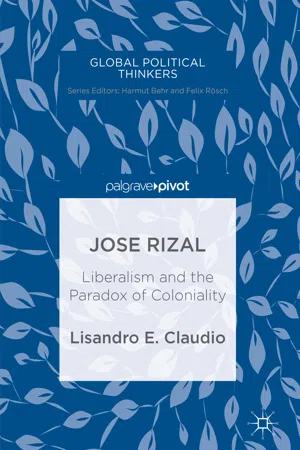
The global history of liberalism has paid too much attention to the West, neglecting the contributions of liberals from colonial nations. This book mines the thought of Filipino propagandist and novelist, Jose Rizal, to present a vision of liberalism for the colonized. It is both an introduction to Rizal and a treatise on rights, freedom, and tyranny in colonial contexts. Though a work on history, it responds to the illiberal present of rising authoritarianism and populism.
Information
© The Author(s) 2019
Lisandro E. ClaudioJose RizalGlobal Political Thinkershttps://doi.org/10.1007/978-3-030-01316-5_11. Creolism and the Liberal Nineteenth Century
Lisandro E. Claudio1
(1)
De La Salle University, Manila, Philippines
Lisandro E. Claudio
Abstract
This chapter situates the life of Jose Rizal. First, it examines the origins of Philippine liberalism in the creole intellectuals of the late eighteenth century/early nineteenth century. It explains how these creoles, inspired by the French Revolution and other liberal movements in Europe, articulated the broad contours of the propaganda movement that Rizal would lead in the nineteenth century. Second, it provides an overview of the political and economic changes in the Philippines during the late nineteenth century. It was a period of economic growth and political stagnation, creating a revolutionary atmosphere that would form not only the ideas of Rizal but also the Philippine Revolution of 1896. It ends with a brief biography of Rizal.
Keywords
CreolesNationalismIlustradosRizalFilipino liberalsAlthough this book is about a global idea, we must begin our story locally. For the context in which Rizal wrote was specific, and some might even say anomalous. It is now routine for historians of the Philippines to claim that Rizal’s writings inspired the nationalist revolution of the Kataas-taasan, Kagalang-galang na Katipunan nang Manga Anak ng Bayan (The Supreme and Most Honorable Society of the Children of the Nation), the Katipunan, or the KKK for short. And recent historiography has shown that the Katipunan’s revolution of 1896, which overthrew Spanish colonial rule, was Rizalian inasmuch as it espoused an anti-colonial, liberal agenda and not, as previously thought, a utopian and socialist/millenarian one (see Rafael 2015 for a summary of this new historiography).
The Philippine Revolution was the first anti-colonial revolution in Asia. But it was the last in the Spanish empire. It is this anomalous, revolutionary context that must frame our understanding of Rizal’s work. For although Rizal was executed as the revolution was just starting, it was the broader radical ethos of the period that informed his thinking. The late nineteenth century was a time of liberal radicalism.
“Liberal radicalism” might sound like an anachronism today, since we equate liberalism with the status quo of the West. It is, notes Adam Kirsch (2016), “the air we [in the West] all breathe and the lens through which we see all political issues.” But liberalism was the leading revolutionary ideology of the eighteenth and nineteenth centuries, and liberals were the main challengers of autocratic and religious governments the world over. Prior to the Bolshevik Revolution, it was the French and American revolutions that radicals looked toward for inspiration. As with the enslaved peoples of the Caribbean (Polasky 2015, 138), it was “rumors of freedom” that inspired liberal radicals in the Philippines. In the nineteenth century, news of events like the Paris Commune of 1871 and the Spanish Glorious Revolution 1868 would have made Filipino patriots believe in the continued vibrancy of liberal thought.
This chapter moves from broad to specific: from a history of Philippine liberalism prior to Rizal, to a history of the changes in the Philippines during the nineteenth century, to a short biography of Rizal himself. Beyond introducing Rizal, my aim is to show that liberalism was the key idea of early Filipino nationalist imagination and that this articulation of liberalism with nationalism was central to Rizal’s political views.
Liberalism in the Philippines
The early history of nationalism is inevitably tied up with liberalism. To launch a liberal experiment in the New World, North Americans forged a civic-minded nationalism/patriotism to bind the various colonies. The different forces that sought to defend French revolutionary ideals—from the Girondins, to the Jacobins, to Napoleon—aroused support for their cause by claiming affinity to a fatherland. After the fall of Napoleon and the emergence of the Concert of Europe/Metternich system which sought to repress both nationalism and the ideas of the French Revolution, liberals and nationalists found common cause against a common reactionary foe. Much later, the architects of Italian unification, thinkers like Giuseppe Mazzini, saw the unified nation as the perfect symbol and vehicle for liberal thought.
In the Philippines, as in the Americas, the formation of a liberal-nationalist consciousness may be traced to the unique experiences of Europeans born in the colony—“creoles.” Benedict Anderson’s (1983, 47–66) work on nationalism shows that independence movements in Spanish and British America were both led by “creole pioneers,” who were racially European, but developed greater attachments to their countries of birth. Since they could not obtain high-ranking positions in the metropole, their upward mobility circumscribed by the conditions of their birth, they began to imagine the colonies as separate fatherlands from the metropole.1 Others, particularly the English-speaking creoles, decried unfair trade policies between North American colonies and Britain.
Although Anderson himself does not state it, these creoles were largely liberals. This point becomes evident when one examines the English-speaking creoles of North America, that is, the American founding fathers. In the figure of Thomas Jefferson, for example, we see an Englishman born in the colonies (creole), who develops a nationalist attachment to his place of birth, and writes the declaration of independence—one of the world’s key liberal texts.
The origins of Philippine nationalism can likewise be traced to creole liberals. The emergence of “‘modern’ dissent” in the Philippines, explains Resil Mojares (2017, 27), occurred amid “the rise of liberalism in Spain and the Latin American revolutions of 1808–25,” which “provided stimulus and space for political dissent in Manila and its environs, expressed in the activities of Creoles and secular priests who, invoking the entitlements of race and education, worked for greater autonomy within the colonial state.” Though tame by Latin American standards, this early liberalism would paved the way for radical propagandists like Rizal.
The pre-eminent Filipino public intellectual of the twentieth century, Nick Joaquin (2005, 24) begins the story of Filipino nationalist propaganda with the early nineteenth-century creole Luis Rodriguez Varela. Varela was not just a liberal, who sought to bring the enlightenment of the French Revolution to the Philippines; he was also an early nationalist. He was the first writer to identify himself as a “Filipino,” eventually taking on the moniker of “El Conde Filipino.” Prior to the Conde, the term “Filipino” was simply an administrative designation for creoles from the Philippines, rarely used by these creoles themselves, who identified as Spaniards. It was through Varela that the term began to take on a political meaning.
In 1799, Varela published three books in defense of the liberalism and the Enlightenment. These early works were critical of the obscurantism of the friar orders—a theme central theme that would dominate liberal writing until Rizal’s time. They were also pleas for a transplantation of Enlightenment principles into the colony. Varela admired the French Revolution, but grew wary of it when Napoleon captured the revolution and imposed his brother, Joseph Bonaparte, as king of Spain in 1808 (ibid., 29). For Varela, as with Rizal, liberalism was best expressed through an independent republic.
During this period, the fortunes of creoles in the Philippines were contingent on developments in Spain, and their confidence rose as political liberalism asserted itself at the center of Spanish politics. Unifying against the French, the Spanish set up the country’s first sovereign assembly, the Cortes, in 1810. Though the Cortes in Cadiz was initially divided between liberals and those who wished to restore the Bourbon dynasty, it soon became clear that the appeal of the liberally oriented French could not be blunted unless new liberal laws were enacted. The threat of French influence, therefore, ensured that the liberals won out. Among the deputies of the Cortes, Raymond Carr (1966, 94) argues, there was “a widespread, if ill-defined, feeling for a constitution based on a division of powers, for uniform, modern laws, for civil equality, and the curtailment of corporate privilege.”
The Cadiz Constitution was the most liberal constitution of the period. But since it never took full effect, its legacy lies less in its specific provisions than in the liberal ideas that informed it. Carr (1966, 96) notes that the Spanish liberalism of this period drew from a variety of sources:
the facts and necessities of the national rising; the commonplaces of the eighteenth-century natural law school and Montesquieu; the historically tinged constitutionalism and generalized feeling for reform that was characteristic of the Godoy epoch; the more radical brand of constituent reform that found strong press support in 1808; the influence and example of France; the works of Bentham.
The liberalism of Cadiz had implications for the Philippines. The Constitution designated American colonies and the Philippines as overseas provinces entitled to representation. And although the Constitution’s eventual nullification would reverse this arrangement, the demand that the Philippines become a Spanish province entitled to representation continued until Rizal’s time (Legarda 2011, 3).
Varela was a staunch defender of the liberalism of the Cortes and its constitution. At the request of the City of Manila in 1810, he composed instructions for Ventura de los Reyes, the representative of the Philippines to Cadiz. The instructions to de los Reyes, notes Joaquin (2005, 29), already contained reforms similar to those that Rizal would advocate later: Varela told de los Reyes to lobby for the establishment free schools outside friar control and the foundation of colleges for pharmacy, mathematics, and navigation. In 1813, Varela published a collection of verses entitled Parnaso Filipino. In its introduction, he defended the Cadiz Constitution, thereby drawing attacks from friars in the Philippines, who disdained the constitution for granting equal rights to natives of the Philippines, indios (ibid., 29).
The brief liberal interregnum in Spain ended with the restoration of Ferdinand VII to the throne in 1813. The Bourbon King nullified the constitution, jailed many of the Cadiz’s liberal representatives, and broke his promise to convene a new Cortes—re-establishing an absolutist monarchy. In 1820, however, a mutiny in defense of the Cadiz Constitution broke out under the leadership of Col. Rafael de Riego. The three-year period of liberal rule under Riego, known as the Trienio Liberal, was another period of liberal promise cut short by French, who restored Ferdinand to the throne. Upon Ferdinand’s return to power, he sentenced numerous liberals to death, including the parliamentary deputy for the Philippines, Vicente Posada (Sarkisyanz 1995, 80).
Ferdinand’s second reign coincided with Spain losing its control over its Latin American colonies to creole radicals. The colonial government in the Philippines rightly suspected that creole radicalism would...
Table of contents
- Cover
- Front Matter
- 1. Creolism and the Liberal Nineteenth Century
- 2. Pain and the Purification of Liberty
- 3. Noli me Tangere and the Failure of Transplanted Liberalism
- 4. The Solution of the Enigma in El Filibusterismo
- 5. Conclusion: Resurrecting Plants
- Back Matter
Trusted by 375,005 students
Access to over 1.5 million titles for a fair monthly price.
Study more efficiently using our study tools.
Frequently asked questions
Yes, you can cancel anytime from the Subscription tab in your account settings on the Perlego website. Your subscription will stay active until the end of your current billing period. Learn how to cancel your subscription
No, books cannot be downloaded as external files, such as PDFs, for use outside of Perlego. However, you can download books within the Perlego app for offline reading on mobile or tablet. Learn how to download books offline
Perlego offers two plans: Essential and Complete
- Essential is ideal for learners and professionals who enjoy exploring a wide range of subjects. Access the Essential Library with 800,000+ trusted titles and best-sellers across business, personal growth, and the humanities. Includes unlimited reading time and Standard Read Aloud voice.
- Complete: Perfect for advanced learners and researchers needing full, unrestricted access. Unlock 1.5M+ books across hundreds of subjects, including academic and specialized titles. The Complete Plan also includes advanced features like Premium Read Aloud and Research Assistant.
We are an online textbook subscription service, where you can get access to an entire online library for less than the price of a single book per month. With over 1.5 million books across 990+ topics, we’ve got you covered! Learn about our mission
Look out for the read-aloud symbol on your next book to see if you can listen to it. The read-aloud tool reads text aloud for you, highlighting the text as it is being read. You can pause it, speed it up and slow it down. Learn more about Read Aloud
Yes! You can use the Perlego app on both iOS and Android devices to read anytime, anywhere — even offline. Perfect for commutes or when you’re on the go.
Please note we cannot support devices running on iOS 13 and Android 7 or earlier. Learn more about using the app
Please note we cannot support devices running on iOS 13 and Android 7 or earlier. Learn more about using the app
Yes, you can access Jose Rizal by Lisandro E. Claudio in PDF and/or ePUB format, as well as other popular books in Politics & International Relations & Literary Criticism. We have over 1.5 million books available in our catalogue for you to explore.