eBook - ePub
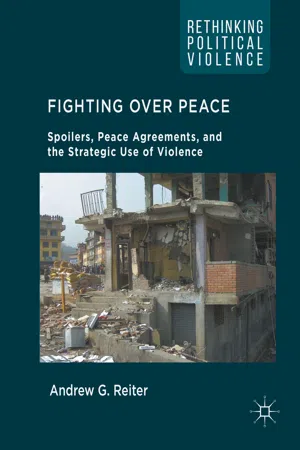
Fighting Over Peace
Spoilers, Peace Agreements, and the Strategic Use of Violence
- English
- ePUB (mobile friendly)
- Available on iOS & Android
eBook - ePub
About this book
Information
© The Author(s) 2016
Andrew G. ReiterFighting Over Peace Rethinking Political Violence10.1007/978-3-319-40102-7_11. Introduction: When Peace Begets Violence
Andrew G. Reiter1
(1)
Department of Politics, Mount Holyoke College, South Hadley, Massachusetts, USA
Armed conflict has marred the Mindanao region of the Philippines since the late 1960s as Moro nationalists have fought the central government for independence. The four-decades-long war has killed as many as 120,000 people (BBC News 2014). The Internal Displacement Monitoring Centre estimates that nearly 4 million people have been displaced from their homes in the region just since 2000 (Internal Displacement Monitoring Centre 2015). Mindanao remains one of the most impoverished regions of the Philippines , home to ten of the sixteen poorest provinces in the country (Gallarde 2014).
Hope, however, has been on the rise. The main rebel group, the Moro National Liberation Front (MNLF) , dropped its demand for complete independence and engaged in a series of peace negotiations with the government, culminating in a comprehensive agreement in 1996 that granted regional autonomy. Shortly thereafter, the government began negotiations with the major remaining rebel group, the Moro Islamic Liberation Front (MILF ). After 17 years of peace talks, the two sides finally signed the Comprehensive Agreement on Bangsamoro (CAB ) in March 2014, bringing with it high aspirations that the region would finally be at peace (Inquirer Mindanao 2014).
Yet factions of the MILF , including the Bangsamoro Islamic Freedom Fighters , and other armed groups in the region immediately threatened the agreement. These actors combined public statements against the accord with violent attacks in an effort to derail—or “spoil”—the peace. As one government official states, “Spoilers still abound. There are those who will persist in their own agenda for self-serving or ideological reasons”(The Philippine Star 2014). At present, the government is debating the Bangsamoro Basic Law (BBL ) that would, if passed, effectively implement the CAB . The strategy of these spoilers, however, has succeeded in casting doubt on the value of peace process. As recently as May 2015, a prominent senator cited their behavior in his opposition to the agreement: “the BIFF [Bangsamoro Islamic Freedom Front] … and private armed groups have already indicated they do not support the BBL led by MILF . So this early, we already know there can be no just and lasting peace in Mindanao even if we pass BBL ” (Adel 2015). In addition, Abu Sayyaf and other armed groups in the region have recently pledged their allegiance to the Islamic State of Iraq and Syria (Taylor 2016). The ultimate outcome of this peace process remains uncertain.
Mindanao is not a unique case. Spoilers have threatened countless peace agreements around the world. In 2006, within hours of the signing of the Darfur Peace Agreement (DPA ) in Sudan , the main rebel group split over the terms of the agreement. The faction opposed to the accord united with several other rebel groups who were excluded from the agreement to form the National Redemption Front (NRF ), whose main objective was to spoil the DPA . 1 Thus instead of bringing peace, the agreement triggered the rise of spoilers and led to an escalation of violence (Nathan 2006, 1–2). The next attempt at peace—the 2011 Doha Agreement —suffered from the same issue, with various rebel factions opposing the accord and preventing its implementation.
In Colombia , paramilitaries assassinated political candidates of former guerrilla groups to spoil a number of peace agreements in the 1990s (Chernick 2003). Fears of potential spoiling by rebel factions or drug trafficking organizations likewise continue to hang over the government’s ongoing peace process with the Revolutionary Armed Forces of Colombia (FARC) rebel group (Battaglino and Lodola 2013). Spoiling by the National Forces for Liberation (FNL) has threatened peace in Burundi (Izama 2008), and the fear of potential spoiling has dominated recent peace talks in Assam , India (Handique 2009).
There is now a consensus in the scholarly community that violence directed at peace agreements poses a serious threat to the maintenance of peace (e.g. Kydd and Walter 2002). As John Darby states, “in the great majority of cases, the reason for post-agreement collapses is violence” (Darby 2001, 9). Stephen Stedman goes as far as to argue that spoilers are the biggest obstacle to peace and that they should be a high priority for peacemakers (Stedman 2002; Stedman 2003). At its worst, spoiling can usher in renewed war, bringing further devastation to already-suffering populations. Such conflicts lead to mass civilian casualties, large-scale human rights violations, environmental degradation, humanitarian crises, and create safe havens for international terrorism and trafficking of drugs and arms (Rotberg 2004). Even in cases where the peace agreement remains intact, such as the 1998 Good Friday Agreement in Northern Ireland , post-agreement periods are often marred by years of violent protests, assassinations, and bombings by those opposed to the agreement (Darby 2001; Mac Ginty 2006; Höglund 2008a). Such spoiling efforts can divert precious resources from rebuilding to security, further hampering the implementation of the accord. Spoiling during the Israel –Palestine peace process in the mid-1990s, for example, contributed to a shift in Israeli public opinion and the subsequent election of a hardliner as prime minister. There was then a dramatic increase in the amount of resources dedicated to security in Israel , and Israeli –Palestinian relations deteriorated (Shikaki 1998).
In response to these developments, policymakers have begun to focus on spoilers and have taken a number of steps to address the problem (e.g. Chigas 2005; Conciliation Resources 2009; Lovelock 2005). The United Nations (UN) Security Council regularly imposes targeted sanctions, monitored by Panels or Groups of Experts, on countries, groups, or individuals it feels pose a threat to its work to secure peace in civil wars around the world (Boucher and Holt 2009); mostly recently establishing a sanctions regime in Yemen (United Nations Security Council 2015). 2 Each UN peacekeeping mission has a Joint Mission Analysis Centre that monitors the emergence of threats to its work on the ground and the maintenance of peace. Likewise, in its conflict resolution work, the European Union (EU ) pays particular attention to spoilers. At a peace conference in June 2014, EU Ambassador Guy Ledoux declared that the goal was to ensure that “there is no opportunity for spoilers to damage” the newly signed CAB in the Philippines (Legaspi 2014). The Foreign & Commonwealth Office of the UK sponsored a special seminar on spoilers in 2010, and non-governmental organizations, such as the International Peace Institute , have also begun to focus on the role of spoilers in post-peace environments (Shaw and Kemp 2012).
Yet to date policymakers and scholars lack the ability to accurately predict spoiler emergence following peace agreements, most of which do not experience this type of threat. In part, this is because existing approaches typically only examine key cases where spoiling occurs. Few studies investigate spoiling more broadly to determine what factors may determine its presence and absence following an agreement. Determining the types of agreements and characteristics of post-agreement settings that are more or less likely to incite spoiling is crucial to predicting and preventing such violence in the future. Predicting spoiling is also a key piece of larger efforts at early warning that can aid policymakers in acting quickly enough to prevent crisis escalation (Harff and Gurr 1998). Why then are some peace agreements incessantly plagued by spoiling while others are implemented comparatively smoothly?
Moreover, when spoiling does occur, its effects vary significantly. The first attempt to end the Angolan civil war in the early 1990s, for example, was spoiled by Jonas Savimbi and his National Union for the Total Independence of Angola (UNITA) , plunging the country back into conflict and killing over 300,000 people (Stedman 1997, 36–40; Greenhill and Major 2006, 15–23). Yet spoiling attempts by right-wing paramilitaries in Guatemala and El Salvador in the early 1990s were largely shrugged off with little effect. While violence occurred, both countries successfully ended long-running Cold War conflicts and remain at peace today.
More paradoxically, there are also cases where violence and threats of violence appear to strengthen peace in the long term. In November 2006, for example, the Nepalese government signed a comprehensive peace agreement with the Communist Party of Nepal-Maoist (CPN-M ) rebels. The agreement dissolved the monarchy and specified rules for new elections. Months later, however, the CPN-M withdrew from the agreement and threatened renewed warfare. The rebels called on the government to recommit to the agreement (the monarchy was still in place) and demanded particular terms be renegotiated, including a change in the number of seats elected to parliament via proportional representation (Reuters 2007). Shortly thereafter, the electoral system was revised, and the rebels rejoined the agreement and became the largest party in government following the elections, and the King was deposed. Though politically contentious, Nepal remains at peace.
Rather than always being a threat, spoiling then can also “raise new questions within a peace process...
Table of contents
- Cover
- Frontmatter
- 1. Introduction: When Peace Begets Violence
- 2. Who Spoils and Why
- 3. Where Spoiling Occurs
- 4. Termination Spoiling: Sabotage and Obstruction
- 5. Modification Spoiling: Bargaining and Enforcement
- 6. Conclusion: Implications for Theory and Practice
- Backmatter
Trusted by 375,005 students
Access to over 1.5 million titles for a fair monthly price.
Study more efficiently using our study tools.
Frequently asked questions
Yes, you can cancel anytime from the Subscription tab in your account settings on the Perlego website. Your subscription will stay active until the end of your current billing period. Learn how to cancel your subscription
No, books cannot be downloaded as external files, such as PDFs, for use outside of Perlego. However, you can download books within the Perlego app for offline reading on mobile or tablet. Learn how to download books offline
We are an online textbook subscription service, where you can get access to an entire online library for less than the price of a single book per month. With over 1.5 million books across 990+ topics, we’ve got you covered! Learn about our mission
Look out for the read-aloud symbol on your next book to see if you can listen to it. The read-aloud tool reads text aloud for you, highlighting the text as it is being read. You can pause it, speed it up and slow it down. Learn more about Read Aloud
Yes! You can use the Perlego app on both iOS and Android devices to read anytime, anywhere — even offline. Perfect for commutes or when you’re on the go.
Please note we cannot support devices running on iOS 13 and Android 7 or earlier. Learn more about using the app
Please note we cannot support devices running on iOS 13 and Android 7 or earlier. Learn more about using the app
Yes, you can access Fighting Over Peace by Andrew G. Reiter in PDF and/or ePUB format, as well as other popular books in Politics & International Relations & Diplomacy & Treaties. We have over 1.5 million books available in our catalogue for you to explore.