- English
- ePUB (mobile friendly)
- Available on iOS & Android
eBook - ePub
About this book
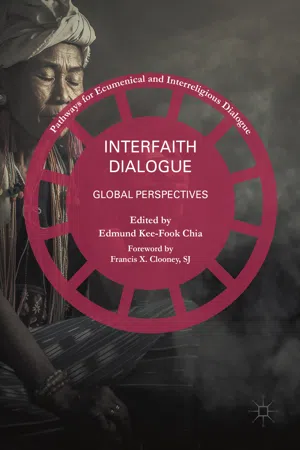
This book addresses issues central to today's Catholic Church, focusing on the relationship between various religions in different contexts and regions across the world. The diverse array of contributors present an inclusively interfaith enterprise, investigating a wide range of encounters and perspectives. The essays include approaches from the Jewish, Muslim, Buddhist, and Bahá'í traditions, in a variety of geographic contexts. Contributors reflect on Muslims in the West, Christian-Buddhist social activism, and on Chinese, Indian, and Japanese religions. The volume also explores the experiences of communities that are often marginalized and overlooked such as the Aborigines and Torres Strait Islanders of Australia and the Karen tribal peoples of Thailand. Contributors examine the works of the Focolare, Gülen, and Rissh? K?sei-kai movements, and integrate the vision of Raimon Panikkar and Ken Wilber. Chapters incorporate discussions of dialogue documents such as Nostra Aetate and Dabru Emet, and methodologies such as Receptive Ecumenism, Comparative Theology, and Scriptural Reasoning. Among other goals, the book seeks to offer glimpses into interfaith dialogues across the world and examine what Christians can learn from other religions and global contexts.
Information
Topic
Theology & ReligionSubtopic
Christian DenominationsThe Second Vatican Council and Nostra Aetate
© The Author(s) 2016
Edmund Kee-Fook Chia (ed.)Interfaith DialoguePathways for Ecumenical and Interreligious Dialogue10.1057/978-1-137-59698-7_11. Vatican II and Interfaith Dialogue
Michael Louis Fitzgerald1
(1)
St Anne’s Church, Jerusalem (Old City), Israel
Introduction
The Second Vatican Council involved many people, but it was, in particular, the affair of two popes: John XXIII (who convoked and launched it) and Paul VI (who brought it to a conclusion). This council was the first in the history of the church to address specifically the question of the relations of the church with other religions, resulting in the declaration Nostra Aetate (NA). Both popes had a role in bringing this about. This is not the place to go into great detail, but let me just say that John XXIII introduced the theme into the agenda of the council by asking Cardinal Bea, the German Jesuit whom he had appointed to head the Secretariat for Christian Unity, to prepare a short statement condemning anti-Semitism. Paul VI, for his part, gave his personal backing to the ensuing declaration and facilitated its passage through the conciliar debates. On August 6, 1964, Paul VI published his first encyclical Ecclesiam Suam (ES) which was to have a considerable impact on the teaching of Vatican II about interfaith dialogue.
In this chapter I will indicate, first, how interfaith dialogue came to be a concern of Vatican II. Second, I will attempt to trace the influence of ES on the council’s teaching on this subject. Third, I will show how interfaith relations are reflected in different documents of the council. Finally, I shall add some reflections on the role of the papacy in spreading and consolidating what was for many a new teaching.
The Introduction of Interfaith Dialogue in Vatican II
It is good to remember that NA was a surprise result of Vatican II. It had not been foreseen in the preparatory agenda. There were, it is true, some pioneers who were advocating a more open attitude toward the followers of other religions and the churches in the Middle East and in Asia were accustomed to living out their Christian faith in a milieu marked by other religions. Yet, there was in the church at large no strong movement promoting interfaith dialogue (comparable to the biblical, liturgical, and ecumenical movements), which could have provided a stimulus for treating this theme. At the origin of the declaration was the desire of Pope John XXIII to issue a statement about the relations of the church to Judaism in order to counter the anti-Semitism that was rife even among Christians. Because of political and ecclesial circumstances it was decided to broaden the document to encompass the church’s relations with all religions.
Nostra Aetate begins by taking cognizance of the growing sense of unity of the whole of humankind, the growth of a “global village” in which the followers of different religions live side by side. The increase in the contacts between people of different religions, or at least the heightened awareness of these contacts, had presented new questions concerning religious liberty and the legitimate requirements of religious communities. It is not, however, NA that deals with these questions, but rather Dignitatis Humanae (DH), the council’s Declaration on Religious Freedom. It is important to mention this fact in order to remind ourselves that NA is not to be taken in isolation, but rather must be read in conjunction with the other documents of Vatican II. It cannot be isolated from Ad Gentes (AG), which deals with the mission of the church in a world marked by religious plurality. It is obviously related to Gaudium et Spes (GS), which outlines how the church relates to the modern world. Above all, it finds its theological foundation in Lumen Gentium (LG), the Dogmatic Constitution on the Church.
In fact, none of these documents constituted the initial focus of the council. Before arriving in Rome the members of the council had received seven schemata, or draft documents, plus about seventy other documents, of varying sizes and on many different topics, prepared by the Preparatory Commissions. It was the schema on the liturgy that provided the first subject for discussion. This was followed by the schema on revelation, which in fact was rejected and sent back to be rewritten. A short debate followed on a document dealing with the mass media, a topic which held much less importance fifty years ago. Then the long-awaited schema on the church was introduced to the council members. This too, like the draft document on revelation, was considered unsatisfactory and an impasse seemed to have been reached. It was left to Cardinal Suenens, of Belgium, to suggest a way forward. He proposed that the central theme of the council should be “The Church of Christ, Light of the World” (Ecclesia Christi, lumen gentium). This should be tackled in two parts: (i) the church in itself, the question of its identity; and (ii) the church in its relationship with the world. This relationship would be essentially one of dialogue: dialogue among its own members, with other Christians, and with the world at large. This presentation, which received an enthusiastic reception from the council members, paved the way for the two major constitutions of Vatican II: the Dogmatic Constitution on the Church (LG) and the Pastoral Constitution on the Church in the Modern World (GS). It also indicated the direction that could be taken by other documents, such as on ecumenical relations (Unitatis Redintegratio [UR]) and on interfaith relations (NA). 1
The Influence of Ecclesiam Suam
John XXIII’s health was already failing by the end of 1962 and the close of the first period of the council. It was under his successor, Giovanni-Battista Montini (Pope Paul VI), that the council was to continue. Whereas John XXIII did not attend the sessions of the council and had generally allowed the council members to get on with their business without his intervening, Paul VI, who of course as Archbishop Montini had been present for the debates of the first period, played a much more active role. Though as pope he no longer attended the sessions, he followed the debates on the documents very closely and was not averse to communicating in writing his own suggested amendments. At the opening of the second period he spoke for about one hour, insisting that the church should be the focal point for the deliberations of the council. This speech was, in fact, a foretaste of his first encyclical, Ecclesiam Suam, which was made public between the second and third periods of the council. Paul VI stated clearly that his aim was “not to expound new or duly developed insights. That is the proper task of the Ecumenical Council. It is certainly not Our wish to disrupt the work of the council in this simple, conversational letter of Ours, but rather to commend it and to stimulate it” (ES, 6). Nevertheless, this “simple” letter of 119 paragraphs had, as has been observed, “a direct impact on the Council in one important regard, the remarkable prominence it gave to dialogue.” 2
In ES, Paul VI proposed three “policies” which he said he would try to follow in the first years of his pontificate: (i) pondering on the church’s own being and promoting a lively self-awareness, taking into account both its ideal image and its actual image (ES, 18–40); (ii) encouraging renewal or reforms (ES, 41–57); and (iii) fostering the church’s dialogue with the modern world (ES, 48–119). It can be observed that the question of dialogue occupies over half of the letter.
The pope asserted that the church, before tackling any particular problem, must be clear about its own identity and mission (ES, 18). He thus gave his full backing to the plan that had been proposed by Cardinal Suenens and which was being implemented by the council. He himself stated that the mission of the church was to effect and manifest the two-way relationship between God and the human person (ES, 19). This could put us in mind of the opening of LG where the church is defined as being “a sacrament or as a sign and instrument both of a very closely knit union with God and of the unity of the whole human race” (LG, 1).
ES goes on to say that in order to fulfil its mission the church needs to arrive at a fuller understanding of itself (ES, 25). The church, which is the Mystical Body of Christ, can be considered to be like a person who grows in self-consciousness. This awareness of self can only come about through relations with others. Accordingly, the church needs to take into account that it exists within a changing world. It is, the encyclical says, “being engulfed and shaken by this tidal wave of change” (ES, 26). This leads us to the preface of GS: “Hence this Second Vatican Council, having probed more profoundly into the mystery of the Church, now addresses itself without hesitation, not only to the sons of the Church and to all who invoke the name of Christ, but to the whole of humanity. For the council yearns to explain to everyone how it conceives of the presence and activity of the Church in the world of today” (GS, 2).
Some say the church should “abdicate” before the “progress” of the modern world, but the pope insists that the need is to go back to the mind of Christ as known through Scripture and the Apostolic Tradition. So for him the first benefit of a deepened self-awareness will be the renewed discovery of the church’s vital bond of union with Christ (ES, 35). This dual characteristic of the church—being open to the world in which it exists but also being rooted in Christ—leads Paul VI to stress the need for constant reform: “In its pilgrimage through the world the Church must really strive to manifest that ideal of perfection envisaged for it by the divine Redeemer” (ES, 41). This puts us in mind again of the opening sentence of LG: “Christ is the Light of nations. Because this is so, this Sacred Synod gathered together in the Holy Spirit eagerly desires, by proclaiming the Gospel to every creature (Mark 16:15), to bring the light of Christ to all men, a light brightly visible on the countenance of the Church” (LG, 1). The church must therefore engage in a “continual process of self-examination and re-appraisal” (ES, 42), for this will help to infuse “fresh spiritual vigor into Christ’s Mystical Body” (ES, 44).
It is with this fresh vigor that the church addresses the world from which it is distinct, but not entirely separate and to which it is certainly not indifferent, but which it faces with an attitude of neither fear nor contempt (ES, 63). The church’s relation to the world is governed by “this internal drive of charity which seeks expression in the external gift of charity,” which is what is meant when the word “dialogue” is used (ES, 64). Then comes an oft-quoted line: “The Church must enter into dialogue with the world in which it lives. It has something to say, a message to give, a communication to make” (ES, 65).
This dialogue of the church with the world is rooted in God’s dialogue with humanity, which forms the history of salvation. Since in this dialogue of salvation God took the initiative, so the church too “must be the first to ask for a dialogue with men, without waiting to be summoned to it by others” (ES, 72). Similarly, God’s dialogue provides the model for the church’s effort: it does not depend on the merits of those addressed, but is open to all. As Paul VI says further on in the encyclical, “It [the church] has no enemies except those who wish to make themselves thus” (ES, 94). He then goes on to outline the concentric circles of dialogue, going from the outer circle inwards. There is first, “the entire human race” (ES, 97), then all “who worship the one supreme God” (and here Paul VI makes explicit mention of the Jewish people who are worthy of “our respect and love”), and then other monotheists, especially Muslims, of whom it is said “we do well to admire these people for all that is good and true in their worship of God,” to which is added with a broad sweep, “the followers of the great Afro-Asiatic religions” (ES, 107). Ecclesiam Suam enumerates two other circles of dialogue, that among fellow Christians and that among Catholics themselves.
After taking cognizance of the vastness of dialogue it is necessary to return to its nature. The pope teaches that this dialogue exerts no pressure, but takes the form of an ordi...
Table of contents
- Cover
- Frontmatter
- 1. The Second Vatican Council and Nostra Aetate
- 2. Islam and Muslims Around the Globe
- 3. What Christians Can Learn
- 4. Methods and Models for Interfaith Dialogue
- Backmatter
Trusted by 375,005 students
Access to over 1.5 million titles for a fair monthly price.
Study more efficiently using our study tools.
Frequently asked questions
Yes, you can cancel anytime from the Subscription tab in your account settings on the Perlego website. Your subscription will stay active until the end of your current billing period. Learn how to cancel your subscription
No, books cannot be downloaded as external files, such as PDFs, for use outside of Perlego. However, you can download books within the Perlego app for offline reading on mobile or tablet. Learn how to download books offline
Perlego offers two plans: Essential and Complete
- Essential is ideal for learners and professionals who enjoy exploring a wide range of subjects. Access the Essential Library with 800,000+ trusted titles and best-sellers across business, personal growth, and the humanities. Includes unlimited reading time and Standard Read Aloud voice.
- Complete: Perfect for advanced learners and researchers needing full, unrestricted access. Unlock 1.5M+ books across hundreds of subjects, including academic and specialized titles. The Complete Plan also includes advanced features like Premium Read Aloud and Research Assistant.
We are an online textbook subscription service, where you can get access to an entire online library for less than the price of a single book per month. With over 1.5 million books across 990+ topics, we’ve got you covered! Learn about our mission
Look out for the read-aloud symbol on your next book to see if you can listen to it. The read-aloud tool reads text aloud for you, highlighting the text as it is being read. You can pause it, speed it up and slow it down. Learn more about Read Aloud
Yes! You can use the Perlego app on both iOS and Android devices to read anytime, anywhere — even offline. Perfect for commutes or when you’re on the go.
Please note we cannot support devices running on iOS 13 and Android 7 or earlier. Learn more about using the app
Please note we cannot support devices running on iOS 13 and Android 7 or earlier. Learn more about using the app
Yes, you can access Interfaith Dialogue by Edmund Kee-Fook Chia in PDF and/or ePUB format, as well as other popular books in Theology & Religion & Christian Denominations. We have over 1.5 million books available in our catalogue for you to explore.