eBook - ePub
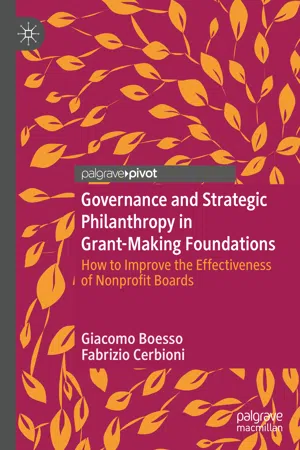
Governance and Strategic Philanthropy in Grant-Making Foundations
How to Improve the Effectiveness of Nonprofit Boards
- English
- ePUB (mobile friendly)
- Available on iOS & Android
eBook - ePub
Governance and Strategic Philanthropy in Grant-Making Foundations
How to Improve the Effectiveness of Nonprofit Boards
About this book
This book discusses the role of grant-making foundations in supporting local communities, and how effective governance can contribute to greater success of the social projects they finance. The book considers the extent to which granting foundations act as social investment banks or strategic philanthropists, and identifies possible areas of evolution and improvement in the granting process of foundations similar to other innovative firms. It seeks to explore the possibility of foundations becoming a reference point in the Third Sector for innovativeness and risk taking.
Information
© The Author(s) 2019
Giacomo Boesso and Fabrizio CerbioniGovernance and Strategic Philanthropy in Grant-Making Foundationshttps://doi.org/10.1007/978-3-030-16357-0_11. Social Role, Strategic Profiles and Management Tools of Foundations
Giacomo Boesso1 and Fabrizio Cerbioni1
(1)
University of Padua, Padova, Italy
Abstract
The institutional activity of Granting Foundations consists of the indication and selection of projects and initiatives aimed at the pursuit of social interest objectives, which precisely because of their lack of “economic benefits”, would hardly be able to find financial cover.
Granting Foundations play the role of “development engine”, by working closely with other Third Sector entities, and of “specialised operators”, whose human and financial resources are offered in the service of social issues.
This chapter illustrates the main business features of organisations operating in the Third Sector:
- mission
- corporate governance
- operations
- accountability
Good governance can go beyond the classic function of planning and controlling the activity of the Non-Profit operator. Boards’ action can provide “additional” resources, mainly intangible, represented by the expertise of the administrators and their willingness to support the organisation and its projects to increase their probability of success.
Foundations can also borrow planning and control tools from the business world and three accounting documents for planning and control are discussed:
- the annual report
- the social report
- the project budget
Keywords
Foundations roleStrategic profilesIn This Chapter,1 You Will Learn About:
- The important social role played by Granting Foundations in supporting the Non-Profit Sector;
- Granting Foundations’ peculiar “corporate” features;
- Strategic profiles;
- How an effective governance system can contribute to the success of supported social projects;
- Classification of Foundations;
- Programming and control tools for Foundations.
1.1 The Growing Social Role of Foundations
Numerous studies analyse the social and philanthropic processes that grant-making Foundations put in place in close cooperation with grants’ beneficiaries. The often argued thesis identifies the governing bodies of Foundations as the most suitable environments to conduct studies and experiments aimed at improving the efficiency and the effectiveness of the philanthropic process. The proposed operational logic is similar to that of a social “investment bank”, with a grant-making policy that tends to encourage the funding of some worthy ideas as well as to support the operational development of social projects.
In this book, the analysis of the benefits that can derive from an effective governance of grant-making Foundations also extends, with the appropriate specifications, to other Non-Profit operators such as operating Foundations, service cooperatives and associations.
The governance system of Foundations is a central element for the success of the initiatives undertaken by Non-Profit organisations. In fact, good governance can go beyond the classic function of planning and controlling the activity of the Non-Profit operator. Boards’ action can provide “additional” resources, mainly intangible, represented by the expertise of the administrators and their willingness to support the organisation and its projects to increase their probability of success.
This chapter discusses some of the recent proposals regarding the role that Foundations can play in supporting the Non-Profit Sector by focusing primarily on how an effective governance system can contribute to the success of supported projects, to the professional growth of beneficiary organisations and to the positive impact of funded initiatives.
The world of Foundations is taking a central role in Europe and the USA in funding valuable initiatives from the social standpoint. Contemporary Foundations deploy a subsidiarity function with respect to increasingly meagre public funding for important sectors such as: culture, psychological and physical discomfort, poverty, minors, healthcare, education, scientific research, infrastructures, the protection of the territory and artistic heritage, sports and so on.
Several observers speak of “private welfare” to summarise the growing involvement of private actors in important public and social projects (Prewitt et al. 2006). To better understand the important role of Foundations (whether founded by individuals, businesses, families or banks) in the contemporary society, it is useful to frame them in a dual perspective in relation to the role they can play interacting with other Non-Profit operators. On the one hand, Foundations can be seen as “external relations facilitators” if they are interpreted as local development engines and change agents that optimise and leverage their frequent interactions with other Non-Profit operators (associations, cooperatives, etc.). On the other hand, they can be considered as “internal relations optimisers” if they are interpreted as specialised operators whose human and financial resources are offered in the service of social issues. Foundations’ resources, however, are conferred by the community to which they belong and, accordingly, are subject to its careful scrutiny (who governs them, with what working tools, with how much transparency and so on).
Both of these points are dealt with in the following paragraphs.
1.1.1 Foundations, Non-Profit Sector and Private Welfare
The Non-Profit Sector is represented by private institutions that pursue social and public ends by adopting specific legal forms characterised by the “not for profit principle” (associations, committees, funding foundations, operating foundations, cooperatives, voluntary organisations, non-governmental bodies, mutual aid entities, ecclesiastical bodies, etc.). Sometimes they are accredited as “social enterprises” if compliant with the relevant regulatory requirements.2 The principle of “absence of profit” is concerned with the statutory choice not to distribute any operating surplus to the promoters or founders of these private entities and is not to be interpreted as an uneconomical management, loss or otherwise ineffective conduct of these institutions.
Non-Profit organisations and private For-Profit businesses need an economic management geared at long-term autonomous survival. However, in Non-Profit organisations often the revenue (or income) generating process just only indirectly relates to cost (or expenditure) support. Non-Profit entities, in fact, are often more oriented towards obtaining contributions from outside parties for supporting specific projects than real revenue gains. This system is defined as “Third Sector” because it is complementary and integrated with respect to the other two main drivers of the economic system: the State and the Market.
The activity of Third Sector Institutions is fundamental for the good of the community and their initiatives “embrace” all major social areas: arts and culture, education, social assistance, philanthropy and volunteering, research, healthcare, local promotion, sport and recreation, international activities, religious activities, promotion and protection of civil rights and so on (Kania et al. 2014).
In developed countries, and in general in the world, the Non-Profit Sector shows concrete signs of vitality and has gained a strong recognition from the public for its marked subsidiarity in the organisation and management of essential public services. The Center for Effective Philanthropy (CEP) in the USA reports 87,000 Foundations, USD 60 billion of grants and USD 865 billion of assets. Foundations are a segment of the 1.6 million of Non-Profit organisations. In Europe, Lang Italia Foundation reports: €25.3 billion of grants in the UK; €23.8 in Germany and €9.1 in Italy.
This book will present and discuss data about Italy. Italian Foundations provide an ideal research environment because of the country’s sharp reduction in governmental social spending after the 2008 financial crisis, which increased the importance of private Foundations in supporting significant social causes. Furthermore, it is worth noticing that the modern philanthropy was probably born in Italy during the renaissance (fourteenth to seventeenth century), when rich and dominant families started their patronage of arts and culture.
Currently, in Italy from 2001 to 2016 private Non-Profit organisations increased their delivery of social and public goods far above 100%. The official Italian census figures record: 292,000 volunteer associations; 15,600 social cooperatives and 7500 Foundations. The first reports of AltraEconomia (2009) record 174,000 entities; 1.4 million jobs (6% of the total national) and 700,000 volunteers. The first report from Unicredit Foundation (2012) estimates the economic value of the Third Sector in €67 billion, indicating 257,000 entities and over 629,000 employees. The experimental results discussed for Italy in the following chapters can be easily extended to other civil law countries (Austria, Germany, France, etc.) as well as, with proper adjustments, to common law countries (UK, USA, etc.).
For the merits acquired on the field, the organisations belonging to the Third Sector are recognised as important actors in the construction of so-called social capital. Through the production and exchange of goods and services of public interest, they are able to contribute to the creation of ever increasing shares of the domestic product (estimated at around 3.5% in 2007 by the European Union and 4.3% in 2012 by the Unicredit Foundation).
Meritorious initiatives carried out by the Third Sector (often without any economic return) can be supported by fundraising that the proponent organisations carry out among citizens, or donations (grant) that other specialised third sector players provide...
Table of contents
- Cover
- Front Matter
- 1. Social Role, Strategic Profiles and Management Tools of Foundations
- 2. The First Survey on the “Governance” of Foundations: The Original Model
- 3. The Second Survey on the Governance and Actions to Support Strategic Philanthropy: The Integrated Model
- 4. Data on Governance and Strategy of Italian Foundations
- 5. A Virtuous Symbiosis: Determinism and Solidarity in the Strategic Action of Foundations
- 6. Conclusions
- Back Matter
Trusted by 375,005 students
Access to over 1.5 million titles for a fair monthly price.
Study more efficiently using our study tools.
Frequently asked questions
Yes, you can cancel anytime from the Subscription tab in your account settings on the Perlego website. Your subscription will stay active until the end of your current billing period. Learn how to cancel your subscription
No, books cannot be downloaded as external files, such as PDFs, for use outside of Perlego. However, you can download books within the Perlego app for offline reading on mobile or tablet. Learn how to download books offline
Perlego offers two plans: Essential and Complete
- Essential is ideal for learners and professionals who enjoy exploring a wide range of subjects. Access the Essential Library with 800,000+ trusted titles and best-sellers across business, personal growth, and the humanities. Includes unlimited reading time and Standard Read Aloud voice.
- Complete: Perfect for advanced learners and researchers needing full, unrestricted access. Unlock 1.5M+ books across hundreds of subjects, including academic and specialized titles. The Complete Plan also includes advanced features like Premium Read Aloud and Research Assistant.
We are an online textbook subscription service, where you can get access to an entire online library for less than the price of a single book per month. With over 1.5 million books across 990+ topics, we’ve got you covered! Learn about our mission
Look out for the read-aloud symbol on your next book to see if you can listen to it. The read-aloud tool reads text aloud for you, highlighting the text as it is being read. You can pause it, speed it up and slow it down. Learn more about Read Aloud
Yes! You can use the Perlego app on both iOS and Android devices to read anytime, anywhere — even offline. Perfect for commutes or when you’re on the go.
Please note we cannot support devices running on iOS 13 and Android 7 or earlier. Learn more about using the app
Please note we cannot support devices running on iOS 13 and Android 7 or earlier. Learn more about using the app
Yes, you can access Governance and Strategic Philanthropy in Grant-Making Foundations by Giacomo Boesso,Fabrizio Cerbioni in PDF and/or ePUB format, as well as other popular books in Politics & International Relations & Corporate Governance. We have over 1.5 million books available in our catalogue for you to explore.