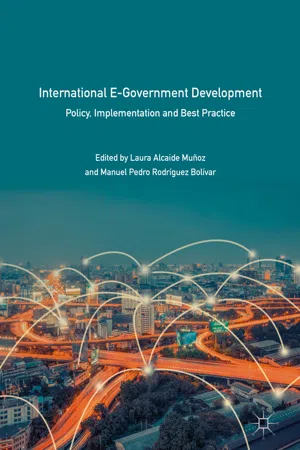
This book provides an examination of e-Government frameworks and maturity stages in governments around the world, including an overview of the legal frameworks that have supported them. Divided into three sections, the first part of this book analyses the theoretical context of current policies, codes of best practice and their implementation. The second section presents case studies which bring key issues to the fore including open government, privacy protection, social media, democracy, systems failures, innovations in inter-organizational e-government projects, and open data systems. The authors demonstrate the importance of the successful implementation of e-Government for improving managerial efficiency, public service delivery and citizen engagement, with special attention given to developing countries. The book concludes by drawing out the lessons learned from the latest research and recommending solutions for improving the implementation of e-Government in the future, thereby helping to achieve more transparent, participative and democratic societies. This book will provide an invaluable resource for researchers, policy-makers, public managers, international organizations and technical experts.
eBook - ePub
International E-Government Development
Policy, Implementation and Best Practice
- English
- ePUB (mobile friendly)
- Available on iOS & Android
eBook - ePub
International E-Government Development
Policy, Implementation and Best Practice
About this book
Information
E-Government Regulations, Guidelines, Code of Best Practices, Programs and Policies of International Organizations
© The Author(s) 2018
Laura Alcaide Muñoz and Manuel Pedro Rodríguez Bolívar (eds.)International E-Government Development https://doi.org/10.1007/978-3-319-63284-1_11. Experiences of E-Government Development Implementation in Developing Countries: Challenges and Solutions
Laura Alcaide Muñoz1 and Manuel Pedro Rodríguez Bolívar1
(1)
University of Granada, Granada, Spain
Laura Alcaide Muñoz (Corresponding author)
Manuel Pedro Rodríguez Bolívar
Laura Alcaide Muñoz
is Associate Professor in Accounting and Finance in the Department of Financial Economy and Accounting at the University of Granada. She is interested in E-government, E-Participation and Smart Cities. She has been author of numerous articles in leading SSCI journals (Business, Economics, Information Science and Public Administration) and has written book chapters in prestigious publications for IGI Global, Springer and Routledge-Taylor & Francis.
Manuel Pedro Rodríguez Bolívar
is Professor in Accounting at the University of Granada. He has authored numerous articles in leading SSCI journals and several book chapters published by Routledge, Kluwer Academic Publishers, Springer, Nova Publishers and IGI Global. He is author of full-length books and editor of books for Springer, Palgrave and IGI Global publishers. In addition, he is a member of the Editorial Board of Government Information Quarterly and Associate Editor for other leading international journals.
1.1 Introduction
In the past decade, many governments have made numerous efforts to innovate the public sector and implement e-government strategic projects , which many of them have adopted successfully while others have fallen by the wayside. These implementations and experiences have been collected in a number of studies and research projects published in different knowledge disciplines (Alcaide Muñoz and Rodríguez Bolívar 2015; Alcaide Muñoz et al. 2014).
Most e-Government research has been focused on developed countries, neglecting the area of developing economics (Rodríguez Bolívar et al. 2016). However, this analysis is of particular importance in developing countries because prior research has indicated that e-Government constitutes a central element in the process of modernizing the public sector (Chan and Chow 2007) and strengthening governance within democratic societies (Calista and Melitski 2007). In addition, academic studies have indicated that countries which invest more in e-Government achieve larger reductions in levels of corruption than those which do not make such investments (Andersen et al. 2011; Andersen 2009; UNDESA 2016).
In addition, many of these efforts fail because a great deal of e-Government implementations were not carried out in the end, were implemented but immediately abandoned, or were implemented but major goals were not attained and there were undesirable outcomes (Choi et al. 2016). Research in this field of knowledge shows that only an adequate implementation of e-Government, and its subsequent evolution and development, promotes the economic growth of the country (Serenko et al. 2010), especially developing countries (Lee et al. 2011), seeking contexts wherein to build solid structures for participatory democracies (Reddick 2011).
Therefore, the success in the implementation of e-Government is essential, with special attention paid to developing countries, since these countries have a limited number of resources at their disposal and cannot afford to waste the large amounts of money necessary to carry out e-Government projects (Weerakkody et al. 2009). Given the organizational transcendence and support with economic resources and political awareness that involves the adoption and implementation of Information and Communication Technologies (ICTs), knowledge of the conditions and processes of socio-technical change in developing countries acquires general significance for research and practice.
To acquire this knowledge, the analysis of research into e-Government initiatives implementation could be relevant. According to King (2004), the quality and quantity of scholarly publications reflect a nation’s scientific wealth and boost its economic prosperity. In fact, there is a positive relationship between the gross domestic product and the volume of scientific research (Serenko et al. 2010), which is particularly apparent in underdeveloped countries (Lee et al. 2011). Nevertheless, previous studies have highlighted that the academic research of information systems in developing countries are poorly understood (Liu and Yuan 2015; Alcaide and Rodríguez 2015). In this regard, we need to examine experiences in the implementation of e-Government in developing countries with the aim of identifying mistakes in order to correct and prevent them in the future. Similarly, it is also relevant to highlight challenge s that the political leaders of developing countries have to face in adopting e-Government initiatives.
So, the objective of this chapter is to highlight the challenges , problems and recommended solutions for improving the implementation of e-Government in developing countries in the future, which could help to achieve more transparent, participative and democratic societies. To this end, this chapter is organized as follows. Section 1.2 describes the context and importance of e-Government in developing countries. Then, Section 1.3identifies the limiting factors that hinder the successful implementation of e-Government in developing countries and, examine possible and recommended solutions for preventing failed implementation in the future. Finally, the discussions and conclusions section (Section 1.4) reflects on issues raised in the chapter.
1.2 Importance of E-Government in Developing Countries
Previous studies highlighted that e-Government promotes civic engagement by enabling the public to interact with government officials (Susha and Grönlund 2014; Cheng et al. 2015), providing greater access to government information, making government more accountable and reducing corruption (Andersen 2009; Andersen et al. 2011), and delivering higher quality services to citizens (Sá et al. 2016). Therefore, the implementation and adoption of e-Government has many advantages for governmental organizations around the world, given that it can support integrated services delivery in the economic, social and environmental dimensions of sustainable development, while also supporting integration across these three dimensions (UNDESA 2016; Estevez and Janowski 2013).
However, this development of e-Government has not occurred equally in all countries. The United Nations e-Government Survey 2016 (UNDESA 2016) shows that the number of countries with a low e-Government Development Index (EGDI) value remains at 32 in 2016, out of which 29 are least developed countries. So, in the light of this data, there is the risk that the digital divide persists and remains anchored in time in developing countries, despite many developments and efforts carried on in many countries.
The United Nations’ Programme of Action (UN 2011) shows that low productive capacity and structural challenges , as well as lack of ICT infrastructure and limited access to technologies are related problems and limitations, which continue to challenge e-Government advancement in developing countries. These technological issues provoke system incompatibility and problems in the use of e-Government applications, which, in turn, generate distrust in citizens when using e-Government services, platforms, apps and tools (Arendsen et al. 2014). Therefore, it is important that the political leaders and public managers in developing countries have clear ideas of how to provide universal access to quality services while ensuring coherent decisions, developing integrated policies and increasing effectiveness, transparency and accountability .
But to achieve these goals, governments of developing countries must take many decisions and undertake coordinated actions plans, i.e. political leaders and managers in the public sector will need a more strategic, integrated and sustained approach that is ambitious yet focused, with realistic commitments towards sustainable development and concrete ways to ensure the inclusiveness of online services (Axelsson et al. 2013). These countries will need to avoid the technocratic approach to e-Government which means providing basic online services and irrelevant websites, given that the use of ICT is not merely a cost or labour saving tool, but should go further (UN 2002).
Previous studies have highlighted that e-Government, coupled with smart and timely governmental policies, has the potential to reach development objectives faster and at a lower cost than conventional approaches (Brown and Thompson 2011). But developing countries need to make enormous efforts to provide and develop an ICT infrastructure in order to improve access to knowledge and technologies. In this way, governments will respond to their citizens increasingly varied and complex needs, as well as the persistent call for new, better and faster public services .
Together with the provision of appropriate and modern ICT infrastructure, the governments of developing countries must face the limited internet access of certain sectors of the population—the so-called digital divide —(Zhao et al. 2014). To deal with this problem, political leaders and governmental organizations should provide communal access through village computer centres or kiosks, and combine access with training courses, communication programmes and promotion campaigns on the importance of using the Internet in everyday life (Atkin et al. 2008; Schuppan 2009).
Also, access to ICT infrastructure and the provision of education, including ICT literacy, ar...
Table of contents
- Cover
- Frontmatter
- 1. E-Government Regulations, Guidelines, Code of Best Practices, Programs and Policies of International Organizations
- 2. Actions Plans in Specific Countries: Case Studies
- 3. Initiatives Undertaken, Good Practices and Lessons Learned in Other Countries
- Backmatter
Trusted by 375,005 students
Access to over 1.5 million titles for a fair monthly price.
Study more efficiently using our study tools.
Frequently asked questions
Yes, you can cancel anytime from the Subscription tab in your account settings on the Perlego website. Your subscription will stay active until the end of your current billing period. Learn how to cancel your subscription
No, books cannot be downloaded as external files, such as PDFs, for use outside of Perlego. However, you can download books within the Perlego app for offline reading on mobile or tablet. Learn how to download books offline
Perlego offers two plans: Essential and Complete
- Essential is ideal for learners and professionals who enjoy exploring a wide range of subjects. Access the Essential Library with 800,000+ trusted titles and best-sellers across business, personal growth, and the humanities. Includes unlimited reading time and Standard Read Aloud voice.
- Complete: Perfect for advanced learners and researchers needing full, unrestricted access. Unlock 1.5M+ books across hundreds of subjects, including academic and specialized titles. The Complete Plan also includes advanced features like Premium Read Aloud and Research Assistant.
We are an online textbook subscription service, where you can get access to an entire online library for less than the price of a single book per month. With over 1.5 million books across 990+ topics, we’ve got you covered! Learn about our mission
Look out for the read-aloud symbol on your next book to see if you can listen to it. The read-aloud tool reads text aloud for you, highlighting the text as it is being read. You can pause it, speed it up and slow it down. Learn more about Read Aloud
Yes! You can use the Perlego app on both iOS and Android devices to read anytime, anywhere — even offline. Perfect for commutes or when you’re on the go.
Please note we cannot support devices running on iOS 13 and Android 7 or earlier. Learn more about using the app
Please note we cannot support devices running on iOS 13 and Android 7 or earlier. Learn more about using the app
Yes, you can access International E-Government Development by Laura Alcaide Muñoz, Manuel Pedro Rodríguez Bolívar, Laura Alcaide Muñoz,Manuel Pedro Rodríguez Bolívar in PDF and/or ePUB format, as well as other popular books in Politics & International Relations & Hardware. We have over 1.5 million books available in our catalogue for you to explore.