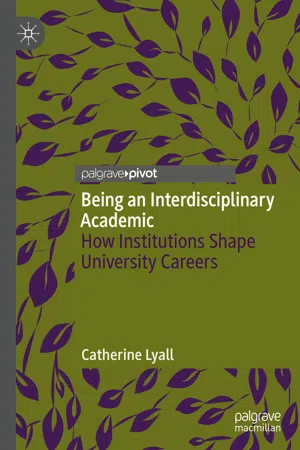
eBook - ePub
Being an Interdisciplinary Academic
How Institutions Shape University Careers
- English
- ePUB (mobile friendly)
- Available on iOS & Android
eBook - ePub
About this book
This book highlights the importance of interdisciplinarity in the academic landscape, and examines how it is understood in the context of the modern university. While interdisciplinarity is encouraged by research funders, academics themselves receive mixed messages about how, when and whether to follow this route. Building upon a series of career history interviews with established interdisciplinary researchers, the author reveals fundamental misunderstandings about the nature of interdisciplinary knowledge, how this is shared, and the skills these researchers bring. The book addresses these issues on both a personal and systemic level, identifying how a resilient researcher can craft their own research trajectory to view interdisciplinarity as a truly embedded approach.
Information
Topic
EducationSubtopic
Education General© The Author(s) 2019
Catherine LyallBeing an Interdisciplinary Academichttps://doi.org/10.1007/978-3-030-18659-3_11. Introduction: Mixed Messages for the Interdisciplinary Research Community
Catherine Lyall1
(1)
School of Social and Political Science, The University of Edinburgh, Edinburgh, UK
Keywords
Individual interdisciplinariansMethodologyResearch sampleTerminologyVice Rectors of ResearchInterdisciplinary research may have become a cornerstone of research policy internationally (e.g. European Commission 2007; National Science Foundation 2006; National Academy of Sciences 2005; Bammer 2013) but is still widely regarded as not having achieved its full potential (League of European Research Universities, LERU 2016). This limited achievement is due in large part to persistent—and well-documented obstacles—within academic structures traditionally built upon single disciplines (e.g. LERU 2016; Lyall et al. 2011, 2013; Lyall and Fletcher 2013). The core purpose of this book is to investigate what this rift between rhetoric and reality implies for those who wish to either foster, or to pursue, interdisciplinary academic careers.
In what follows, I present empirical data collected through a series of interviews with individuals who practise interdisciplinary research in contradistinction to those who promote it. What this reveals is a manifest misalignment between the high-level strategic pronouncements that institutions, such as universities and research funders, make about wanting to support interdisciplinarity and the actuality of what it means to be an interdisciplinary researcher trying to forge an academic career and scholarly identity. While the vision and strategy might exist, operationalising those in practice was regarded by fellow academics as being far less developed, highlighting the mismatch between interdisciplinary expectations and the prevailing norms of discipline-based scholarship.
One might be forgiven for assuming that “interdisciplinarity” is the new zeitgeist in academia given the apparent attention paid to it by funders and policymakers (e.g. Global Research Council 2016). Nevertheless, implementation of interdisciplinary research is by no means universal.1 While there are undoubtedly pockets of excellence (or at least good practice), one could reasonably argue that the university sector in the UK is still approaching interdisciplinarity as “a trend rather than a real transition” (Rhoten 2004).
The downsides of interdisciplinary research within an academic context are well established (e.g. Lowe et al. 2013) and it has certainly not achieved the status of a mainstream activity within British universities. Academic recognition, in the form of promotion, prizes or membership of professional bodies, still predominantly comes from established disciplines. The majority of the world’s leading research-intensive universities are still organised along disciplinary lines. Disciplines help to organise knowledge for teaching and for quality assessment purposes. The more one strays outside disciplinary frames, the harder it may be to demonstrate one’s depth and pertinence of expertise and hence to pursue what is conventionally deemed a “successful” academic career.
Interdisciplinary research and innovation have become conclusively linked in the minds of policymakers and research funders (e.g. UKRI 2018). There is, today, a general consensus within national and international research policy that many striking research advances take place at the boundaries between disciplines, leading in some cases to the emergence of new fields (e.g. nanotechnology, synthetic biology). At the same time, issues of global concern, such as climate change or ageing populations, demand that we find new approaches to combine insights from different disciplines and bodies of knowledge. So, in a sense, this provides an answer to the question: why do interdisciplinary research. However, for every policy statement and publication promoting this “new”2 mode of research, there are detractors (e.g. Abbott 2001; Jacobs and Frickel 2009) who still value a narrower perspective, arguing that this brings greater depth of insight. This theme of breadth versus depth is fundamental and one to which I return at various points in the book.
Even more significant for the theme of this book is the question of who conducts this research. Modern universities still predominantly privilege disciplinary over interdisciplinary work (Aldrich 2014, p. 61). Academics who come from a strong disciplinary foundation, work in a team-based interdisciplinary collaboration but can then return to their discipline, face fewer career obstacles than those who do not associate strongly with a single discipline and who have been trained from the outset to work across disciplines (see e.g. Hess 2018). Arguably, the former group sits much more comfortably within existing institutional governance structures.3 The latter group, those who do not have an immediately obvious disciplinary “home”, experience rather different impediments to their academic careers and are the primary focus of this book.
Our identities, and our career progression, as academics seem irrefutably bound to disciplines (in the context of both our research and teaching). This leads to the “paradox of interdisciplinarity” (Weingart 2000; Woelert and Millar 2013) where interdisciplinary research is often encouraged at policy level but poorly rewarded by funding instruments and academic structures.4 In promulgating greater interdisciplinary capacity building, do we then risk training future generations of scholars who will feel like strangers in their home departments, inhabiting uncomfortable liminal spaces within their institutions?
The British Academy (2016, p. 10) has urged its constituency to “develop an academic home and remain attached to it” even while being encouraged to connect with those working in different disciplines. In contrast, other commentators embrace much earlier engagement with interdisciplinarity, arguing that
[p]ostponing interdisciplinary work to the time a researcher is well established means that such research is generally pursued as a side activity….this means that the inventiveness and creativity of younger scholars is discouraged from going into interdisciplinary work, slowing down this work, making it intellectually and practically less attractive. (Sperber 2003, quoted in Henry 2005)
There is an expanding literature on the hazards of interdisciplinarity for early career researchers trying to foster an academic career (e.g. Golde and Gallagher 1999; Graybill et al. 2006; Pfirman and Begg 2012; Martin and Pfirman 2017). Interdisciplinary research has been deemed “career suicide” for young researchers (Bothwell 2016) but systematic investigation of interdisciplinarity’s longer-term effects on academic careers is sparse (Leahey et al. 2017; Millar 2013). One of the central motivations for writing this book is that the UK research community apparently finds it difficult to recruit adequately experienced interdisciplinary researchers (LWEC 2012). In contrast, Callard and Fitzgerald (2015, p. 12) have suggested that “the risks of interdisciplinarity aren’t what they used to be” and that these negative opinions are “overemphasized”. Consequently, one of my key goals has been to explore whether well-established truisms about interdisciplinary careers do indeed still hold true in an area of research policy where researchers—and especially those at the start of their academic career—receive very mixed messages.
Avoiding Terminological Minefields
“Interdisciplinarity” is a word that denotes a spectrum of experience: while the term may have become ubiquitous, it is also contested, so that it is indeed “a term that everyone invokes and none understands” (Callard and Fitzgerald 2015, p. 4), a “catch-all” term (Bammer 2016), often used imprecisely in a variety of contexts.
Research policy (and indeed the policy community at large) invariably makes the mistake of talking about “interdisciplinarity” as if it is one, unified approach to research. While attempts are being made to bring greater coherence and integration to the field (Bammer 2013), in reality it is much more nuanced. Experiences of interdisciplinary research may be very different depending on whether it takes place between proximate disciplines (i.e. within the social sciences, the natural sciences, the medical sciences, or the arts and humanities) or involves much more distant disciplines, for example, spanning the social sciences and natural sciences. This prompts Barry and Born (2013, p. 5) to ask how we might better understand interdisciplinarity as “a field of differences”.
Taken to extremes, contestation around terminology in this field can verge on “theological hair-splitting” (Rylance 2015) so, rather than revisit these debates in great detail, I propose to adopt the following broad definition:
Interdisciplinary research (IDR) is a mode of research by teams or individuals that integrates information, data, techniques, tools, perspectives, concepts, and/or theories from two or more disciplines or bodies of specialized knowledge to advance fundamental understanding or to solve problems whose solutions are beyond the scope of a sing...
Table of contents
- Cover
- Front Matter
- 1. Introduction: Mixed Messages for the Interdisciplinary Research Community
- 2. “What Am I?” The Path to Becoming an Interdisciplinary Academic
- 3. “Are You One of Us?” How Institutions Impact Interdisciplinary Careers
- 4. The Nets We Weave: Consequences for Interdisciplinary Capacity Building
- 5. Facilitating Serendipity?
- 6. Towards New Logics of Interdisciplinarity
- 7. Conclusion: “The Funding Can Only Do So Much”
- Back Matter
Trusted by 375,005 students
Access to over 1.5 million titles for a fair monthly price.
Study more efficiently using our study tools.
Frequently asked questions
Yes, you can cancel anytime from the Subscription tab in your account settings on the Perlego website. Your subscription will stay active until the end of your current billing period. Learn how to cancel your subscription
No, books cannot be downloaded as external files, such as PDFs, for use outside of Perlego. However, you can download books within the Perlego app for offline reading on mobile or tablet. Learn how to download books offline
Perlego offers two plans: Essential and Complete
- Essential is ideal for learners and professionals who enjoy exploring a wide range of subjects. Access the Essential Library with 800,000+ trusted titles and best-sellers across business, personal growth, and the humanities. Includes unlimited reading time and Standard Read Aloud voice.
- Complete: Perfect for advanced learners and researchers needing full, unrestricted access. Unlock 1.5M+ books across hundreds of subjects, including academic and specialized titles. The Complete Plan also includes advanced features like Premium Read Aloud and Research Assistant.
We are an online textbook subscription service, where you can get access to an entire online library for less than the price of a single book per month. With over 1.5 million books across 990+ topics, we’ve got you covered! Learn about our mission
Look out for the read-aloud symbol on your next book to see if you can listen to it. The read-aloud tool reads text aloud for you, highlighting the text as it is being read. You can pause it, speed it up and slow it down. Learn more about Read Aloud
Yes! You can use the Perlego app on both iOS and Android devices to read anytime, anywhere — even offline. Perfect for commutes or when you’re on the go.
Please note we cannot support devices running on iOS 13 and Android 7 or earlier. Learn more about using the app
Please note we cannot support devices running on iOS 13 and Android 7 or earlier. Learn more about using the app
Yes, you can access Being an Interdisciplinary Academic by Catherine Lyall in PDF and/or ePUB format, as well as other popular books in Education & Education General. We have over 1.5 million books available in our catalogue for you to explore.