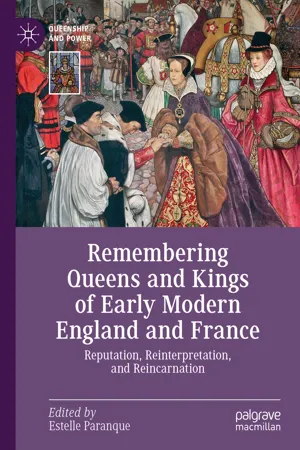
eBook - ePub
Remembering Queens and Kings of Early Modern England and France
Reputation, Reinterpretation, and Reincarnation
- English
- ePUB (mobile friendly)
- Available on iOS & Android
eBook - ePub
Remembering Queens and Kings of Early Modern England and France
Reputation, Reinterpretation, and Reincarnation
About this book
This collection examines the afterlives of early modern English and French rulers. Spanning five centuries of cultural memory, the volume offers case studies of how kings and queens were remembered, represented, and reincarnated in a wide range of sources, from contemporary pageants, plays, and visual art to twenty-first-century television, and from premodern fiction to manga and romance novels. With essays on well-known figures such as Elizabeth I and Marie Antoinette as well as lesser-known monarchs such as Francis II of France and Mary Tudor, Queen of France, Remembering Queens and Kings of Early Modern England and France brings together reflections on how rulers live on in collective memory.
Information
© The Author(s) 2019
Estelle Paranque (ed.)Remembering Queens and Kings of Early Modern England and FranceQueenship and Powerhttps://doi.org/10.1007/978-3-030-22344-1_11. Introduction: Remembering, Forgetting, and the Power of Memory
Estelle Paranque1
(1)
New College of the Humanities, London, UK
Estelle Paranque
I am incredibly indebted to Jo Eldridge Carney and Carole Levin, who have revised drafts of this introduction. Thank you so much for your help.
End Abstract“The historian’s representation is indeed a present image of an absent thing; but the absent thing itself gets split into disappearance and existence in the past.”1 Historians, sociologists, philosophers, and other thinkers have spent centuries wondering about how to represent something that is absent, that no longer occurs, that is, the past. Even though history seems to disappear as soon as it unfolds itself, historians have for many centuries aimed and still aim to understand, analyze, and reimagine that past in part to make sense of the present, but also distinguish something that is unimaginably different, but has potentially familiar fragments.
Political rulers in particular continue to attract the attention of historians who seek to understand them not just within the context of their own time period and reigns, but in their afterlives. Understanding how rulers in the past have been represented, remembered, and reimagined not only allows us to grasp the different and complex representations of leadership that have existed but also enables us to examine the social construction behind these reputations and their influence on collective memory and shared identity. Moreover, we are often compelled to position our knowledge of previous rulers with and against current political leadership, and the comparison is often mutually informative.
This collection of chapters focuses on early modern English and French kings and queens, examining past representations, the shaping of rulers’ reputations in premodern literature, their reinterpretation in art, and their reincarnation in popular culture. It is invaluable to examine memories of French and English kings and queens as the histories of these two countries, particularly in the period the chapters discuss, were so intertwined with alliances, wars, and intermarriage between the royal houses. As a result, the political landscape often featured family fighting family, cousins trying to destroy other cousins—or members of both countries collaborating for a common goal. Among those who are discussed in this collection, Henry VIII’s younger sister Mary became, at least briefly, Queen of France, and Henry IV’s youngest daughter Henrietta Maria became Queen of England. Henry VIII’s second wife Anne Boleyn spent much of her formative youth in France and her daughter Elizabeth was courted by a series of French princes.
It is undeniable that European early modern rulers still garner enormous interest and influence our understanding of modern societies. In her work on how representations of modern monarchies allow the rise of nationalist movements, Milinda Banerjee argues “spectres of dead kings are haunting the world today.”2 Historians’ attempts to understand an era are not confined to the study of great rulers, but a particular reign is often where such a study begins as we try to learn how they influenced their time and shaped it. These rulers accomplished things we might celebrate or deplore; they may have promoted admirable advances culturally or politically, and they may have also shaped hierarchal and oppressive political systems and ideologies. Historians seek to understand how rulers acted not as an isolated phenomenon, for their actions inevitably influenced what followed. Centuries after their death, these political figures and leaders that have shaped France and England remained part of our common history and have helped us build a shared identity. Historians endeavor to make sense of their reign for our present society.3
Why is it so important to remember early modern monarchs? First, because the ways in which they were represented after their death show us how societies have evolved and shaped their ruling model from premodern monarchs’ own style of rulership. Second, it also demonstrates that representations are intertwined with reputations and influence, shedding light on the cult of power but also on the cult of personalities. European premodern kings and queens were important political players and were remembered as such, but through memory other images take form and are remembered as celebrities in their own right.
Remembering can take place through different spectrums: reputation, reinterpretation, and reincarnation. This collection features a series of case studies that offer new examinations of particular historical monarchical figures through these various lens: reputation through literature, reinterpretation through arts, and reincarnation in popular culture.
Remembering Through Reputation
While the Oxford English Dictionary defines reputation as “the beliefs or opinions that are generally held about someone or something,”4 one only has to look at the play Othello to see concerns and anguish about reputation in the early modern period. In part of it was Othello’s reputation—“his honors and his valiant parts” (1.3.288) that led Desdemona to fall in love with him. While Cassio wails “Reputation, reputation, reputation! Oh, I have lost my reputation! I have lost the immortal part of myself, and what remains is bestial” (2.3.281–2), the cynical villain Iago responds that “[r]eputation is an idle and most false imposition” (2.3.287–8). But Iago does not know how significant reputation—the reputation for honor—is, and it is that knowledge that leads him to destroy Othello’s reputation and eventually his life. At the end of the play Othello decries “I am not valiant neither,” and questions why honor should outlive honesty (5.2.291) Those especially in the public sphere are deeply aware how important it is to create a good reputation and fear the political and social impact if that reputation is harmed. Sometimes reputations become so dominant it is difficult to reassess them. While early modern queens and kings shaped their own reputations through speeches, letters, and portraits, often events helped develop their reputations for good or ill in ways that were beyond control. And the ways in which their reputations were remembered after their deaths varied and evolved.
In the first part of this volume, five chapters tackle rulers’ reputations through premodern literature and examine how in the decades and even centuries following a queen or a king’s death some reputations emerged and took hold in our modern preconception of that said queen or king. Carole Levin focuses on the parallels between two iconic queens: Boudicca and Elizabeth I. Through meticulous research, Levin examines how Boudicca was remembered in the centuries after her death, including during Elizabeth I’s reign, and then reveals the parallels that can be drawn between the two queens regarding how they were both remembered in the seventeenth and eighteenth centuries.
Chapter 3 discusses Mary Tudor, queen of France’s romanticized reputation in a seventeenth-century love story written by Jean de Préchac, a courtier and author at the French court. Valerie Schutte demonstrates that a sixteenth-century French queen and English princess were still part of a shared identity and a focus of interest over a century after her death. In Chap. 4, Stephanie Russo explores how Anne Boleyn was remembered by three female writers in the long eighteenth century, whose works represented the English queen in a new light. More complicated than previous depictions of “whore or martyr,” Anne Boleyn remained a subject of interest centuries after her execution and has drawn attention of novelists and historians alike, making them reassess her fatal demise and reshape her reputation.
Chapter 5 focuses on Edward VI of England’s legacy regarding the English Reformation and how his reputation as a king influenced it in the second half of the sixteenth century and in the seventeenth century. This reassessment of Edward’s reputation is paramount to understanding the foundational narratives of the Reformation and to what extent Edward’s actual political power played a role in his posthumous representation. The last chapter of this section examines how Richard Hurd presented Elizabeth’s reign to his contemporaries, emphasizing the importance of the nobility during her reign and reimagining an Elizabethan England where the last Tudor queen was only a voice among her chivalric nobles.
This section of the volume provides complementary chapters on how English and French kings and queens were represented in premodern literature. Boudicca, Elizabeth I of England , Anne Boleyn, Edward VI of England, and Mary Tudor queen of France remained part of a shared identity, and their memory was used as a means to understand and cross bridges between societies that kept evolving throughout centuries. Their reputations also evolved and changed over time; being remembered in premodern literature could mean having reputations distorted or romanticized, but more importantly it showed that these monarchs were still part of a collective memory.5
Remembering Through Reinterpretation
Following the death of those who are powerful, politicians, scholars, artists, and others have found...
Table of contents
- Cover
- Front Matter
- 1. Introduction: Remembering, Forgetting, and the Power of Memory
- Part I. Reputation in Premodern Literature
- Part II. Reinterpretation in Art
- Part III. Reincarnation in Popular Culture
- Back Matter
Trusted by 375,005 students
Access to over 1.5 million titles for a fair monthly price.
Study more efficiently using our study tools.
Frequently asked questions
Yes, you can cancel anytime from the Subscription tab in your account settings on the Perlego website. Your subscription will stay active until the end of your current billing period. Learn how to cancel your subscription
No, books cannot be downloaded as external files, such as PDFs, for use outside of Perlego. However, you can download books within the Perlego app for offline reading on mobile or tablet. Learn how to download books offline
Perlego offers two plans: Essential and Complete
- Essential is ideal for learners and professionals who enjoy exploring a wide range of subjects. Access the Essential Library with 800,000+ trusted titles and best-sellers across business, personal growth, and the humanities. Includes unlimited reading time and Standard Read Aloud voice.
- Complete: Perfect for advanced learners and researchers needing full, unrestricted access. Unlock 1.5M+ books across hundreds of subjects, including academic and specialized titles. The Complete Plan also includes advanced features like Premium Read Aloud and Research Assistant.
We are an online textbook subscription service, where you can get access to an entire online library for less than the price of a single book per month. With over 1.5 million books across 990+ topics, we’ve got you covered! Learn about our mission
Look out for the read-aloud symbol on your next book to see if you can listen to it. The read-aloud tool reads text aloud for you, highlighting the text as it is being read. You can pause it, speed it up and slow it down. Learn more about Read Aloud
Yes! You can use the Perlego app on both iOS and Android devices to read anytime, anywhere — even offline. Perfect for commutes or when you’re on the go.
Please note we cannot support devices running on iOS 13 and Android 7 or earlier. Learn more about using the app
Please note we cannot support devices running on iOS 13 and Android 7 or earlier. Learn more about using the app
Yes, you can access Remembering Queens and Kings of Early Modern England and France by Estelle Paranque in PDF and/or ePUB format, as well as other popular books in History & British History. We have over 1.5 million books available in our catalogue for you to explore.