This book offers scholars who ground their research in compassion and pacifism a new framework for the socio-political analysis of current global events. By tackling a broad range of critical themes in various disciplines, the essays compose a critical narrative of the ways in which power and violence shape society, culture, and belief. In addition to the contemporary dynamics of international economics, political murder, and the rhetorical antagonism between Christianity and Islam, the book addresses cultural strife in the West, the societal effects of neoconservative hegemony in the United States and the world, and the overall question of religious credence in connection with political action. All such topics are discussed with a view toward providing solutions and policies that are informed by a comprehensive desire to resist violence and war, on the one hand, and to fomentcohesion and harmony at the community level, on the other.
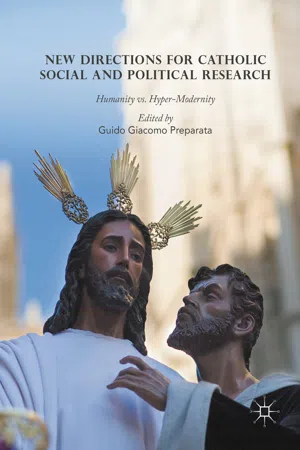
eBook - ePub
New Directions for Catholic Social and Political Research
Humanity vs. Hyper-Modernity
- English
- ePUB (mobile friendly)
- Available on iOS & Android
eBook - ePub
New Directions for Catholic Social and Political Research
Humanity vs. Hyper-Modernity
About this book
Information
Topic
Theology & ReligionSubtopic
Christian Theology© The Author(s) 2016
Guido Giacomo Preparata (ed.)New Directions for Catholic Social and Political Research10.1007/978-3-319-33873-6_11. Introductory: Hyper-Modernity
Guido Giacomo Preparata1
(1)
Pontifical Gregorian University, Rome, Italy
The science and scholarship that is the peculiar pride of civilized Christendom is not only international, but rather it is homogeneously cosmopolitan; so that in this bearing there are, in effect, no national frontiers; with the exception, of course, that in a season of patriotic intoxication, such as the current war has induced, even the scholars and scientists will be temporarily overset by their patriotic fervor. Indeed with the best efforts of obscurantism and national jealousy to the contrary, it remains patently true that modern culture is the culture of Christendom at large, not the culture of one and another nation in severalty within the confines of Christendom.—Thorstein Veblen, The Nature of Peace 1
This project came into being by assembling a team of pacifist scholars and activists to take stock, collegially, of the current state of social and human affairs. The point of departure was for each, in his field, to assess the situation and describe the extent to which the Social Doctrine of the Church—and that is to say, to certain extent, the Holy See as a political actor—has failed to address the various issues in which the Church is supposed to play a leading role. The question, then, was to suggest how one may move forward and correct the trajectory in order to remedy visible shortcomings. This sort of project has coalesced into what we here propose as a methodological manifesto, as a choral approach to the social sciences and the humanities. It is not presented or intended to be a “Catholic thing.” Our appeal, instead, is to the entire front of progressive activism. We think it is a timely and necessary initiative—namely, to have a “platform” for sociopolitical research written from the progressive camp at a time when the so-called Neoliberal/Neoconservative consensus has virtually wiped out any kind of intellectual opposition, on the one hand, and, on the other, the so-called Left is, we believe, a wasteland ambivalently controlled by the postmodern movement, which seems no less conservative than Neoliberalism and, as such, disinclined to address what we think are the essential problems of our era: for example, the damages of nationally defined economic hegemony, the paean of individualism, and the unquestioned espousal of the “globalizing” culture.
The Problematic Areas Are Essentially Three: Politics, Economics, and Discourse
Politically, the main contention here is that we now find ourselves living in a strident exasperation of the conventionally modern setting postdating the fall of the Berlin Wall. The geopolitical game has been the same for the past 100 years, with the USA carrying the torch of the former British empire in preventing (by whatever means it may take), as it typically must go, any kind of political coalescence along the eastern ridge of what could have been Walter Rathenau’s imaginary dukedom of Mittel-Europa. To this end, Balts, Poles, Czechs, and Romanians (and Ukrainians) are holding hands to form one long and hostile cordon, separating one sweep of Europe, the “good” one, from another, the bad, “Asiatic” one. NATO, of course, directs the choreography. In other words, the imperatives are to keep Germany on a tight leash, Europe austere, and Russia as far away as geo-spiritually possible. All of which has lately been garnished by a particularly distasteful intrigue, of the “Oriental” sort, fomented on our southern and southeastern reaches, by agitating anew Old Venice’s old Turkish specter, revamped this time around as the “Islamist” of the sinister Caliphate. The Islamist moonlights more often than not as a “terrorist,” or, when the deployment is thicker, as an “insurgent.” A convenient and obvious prop of destabilization, this “angered other” from the Mohammedan expanses is, in truth, but the bitter harvest of an idle, barbarized, and identity-less sub-proletariat, fit to be manipulated in any sandy scenario whatsoever: anyone who has seen the Near East knows this. This alleged “Jihadist” has been thrown into the mix, so to speak, a decade and a half ago, to suggest, or better, to fulfill the “prophecy” that we would all be mired into an issueless Clash of Civilizations. As a learned characterization of the late international “situation,” this last, we know it, too, is hogwash; the Clash of Civilizations is a Western sport—all of it: the Arabizing screenplays, the deployments, the weapons, the “accursed” expense (Bataille’s dépense), and the (Westerners’) unremitting urge to command far and wide, for the disgraceful sake of which, all such foulness has been set into perpetual motion. Truthfully, this “Near-eastern” generalized geo-strategic morass, passed off by the current “Liberal” rhetoric as the unmanageable congeries of particularistic, ethnic-laden strife, is, of course, yet another “theater” of the self-same “game,” whose proximate object is to keep the Eurasian exchequer as thinly fragmented as possible, especially around those nodes—viz., the late case of Syria—through which further connectors and arteries—be they pipelines or vast highways—could be unrolled to tie the one forlorn swath of Eurasia to the other. Syria, to cite but one recent instance of such administered “shocks,” has now suffered near annihilation from a five-year, brutal, and disfiguring conflict plausibly motivated by the underlying exigency to cleave the zone into scraps, 2 or rather, bones, three of them: i.e., as many as the exploitable fault lines creasing the region, whatever they may be, will allow to exscind: one to the Shi’ites, one to the Sunnis, and one to the embattled Kurds and their peacock. This and similar other conflicts are, as a rule, “Vietnamized,” so to speak, by expending hordes of these “Islamists,” vicariously armed, supplied, and regimented by Near-eastern satrapies, chiefly Turkey, and sheikdoms, which, jointly and severally, gravitate in the orbit of the USA and her European proximities. In this bearing, the state of nightmarish dereliction that has enveloped Iraq since its “second capture” in 2003, otherwise expected at the time to transform Mesopotamia into a proconsular jewel of “democratic pluralism,” appears, then, condign to the logistical decision to employ the area as the Spartan launching pad for laying waste to the vicinity.
One conspicuous by-product of these geo-strategic obscenities is the recent phenomenon of the massive migrant waves of indigents and asylum-seekers to the shores and gates of Europe. The migrant hemorrhaging from war zones has mostly come from Syria and Libya. Notoriously, these mass movements conjoin both economic and geopolitical dynamics, whose individual and separate reasons and histories, however, have been merged in the ensuing public debate into one big blur. The European Right, whose electoral fortunes had hitherto suffered a marked decline, has been clearly boosted by what it could, enthusiastically, decry as the destabilizing onslaught of a barbarian invasion, whereas the institutional Left, presently deporting itself as the Pretorian guard of the supranational technostructure, while condemning the opponents as soulless fascists, appealed to everyone’s good heart for “letting them all in.” As it always is, the conventional polarization on this issue is fomented by the tactical scruple to conceal ulterior transactions; a surmise, this last, all the more instinctive as the suggestion of adversarial interplay between Right and Left generally is, even upon a distracted scrutiny, undone by the temperamental hypocrisies of the parties involved. When the business cycle allows it, foreign slave labor, with or (preferably) without papers, filters in effortlessly, above all cheered by Right-wingers, who thereupon rave to their constituencies about the unique opportunity for the community as a whole to enjoy the priceless cultural “diversity” which all such “others” bring to (the neatness of the toilets, lodgings, and hedges of) the Nation. The Left cheers so, too. When times are “tight,” instead, such as they are now, the Right, in the goodly name of Law and Order, raises walls to keep “the other” out, yet the Left, usually buttressed by the conventional armada of international organizations and their coterie of non-profit satellites feistily pushing for the “effacement of nationhood,” insists on absorbing as many as the situation compels it to, without truly offering, however, any rhyme or reason as to its admittance criteria, procedures, or logistical action-plans(s). By default, these loads of refugees and migrant workers, once inside, are shoveled into metropolitan ghettoes, where, speaking of “ulterior transactions,” they may be expected, under the current regime’s tacit encouragement of interethnic and interreligious animosity (“respect for diversity”), to pigment all of Europe’s urban peripheries, like America’s (finally…), with the tribal marks of multi-ethnic and multi-religious apartheid. Out of ghettoes thus remodeled, in turn, it might not be entirely unwarranted to presume that radicalized contingents of home-bred misfits of foreign origin and creed—a whole diversified gamut of them, in fact—could sprout in sufficient numbers as to provide “indigenous” material for an indoor game of provocation and ricochet under cover of an all-European “War on Terror”—itself, quite obviously, understood, officially, as the dramatic and unintended result of (unstoppable) ethnic “empowerment.”
The other half of the migration issue is poverty, with Africa still providing the main egress to the diaspora. Whose fault? One wonders: it has been at least 40 years since the West, in full global regalia, took a symphonic stand to denounce the hunger and the plethora of injustices surrounding the ravages of famines, dearth, and pandemics, which, notoriously, continue to this day, as potently as then. Allegedly, the consequent establishment of a colossal apparatus of financial and research institutions, public and private, devoted to “foreign aid” and “feeding the world” has colossally failed. Wars, exploitation, and genocide persist: in truth, the white absentees have never left their old, famished colonies. It must be so if, indeed, the chief two developments which have lately been hailed as the miraculous antidotes to hunger and poverty are transgenic food and microfinance. Though there have been plenty of sinister warnings as to the nefarious impact of so-called genetically modified organisms (GMOs), most of us, through personal ignorance and misinformation, remain in no position to assess definitely the biological valence of these organisms. And though we may not know exactly, we possess, however, enough intuition to shudder at the thought of what a manipulation so profoundly alien to Nature as a GMO could possibly wreak on the world’s environment and fauna, and, of course, on humanity’s health. Even better do we intuit, and shudder no less at the economic rationale behind the process, which is simply that of patenting, that is, privatizing, the earth’s and humanity’s common-core seeds, that is, the source of our nutriment at the very foundational level: a design which can only be construed as nothing short of monstrous. Microfinance, on the other hand, has been a clever ploy, not devoid of grand entrepreneurial foresight (it won its inventor a Nobel Prize). What it proposed was, factually, to harness the six billion have-nots to the proprietary banking grid of the one billion haves by an interface, a local banking outfit, whose “alluring” business proposition was, to put it coarsely, a tenfold reduction of three-figure loan-sharking rates to the more manageable two-figure usury of microcredit—a mitigation: two ounces instead of a full pound of flesh. More than anything, microfinance owed its political anointment to its shimmering promise of turning static misery into dynamic wretchedness. It, too, has been grandiloquently sold as yet another tool of female empowerment; poor females.
As for the economic condition of our time, suffice it to say in these preliminary pages that ours, if at all necessitous of a novel appellation, is the age of “offshoring.” Globalism/globalization does not exist; it is a self-gratulatory and bombastic label that was perhaps coined to occult the palpable lack of change in the basic routines of business enterprise, the only variation being, as said, the late practice of delocalizing anything delocalizable: the fantastic odysseys of call centers that have set sail from California to Punjab or from Latium to Budapest, and of cowboy apparel stitched in Cambodia are sufficiently well known as to excuse further reflections on this count. Barring transformative occurrences of a drift wholly alien to the ongoing management of international affairs, American leadership appears, in the foreseeable future, to auspicate the regression of the world’s economy into the compartmentalization of a vaster space of commercial exchange under its attentive supervision. Imagine such a space divided chiefly into an Atlantic and a Pacific sector, and crisscrossed by formidable fleets of chartered corporate outfits, seaborne and airborne. Pepsi’s aircraft carriers with air cover from Procter & Gamble’s squads of F-35s would course in the glorious wake of the East India Company to wage new Opium Wars, while flexible ground troops would be pushing upstream to quarantine Russia ever more stringently. For its part, finance, which never was the tyrannizing fetish recently reviled with culpable ingenuousness in pop iconography, will appositely continue to play its subaltern, though richly rewarded, role in keeping with the higher directives of the Elder Statesmen. This is a story we shall recount in Chapter 9 (“The Political Economy of Hyper-Modernity”).
The discursive stakes of the game appear to be not inconsiderable. So much so that in order to deflect attention from the basic elements of the case such as they are, the propagandistic apparatus of the West has, for the past generation, taken remarkable pains to convince us all, instead, that ours is unequivocally the “postmodern epoch,” the “postmodern moment.” An epoch that is “complex,” too complex, in fact, contradistinguished as it putatively is by the end of universals and certitudes; the exacerbation of “difference”; the invasion of “sculpted bodies”; all kinds of menacing “feminine” avatars out of Pandora’s box; unrelenting ethnic and devout feuding; multi-polarity for lack of a single imperial “center”; and, impregnating it all, “liquidity.” (Liquidity?) If anything, the world of, say, 1910, gauged in terms of complexity—what with its Balkan chicaneries, interlocked nebulae of Social Revolutionaries, the esoteric jockeying behind prewar alliances, and titanic industrial mutations—appears far more recalcitrant to linear theorizing than the contemporary era. If anything, the world of today is far simpler than yesterday’s: as mentioned at the outset, it is but an aggravation of trends, traits, and vogues, which have come into full maturation over the course of the past century and are now suppurating in a state of pathological hypertrophy typically indicative of an unraveling da fine impero. Ours is not an era of difference but one of flattening conformism, of uniformization; women are not empowered, they rather strive to comport themselves like men, who look ever more like machines. There is no menace from Islam, and unless deliberately and systematically instigated, which it is, ethnic strife, precisely because cultural difference substantially dissolves in the Anglophone mainstream, does not really belong to the common drift of things anymore. The view from the rooftops in Cairo, Amman, and Damascus yields a mirror stippled with satellite dishes all pointing West. 3 There is nothing postmodernly awkward about any of this; we are moving toward the end of the line, before the next discrete leap along the ongoing descent. Culturally, America is, owing to her indubitable dynamism and unrivaled creative tempo, dominant; Europe is moribund, China, for the time being, a mere copycat, and Russia, who knows? Small wonder, then, that everybody craves a piece of the Anglophone mainstream; if one could only purge this unchallenged US standard of its idolatry of violence, and couple the cleansing with a genuine peace overture across Eurasia, there might be a chance after all.
And where does the Church fit in all this? It is hard to say, considering how in arrears she appears to be on virtually every significant front of social action. Except for its charitable undertakings, chiefly though not exclusively through Caritas, and the sedulous labor of its diplomatic corps, which allegedly never sleeps, Catholicism is at the forefront of nothing. Indeed, the Church suffered deeply the advent of modernism for obvious reasons; she suffered in particular the rupture of communal bonds via the creation of vast labor markets. And the culture of hedonism gave her the coup the grâce. “The place in men’s esteem once filled by church and state,” wrote Veblen in 1918, “is now held by pecuniary traffic, business enterprise.” 4 Clearly, the acceleration, such as that characterizing “hyper-modernity,” of a transformative process, which the Church took in stride unsympathetically, could not but aggravate the discomfort. In this protracted state of general malaise, despite her best pastoral efforts, the Church seems to be suffering, more than anything, from a guilt-ridden presentiment of being, in the final analysis, completely insignificant. To begin, she has not been capable in over a century of producing a single influential intellectual, 5 let alone a whole class of maîtres à penser, which she would have sorely needed. As a consequence, she has no science worth speaking of, despite Veblen’s solemn evocation of Christendom’s faded glories. Because her so-called Social Doctrine is, at heart, a compendium of homiletic platitudes—a form of “catechism on steroids,” as it were—the Church has not been able to form in her clergy a proper and structured sensitivity to socioeconomic analysis and policy. In ecclesiastical universities, rather than being shepherded into the study of the social sciences, seminarians and priests, and the future diplomats in their midst, are obdurately cut to size, instead, by the grinding motions of a perfectly bootless trivium of philosophy, theology, and canon law. And, even worse than this, unforgivably so, is Catholicism’s decision to subcontract the entire social science offerings of its own denominational schools to the Malthusians of the Liberal academy. And so it is that such colleges, Catholic only in name, presently pride themselves on the ranking of their heavily endowed business schools, where, for the most part, upper-middle-class scions are taught to blend the proprieties of pious decorum with a transcendental awe for the microeconomic principle of scarcity to the joint satisfaction of donors and chaplains.
It must be that the spiritual “quid” the priests-educators are asked in exchange for the pecuniary “quo” (the endowment) does not allow for more than this. In any event, Catholicism, at present, possesses no programmatic ideas of its own. Politically, as said, save for the diplomatic effort, which, in any case, is not the affair of the flock since it must remain sub rosa, Vatican pronouncements have not been equal to the gravity of the contemporary situation: as wars are exclusively fought to expand imperium, it would behoove world peace if a center as influential as the Holy See would denounce them overtly and punctually, naming names and exposing the belligerents’ intentions, rathe...
Table of contents
- Cover
- Frontmatter
- 1. Introductory: Hyper-Modernity
- 2. Blasphemous Speech in a Secular Society: An Anachronism?
- 3. Epidemiological Research, Individualism, and Public Health
- 4. Unspeakable: James W. Douglass, Non-violence, and Political Murder
- 5. The Neoconservative Influence on American Catholics, 1950–2015: Smothering Pacifism in the Cradle
- 6. René Girard and Modernity’s Apocalypse
- 7. On the Science of Discord The “Diabolic” Idiom of French Postmodernism and the “Politics of Diversity” in America
- 8. The Political Scripting of Jesus: Utilizing the Savior Story to Exercise Power Today The Debate over Vatican Censures, Apocrypha, and Literary Interpretations
- 9. The Political Economy of Hyper-Modernity A Tale of America’s Hegemonic Exigencies Recounted Through the Undulations of the US Balance of Payments (1946–2015)
- 10. “The Blueprint” A Modest Monetary and Organizational Proposal for Re-launching the Economic Welfare of Communities
- Backmatter
Trusted by 375,005 students
Access to over 1.5 million titles for a fair monthly price.
Study more efficiently using our study tools.
Frequently asked questions
Yes, you can cancel anytime from the Subscription tab in your account settings on the Perlego website. Your subscription will stay active until the end of your current billing period. Learn how to cancel your subscription
No, books cannot be downloaded as external files, such as PDFs, for use outside of Perlego. However, you can download books within the Perlego app for offline reading on mobile or tablet. Learn how to download books offline
Perlego offers two plans: Essential and Complete
- Essential is ideal for learners and professionals who enjoy exploring a wide range of subjects. Access the Essential Library with 800,000+ trusted titles and best-sellers across business, personal growth, and the humanities. Includes unlimited reading time and Standard Read Aloud voice.
- Complete: Perfect for advanced learners and researchers needing full, unrestricted access. Unlock 1.5M+ books across hundreds of subjects, including academic and specialized titles. The Complete Plan also includes advanced features like Premium Read Aloud and Research Assistant.
We are an online textbook subscription service, where you can get access to an entire online library for less than the price of a single book per month. With over 1.5 million books across 990+ topics, we’ve got you covered! Learn about our mission
Look out for the read-aloud symbol on your next book to see if you can listen to it. The read-aloud tool reads text aloud for you, highlighting the text as it is being read. You can pause it, speed it up and slow it down. Learn more about Read Aloud
Yes! You can use the Perlego app on both iOS and Android devices to read anytime, anywhere — even offline. Perfect for commutes or when you’re on the go.
Please note we cannot support devices running on iOS 13 and Android 7 or earlier. Learn more about using the app
Please note we cannot support devices running on iOS 13 and Android 7 or earlier. Learn more about using the app
Yes, you can access New Directions for Catholic Social and Political Research by Guido Giacomo Preparata in PDF and/or ePUB format, as well as other popular books in Theology & Religion & Christian Theology. We have over 1.5 million books available in our catalogue for you to explore.