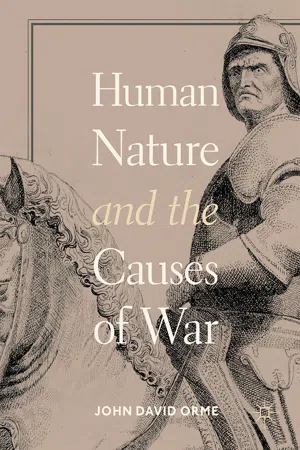
What are the causes of war? Wars are generally begun by a revisionist state seeking to take territory. The psychological root of revisionism is the yearning for glory, honor and power. Human nature is the primary cause of war, but political regimes can temper or intensify these passions. This book examines the effects of six types of regime on foreign policy: monarchy, republic and sultanistic, charismatic, and military and totalitarian dictatorship. Dictatorships encourage and unleash human ambition, and are thus the governments most likely to begin ill-considered wars. Classical realism, modified to incorporate the impact of regimes and beliefs, provides a more convincing explanation of war than neo-realism.
- English
- ePUB (mobile friendly)
- Available on iOS & Android
eBook - ePub
Human Nature and the Causes of War
About this book
Information
© The Author(s) 2018
John David OrmeHuman Nature and the Causes of Warhttps://doi.org/10.1007/978-3-319-77167-0_2Kings and Counselors
John David Orme1
(1)
Oglethorpe University, Brookhaven, GA, USA
Monarchy
Monarchy has been the most prevalent form of government in human history. Even in Europe, the region whose political culture was least supportive of the institution, only three republics had been established in the early twentieth century. 1 That there were risks to this concentration of authority was apparent to perceptive observers from the beginning. In the time of the Judges (circa 1200–1000 bc) “there was no king in Israel [and] every man did what was right in his own eyes.” 2 When the Israelites clamored for a king around 1000 bc “to govern us like all the nations,” Samuel warned them sternly:
These will be the ways of the king who will reign over you: he will take your sons and appoint them to his chariots and to be his horsemen, and to run before his chariots; and he will appoint for himself commanders of thousands and commanders of fifties, and some to plow his ground and to reap his harvest, and to make his implements of war and the equipment of his chariots. He will take your daughters to be perfumers and cooks and bakers. He will take the best of your fields and vineyards and olive orchards and give them to his servants. He will take the tenth of your grain and of your vineyards and give it to his officers and to his servants. He will take your menservants and maidservants, and the best of your cattle and your asses, and put them to his work. He will take the tenth of your flocks and you shall be his slaves. And in that day, you will cry out because of your king, whom you have chosen for yourselves, but the Lord will not answer you in that day. 3
After Israel’s acme under David, Samuel’s warning came to pass during the reign of Solomon, who imposed a crushing burden of taxation and forced labor on the Hebrews to maintain his 1400 chariots and 12,000 cavalry. When his foolish successor, Rehoboam, refused to heed the advice of elders to ease the peoples’ burden, threatening instead to “chastise [them] with scorpions,” they rose in a revolt that fragmented ancient Israel. 4
Why, in view of these risks, was monarchy so widely adopted? 5 The most insightful treatment of monarchy remains that of the Baron de Montesquieu. Montesquieu proposed a typology of governments based not only on their form but also their “principle,” the predominant passion animating its people. Republics are ruled by some (Aristocracy) or all (Democracy); their principle is civic virtue. Despotism is the rule of one according to his will, untrammeled by law; its principle is fear. Monarchy is the rule of one by ‘fixed and established law;’ its principle is honor. 6 Honor, for the nobility, is the desire for “preferences and distinctions,” especially those achieved in battle. The King is a member of the nobility and shares the values of that class. Hence, glory for the citizens, the state and the prince is the “purpose” of monarchy and “the spirit of monarchy is war and expansion.” 7
Montesquieu’s treatment of monarchy is less critical than it first appears. The foreign policy of monarchy is more rational and humane than that of despotism. A despot is capable of rapid decision making, but there is no check on his impulsiveness or errant judgment. Monarchs, constrained by law and some degree of institutional pluralism, are not so prone to reckless haste. 8 Because a monarch’s rule is legitimate, he can trust his subjects, making a defensive strategy involving fortification more feasible. 9 Montesquieu defines just war broadly enough to include preventive war to forestall grave threats. Although he condemns wars fought solely for the glory of the king, one may deduce that if the desire for glory motivates a ruler to eliminate a threat before it becomes imminent, the result would be praiseworthy. 10 Republics, by contrast, face a dilemma in providing for their defense. If they remain small enough to preserve the civic virtue that is their animating spirit, they are easily overmatched by despotisms, but if they expand in size to increase their power, the resulting differentiation of interests could diminish the public’s virtue. Monarchies, whose appeals to ambition produce “impressive” results, succeed without civic virtue. A confederation of smaller republics promises to resolve this dilemma, but the reader is left to wonder whether such an association could ever match the promptitude, unity and energy of regimes led by a single decision maker. 11
Montesquieu’s presentation clarifies why Samuel’s advice was so often rejected. The world has been a dangerous place: “a city without power risk[s] greater perils.” 12 The Israelites demanded a king because they were mortally threatened by the Philistines. 13 Only a powerful executive capable of assembling sufficient resources and applying them promptly and vigorously could guarantee a people’s survival. Discretionary executive power, animated by a desire for glory, was the most effective form of protection in a perilous world. Once constituted, however, that power could be abused at home and abroad. Those who granted such authority might endure the trials of the Hebrews under Rehoboam; but those who did not could meet the fate of the Canaanites. To be without a king in a world of kings was to risk destruction.
The wars of five monarchies will now be examined to determine how and why they went to war and with what consequences. The best guide through these complicated histories will be the Baron de Montesquieu.
The Wars of Louis XIV
Situation, Alternatives and Decisions
When Louis XIV’s personal rule began in 1661, France enjoyed greater security than at any time in the last three centuries. “All was calm in all places,” the King himself observed. The United Provinces (The Netherlands) were allied to France, neither Spain nor England posed an immediate threat and France’s eastern border was shielded by the Rhine League, an association of German states opposed to the Austrian Habsburgs. This favorable state of affairs was the achievement of Cardinal Mazarin, who had conducted French policy during Louis’s minority. Louis XIV squandered Mazarin’s inheritance within a decade, embroiling France in a series of lengthy and exhausting wars. 14
The aim of the first of these, the War of Devolution, was to seize territory from the Spanish Netherlands (modern day Belgium). A claim of the Queen provided the pretext. Louis rode to battle in May 1667 accompanied not only by his wife but also his two mistresses and a dozen other ladies of the court. His forces met little resistance from enfeebled Spain, but his success alarmed Europe. Several members of the Rhine League grew suspicious and refused to renew their alliance with France. The United Provinces broke off a war with England and began cooperating with her to restrain France. Compelled by this coalition to make peace with Spain, Louis was incensed at what he deemed the treachery of his erstwhile allies, who, in his mind, owed their very existence as an independent state to France. “[The Dutch] insolence struck me to the quick,” he exclaimed. 15
Sir William Temple, an English resident in and later ambassador to the United Provinces, stated:
that trade had brought “the most prodigious growth that has been seen in the world” with the result that the Dutch “have [been] treated upon an equal foot with all the great Princes in Europe.” He predicted, however, that “their vast trade, which was the occasion of their greatness [will also be] the one likewise of their fall, by having wholly directed the genius of their native subjects and inhabitants from arms to traffic and the arts of peace, leaving their whole fortune to be managed by foreign and mercenary troops, which much abased the courage of their nation and made the burghers of so little moment towards the defence of their towns.” 16
France struck back at the United Provinces in May 1672. Outnumbered, unprepared and initially isolated by French diplomacy, the Dutch could not stop the French offensive, which advanced to the heart of the Netherlands. Facing disaster, the Dutch offered gene...
Table of contents
- Cover
- Front Matter
- Human Nature, the Regime and War
- Kings and Counselors
- Heroes and Sultans
- Soldiers and Subordinates
- Despots and Demagogues
- Oligarchs, Democrats and Rebels
- Classical Realism and History: Findings and Implications
- Back Matter
Trusted by 375,005 students
Access to over 1.5 million titles for a fair monthly price.
Study more efficiently using our study tools.
Frequently asked questions
Yes, you can cancel anytime from the Subscription tab in your account settings on the Perlego website. Your subscription will stay active until the end of your current billing period. Learn how to cancel your subscription
No, books cannot be downloaded as external files, such as PDFs, for use outside of Perlego. However, you can download books within the Perlego app for offline reading on mobile or tablet. Learn how to download books offline
Perlego offers two plans: Essential and Complete
- Essential is ideal for learners and professionals who enjoy exploring a wide range of subjects. Access the Essential Library with 800,000+ trusted titles and best-sellers across business, personal growth, and the humanities. Includes unlimited reading time and Standard Read Aloud voice.
- Complete: Perfect for advanced learners and researchers needing full, unrestricted access. Unlock 1.5M+ books across hundreds of subjects, including academic and specialized titles. The Complete Plan also includes advanced features like Premium Read Aloud and Research Assistant.
We are an online textbook subscription service, where you can get access to an entire online library for less than the price of a single book per month. With over 1.5 million books across 990+ topics, we’ve got you covered! Learn about our mission
Look out for the read-aloud symbol on your next book to see if you can listen to it. The read-aloud tool reads text aloud for you, highlighting the text as it is being read. You can pause it, speed it up and slow it down. Learn more about Read Aloud
Yes! You can use the Perlego app on both iOS and Android devices to read anytime, anywhere — even offline. Perfect for commutes or when you’re on the go.
Please note we cannot support devices running on iOS 13 and Android 7 or earlier. Learn more about using the app
Please note we cannot support devices running on iOS 13 and Android 7 or earlier. Learn more about using the app
Yes, you can access Human Nature and the Causes of War by John David Orme in PDF and/or ePUB format, as well as other popular books in Politics & International Relations & Military & Maritime History. We have over 1.5 million books available in our catalogue for you to explore.