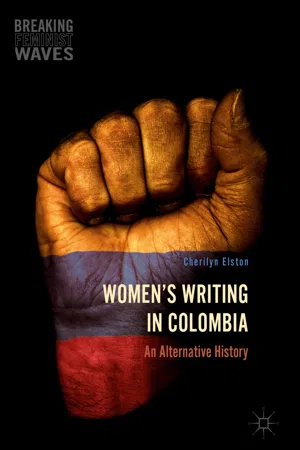
- English
- ePUB (mobile friendly)
- Available on iOS & Android
eBook - ePub
About this book
Information
© The Author(s) 2016
Cherilyn ElstonWomen's Writing in ColombiaBreaking Feminist Waves10.1007/978-3-319-43261-8_11. Introduction: Modernity’s Rebel Daughters
Cherilyn Elston1
(1)
SM2 6ER, UK
In Colombia in the late 1940s, in the city of Pereira, a young girl listens to the radio. It tells of how in Bogotá, the country’s capital, a civil conflict has begun after the assassination of a populist leader. Her mother moves the dial and the radio announcer’s shrill voice is replaced by the latest radionovela. In that same Andean capital, at the turn of the millennium, a woman narrates the difficulties of adjusting to civilian life after her demobilization from a left-wing insurgent group ten years ago. She remembers how she felt watching the Palace of Justice burn in 1985, knowing she had lost many compañeros in the siege. 1 Across the Atlantic in Paris, also in the mid-1980s, another woman recalls her adolescence in the Caribbean port city of Barranquilla in the 1950s. Looking at the young women around her, she reflects on the struggle of her generation for social and sexual freedom in the midst of a rapidly changing society. In the 2000s, a female activist in Medellín reflects on that same struggle. She thinks about the peace community of San José de Apartadó and imagines a feminist alternative to a country marked by war, violence and militarization. A few hundred miles away, back in Bogotá, another woman loses hope that the conflict will ever end. She also imagines the Colombian nation, but for her it is figured as a colonial house falling into ruin.
These examples are drawn from the lives and texts of Colombian women writing in the late twentieth and early twenty-first centuries. The juxtaposition of a series of distinct, yet somehow simultaneous, temporalities is deliberate. This book is a study of women’s writing and its relationship to feminist history in Colombia from the 1970s to the present. In a period dominated by the idea that feminism belongs to the past and where questions surrounding women and women’s writing are often side-lined in the academic arena, it may seem untimely to publish a book concerned with these themes and especially about a country not known for its feminist politics. Nevertheless, the extent and diversity of feminist theoretical work and practice in Colombia, and the texts written by women that engage with both feminism and the country’s particular social and political history, reveal the key role that feminism has played and continues to play in Colombian history. In 2008 I moved to Colombia where I began investigating the alternative canon of women’s writing, the history of feminism and contemporary women’s activism in the country. What my research began to reveal confounded the predominant historical and theoretical frameworks that I had been taught structured the story of feminism and women’s writing in Latin America. These had told me that feminism was a “Western” import to the continent, that Latin American feminist writing emerges in the 1980s with the so-called boom femenino (female boom) and that feminism had then been “exhausted” by the rise of postmodern theory.
This book is concerned with challenging these narratives. It questions the story that feminism is not “Colombian”, or even “Latin American”, and is supposedly a “Western” import deriving from white, middle-class, mainly European or North American theory, which has no relevance to the concerns of Latin American women. Alongside this it critiques the story that feminism suddenly emerges in Latin America in the 1980s with the rise of women’s social movements—a development that was paralleled by the emergence of women’s writing and Latin American feminist literary criticism—which then disappears as we move into a critical terrain defined by the poststructuralist critique of identity politics and the predominance of a certain interpretation of “postmodern feminism”. I argue that by exploring the work of understudied women writers who have been neither included in the (masculine) canon or the canonized boom femenino—in this case the novelists Albalucía Ángel and Marvel Moreno, the testimonial writings of ex-guerrilleras Vera Grabe and María Eugenia Vásquez and the poets María Mercedes Carranza and Piedad Morales—we can reveal a more complex history of feminism and women’s writing in Colombia, which has lessons for our understanding of global feminisms and writing by women in general.
I am not alone in my desire to rethink the stories we tell about feminist politics, history and women’s writing in Colombia. Recent publications by Colombian feminist academics have also sought to challenge the silence regarding the feminist movement in the country and the way Colombian feminist history has been told. These include María Emma Wills’ Inclusión sin representación. La irrupción política de las mujeres en Colombia (1970–2000) (Inclusion without Representation: The Political Emergence of Women in Colombia) (2007), Doris Lamus Canavate’s De la subversión a la inclusión: movimientos de mujeres de la segunda ola en Colombia, 1975–2005 (From Subversion to Inclusion: Second-wave Women’s movements in Colombia, 1975–2005) (2010) and Diana Gómez Correal’s Dinámicas del movimiento feminista bogotano. Historias de cuarto, salón y calle. Historias de vida (1970–1991) (Dynamics of the Feminist Movement in Bogotá. Stories from the Bedroom, the Meeting Room and the Street. Life Stories (1970–1991) (2011). All of these works are inspired by the need to narrate an ignored history in a period in which feminism is presumed to have completed its goals. 2
This aim also motivates Florence Thomas’ 2006 text Conversaciones con Violeta (Conversations with Violet), where one of Colombia’s most prominent feminist intellectuals creates a dialogue with an imaginary daughter, Violeta—a young woman who has grown up in a world marked by the gains of the second-wave but sees feminism as another-ism—to convince her of the necessity of feminism today. The same metaphor is taken up in Gómez’s work, where the author, who comes from the same generation as the fictional Violeta, inverts it, terming those feminists of the 1970s such as Thomas “las Violetas”, in an attempt to overcome the historical invisibility of a generation of feminist activists. The titles and narrative frameworks of these texts very clearly evoke notions of temporal shifts and ruptures. Most importantly, they are underpinned by a common claim in recent feminist discourse that the goals of feminism have not been achieved. The radical subversive movement of the 1960s and 1970s, according to this narrative, has been both appropriated and depoliticized by its institutionalization and abandoned by new generations of women who have accepted the tenets of political individualism.
This is a story also commonly told about feminism in the West. As Clare Hemmings points out in her incisive study of the political grammar of feminist theory, Why Stories Matter (2011), this “loss” narrative is only one of a series of interlocking narratives that structure representations of the recent past of feminist history and theory. As the story goes, Marxist/socialist and essentialist radical feminism occupies the 1970s, which gives way to identity politics and postcolonial feminisms in the 1980s, which gives way to deconstructivist critiques of identity and poststructuralism in the 1990s, which in turn are now being challenged by new materialism (2011: 5–6). Depending on your opinion, this linear trajectory is either seen as progress (poststructuralism overcoming the essentialism of feminist theory), loss (the depoliticization of the feminist project and any unified category for progressive social change), or return (combine the lessons of postmodern feminism with a focus on materiality or embodiment to overcome the current impasse) (2011: 4–5). Hemmings rightly critiques these stories for fixing feminist history into a series of teleologies that simplify the complex trajectory of feminism over the last 40 years.
Intrinsic to this narrative, she also argues, is the idea that feminism originates in the West, marking “the subject of gender equality as Western, capitalist, and democratic” (2011: 9). The erroneous story always told about feminism is that of the autonomous activism of white, middle-class, urban women, beginning in the Anglophone world and then exported elsewhere. As Nancy MacLean critiques, “That story stars white, middle-class women triangulated between the pulls of liberal, radical/cultural and socialist feminism. Working-class women and women of color assume walk-on parts late in the plot, after tendencies and allegiances are already in place” (1999: 47). In this narrative, which erases the development of feminism elsewhere in the world, Latin American feminism—subsumed within the problematic category of “Third World feminism”—only assumes a “walk-on part” after the emergence of feminist theory and practice in North America and Europe. Thus scholars have often claimed that feminism is not “Latin American” or only arrived belatedly in the continent, as Anny Brooksbank Jones argued in an important work of Latin American feminist literary criticism of the 1990s:“Throughout the 1970s and early 1980s few signs of anything resembling a home-grown Latin American feminist movement were recorded” (1996: 201).
This inaccurate narrative, which situates Latin American feminism firmly in the move away from the socialist and radical feminist politics of the 1970s towards the postmodern identity politics of the 1980s, obscures what this book emphasizes is one of the most important features of the development of Latin American feminism and women’s writing in the twentieth century. So-called second-wave feminism was not belatedly imported from the West to Colombia but emerged from women’s activism in and dissatisfaction with Marxist and left-wing politics in 1960s and 1970s. As Gómez highlights in her excellent study of the feminist movement in Bogotá:
The participation of women in guerrilla movements, the representation of left-wing militancy and the consequences of revolutionary violence are consistent themes throughout Colombian women’s literature. This comes as no surprise considering the history of left-wing insurgency in Colombia and the large numbers of women who have participated in guerrilla movements and militant organizations, including many of the women writers studied here. However, this is a relationship, as Gómez points out, which is both conflicted and contradictory. Colombian feminists and women writers negotiated the complicated relationship between feminism and Marxism, deploying Marxist theories of history, modernity and violence, and placing specific feminist concerns behind the primacy of the ideological class struggle. Yet simultaneously, they also developed a sustained critique of Marxist theory, narrating the ambivalent position of women in left-wing organizations and criticizing the patriarchal logic of male-dominated revolutionary violence.Sin duda, el feminismo de la segunda ola, hija rebelde de la modernidad, está más cercana a las apuestas modernas que tienen cuna en el marxismo. No obstante, como el feminismo de la primera ola, esta es una hija rebelde que cuestiona los principios marxistas modernos ligados a lo político y a la construcción del conocimiento. (2011: 176)Without doubt, second-wave feminism, modernity’s rebel daughter, is closer to the modern ideas that are born with Marxism. However, like first-wave feminism, this is a rebel daughter that questions modern Marxist principles related to politics and the construction of knowledge.
This conflicted use and critique of Marxism in Colombian feminism and women’s writing is thus embedded in a broader, and likewise complicated, discussion of the relationship between feminism and modernity, as Gómez indicates. In her familial metaphor, from which the title of this introduction is taken, Gómez refers to feminism as “modernity’s rebel daughter”, for feminism, as we shall see throughout the work of the women writers studied here, is both formed by modernity at the same time as it rebels against it. On the one hand, feminism is rooted in the emancipatory narratives of the Enlightenment: it is “profundamente arraigada en la modernidad y, por lo tanto, en la concepción del yo emergente de la tradición humanista occidental” (profoundly rooted in modernity and therefore in the conception of the self as constructed by the Western humanist tradition) (Schutte, cited in Gargallo 2004: 61). However, at the same time, feminism cannot solely be defined as a metanarrative of modernity, as one of its main objectives has been to critique the patriarchal foundations of those metanarratives. As Rita Felski states, feminism, alongside postmodernism and postcolonialism, has “developed one of the most sustained and influential critiques of the Western philosophical and cultural tradition, exposing the patriarchal foundations of its ethical and epistemological assumptions and its claims to objective authority” (1989: 37). This tension between modernity and postmodernity has structured feminist debates over the last few decades, specifically the huge amount of literature engaging with the complex questions surrounding the relationship between feminism and postmodernism. Much of this, as Felski explains, engages debate about whether or not feminism should be considered postmodern: “Is feminism a child of modernity in a postmodern age? Or does feminism radically subvert the tradition of the Enlightenment?” (2000: 4).
However, the distinction between modernity and postmodernity for feminism is a false one. Felski also argues in Doing Time: Feminist Theory and Postmodern Culture (2000) that the modern and the postmodern are not unified and distinctive entities. Similar to Hemmings’ critique of the teleologies of feminist theory and history, she questions how despite postmodernism’s supposed undoing of teleological, linear and developmental ideas of history and truth, many discussions of postmodernism are told through a big historical narrative of epochal stages, for example, the shift from the modern to the post...
Table of contents
- Cover
- Frontmatter
- 1. Introduction: Modernity’s Rebel Daughters
- 2. La Violencia, Postmodernity and Feminism: The Nonsynchronicity of Albalucía Ángel
- 3. “Ni Engels, ni Freud, ni Reich”: Marvel Moreno as Boom/Post-Boom Writer
- 4. Una voz antifeminista? María Mercedes Carranza, Public Intellectual and “Postmodern” Poet
- 5. Testimonio in a Post-revolutionary Era: The Writings of Female Ex-combatants
- 6. Sexual Difference in Times of War: The Poetry of Piedad Morales and The Ruta Pacífica de las Mujeres
- 7. Conclusion
- Backmatter
Trusted by 375,005 students
Access to over 1.5 million titles for a fair monthly price.
Study more efficiently using our study tools.
Frequently asked questions
Yes, you can cancel anytime from the Subscription tab in your account settings on the Perlego website. Your subscription will stay active until the end of your current billing period. Learn how to cancel your subscription
No, books cannot be downloaded as external files, such as PDFs, for use outside of Perlego. However, you can download books within the Perlego app for offline reading on mobile or tablet. Learn how to download books offline
Perlego offers two plans: Essential and Complete
- Essential is ideal for learners and professionals who enjoy exploring a wide range of subjects. Access the Essential Library with 800,000+ trusted titles and best-sellers across business, personal growth, and the humanities. Includes unlimited reading time and Standard Read Aloud voice.
- Complete: Perfect for advanced learners and researchers needing full, unrestricted access. Unlock 1.5M+ books across hundreds of subjects, including academic and specialized titles. The Complete Plan also includes advanced features like Premium Read Aloud and Research Assistant.
We are an online textbook subscription service, where you can get access to an entire online library for less than the price of a single book per month. With over 1.5 million books across 990+ topics, we’ve got you covered! Learn about our mission
Look out for the read-aloud symbol on your next book to see if you can listen to it. The read-aloud tool reads text aloud for you, highlighting the text as it is being read. You can pause it, speed it up and slow it down. Learn more about Read Aloud
Yes! You can use the Perlego app on both iOS and Android devices to read anytime, anywhere — even offline. Perfect for commutes or when you’re on the go.
Please note we cannot support devices running on iOS 13 and Android 7 or earlier. Learn more about using the app
Please note we cannot support devices running on iOS 13 and Android 7 or earlier. Learn more about using the app
Yes, you can access Women's Writing in Colombia by Cherilyn Elston in PDF and/or ePUB format, as well as other popular books in Literature & Modern Literary Criticism. We have over 1.5 million books available in our catalogue for you to explore.