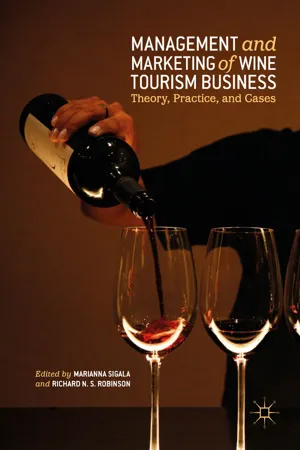
This book links research in wine marketing/management and wine tourism, offering international and multidisciplinary perspectives. Addressing the evolving nature of the wine tourism industry and market, the book brings in new research streams and technology advances such as; social media, customer empowerment and engagement, co-creation, social / responsible marketing and wine consumption. Each section includes an introductory chapter written by the editors discussing the aims and the chapters of the section. Section chapters provide theoretical and research based insights with practical implications, while every section is also complemented with case studies that further enrich the practice and industry implications of theory. Researchers will find in this book a holistic analysis of research and cases relating to the management and marketing of wine tourism businesses and visitors.
eBook - ePub
Management and Marketing of Wine Tourism Business
Theory, Practice, and Cases
- English
- ePUB (mobile friendly)
- Available on iOS & Android
eBook - ePub
Management and Marketing of Wine Tourism Business
Theory, Practice, and Cases
About this book
Information
© The Author(s) 2019
Marianna Sigala and Richard N. S. Robinson (eds.)Management and Marketing of Wine Tourism Businesshttps://doi.org/10.1007/978-3-319-75462-8_11. Introduction: The Evolution of Wine Tourism Business Management
Marianna Sigala1 and Richard N. S. Robinson2
(1)
University of South Australia, Adelaide, SA, Australia
(2)
University of Queensland, Brisbane, QLD, Australia
Keywords
WineTourismEvolution, researchResearchTrends, demand, supply, co-creation, strategiesInnovation, experiencesIntroduction
Over recent years, wine tourism has been increasing in volume and importance all over the globe. The growth of wine tourism is driven by reinforcing powers between a demand pull and a supply push. Wine tourism has evolved into a popular lifestyle leisure and tourism activity attracting and appealing to a great variety of market segments. Indeed, a transformed and diversified wine tourism demand reveals that wine tourism is no longer an activity strictly reserved for wine lovers wishing to enjoy wine tasting. Nor is wine tourism a pursuit of the elite and wine connoisseur alone. Instead, wine tourists of all manner go to wineries to also visit and immerse themselves into the winescape (the wine tourism terroir ) for experiencing and learning about the winery ’s landscape, scenery, traditions, culture and heritage . In fact, research findings show that the attractiveness and the authenticity of the winescape plays a more critical role in generating and driving wine tourism demand than the provision of high-quality wine (Kim and Bonn 2016; Sigala and Dimopoulou 2017). Research also shows that visitation of cellar doors leads to increased (direct) wine sales, customer education and relationship building that results in long term benefits for wineries (Hall et al. 2000). In this vein, satisfying the needs of the new wine tourism consumers by developing wine tourism experiences that embed the physical, cultural and natural resources of wine destinations and wineries has become a strategic priority for wineries and wine destinations alike.
The diversification of wine tourism into experiences beyond wine tasting and the cellar door as well as the appeal of wine tourism to attract a wide variety of people are explicitly reflected in widely known definitions of wine tourism. Wine tourism is conceptualised as:
…a form of consumer behavior based on the appeal of wine and wine regions , and a development and marketing strategy for the wine industry and destinations in which wineries and wine-related experiences are the dominant attractions. (Getz and Brown 2006, p. 147)…visiting wine-associated destinations to taste wine and have other favorable experiences . (Hall and Macionis 1998)
Wineries use wine tourism as a way to attract, educate and build long-term emotional and social ties with their guests and so, ultimately drive long-term financial, promotional and marketing benefits. Wine destinations consider and use wine tourism as a tourism development strategy that generates sustainable value through the promotion of sectoral synergies, particularly food (cf. Getz et al. 2014), but also arts, crafts other cultural activities, enabling multiplier economic effects and socio-cultural value by valorising local culture and empowering local communities and entrepreneurs (Bruwer 2003; Nella et al. 2013).
The increasing importance and growth of wine tourism has been followed by, and is also reflected in, the substantial influx of research in wine tourism (Bonn et al. 2018). However, the majority of wine tourism research has so far primary focused on definitional and developmental issues such as the conceptualisation and understanding of wine tourism and wine tourists (Hall and Prayag 2017), regional wine tourism development, the design of wine routes and branding and marketing of wine destinations . Actually, segmentation and motivational studies of wine tourists had been dominating wine tourism research (e.g. Alant and Bruwer 2004; Carmichael 2005; Getz and Brown 2006; Hall and Macionis 1998; Hall et al. 2000; Williams and Young 1999). On the other hand, there are very few studies focusing on issues related to the strategic development and operational issues of wine tourism businesses. Few studies exist related to strategic decision-making (Alonso et al. 2015; Lavandoski et al. 2016), entrepreneurship (Dawson et al. 2011), innovation (Alonso and Bressan 2016; Baird and Hall 2016) and recently social media for wine tourism marketing (cf. Alonso et al. 2013; Reyneke et al. 2011). Thus, there is a lack of systematic research to guide wine tourism business to effectively and efficiently develop and implement their strategies and product offerings.
Rapidly increasing competition at a local but also international scale also means that wine tourism firms face more challenges in attracting, maintaining and developing their visitor market share. As competition intensifies and the wine tourism market also becomes more sophisticated and diverse, the urgency to conduct more research in order to help wine tourism firms how to survive but also differentiate in this highly competitive world becomes more intense. To achieve that, research should start by paying more attention to the two major drivers and factors influencing the management of wine tourism businesses namely, the wine tourism demand and the wine tourism supply. The need to adopt a customer-focused and—oriented strategy is well documented in the literature and thus, research aiming to better understand and unravel the major factors influencing and driving change within the wine tourism market is a must, as has been noted previously (Cambourne et al. 2000). In addition, wine tourism firms that succeed are those that manage to design strategies that consider competitors’ actions, collaborate with other (different and even competing) firms and/or lead industry innovation . Thus, research looking into competitive issues relating to the wine tourism supply (such as innovation , differentiation and collaboration) is critically important for informing the management and marketing of wine tourism firms.
To better guide future research, the following sections identify and discuss the driving forces shaping and transforming wine tourism demand as well as wine tourism supply/firms. Ideas for future research are also provided.
The Transformed Wine Tourist
Profile and Behaviour of the Wine Tourism Market
Wine tourism research has been dominated by studies focusing on understanding the wine tourist profile and behaviour (Bonn et al. 2018). Studies have investigated issues related to: wine tourists’ experiences ; perceived value and service quality; motivations; socio-demographic and psychographic profiles and their relation to lifestyle; post-visit behaviours (Hall and Prayag 2017). Market segmentation studies have also revealed that psychographic profiles, similar to food tourism (e.g. Robinson and Getz 2014), can better identify discrete wine tourism groups and more effectively explain wine tourists’ behaviour in terms of their winery experiences , preferences and expenditures (Alonso et al. 2007). However, research aiming to understand wine tourists is reported to have failed to reveal the impact of cultural and country differences amongst wine tourists and motivations, as well as the impact of country and tourism destination branding and image on wine tourists behaviour (Bruwer and Sigala 2016). The latter is critically significant, as research increasingly shows that the brand image and reputation of both the wine terroir (country-of-origin impact) (Famularo et al. 2010) and the winescape (the difference of place of the tourist terroir , Bruwer 2003) critically affects wine tourists demand, selection and expenditure on wine products, experiences and destinations (Brown and Getz 2005). Moreover, because of these wine region effects on wine tourism demand, wine tourism suppliers and developers cannot strictly rely on international statistics of wine demand, while cross-regional comparisons become dangerous and diluting (Sigala and Bruwer 2016). Thus, there is an increasing need to study wine tourists on a country-to-country or better still on a region-to-region basis.
In addition, a deeper and updated understanding of consumer profiling and behaviour in wine tourism also becomes more paramount when considering the rapid evolution of the wine tourism offering and the continuous diversification of its market segments. As wine tourism is ...
Table of contents
- Cover
- Front Matter
- 1. Introduction: The Evolution of Wine Tourism Business Management
- Part I. The Market of Wine Tourism: Profiling, Segmentation and Behavior
- Part II. Capturing the Market: Marketing, Distribution and Promotion
- Part III. Experience Management in Wine Tourism: Design and Differentiation
- Back Matter
Trusted by 375,005 students
Access to over 1.5 million titles for a fair monthly price.
Study more efficiently using our study tools.
Frequently asked questions
Yes, you can cancel anytime from the Subscription tab in your account settings on the Perlego website. Your subscription will stay active until the end of your current billing period. Learn how to cancel your subscription
No, books cannot be downloaded as external files, such as PDFs, for use outside of Perlego. However, you can download books within the Perlego app for offline reading on mobile or tablet. Learn how to download books offline
Perlego offers two plans: Essential and Complete
- Essential is ideal for learners and professionals who enjoy exploring a wide range of subjects. Access the Essential Library with 800,000+ trusted titles and best-sellers across business, personal growth, and the humanities. Includes unlimited reading time and Standard Read Aloud voice.
- Complete: Perfect for advanced learners and researchers needing full, unrestricted access. Unlock 1.5M+ books across hundreds of subjects, including academic and specialized titles. The Complete Plan also includes advanced features like Premium Read Aloud and Research Assistant.
We are an online textbook subscription service, where you can get access to an entire online library for less than the price of a single book per month. With over 1.5 million books across 990+ topics, we’ve got you covered! Learn about our mission
Look out for the read-aloud symbol on your next book to see if you can listen to it. The read-aloud tool reads text aloud for you, highlighting the text as it is being read. You can pause it, speed it up and slow it down. Learn more about Read Aloud
Yes! You can use the Perlego app on both iOS and Android devices to read anytime, anywhere — even offline. Perfect for commutes or when you’re on the go.
Please note we cannot support devices running on iOS 13 and Android 7 or earlier. Learn more about using the app
Please note we cannot support devices running on iOS 13 and Android 7 or earlier. Learn more about using the app
Yes, you can access Management and Marketing of Wine Tourism Business by Marianna Sigala, Richard N. S. Robinson, Marianna Sigala,Richard N. S. Robinson in PDF and/or ePUB format, as well as other popular books in Business & Industria dell'ospitalità e del turismo. We have over 1.5 million books available in our catalogue for you to explore.