- English
- ePUB (mobile friendly)
- Available on iOS & Android
eBook - ePub
About this book
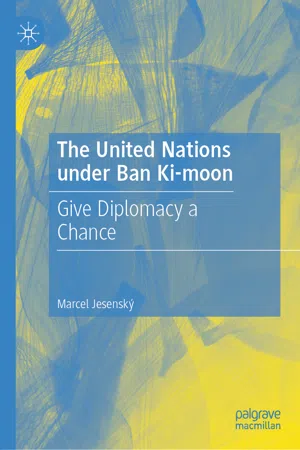
This book chronicles the story of the United Nations under Secretary-General Ban Ki-moon in the decade 2007–2016. Marcel Jesenský provides a compelling account of the organization's activities and Ban Ki-moon's role in reconciling the aims, principles and prerogatives of his office, the organization and its Charter with the demands, interests and power of the member states. Today, as never before, the concept of the post–World War II multilateral framework of international relations tries to harmonize the claims for its reform and re-evaluation with growing demands to manage the globalized world. This work, invaluable for readers interested in global governance, multilateral diplomacy, the United Nations and international relations, presents its subject in historical context and provides answers to assist its understanding.
Information
© The Author(s) 2019
Marcel JesenskýThe United Nations under Ban Ki-moonhttps://doi.org/10.1007/978-3-030-12220-1_11. Introduction: I Will Not Ban Anything
Keywords
Ban Ki-moonUN Secretary-GeneralUnited NationsDiplomacyMultilateralismInternational relationsThe sources for this book are UN documents, press releases and meetings coverage of the Security Council, General Assembly, Economic and Social Council , as well as other United Nations bodies. UN documents from the General Assembly, Security Council, Human Rights Council , Economic and Social Council and others are available on the UN documents website—https://www.un.org/en/documents/index.html—searched by symbol (e.g. A/72/1). Press releases and meetings coverage of the Security Council, General Assembly and other United Nations bodies are available on the website of the Meetings Coverage Section, United Nations Department of Public Information—https://www.un.org/press/en/advanced-search—under their symbol (e.g. SC/9021) or title (e.g. Press Conference by United Nations Special Coordinator for Lebanon) or/and date. The author has limited the facts of publication in the notes to a symbol, a meeting number and a date in most cases. The information on an access date and a URL is not referenced at each point as it is possible to positively identify and locate each source without them and accordingly to reduce the notes’ extent.
End AbstractHe said he does not want to be called “Mr. Ban”, because he is not planning to ban anything. He is not going to ban any constructive dialogue with the staff - definitely not. So it’s “bahn gee-moon.”Michele Montas, Spokesperson of the Secretary-General1
It has been often said that the twenty-first century would be an era of Asia Pacific. North-East Asia, that means China , Japan and the Republic of Korea, has been regarded as economically and socially dynamic region, commended, even envied, by many people around the world. On 1 January 2007 Korean diplomat Ban Ki-moon became the first Secretary-General from East Asia, further enhancing the region’s high profile in international area.2
The Charter of the United Nations makes the Secretary-General the chief administrative officer of the Organization, but at the same time bestows upon him an initiative on any matter which may threaten the maintenance of international peace and security. This dichotomy is captured by the ongoing debate among the scholars and practitioners whether and to what extent a UN chief should be more Secretary or a General. The literature on the Secretary-General offers three streams of writing on the role of office-holders: emphasizing importance of contextual factors for the office, accepting centrality of individual office-holder or considering the differences in the personal characteristics and leadership style of the Secretaries-General.3
Most scholars consider the political context—the activities of Member States and the international political environment—to be the most important factor to determine the role of the Secretary-General. This stream emphasizes the broader dynamics of the world politics. In such an approach, the individual, and his personal characteristics and initiatives are downplayed or ignored, the scope of his activities is inherently limited by circumstances.4
A second stream of writing examines the importance of the individual. In this approach, the role of an office-holder is given greater consideration. In fact, the importance of all office-holders is emphasized in a positive light. This so-called “super Secretary-General syndrome” establishes that every Secretary-General has played an influential role in international affairs. Intensity and priority among various arguments are here acknowledged, but this does not detract from the thesis of centrality of the Secretary-General’s position.5
The third approach addresses the differences in the personal characteristics and leadership style of the Secretaries-General. Evaluation of their personal characteristics and leadership styles permits to insert the office-holder onto the imaginary scale of desired managerial or leadership qualities (Secretary or General?). More recent works tried to establish, and eventually to compare, key personal traits required for ideal leadership style.6
The General Assembly appointed Foreign Minister Ban Ki-moon of the Republic of Korea as the next United Nations Secretary-General on 13 October 2006. He succeeded 2001 Nobel Peace Prize winner Kofi Annan of Ghana, who led the United Nations for a decade. Earlier in his 40-year diplomatic career, Ban Ki-moon served in his country’s Mission to the United Nations and, in 2001, was Chef de Cabinet to then-General Assembly President Han Seung-soo.7
Ban Ki-moon—“a teenager from a dusty village in Korea” in his own words—never expected to be a public servant. He credited his decision to become a diplomat and dedicate himself to public service to his meeting with President John F. Kennedy. He was in the United States as part of a tour organized by the Red Cross for a group of young people from around the world. President Kennedy encouraged everyone to be a global citizen and love his or her country by serving the world.8
Ban Ki-moon liked to point out that the United Nations was the story of his life, and of many Korean people: “After the Korean War, United Nations aid fed us. United Nations textbooks taught us.” For him, the power of the United Nations and global solidarity were never abstract or academic. With the help of the United Nations and other international partners, his country recovered and rebuilt. His profound appreciation grew even stronger during his service with the United Nations .9
New Secretary-General pledged to restore trust between Member States and UN Secretariat, to strengthen institutional capacity, and to change the working culture of the Organization itself. He saw Africa with Darfur and Somalia at the top of his agenda. He desired to inject new momentum into the search for peace and stability in the Middle East and to address the political and security challenges posed by the cases of Iran, the Democratic People’s Republic of Korea, Afghanistan and Iraq , and the status of Kosovo . He planned to step up work to halt climate change and to reach the Millennium Development Goals by the target date of 2015.10
Secretary-General Ban Ki-moon started his duties at a daunting time for international affairs. He stepped into trouble on his first day. Speaking to reporters and asked about the death sentence imposed in Iraq against Saddam Hussein , he suggested that it was up to each Member State to decide on the issue of capital punishment, adding that all States should pay due respect to international humanitarian law. The Secretary-General was sending a mixed message on the Iraq death penalty situation, because the United Nations remained opposed to capital punishment, even in the case of war crimes, crimes against humanity and genocide.11
The first statement on Saddam Hussein’s execution and his refusal in other interviews to back the former statement by Kofi Annan that the war in Iraq was illegitimate, raised concerns about Ban Ki-moon’s level of independence from the US positions, especially considering that they backed his appointment strongly. Being considered too close to some US officials and comparisons made between him and former Secretary-General Kofi Annan and their different leadership styles, drew attention of correspondents and the media. In response, Ban Ki-moon maintained that as a “middle of the road” man, as taught by Confucius, he has been trying to maintain harmonious, very good and friendly relationships with everybody, not only in Korea, but in dealing with international affairs. His leadership style and early results were vindicated by the public support. According to the poll taken in 20 nations in June 2008, of all world leaders, only the Secretary-General received largely positive ratings.12
When Ban Ki-moon took over as the Secretary-General in 2007, relations between the United States and the United ...
Table of contents
- Cover
- Front Matter
- 1. Introduction: I Will Not Ban Anything
- Part I. International Cooperation and Multilateralism
- Part II. The Regional Impact on Global Security
- Part III. Challenges to the Post-Cold War Security Architecture
- Part IV. Multilateral Diplomacy
- Part V. Conclusion
- Back Matter
Trusted by 375,005 students
Access to over 1.5 million titles for a fair monthly price.
Study more efficiently using our study tools.
Frequently asked questions
Yes, you can cancel anytime from the Subscription tab in your account settings on the Perlego website. Your subscription will stay active until the end of your current billing period. Learn how to cancel your subscription
No, books cannot be downloaded as external files, such as PDFs, for use outside of Perlego. However, you can download books within the Perlego app for offline reading on mobile or tablet. Learn how to download books offline
Perlego offers two plans: Essential and Complete
- Essential is ideal for learners and professionals who enjoy exploring a wide range of subjects. Access the Essential Library with 800,000+ trusted titles and best-sellers across business, personal growth, and the humanities. Includes unlimited reading time and Standard Read Aloud voice.
- Complete: Perfect for advanced learners and researchers needing full, unrestricted access. Unlock 1.5M+ books across hundreds of subjects, including academic and specialized titles. The Complete Plan also includes advanced features like Premium Read Aloud and Research Assistant.
We are an online textbook subscription service, where you can get access to an entire online library for less than the price of a single book per month. With over 1.5 million books across 990+ topics, we’ve got you covered! Learn about our mission
Look out for the read-aloud symbol on your next book to see if you can listen to it. The read-aloud tool reads text aloud for you, highlighting the text as it is being read. You can pause it, speed it up and slow it down. Learn more about Read Aloud
Yes! You can use the Perlego app on both iOS and Android devices to read anytime, anywhere — even offline. Perfect for commutes or when you’re on the go.
Please note we cannot support devices running on iOS 13 and Android 7 or earlier. Learn more about using the app
Please note we cannot support devices running on iOS 13 and Android 7 or earlier. Learn more about using the app
Yes, you can access The United Nations under Ban Ki-moon by Marcel Jesenský in PDF and/or ePUB format, as well as other popular books in Politics & International Relations & Diplomacy & Treaties. We have over 1.5 million books available in our catalogue for you to explore.