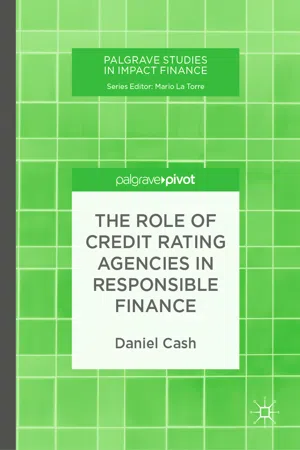
This Palgrave Pivot aims to examine the bourgeoning relationship between the Principles for Responsible Investment and the Credit Rating Industry. Since May of 2016, when the partnership was initially publicised, the PRI have endeavoured to incorporate Credit Rating Agencies into its initiative via its 'ESG in Credit Ratings Initiative', and have been working diligently to find, and create common ground between Credit Rating Agencies and Institutional Investors seeking to be more forward-looking in their investment approaches. However, in recent years the 'Big Two' Credit Rating Agencies – Standard & Poor's and Moody's – have finally received record fines for their conduct in the run-up to the Financial Crisis. There is a need, then, to examine the incorporation of the Credit Rating Agencies into such a progressive initiative. To achieve this objective, this book examines the field of 'responsible investing', the credit rating industry, and the power dynamic that exists betweenthe rating industry, investors, and the PRI (via its 'Initiative').
- English
- ePUB (mobile friendly)
- Available on iOS & Android
eBook - ePub
The Role of Credit Rating Agencies in Responsible Finance
About this book
Information
© The Author(s) 2018
Daniel CashThe Role of Credit Rating Agencies in Responsible FinancePalgrave Studies in Impact Financehttps://doi.org/10.1007/978-3-030-03709-3_11. Introduction
Abstract
There are a number of complex issues and delineations which need to be deconstructed in this book, so in the introduction, the aim is to chart a course for how those complexities will be unravelled. It is also discussed how the work is positive regarding the endeavour of the Principles for Responsible Investing, but that great care ought to be taken when moving forward, on account of the importance of the responsible investment movement.
Keywords
IntroductionInvestment definitionsCredit rating agenciesFinancial crisisThere is a difficulty with regard to the semantics of the mode of investment that will be discussed in this book, with terms such as ‘ethical investing
’, ‘sustainable investing’, and ‘socially responsible investing
’ seemingly
being used interchangeably depending on the author’s understanding. Yet, using the term ‘responsible investing’ just to begin to make inroads into this work, the idea of taking a forward-looking and long-term approach to business is of crucial importance to the transmission of this work’s thesis. The concept of investing for anything other than financial return far outdates the Financial Crisis
, but the recent and rapid escalation in focus of this ethos since the Financial Crisis perhaps suggests to us that these alterations in focus are moving ever closer to the forefront of popular thinking, at least in the financial arena. If one were to undertake a sweeping examination of the investing sphere, then one may believe that this altered sentiment is moving to the forefront of collective thinking in a concerted and seemingly unstoppable manner, but it is vital that we remain critical with our thinking, particularly since we have witnessed, and continue to witness, the remarkable consequences of the Financial Crisis
. So, with all that in mind, our aim here is to conduct that critical analysis and examine the incredible developments that are currently occurring within the financial sector.
This book will assess the investing ‘field’ to begin with, but there is a particular focus to the work. That focus is on the ‘Principles for Responsible Investment’ (PRI
) movement and, more specifically, its relationship with the credit rating industry via its ‘ESG
in Credit Ratings Initiative’; for the purposes of clarity and accuracy, reference will be made to the ‘Initiative’ throughout this work, in order to make clear that the CRAs are connected to the PRI
via the Initiative and are not signatories. The Initiative is determined to push the narrative that a ‘change’ in mentality is required, and although this work will remain as impartial as one can be when producing a narrative, that objective of the Initiative is an incredibly important one. Yet, the relatively recent connection between the Initiative and the credit rating agencies, with the leading two agencies—Standard & Poor’s
and Moody’s
—coming to mind (the third member of the Rating Oligopoly—Fitch Ratings—only joining the Initiative in September 2018), should lead to a questioning of whether that objective can truly be achieved when we consider the two agencies are currently recovering from what has been the most publically damning period in their history. Therefore, this book has a number of defined and considered questions to answer.
The first of these questions is what the term ‘Responsible Investment’ actually means. In deconstructing this vast area within the literature, we will be presented with the opportunity to define a practice that has proven difficult to define. This will be an important endeavour if we are to understand the bourgeoning relationship between the Initiative and the CRAs, as the parameters of this ethos may define the success that the relationship experiences. One element that will be of particular interest to us is the concept of ‘mainstream’, as taking the practice of investing for something more than just financial return into the ‘mainstream’ is a defined objective of the PRI
, and the Initiative. However, understanding what this means may allow us to make sense of some of the decisions that are being taken, which will be of direct benefit when this work contributes to the literature by examining the objectives of the Initiative as a separate entity, above the collective of institutional investors
who make up the signatory base of the PRI
.
We will then examine the CRAs themselves, and develop an understanding of the dynamics of the rating industry. Doing this will allow us the opportunity to understand the oligopolistic nature of the rating industry, and everything that is associated with that. Understanding the nature of an oligopolistic industry is, as is proposed in this work, absolutely vital if one is to attempt to predict the chances of success for this new relationship. The leading CRAs and their actions are essentially defined by the parameters of the oligopolistic position they enjoy, so incorporating that understanding into the analysis of the relationship will be key as we build towards the aim of the book, which is to present certain proposals that may facilitate the development of the relationship for the purposes of advancing the Responsible Investment movement.
This work operates upon an impartial basis, but this basis is defined by a commitment to critique. There are many reasons why the conduct of the leading CRAs may be minimised when attempting to incorporate them into such an important and progressive initiative, but none of them is justifiable. One of the overriding theses of this work is that in order for the initiative to develop, great care must be taken when dealing with the CRAs. There are ‘headline’ reasons for this viewpoint, including the record fines that both S&P
and Moody’s
received recently from the U.S. Department of Justice, but it is important that we look much deeper than the headlines. As we shall see, there is an inherent and underlying distrust that exists within the investing community
in relation to the CRAs, and a large proportion of that distrust relates to the historic relationship the two entities have had. The Financial Crisis
was not the first time that investors have been harmed by the CRAs, and any student of history within this field would agree that it is unlikely to be the last. It is on that basis that the signatory investors are incredibly cautious of dealing with the CRAs, and this is understandable. However, whilst this work does not attempt to downplay the transgressive nature of the leading CRAs (far from it), it does subscribe to a viewpoint that is based upon the potential of the relationship, albeit upon a very pragmatic footing.
The CRAs performed incredibly poorly in the creation of the Financial Crisis
, and their historical record is one that is defined by the concept of survival by any means necessary. Yet, it is proposed at the end of this book that the CRAs do have a part to play in the development of the Responsible Investment movement, particularly as their position within the marketplace effectively positions them as a vehicle for the adoption of certain ‘norms’. However, this does not mean that they will do this, but that they have the potential to do so. On that basis, the work concludes with a number of potential ‘safeguards’ that the PRI
may want to incorporate into their relationship with the CRAs, in order to protect the movement from the inherent nature of the leading CRAs whilst benefitting from the potentially progressive elements of the CRA’s position within the marketplace. Additionally, the CRAs themselves are presented with a tremendous opportunity to right certain wrongs, and they can do this by committing to the movement without seeking to take absolute advantage. It is normal for them to seek advantage, but it is argued here that the advantage need not be absolute. The advantage they can gain comes in the form of being part of a progressive movement that has the potential to impact upon the direction of modern finance, and apart from being financially compensated for being attached to that movement, there is a potential that the distrust that exists between investors and CRAs may be reduced, somewhat.
Yet, the aim of this book is to suggest that this aim cannot be left to the CRAs to implement. There are a number of reasons for this, but perhaps the main one is that they do not really have the incentive to do so. I have discussed, on numerous occasions elsewhere (as have a number of other scholars), that the CRAs were essentially concretised in the wake of the Financial Crisis
, with the removal of the state from the equation (via the removal of legislative references to their products) proving pivotal. This is perhaps the main reason why the CRAs have little incentive to take the lead on performing progressively in relation to the Responsible Finance movement, quite simply because they do not have to, and that their survival does not depend upon it. So, it is for this reason that the book takes the position of promoting the understanding that the Initiative has the responsibility of shaping the relationship for the benefit of the movement and, after analysing the movement itself, it fundamentally has the power to do so. We will discuss the slight concern that the Initiative has not, perhaps, fully acknowledged its position within this dynamic, but it is very important that it does so.
This movement has the real potential to change the reality of finance, and society as a result. However, to do that, there is a requirement that an alteration in mentality is witnessed, and for our purposes, that sentiment applies to more than just the obvious. The obvious sentiment is that investors and CRAs need to change their mentality, but it is suggested here that the Initiative may need to alter its mentality too. The Initiative has rightly sought to incorporate the CRAs into its initiative, but in doing so, it has welcomed the wolf to the door. It is extremely important that the Initiative recognise this, as they are being warned by the PRI
’s signatory base and by the associated literature that this is (potentially) the case—there are measures to be taken to protect the movement, and it is on that basis that this book is developed.
© The Author(s) 2018
Daniel CashThe Role of Credit Rating Agencies in Responsible FinancePalgrave Studies in Impact Financehttps://doi.org/10.1007/978-3-030-03709-3_22. “Setting the Scene”
Abstract
The world of ‘responsible investing’ is a complex one that is defined by a number of approaches and delineations. In this chapter, the aim is to present an overview of this particular arena and present an account of those delineations. In addition, there is a need to present an account of the different terminologies used within the sector, so the chapter will introduce these terminologies and make clear the forward trajectory for the rest of the work. The biggest issue to disentangle is the differences between the classical understandings of the concepts of ‘Ethical Investing’, ‘Sustainable Finance’, and ‘Responsible Finance’. As this work is focused upon the Principles for Responsible Investment, the chapter will conclude with an introductory examination of that initiative.
Keywords
Responsible investmentEthical investmentPrinciples for responsible investmentSustainable rating agencies2.1 Introduction
The title of this book is The Role of Credit Rating Agencies in Responsible Finance, but that title is, perhaps, problematic. It is problematic because the obvious question it may or indeed should raise is ‘what is responsible finance?’ The notion of ‘finance’ as a definitive subject is problematic in itself, because what does one mean when the word finance is used? For our purposes, it is the concept of investing that is of importance, but by that same token is it not the case that all investors are responsible? Perhaps there is an argument to say that those who invest solely for financial return are acting responsibly, if only for their own ends. Yet, we do need to begin our examination and to do that, we shall have to develop a simplistic foundation upon which the examination can develop. That foundation is that when we consider the concept of ‘responsibility’ in this particular realm, we ought to summon the notion of an investor who makes an investment decision for reasons other than pure financial gain.
However, this simplistic foundation does not stand up to scrutiny for long when we begin to apply it to the world within which we live. There are clearly problematic elements to this foundation, because at what point should one prioritise financial recompense for their investment and maintain their status as a ‘responsible investor’? Does one need to prioritise something o...
Table of contents
- Cover
- Front Matter
- 1. Introduction
- 2. “Setting the Scene”
- 3. The Role of the Credit Rating Agencies
- 4. “Disconnects”
- 5. The Future for the Relationship
- 6. Conclusion
- Back Matter
Trusted by 375,005 students
Access to over 1.5 million titles for a fair monthly price.
Study more efficiently using our study tools.
Frequently asked questions
Yes, you can cancel anytime from the Subscription tab in your account settings on the Perlego website. Your subscription will stay active until the end of your current billing period. Learn how to cancel your subscription
No, books cannot be downloaded as external files, such as PDFs, for use outside of Perlego. However, you can download books within the Perlego app for offline reading on mobile or tablet. Learn how to download books offline
Perlego offers two plans: Essential and Complete
- Essential is ideal for learners and professionals who enjoy exploring a wide range of subjects. Access the Essential Library with 800,000+ trusted titles and best-sellers across business, personal growth, and the humanities. Includes unlimited reading time and Standard Read Aloud voice.
- Complete: Perfect for advanced learners and researchers needing full, unrestricted access. Unlock 1.5M+ books across hundreds of subjects, including academic and specialized titles. The Complete Plan also includes advanced features like Premium Read Aloud and Research Assistant.
We are an online textbook subscription service, where you can get access to an entire online library for less than the price of a single book per month. With over 1.5 million books across 990+ topics, we’ve got you covered! Learn about our mission
Look out for the read-aloud symbol on your next book to see if you can listen to it. The read-aloud tool reads text aloud for you, highlighting the text as it is being read. You can pause it, speed it up and slow it down. Learn more about Read Aloud
Yes! You can use the Perlego app on both iOS and Android devices to read anytime, anywhere — even offline. Perfect for commutes or when you’re on the go.
Please note we cannot support devices running on iOS 13 and Android 7 or earlier. Learn more about using the app
Please note we cannot support devices running on iOS 13 and Android 7 or earlier. Learn more about using the app
Yes, you can access The Role of Credit Rating Agencies in Responsible Finance by Daniel Cash in PDF and/or ePUB format, as well as other popular books in Business & Financial Services. We have over 1.5 million books available in our catalogue for you to explore.