Drawing insights from nearly a decade of mixed-method research, Stephen R. Barnard analyzes Twitter's role in the transformation of American journalism. As the work of media professionals grows increasingly hybrid, Twitter has become an essential space where information is shared, reporting methods tested, and power contested. In addition to spelling opportunity for citizen media activism, the normalization of digital communication adds new channels of influence for traditional thought leaders, posing notable challenges for the future of journalism and democracy. In his analyses of Twitter practices around newsworthy events—including the Boston Marathon bombing, protests in Ferguson, Missouri, and the election of Donald Trump—Barnard brings together conceptual and theoretical lenses from multiple academic disciplines, bridging sociology, journalism, communication, media studies, science and technology studies, and political science.
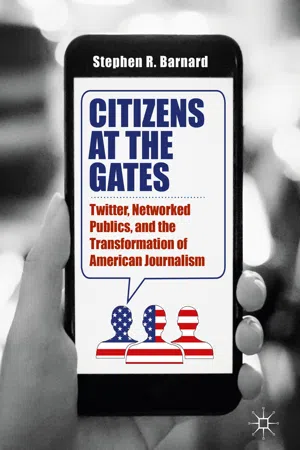
eBook - ePub
Citizens at the Gates
Twitter, Networked Publics, and the Transformation of American Journalism
- English
- ePUB (mobile friendly)
- Available on iOS & Android
eBook - ePub
Citizens at the Gates
Twitter, Networked Publics, and the Transformation of American Journalism
About this book
Information
© The Author(s) 2018
Stephen R. BarnardCitizens at the Gateshttps://doi.org/10.1007/978-3-319-90446-7_11. Introduction
Stephen R. Barnard1
(1)
Department of Sociology, St. Lawrence University, Canton, NY, USA
Stephen R. Barnard
Keywords
GatekeepingGatewatchingGatecrashingJournalismSocial mediaTwitterCultureTechnologyA lot was changing in the world of media and journalism when I first joined Twitter in early 2009. Due in part to the surge of media stories on the topic, a large portion of the American public and the entire journalism profession were growing increasingly worried about the lasting effects of a press system that appeared to be dying. The 2008 financial crisis hit the news industry hard, as did the radical drop in advertising revenue , which was almost universally recognized as a necessary condition for running a successful newspaper. At the same time, a revolution in new media technologies was also starting to shake the profession to its core. This era of journalistic transformation can be explained from at least two distinct perspectives.
The first perspective focuses largely on economic factors. The 2008 financial crisis spread throughout most sectors of the economy, leaving newspapers and other media companies with fewer resources. Print advertising revenues declined steadily during the 2000s (Barthel 2017). This problem was exacerbated by the media industry’s shift toward online publication, where advertising revenues typically yielded pennies on the dollar compared to traditional newspaper advertising (Edmonds et al. 2013). The combined results shocked the journalism world. The value of newspaper companies across the United States began a steady decline (Mitchell and Matsa 2015). Newspaper closures were so numerous by 2007 that a long-time journalist created a “Newspaper Death Watch” to document the death and rebirth of the news industry. The website lists 15 major metropolitan dailies having closed since it went online, while another dozen are “in progress,” meaning they have “cut frequency or adopted hybrid … or online-only models” (Newspaper Death Watch 2017). Meanwhile, the “people formerly known as the audience,” as Jay Rosen (2006) famously named them, grew less trusting of mainstream media sources and more likely to contribute to the stream of news and information (Alterman 2003). While much debate remains about the value and originality of user-generated content and the future of professional journalism , these broad changes illustrate a key shift in the structure and practices of journalism in America.
Another way to view these changes requires a somewhat different focus. At roughly the same time as the economic crisis was hitting American journalism, another important shift was occurring within the political, cultural, and technological corners of the field. Enabled by the growth of digital tools and social networks —namely, “smart” mobile phones equipped with Twitter, Facebook , and YouTube —citizen and professional journalists alike were increasingly likely to engage with one another and share real-time information of civic importance. This shift was not simply journalistic in nature, but it inevitably took on cultural and political characteristics as producing and sharing cultural artifacts with political and/or journalistic significance reemerged as a valuable and increasingly normalized practice for citizen engagement. Thus, given the hybridity of the political and journalistic fields , the shaping of journalism’s history must also be attributed to institutional norms and structures , actors’ decisions and dispositions , as well as the technological affordances that manifest across the field.
While these changes may seem like a relatively routine evolution in what it means to be part of “the public” in the digital age, a close and historically conscious examination suggests that a more remarkable shift is underway. Whereas previous generations of American citizens had a limited number of opportunities to engage with media-makers—let alone to contribute to the conversation around news products and processes—the press–public relationship is steadily changing in the new media environment. What began with expanding access to computers with internet connectivity in the 1990s has evolved over the last decade into the proliferation of mobile phones with cameras, video, and high-speed internet. Access to these technologies , along with the explosion of social media on these devices, has contributed to profound shifts in culture and communication. Of all the platforms that facilitate journalistic discourses , Twitter plays a central role, both for citizens as well as media professionals. While the implications of these shifts can be felt across American society, the fields of journalism and politics have been among the hardest hit.
As the gatekeeping tradition suggests, journalistic actors and institutions have historically controlled the processes of newsmaking (Shoemaker and Vos 2009). This communicative privilege has proved quite powerful in defining reality and shaping public opinion (Bourdieu 1999; McCombs and Shaw 1972). But in recent years, the metaphorical gates that legacy institutions have been poised to keep have attracted the attention of networked publics , who are increasingly prone to watching what flows through the mainstream media’s gates. Furthermore, some have utilized social networks like Twitter to crash (i.e., bypass) the legacy media’s gates entirely. Such efforts are not simply self-serving; they aim to shape public opinion and influence professional gatekeeping processes.
Nevertheless, the power of new media tools is hardly relegated to citizens alone. As will be demonstrated, growing numbers of journalism professionals have embraced new communication technologies , especially Twitter, with remarkable enthusiasm. While this trend is interesting in its own right, the broader array of transformations spanning the field of American journalism are central to this project, and to the field more broadly. Although “acts of journalism” by citizens on social media have been somewhat mythologized in recent years, their significance remains considerable. By assessing this significance empirically, and in concert with accordant shifts in professional journalism , this book examines the ongoing hybridization of journalism and political activism as these fields adopt Twitter, and therefore adapt to the new norms and practices that have followed.
The book considers the converging influences of technological affordances , professional practices, and networked cultures amid overarching norms and power structures that shape action in social fields. It seeks to answer questions, both pressing and enduring, about journalistic practices , networked publics , and the dynamics of social change. In doing so, it provides a vivid account of hybridity at the margins of two converging fields—networked journalism and political activism . I have chosen to focus on the margins of the journalistic field , emphasizing cultural and technological influences over traditional economic and political ones for a number of reasons. As a researcher, I marvel at the combined disruptive power of technological and cultural innovations and seek to understand and explain them. As a citizen, I am amazed and enriched, though admittedly overwhelmed at times, by the converging, communicative potential of new media and communication technologies . Like all instances of disruptive innovation, this one did not occur in a vacuum. Rather, a near-perfect storm of factors combined to make the current environment of American journalism such a revolutionary one.
The major crisis that hit American newspapers, spurred greatly by the economic recession of 2008, played a crucial role in overhauling the media ecosystem. The digital revolution and the increased adoption by greater portions of journalism and media professions brought new actors, practices, and challenges into the mix. The growing cultural and political trends surrounding social media gave rise to a new kind of civic participation and collective intelligence. Each of these is a powerful factor of social change. Altogether, they constitute a disruptive set of innovations that may be utterly transformative, which appears to be occurring, of all places, on Twitter.
Twitter, Social Media, and the Networked Revolution
In today’s networked society, everyday life is increasingly augmented by digitally mediated forms of communication, which lead to transformations in social relations (Couldry and Hepp 2016; Jurgenson 2012). Lee Rainie and Barry Wellman (2012) contend that American society is in the midst of a “triple revolution ” due to the proliferation of the internet, mobile phones, and social networking services. When considered in concert, this revolution has led to a reboot of many sociological dynamics; the result is the emergence of a “new social operating system” brought about by the convergence of these technological and cultural innovations. Approximately 95% of American adults own a cell phone of some kind, and 77% own a smartphone, which are frequently used to access the internet (“Social media” 2017). Specifically, much of this mobile internet usage is social, meaning that users frequently interact with others ofte...
Table of contents
- Cover
- Front Matter
- 1. Introduction
- 2. Twitter: More than 140 Characters
- 3. Understanding the Gates: The Journalistic Field in a Time of Mediatization
- 4. “Tweet or Be Sacked”: Hybridity and Shifts in (Professional) Journalistic Practice
- 5. The Pros and Cons of Pro-Am Journalism: Breaking News During the #BostonMarathon Bombing and Beyond
- 6. Tweeting #Ferguson: Affective Publics, Boundary Maintenance, and Journo-Activism in a Mediatized Field
- 7. We Stand with #Nerdland: Gatewatching and Agenda-Building by the “People Formerly Known as the Audience”
- 8. The Spectacle of #TrumpsAmerica: Political Journalism, Networked Publics, and the Battle for Symbolic Power
- 9. Twitter and Beyond: Journalistic Practice, Platforms, and the Future of Media Power
- Back Matter
Trusted by 375,005 students
Access to over 1.5 million titles for a fair monthly price.
Study more efficiently using our study tools.
Frequently asked questions
Yes, you can cancel anytime from the Subscription tab in your account settings on the Perlego website. Your subscription will stay active until the end of your current billing period. Learn how to cancel your subscription
No, books cannot be downloaded as external files, such as PDFs, for use outside of Perlego. However, you can download books within the Perlego app for offline reading on mobile or tablet. Learn how to download books offline
Perlego offers two plans: Essential and Complete
- Essential is ideal for learners and professionals who enjoy exploring a wide range of subjects. Access the Essential Library with 800,000+ trusted titles and best-sellers across business, personal growth, and the humanities. Includes unlimited reading time and Standard Read Aloud voice.
- Complete: Perfect for advanced learners and researchers needing full, unrestricted access. Unlock 1.5M+ books across hundreds of subjects, including academic and specialized titles. The Complete Plan also includes advanced features like Premium Read Aloud and Research Assistant.
We are an online textbook subscription service, where you can get access to an entire online library for less than the price of a single book per month. With over 1.5 million books across 990+ topics, we’ve got you covered! Learn about our mission
Look out for the read-aloud symbol on your next book to see if you can listen to it. The read-aloud tool reads text aloud for you, highlighting the text as it is being read. You can pause it, speed it up and slow it down. Learn more about Read Aloud
Yes! You can use the Perlego app on both iOS and Android devices to read anytime, anywhere — even offline. Perfect for commutes or when you’re on the go.
Please note we cannot support devices running on iOS 13 and Android 7 or earlier. Learn more about using the app
Please note we cannot support devices running on iOS 13 and Android 7 or earlier. Learn more about using the app
Yes, you can access Citizens at the Gates by Stephen R. Barnard in PDF and/or ePUB format, as well as other popular books in Social Sciences & Journalism. We have over 1.5 million books available in our catalogue for you to explore.