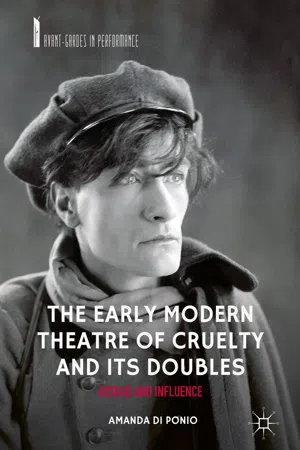
This book examines the influence of the early modern period on Antonin Artaud's seminal work The Theatre and Its Double, arguing that Elizabethan and Jacobean drama and their early modern context are an integral part of the Theatre of Cruelty and essential to its very understanding. The chapters draw links between the early modern theatrical obsession with plague and regeneration, and how it is mirrored in Artaud's concept of cruelty in the theatre. As a discussion of the influence of Shakespeare and his contemporaries on Artaud, and the reciprocal influence of Artaud on contemporary interpretations of early modern drama, this book is an original addition to both the fields of early modern theatre studies and modern drama.
- English
- ePUB (mobile friendly)
- Available on iOS & Android
eBook - ePub
About this book
Information
Subtopic
Literary Criticism in Drama© The Author(s) 2018
Amanda Di PonioThe Early Modern Theatre of Cruelty and its DoublesAvant-Gardes in Performancehttps://doi.org/10.1007/978-3-319-92249-2_11. Introduction
Amanda Di Ponio1
(1)
Huron University College, London, ON, Canada
Amanda Di Ponio
Keywords
Antonin ArtaudTheatre of CrueltyEarly modernThe connection between Antonin Artaud’s Théâtre de la Cruauté (Theatre of Cruelty) and the drama of the age of Shakespeare is a lot closer than we might think. This book considers the direct influence of early modern drama, and the wider cultural contexts in which these plays were written and performed, on Artaud’s theory and concept of cruelty within the theatre. What Artaud promoted in his theatre was rigorous, spectacle-driven performance that was true to culture. He detested the idea of culture as synonymous with sophistication and elegance, and divorced from the unsavoury elements of life—madness, sickness, and death. His theatre, therefore, was less concerned with fixed language, character development, or psychological exploration than it was with showing life authentically as it exists at any moment in time. By stripping the text accordingly, alongside the addition of a language of physicality and gesture, Artaud’s Theatre of Cruelty offers new insights into Classical, Renaissance, and Modern theatre. He maintains that the theatre must be experienced viscerally, honestly, and brutally. No one is to leave a performance intact.
What I propose is that Artaud’s theory is based on the cultural phenomena present in the early modern period. The foundation of his theory aligns the theatre with the plague—an ever-present terror in the Renaissance consciousness—as both are sources of delirium and creativity, destruction and regeneration. The plague and its surrounding atmosphere contain both the grotesque and sublime elements of life Artaud wished to capture in his theatre. His theory of cruelty is part of a larger investigation into the connection between spectacle, violence, and sacrifice explored by Mikhail Bakhtin, René Girard, and Georges Bataille.
Although Artaud was fascinated by what was referred to by critics as Elizabethan theatre, there is very little academic scholarship on the connection between the two, and what does exist tends to focus on Shakespeare.1 In ‘Le Théâtre de la Cruauté (Premier manifeste)’ [‘The Theatre of Cruelty (First Manifesto)’ ], Artaud includes Shakespearean and Elizabethan drama in general as examples of ideal works to illustrate his new theatre. Aside from the studies written in French, most notably Jonathan Pollock’s essays ‘Shakespeare et le Théâtre de la Cruauté d’Antonin Artaud’ (2000) and ‘Le théâtre et la peste: les dramaturges élisabéthains revus par Antonin Artaud’ (2001), Pierre Brunel’s ‘Antonin Artaud et le répertoire élisabéthain’ (1989), and the works by Alain and Odette Virmaux,2 there are only a few works written in English wholly and constructively concerned with this subject. These studies in English tend to focus on specific plays and performances rather than textual or socio-historical analysis, as in Bryan Reynolds’s ‘Untimely Ripped: Meditating Witchcraft in Polanski and Shakespeare’ (2002), Eric S. Mallin’s essay ‘Word and Plague in the Second Quarto Hamlet’ (1995), and in Stephen Phillips’s dissertation ‘History in Men’s Lives: A Study of Two Cycles of Shakespeare’s Histories Produced at Stratford in the Nineteen-Sixties and Nineteen-Seventies’ (1988). In addition to these works which focus on the influence of Artaud on productions of Shakespeare’s plays, there is Dominique Duvert’s dissertation which applies Artaud’s theories of the tension between language and drama to the reading of Coriolanus and other plays in ‘The Tragedy of Language: An Application of Artaud’s Criticism of the Dramatic Text to Shakespeare’s Coriolanus , Molière’s Dom Juan and Calderón’s La Vida es sueño’ (1991). Further, Artaud’s theories concerning violence are applied to King Lear in Naomi Liebler’s ‘Pelican Daughters: The Violence of Filial Ingratitude in King Lear’ (2007), and more generally in Richard Fly’s ‘Shakespeare, Artaud, and the Representation of Violence’ (1989). Jonas A. Barish’s conference paper ‘The New Theatre and the Old: Reversions and Rejuvenations’ (1969) provides a detailed overview of Artaudian principles in relation to the early modern theatre. There is also scholarship in Dutch which focuses on the Shakespeare-Artaud connection by Laurens De Vos. 3 In Arabic and Italian, the focus is on one of the most famous productions of Shakespeare interpreted via Artaud’s Theatre of Cruelty: Peter Brook’s King Lear (1962). Alongside Brook, Richard Schechner and Jerzy Grotowski (1933–99) are perhaps the most well-known, credible directors who accredit a connection to Artaud.
Whereas there is a lack of recent work in establishing links between early modern and Artaudian drama, a vast body of scholarship examines the influence of Artaud’s Theatre of Cruelty on avant-garde theatre and film. This includes the work of Marvin Carlson, Helga Finter, Jane Goodall, David Graver, Naomi Greene , Christopher Innes, and Susan Sontag.4 The best-known, well-received investigation into both the final period of Artaud’s creative activity as well as his legacy upon contemporary theatre, dance, and performance art is Stephen Barber’s collection of books on Artaud: the critical biography Antonin Artaud: Blows and Bombs (1993); Artaud: The Screaming Body (1999); Antonin Artaud: Terminal Curses: The Notebooks, 1945–1948 (2008); The Last Words of Antonin Artaud (2009); The Anatomy of Cruelty: Antonin Artaud: Life and Works (2013); and the recent article ‘Corporeal Disintegration as Last-Gasp Vocal Act: The Final Works of Murobushi, Artaud, and Chéreau’ (2017). Finally, Kimberly Jannarone’s book Artaud and His Doubles (2010) offers insights into his practices as a director aligned less so with his peers—the practitioners of the modern period and their idealism to forge a better world—and more so with contemporary ideas ‘of the rise of the director and the taming of the audience’, and explores Artaud in relation to Jannarone ’s readings of crowd theory.5 The early modern source from which Artaud developed his Theatre of Cruelty is not treated in Barber ’s or Jannarone ’s books.
This book is guided by the following thematic questions: What aspects of early modern culture best stimulated Artaud’s Theatre of Cruelty? How are these cultural phenomena presented in the works of Shakespeare and his contemporaries, and how has Artaud interpreted them? How do his theories intersect with those surrounding spectacle, violence, sacrifice, and cruelty in his theatre? To what extent have Artaud’s followers addressed the early modern context which so inspired his theatre; to what end; and what is irreconcilable between Artaud and their theatres or productions?
To answer these questions, this book is divided into four sections which work interdependently: Artaud’s notion of cruelty as presented in his Theatre of Cruelty; the importance of early modern social history in Artaud’s theatre; the sources for dramatic cruelty focusing on the influence of Seneca and the early modern dramatists who integrated cruelty into their work; and the Theatre of Cruelty in performance both in Artaud’s lifetime and beyond.
But this is not just a singular study that considers the influence of the Elizabethan theatre on Artaud. More so, it examines what I view to be the doubles of the early modern theatre through an Artaudian perspective. The framework of the book is linked to the concept of the double as it takes the comparative action of moving between two different contexts and time frames, not only to show how they correspond to each other, a traditional application of the double, but also to offer some critical reflection on conventional and accepted understandings of theatrical history and practice. This second effect of ‘doubling’ aims to develop a new discourse of anti-establishment and counter-tradition based on an Artaudian reading of the synthesis between theatre and culture. As such, there are different points of view and interchanging perspectives in the study which reflect these different readings. This state of flux supports the shifting understanding of cruelty in the theatre, according to Artaud’s notion of the word, his desired presentation(s) of it, and others’ understanding and use of it. The double motivates the entire investigation and advances the twofold reading of the book’s contents in creating a poetics of the theatre.
The opening section of this book, therefore, aims to explain what Artaud’s Theatre of Cruelty proposes. Not simply a generalization of his ideas, Chapter 2 (Interpreting Antonin Artaud’s Theatre of Cruelty) considers Artaud’s relationship with the traditional theatre he both condemns and reveres, wanting to destroy and renew it, and eventually reproduce it, albeit according to his specifications rather than those adhering to tradition. These conflicting desires regarding theatrical reproduction complement Artaud ’s shifting views on cruelty—as figurative and actual—and its presentation on the stage. Artaud’s theatrical dissidence is identifiable from his early experiments in the theatre with the Théâtre Alfred Jarry (1926–31...
Table of contents
- Cover
- Front Matter
- 1. Introduction
- Section I. The Theatre and Its Double
- Section II. Elizabethan Social History: Doubles of the Theatre
- Section III. The Sources of Dramatic Cruelty
- Section IV. The Theatre of Cruelty in Performance
- Back Matter
Trusted by 375,005 students
Access to over 1.5 million titles for a fair monthly price.
Study more efficiently using our study tools.
Frequently asked questions
Yes, you can cancel anytime from the Subscription tab in your account settings on the Perlego website. Your subscription will stay active until the end of your current billing period. Learn how to cancel your subscription
No, books cannot be downloaded as external files, such as PDFs, for use outside of Perlego. However, you can download books within the Perlego app for offline reading on mobile or tablet. Learn how to download books offline
Perlego offers two plans: Essential and Complete
- Essential is ideal for learners and professionals who enjoy exploring a wide range of subjects. Access the Essential Library with 800,000+ trusted titles and best-sellers across business, personal growth, and the humanities. Includes unlimited reading time and Standard Read Aloud voice.
- Complete: Perfect for advanced learners and researchers needing full, unrestricted access. Unlock 1.5M+ books across hundreds of subjects, including academic and specialized titles. The Complete Plan also includes advanced features like Premium Read Aloud and Research Assistant.
We are an online textbook subscription service, where you can get access to an entire online library for less than the price of a single book per month. With over 1.5 million books across 990+ topics, we’ve got you covered! Learn about our mission
Look out for the read-aloud symbol on your next book to see if you can listen to it. The read-aloud tool reads text aloud for you, highlighting the text as it is being read. You can pause it, speed it up and slow it down. Learn more about Read Aloud
Yes! You can use the Perlego app on both iOS and Android devices to read anytime, anywhere — even offline. Perfect for commutes or when you’re on the go.
Please note we cannot support devices running on iOS 13 and Android 7 or earlier. Learn more about using the app
Please note we cannot support devices running on iOS 13 and Android 7 or earlier. Learn more about using the app
Yes, you can access The Early Modern Theatre of Cruelty and its Doubles by Amanda Di Ponio in PDF and/or ePUB format, as well as other popular books in Media & Performing Arts & Literary Criticism in Drama. We have over 1.5 million books available in our catalogue for you to explore.