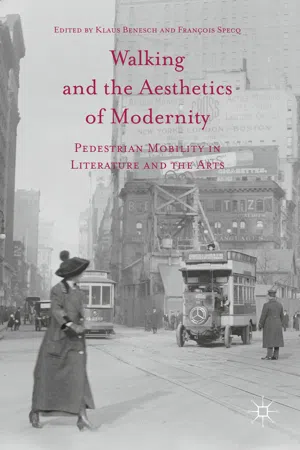
This book gathers together an array of international scholars, critics, and artists concerned with the issue of walking as a theme in modern literature, philosophy, and the arts. Covering a wide array of authors and media from eighteenth-century fiction writers and travelers to contemporary film, digital art, and artists' books, the essays collected here take a broad literary and cultural approach to the art of walking, which has received considerable interest due to the burgeoning field of mobility studies. Contributors demonstrate how walking, far from constituting a simplistic, naïve, or transparent cultural script, allows for complex visions and reinterpretations of a human's relation to modernity, introducing us to a world of many different and changing realities.
eBook - ePub
Walking and the Aesthetics of Modernity
Pedestrian Mobility in Literature and the Arts
- English
- ePUB (mobile friendly)
- Available on iOS & Android
eBook - ePub
Walking and the Aesthetics of Modernity
Pedestrian Mobility in Literature and the Arts
About this book
Information
Poetics
© The Author(s) 2016
Klaus Benesch and François Specq (eds.)Walking and the Aesthetics of Modernity10.1057/978-1-137-60364-7_1Walking the Streets of London in the Eighteenth Century: A Performative Art?
Emmanuelle Peraldo1
(1)
Université Jean Moulin - Lyon 3, 6 Cours Albert Thomas, F-69008 Lyon, France
In the eighteenth century, walking had not been considered a respectable mode of travel. Following in the footsteps of earlier Spanish picaresque tales eighteenth-century readers (and writers) associated street-walking with poverty, prostitution, and panhandling. Characters embodying these negative features abound in eighteenth-century literature. Daniel Defoe’s Moll Flanders is a case in point. Its street-walking protagonist tries to make ends meet as a prostitute and thief. In a similar fashion John Gay’s Trivia also foregrounds the negative, picaresque aspects of walking: its wandering poet is involved with beggars (Bk II, v 141–144), “the Poor” (Bk II, v 157), a “lurking thief” (Bk III, v 135), and he calls upon other men to beware of the “lazy fair” (Bk I, v 110), that is, prostitutes.
Against this restrictive view of the motif of walking, I show that in eighteenth-century texts such as John Gay’s Trivia (1716) or Daniel Defoe’s Journal of the Plague Year (1720) and Moll Flanders (1722) both the representation of walking and its use as a narrative device contribute to the construction of spatial knowledge. Walking in a city means to know it, from the inside out. In both Gay’s and Defoe’s texts perambulating observers abound: in Trivia the poet-geographer “plunges you into the heat, smells and underbelly of London” (Whyman, “Sharing Public Spaces” 43), while in Defoe’s Journal of the Plague Year the streets of plague-ridden London provide the framework for a riveting narrative of the 1665 epidemic or, in Moll Flanders, for a woman’s criminal activities and downfall. Yet in all three cases, walking also allows to experience the city from within—to explore its complexity and participate in its social life. As a pedestrian the subject by way of an “engagement of the body and the mind with the world” (Solnit, Wanderlust 29) is restored and made whole again in the act of walking.
In what follows I will draw on the work of several major theorists of the city: Michel De Certeau (“Walking in the City”), Paul Carter (The Road to Botany Bay), and Guy Debord (“Introduction to a Critique of Urban Geography”). For De Certeau, 1 there are two ways of perceiving a city: the first is a view from the 110th floor of the World Trade Center, a vision from above, which enables us to see the rationality of the urban order. De Certeau contrasts this birds-eye perspective with the view from the street: here the act of walking in the city helps understand the place of the subject in space, and De Certeau is particularly interested in the practices of everyday life, in how ordinary inhabitants enact their own maps of the city, not unlike Defoe’s Moll Flanders or HF perambulating the streets of London. This difference is echoed in Paul Carter’s distinction between mimesis and methexis. Contrary to mimesis and the vision of space that it provides (i.e., “off the ground” [Carter, Road to Botany Bay]), methexis is the term used by Carter to designate the experimentation of/with space, which posits the presence of the body of the observer, the participation of the walker “on the ground,” and the visual perception limited by the horizon. Methexis is a performative principle insofar as it suggests that the walker creates a narrative map of his/her progress through his/her particular observation of space and places. Carter describes methexis as “a non-representational principle that involves an act of concurrent actual production” (Lie of the Land 84): it actually transforms and produces space.
The performativity of walking will be at the center of this paper: I want to revisit De Certeau’s theory of the “flâneur” and Carter’s mimesis and methexis theories, and also discuss Guy Debord’s psychogeographical “drift,” 2 which is “a mode of experimental behavior linked to the conditions of urban society” (Coverley, Psychogeography 93). In doing so I hope to shed light on the connection between the subject and the urban environment out of which she/he evolves. As Coverley states “urban walking, the imaginative reworking of the city, the otherworldly sense of spirit of place, the unexpected insights and juxtapositions created by aimless drifting, the new way of experiencing familiar surroundings” (31) are among the chief characteristics of what may be called psychogeography.
Basically, then, this chapter wants to show that the three texts under scrutiny, Moll Flanders, A Journal of the Plague Year, and Trivia stage performative walks in which walking actually has an impact on the surrounding elements. Walking seems to create an interface between the subject and the landscape around her/him. Michel Collot defines a landscape as “the stretch of land that the eye can embrace” (“Le paysage est l’étendue du pays que l’œil peut embrasser dans son ensemble” [12]), thereby underlining the interconnection between the landscape and the subject (Peraldo, “Two broad shining eyes”). Similarly Augustin Berque theorizes landscape as a space of mediation between humans and their environs, arguing that “landscape … lies neither in the object, nor in the subject, but in the complex interaction between these two notions” (Cinq Propositions, 6).
Through an analysis of the physical engagement 3 of the walker’s body in the act of walking I examine this spatial or geopoetical connection between object and subject within the urbanscapes —or rather “walkscapes” (Careri) of Gay and Defoe. After all, in the subtitle of Trivia, Gay invites us to learn a veritable “art” rather than merely the “act” of walking thereby emphasizing the aesthetic dimension of walking as performance.
The Physical Engagement of the Walker
In Wanderlust: A History of Walking, Rebecca Solnit ponders the connection between the walking subject—his mind and his body—and the world around her/him. Walking connects the individual to the world, and it does so by way of the body of the walker, his feet (that move him), and his eyes (with which he observes and accounts for the world). That contact is perfectly epitomized in a scene where Robinson Crusoe discovers footprints on the allegedly pristine, unpopulated island: once he has seen the traces of another human being, he is no longer an isolated subject, alone in imprinting his feet (and thus himself) on the deserted island.Walking, ideally, is a state in which the mind, the body and the world are aligned, as though they were three characters finally in conversation together. (Solnit, Wanderlust 5)
In the first part of Trivia, the lexis of the body is omnipresent, with an insistence on feet, eyes, and heart, hence underlining the link between the physical act of walking and the mind or the emotions involved in it: words such as hair, breast, ears, feet, ankle, eyes, bosom, arm, blue-eyed, and cheeks can be found frequently. Trivia’s opening stanzas are replete with words designating the body of the walker and the bodily experience of walking: much attention is given to the feet, as can be seen in the polyptoton “untrod”/“tread” (“lanes untrod before,” v 10, “to tread in paths,” v 19), and in the insistence on pace and feet (“the sturdy pavior thumps the ground,” v 13, “let firm, well-hammered soles protect thy feet,” v 33). According to Solnit, “walking returns the body to its original limits again, to something supple, sensitive and vulnerable, but walking itself extends to the world as do those tools that augment the body” (29). The human body is indeed extended and augmented by way of “tools” that support the walker: shoes (v 33), clothes (stanza 3), and walking sticks (v 61). What is more, a kind of fusion between the walker and his “extensions” can be noticed, as for example, in expressions such as “walking hand” (v 61), where body parts are being used metonymically for the walking stick.
Other parts of the body that move in the act of walking are also mentioned. The poet, following Locke’s interest in the sensations of the body, records manifestations of pain (“thy cracking joint unhinge, or ankle sprain,” v 38) or the sensation created by a change in the rhythm of breathing (“his lab’ring lungs resound,” v 14, “my youthful bosom,” v 17). Here it is really the living and sensitive body that is alluded to, the body as medium of perception of the world and action. In the attention to the feeling body there is a form of “rehabilitation” of the body and its manifestations that enable action, as Husserl explained in his phenomenology of embodiment, in which the lived body is at the center of experience and the developments of what Husserl calls “kinaesthetic consciousness” or the consciousness of movements (see Husserl Thing and Space, Section III “The Analysis of the Kinetic Synthesis of Perception”). It is because of this engagement of the body that the act of walking can be seen as performative, as enabling the walker to lend meaning to the space he walks through. It is therefore by way of the body that we get to know the world. In A Journal of the Plague Year, the fact that HF “puts his body out there” in the streets of plague-ridden London, given the risks that roaming a city paralyzed by the quarantine policy entails, carries meaning: it speaks to the aforementioned strong engagement of the individual with his/her physical environment, the will to explore and experience the city, and the danger associated with the act of walking. It also emphasizes the fact that HF is not an urban “flâneur” or wanderer but a walker desperate in his commitment to the act of walking, despite the plague epidemic. What is more, it is only because he walks that he can tell the story of the plague of London of 1665.
Narratives of urban walking are thus frequently characterized by an emphasis on the body and its sensations, as the reader experiences the city through the practice of walking. As a form of methexis, to use Carter’s terminology, the walker physically “experiences the metropolis.” Sounds, sights, and smells are omnipresent in Gay’s poem:
HF’s account is also very visual and auditory; he describes scenes vividly, in a realistic fashion so that the reader has the impression of observing those terrible scenes directly, listening in on what the fictional character hears: “The shrieks of women and children at the windows and doors of their houses … were so frequent to be heard as we passed the streets that it was enough to pierce the stoutest heart in the world to hear them” (37). Similarly, smells are mentioned several times, as on page 38:you’ll hear the SoundsOf whistling Winds, e’er Kennels break their Bounds;Ungrateful Odours Common-shores diffuse,And dropping Vaults distil unwholesome Dews,E’er the Tiles rattle with the smoaking Show’r,And Spouts on heedless Men their Torrents pour.
Following Guy Debord’s definition of the “drift,” where the urban wanderer is driven by a “locomotion without a goal” (Plant, The Most Radical Gesture, 1992, 121), HF is seen drifting without any particular direction in mind (“where I had no business”), observing the behavior of other pedestrians whose only aim is to avoid encountering potentially infected individuals. Walking, by the fluidity of its movement, seems to prevent walkers from the stasis that is synonymous with plague, quarantine, and death. The omnipresence of sensations in the Journal highlights both life and hope. HF and Gay’s poets are healthy embodiments of perception and both aspects are encapsulated in the metaphor of walking. Contrary to HF, Gay’s agoraphobic walker strives to avoid the crowd, to avoid physical contact. As Alison Stenton argues it is a way “of placing the individual’s course over and above the movements of everyone else” (Walking the Streets 65); but when he changes his pace, he “remark[s] each Walker’s diff’rent Face/And in their Look their various Bus’ness trace[s]” (Bk II, v 275–6).One day, being at that part of the town on some special business, curiosity led me to observe things more than usually, and indeed I walked a great way where I had no business. I went up Holborn, and there the street was full of people, but they walked in the middle of the great street, neither on one side or other, because, as I suppose, they would not mingle with anybody that came out of houses, or meet with smells and scent from houses that might be infected.
The emphasis on the body is also a means of gauging the development of the plague. The impact of the plague on the body is noticed first when you are infected, and that impact can be seen on the faces of the people of London (“sorrow and sadness sat upon every face” [37]). Hence the physical aspects of their behavior become intrinsically linked with their emotional response to the plague. In what seems a total blurring of the city and the individual, we are reminded that “the face of London was now indeed strangely altered” and that “London might well be said to be all in tears” (37). Through such hypallages, the subjects’ sufferings are imprinted on the urbanscape, while the city is simultaneously “humanized” as human beings disappear. This is also why Coverley identifies HF as a psychogeographical figure anticipating the Situationist movement: “Defoe foreshadows the subjective reworking of the city that the Situationists were to promote and his figure of an urban wanderer, who moves aimlessly across the city before reporting back with his observations, has since become a crucial part of psychogeographical practice” (15). In the same way, John Gay also uses hypallages (“O happy streets to rumbling wheeled unknown” [Bk I, v 99], or “the blushing morning” [Bk I, v 233]), underlining a similar encounter between the subject and his/her environment.
Since both of these texts are focused on a real city, London, they are conducive to an ecocritical reading of intricate relationships between people and the city and of how both are connected through the practice of walking.
Walking as Spatial Experience
Walking is not only a way of knowing about oneself, but also about the...
Table of contents
- Cover
- Frontmatter
- 1. Poetics
- 2. Performance
- 3. Pathology
- 4. Politics
- Backmatter
Trusted by 375,005 students
Access to over 1.5 million titles for a fair monthly price.
Study more efficiently using our study tools.
Frequently asked questions
Yes, you can cancel anytime from the Subscription tab in your account settings on the Perlego website. Your subscription will stay active until the end of your current billing period. Learn how to cancel your subscription
No, books cannot be downloaded as external files, such as PDFs, for use outside of Perlego. However, you can download books within the Perlego app for offline reading on mobile or tablet. Learn how to download books offline
Perlego offers two plans: Essential and Complete
- Essential is ideal for learners and professionals who enjoy exploring a wide range of subjects. Access the Essential Library with 800,000+ trusted titles and best-sellers across business, personal growth, and the humanities. Includes unlimited reading time and Standard Read Aloud voice.
- Complete: Perfect for advanced learners and researchers needing full, unrestricted access. Unlock 1.5M+ books across hundreds of subjects, including academic and specialized titles. The Complete Plan also includes advanced features like Premium Read Aloud and Research Assistant.
We are an online textbook subscription service, where you can get access to an entire online library for less than the price of a single book per month. With over 1.5 million books across 990+ topics, we’ve got you covered! Learn about our mission
Look out for the read-aloud symbol on your next book to see if you can listen to it. The read-aloud tool reads text aloud for you, highlighting the text as it is being read. You can pause it, speed it up and slow it down. Learn more about Read Aloud
Yes! You can use the Perlego app on both iOS and Android devices to read anytime, anywhere — even offline. Perfect for commutes or when you’re on the go.
Please note we cannot support devices running on iOS 13 and Android 7 or earlier. Learn more about using the app
Please note we cannot support devices running on iOS 13 and Android 7 or earlier. Learn more about using the app
Yes, you can access Walking and the Aesthetics of Modernity by Klaus Benesch, François Specq, Klaus Benesch,François Specq in PDF and/or ePUB format, as well as other popular books in Literature & Art General. We have over 1.5 million books available in our catalogue for you to explore.