History museums are places in which we attempt to grasp and touch history or distil the Zeitgeist of a century. Museums are often seen as an opportunity for visitors to take a break from everyday life to learn something or simply let themselves drift through exhibitions without thinking. Upon entering the museum, visitors can step back in order to relax and be entertained by, quietly reflect on, or heatedly debate something that has been taken from the outside world and is presented in the museum. Curators rearrange artefacts that are understood to represent an outside reality in a way that makes that reality tangible, visible, or audible from a perspective that is different from viewing them in their previous settings or “natural habitats.” In this book, the portrayed referent is nothing less than the history of how two nations, from their founding until today, have represented foreigners. This portrayal is a highly contested one, regarding both images of foreigners and the pictures museums paint of the two nations. More generally, in times in which definitions of the nation state are questioned due to global phenomena of migration, exhibitions on migration and identity are in demand. Exhibitions and entire museums devoted to this topic have existed in other parts of the world for some time. The temporary exhibition project that is the focus of the present study represents one of the first attempts to present this topic from a bi-national perspective in the European context. In a collaboration, three museums in France and Germany produced the exhibition: the Cité Nationale de l’Histoire de l’Immigration (the “Cité”), the Deutsches Historisches Musuem (“DHM”), and the Friedrichshain-Kreuzbergmuseum (“Kreuzbergmuseum”). The exhibition travelled from Paris to Berlin. In the Cité it was entitled “À chacun ses étrangers ? France—Allemagne 1871 à aujourd’hui”; in the DHM “Fremde ? Bilder von den Anderen in Deutschland und Frankreich seit 1871,” and in the Kreuzbergmuseum “Baustelle Identität/Identités en Chantier.”1
I became acquainted with this exhibition project while doing a six-month internship in its early preparation phase at the Cité. To me, museums of this kind were fascinating venues in which cultural theory and political questions on migration were introduced to, and discussed with, a larger public. Following staff from the Cité—in collaboration with the other museums, as well as immigrant associations and the Goethe Institute Paris—who worked on the exhibition concept, debated its questions in the context of a preparatory conference, and discussed what sort of exhibits to find, I became interested in the following questions: How did the project evolve? How did discourse change depending on where it was carried out and which artefacts were selected for presentation? I was intrigued by the possibility of following the same objects’ public presentation in different institutional contexts. Did their meaning change when moved from the museum in France to the ones in Germany? In fact, in addition to exhibition rooms, each museum appeared to contain multiple dramaturgical stages. These included catalogues, conferences, and mass media reviews, to give some examples. On these stages, museum directors, curators, and guides interacted with visiting students, journalists, and politicians. These interactions raised a number of theoretical, methodological, and political issues: Put generally, how do a variety of practices in museums, which stand at the crossroads of academia and the larger public, produce knowledge on a politically contentious topic such as migration? How do specific institutional perspectives differ in the way they publicly represent public representations? What makes up an institutional perspective, if the museums in question largely showed the same exhibits? In other words, I aimed to find out how this museum project tied public discourse on migration from outside the museum space to material objects and specific contexts of social interaction in the exhibition spaces. I thus set out to explore the following questions: To what extent did portrayals of public representations depend on institutional perspectives? How did this exhibition project shape the visitors’ image of the museums? Finally, how did the exhibition versions themselves contribute to public discourse and the way people represent foreigners?
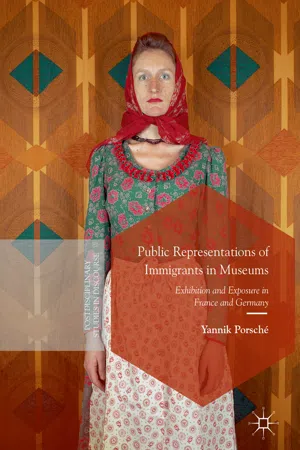
The exhibition showed photographs such as the one on this book’s cover.2 Is this a typical immigrant? What is wrong with this image? Are the patterns on the woman’s dress incongruous with the wallpaper? With which culture do we associate this way of dressing? The patterns and colours seem to have different ethnic origins. Are the patterns and colours not too modern for the traditional clothing? Why is the woman wearing a headscarf and an apron that we might associate with farm or kitchen labour, in combination with a festive dress and necklace? Is she wearing make-up on her eyes and lips to fit the background? Has she positioned herself in front of the wallpaper for the purpose of the photograph? Does her motionless gaze indicate that she is uncomfortable in this pose? Is the photograph a fabrication, playing with our preconceptions? In short, does this picture exhibit an immigrant or do contradictions in it expose stereotypes? Whose stereotypes does an exhibit such as this expose? The people’s or yours? The exhibition of public representations of immigrants in museums raises many questions, concerning both the selection of exhibits and the discussion of those exhibits with visitors. In this book, I examine how interactions over such questions were carried out in the production and reception of the temporary exhibition.
I do so to shed light on how ways of selecting, presenting, and discussing themselves contribute to the exhibition’s topic of the public representations of immigrants. This study analyses the peculiarities, functions, and relevancies of interactions in museum spaces. In this exhibition project, curators, visitors, journalists, and politicians, to give one example, discussed whether the term “Fortress Europe” (on a text panel) best described the outcome of the way people have represented and treated immigrants over one hundred and forty years. Exhibition guides, in their introductions to school tours, asked: Where do we stand in relation to collective images, racism, and propaganda about foreigners and our own nation that circulate in public? How does our knowledge on these issues compare to that of the general publics of both nations? In other words, museum exhibits used in teaching, for reflection and discussion, here served to mediate between individual people and discourse about collective bodies of people.
The exhibition was first shown 2008/2009 at the Cité Nationale de l’Histoire de l’Immigration in Paris, France—Europe’s first national history museum of immigration, which opened a year before the temporary exhibition. In Paris, an accompanying programme was organised by the Goethe Institute association. At the same time, on another floor of the Cité, a smaller, complementary exhibition was shown, which had been organised in parallel by a network of immigrant associations run by the Cité. Half a year later the exhibition travelled to Berlin, Germany, where it was presented at two different museum institutions—the main exhibition was shown in the established national history museum, the Deutsches Historisches Museum, and the smaller one was presented independently at the more alternative neighbourhood museum, Friedrichshain-Kreuzberg. The more prestigious main exhibition focused on an academically curated chronology of German and French nation-building. In the Cité, historical exhibits at the centre of the exhibition had been surrounded by pieces of contemporary art, such as photographs from a series by Katharina Mayer, one of which is shown on this book’s cover. In the DHM, only a few pieces of contemporary art were shown at the end of the exhibition. The smaller exhibition by the immigrant network displayed students’ artwork and exchange projects. The exhibits’ move from Paris to Berlin did not change them physically. Did the move, however, alter their meaning? How did people make sense of them in their new national, cultural, political, and institutional context?
Where are public representations of foreigners generated? Does it suffice to turn on the television or read the newspaper to find out about them? Alternatively, should we analyse election campaigns? That museum institutions are seen as symbolically important venues that deserve attention becomes apparent in this study—for example, when the existence of a museum or official speeches at an exhibition opening are read as political statements or when modifications are called instances of governmental censorship. In this study, I thus take the view that cultural portrayals of foreigners, or immigrants in particular, are not only made up of mass media images of Muslim women wearing headscarves, refugees in overcrowded boats or trying to climb walls of “Fortress Europe”; nor is the political representation of immigrants only decided in political assemblies and elections. Moreover, debates that merge political and cultural issues such as those about an identité nationale (national identity), a Leitkultur (leading culture), Parallelgesellschaften (parallel societies) or a Islamisierung des Abendlandes (Islamisation of the occident) are also not only carried out in the mass media. In addition, museum exhibitions such as those I analyse here confront visitors with publicly circulating images and debates, which—due to the symbolic meaning attributed to the museum context—have considerable political relevance.
The exhibition in question illustrates that not only do museum visitors meet exhibits that represent an outside world, its people, or politicised public discourses; museums are also spaces in which visitors, museum staff, academics, politicians, and journalists engage in public discussion. The complex of an exhibition designed by academics, its authorisation by elected politicians, and its coverage in the mass media make visitors believe that an exhibition does, or at least should, address issues of public relevance and speak the “truth” from an objective and balanced position. Many museum practitioners and visitors hope that exhibitions constitute a more entertaining and memorable venue for teaching than classrooms. Moreover, it is often assumed that museum activities and experiences can potentially change public opinion or facilitate social inclusion. In order to distinguish different yet interrelated perspectives on museum discourse, we can note that much has been said about museums in research and in the press; that some things have been expressed through museums, for example when national museums on immigration symbolically include or exclude immigrants from the nation; and finally, that how much is said in national museums ranges from complete silence in empty exhibition halls or the sounds of projectors and audio installations, occasional whispering in pondering groups of visitors, to busy chatting on the part of school classes pushing through the exhibition or heated debates in the museum’s auditorium.
This book explores how, in their interactions, museum staff and visitors in different ways contributed to generating public images of both foreigners and the two national publics. The aim of the analysis is to examine how expectations, conversations, buildings, exhibits, etc. shape the particular institutional museum contexts and how these as educational institutions themselves contribute to the topic that is explored in the exhibition. Fascinated by the infinite regress that occurs in reproducing representations when speaking about them, I ask what pictures of the relation between the public and immigrants are painted in the museums and what impact this has on the inclusion or exclusion of immigrants in/from the national public. However, in this analysis I am less concerned with describing exhibits, namely public representations of immigrants as the most emblematic figure of foreigners and the stereotypes they supposedly expose. Instead, I analyse minute details, and look at the modalities of how social and mediated interaction works, which produce and question these.
The collaborative and multi-sited production and reception of the exhibition allows for the identification of conceptually very different institutional approaches to museum work. The present study describes a number of paradigmatic ways in which the topic of the exhibition can be dealt with. Whereas interaction in some museum contexts was thought to occur between the government and the (inter)national public, in others visitors and museum staff saw interaction as occurring merely between residents of the same neighbourhood. During my fieldwork, I came to understand museums as dispersed dramaturgical stages, some of which remained hidden from the public, whereas others were designed for public presentation and negotiation. In my analysis, I offer a round-tour of the diversity of stages within one museum institution: This includes, on the one hand, exhibition planning on the back stage of the offices, which I followed doing extensive ethnographic fieldwork during the two-year preparation of the exhibition in the three museums. On the other hand, my analysis covers the exhibition presentation in the French and German catalogues, speeches on the opening nights, and interactions between guides and visitors in the exhibition spaces, as well as guestbook entries and mass media coverage in newspapers, on the radio, and on television. Within each institution, the picture of collectives is thus not drawn on a single canvas but is distributed over various different sites of interaction.
In the second chapter of this book, I review theoretical work on museums, the public, and immigration. A simplified conceptualisation of interaction on museum stages describes it in terms of diverse discursive and materialised “speech acts.” Although speech act theory misses the dynamics of social interaction, it usefully disentangles the performative functions of utterances in communication, which in museums are significant on the level of face-to-face interaction between individuals as well as in terms of collective cultural and political representations in society. Museums generate meaning in three quite different ways: first, according to some research, the press, or other media broadcasts on museums, their function consists in displaying artefacts in which cultural knowledge and memory is stored. Second, an institution’s mere existence in cases such as immigration museums is thought to be a symbol through which political statements are made. And third, in reading text panels and engaging in conversations with museum staff or other people during and after the visit, the visitor gains academic as well as practical, embodied knowledge. Museums are thus involved as passive reference entities, as themselves actively making a statement, or as containers or infrastructures in which interactions take place. Museum studies usually choose one of these three ways of generating meaning as a perspective for in-depth analyses of museums and their exhibitions. They seem to suggest either that artefacts say something independently of what has been said about them and how they are presented, that the existence of museums has political connotations no matter what goes on within them, or else that face-to-face interactions function according to some logic, which is largely independent from the context in which it occurs. My thesis is that these three dimensions of discourse are, however, highly interdependent. A suitable methodology thus needs to focus on how they intertwine. Moreover, approaches that only take one of these perspectives often rely on problematic theoretical notions of museums as material stores of knowledge and memory. Studies that analyse only the concept and content of an exhibition or a museum do not tell us how visitors actually perceive them. And visitor studies that look at how (many) people move and talk in the exhibition space do not consider the symbolic or political meaning of exhibitions. Only by attending to various contextualisation practices in, for instance, the work of a journalist reviewing the exhibition does one shed light on the complexity of speech acts carried out in and through museums. A journalist, for example, might engage in interactions in the museum, based on which she writes an article. In articles, journalists typically construct an image of the exhibition, the visitors, and the general public, and encourage the audience to take a certain perspective on the museum, the exhibition, or particular exhibits.
The second chapter also focuses on concepts of the public and representation as a theoretical grounding for analysing the interaction between the museum as an institution and the general public. This allows us to understand what issues are at stake in the case of representing public representations of immigrants. In this book, my analysis confronts different meanings of the term ‘public.’ National history museums frequently present transformations of the public sphere over time. For this purpose they distinguish between developmental stages of the public sphere (for example, from feudal-representational to the decline of an ideal bourgeois Öffentlichkeit) or between different public cultures (for example, rational debate in salons, coffee houses, the daily newspapers, or the mass media in different countries). Further, in museums more or less institutionalised rhetorical conventions and practices are established for different occasions of presentation to, and debate with, the public (for example, various kinds of guided tours, workshops, vernissages, or press conferences). This exhibition project offers a chance to consider how “the publics” represent foreigners as their counterparts, how museum practice constructs images of the representing publics, and to what extent and in what ways museum practices themselves enable, stimulate, and gear public debate, that is, instantiate public spheres. The study of how public representations of foreigners are staged in museums also acknowledges a question that museum practitioners, visitors, and researchers alike raised, regarding whether foreigners in museums are always only talked about or whether they are also spoken for or themselves speak.
The second chapter further makes a suggestion regarding how to conceptualise knowledge and memory construction in museums. Combining ethnomethodological work on institutional interaction with ethnographic perspectives on epistemic cultures, I propose an approach called ‘institutional epistemics’ to analyse institutional cultures that are geared towards knowledge production. I present typical ways in which museum staff and visitors in talk-in-interaction and other practices—that is, through displaying their understanding of prior talk, conduct, or publications and designing their activities to fit the particular audience and task at hand—instantiate different institutional cultures. Instead of notions of the museum as a neutral “store” of knowledge (about the past), which experts diffuse to the lay audience, museums, on this view, are better described as particular ‘epistemic cultures’ that frame what counts as knowledge and actively construct territories of knowledge. Since museums are situated at the intersection of academia, school, and the mass media this chapter mobilises research on the relations between academia and the public, face-to-face interaction in schools, and the role of the mass media. This is helpful in understanding how museum education gains academic legitimacy in negotiating and passing on knowledge, and is seen to be a symbolically important stage on which voices are publicly heard. The fact that we believe museums are the right venues to teach knowledge and negotiate political recognition itself appears remarkable.
When confronted with the question of how, and where, to study knowledge construc...