This book examines contemporary Afro-Latin@ literature and its depiction of the multifaceted identity encompassing the separate identifications of Americans and the often-conflicting identities of blacks and Latin@s. The Afro-Latin@ Experience in Contemporary American Literature and Culture highlights the writers' aims to define Afro-Latin@ identity, to rewrite historical narratives so that they include the Afro-Latin@ experience and to depict the search for belonging. Their writing examines the Afro-Latin@ encounter with race within the US and exposes the trauma resulting from the historical violence of colonialism and slavery.
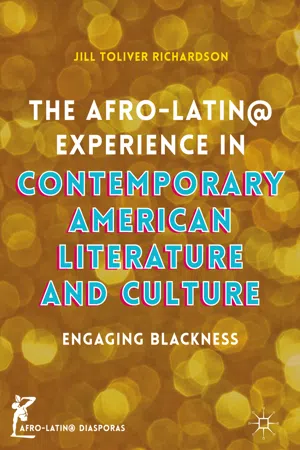
eBook - ePub
The Afro-Latin@ Experience in Contemporary American Literature and Culture
Engaging Blackness
- English
- ePUB (mobile friendly)
- Available on iOS & Android
eBook - ePub
The Afro-Latin@ Experience in Contemporary American Literature and Culture
Engaging Blackness
About this book
Information
© The Author(s) 2016
Jill Toliver RichardsonThe Afro-Latin@ Experience in Contemporary American Literature and CultureAfro-Latin@ Diasporas10.1007/978-3-319-31921-6_11. Introduction
Jill Toliver Richardson1
(1)
Department of English, Borough of Manhattan Community College, Brooklyn, New York, USA
The Afro-Latin@ Experience in Contemporary American Literature and Culture: Engaging Blackness examines contemporary fiction and poetry by US-based Afro-Latino/a writers originating from the Spanish-speaking Caribbean. This study interrogates the complex notion of Afro-Latino/a identity as it relates to the concept of “triple consciousness” posited by Juan Flores as the multifaceted identity encompassing the separate identifications of Americans and the often-conflicting identities of black and Latino/a people (“Triple Consciousness” 80–85). As Afro-Latinos/as are commonly unacknowledged within the larger Latino/a community, not accepted within the African-American community, and invisible citizens within the American national imagination, I concentrate on the writers’ interpretations of the Afro-Latino/a predicament and the conflicted nature of the Afro-Latino/a experience.
Miriam Román and Juan Flores define Afro-Latinos/as as “people of African descent in Mexico, Central and South America, and the Spanish-speaking Caribbean, and by extension those of African descent in the United States where origins are in Latin America and the Caribbean” (1). For the purpose of this study I include fiction and poetry written by Latino/a writers who either immigrated to or were born in the US. Furthermore, they acknowledge their own African heritage and self-identify as Afro-Latino/a, or black, and interrogate the complexity of racial and national identity when confronted with the American system of bipolar racial categorization.
There is a small but growing canon of Afro-Latino/a writers who delineate their experiences within the US and abroad in their fiction, memoirs, and poetry. Some of the foundational texts include Jesus Colon’s A Puerto Rican in New York, And Other Sketches (1961), Evelio Grillo’s Black Cuban, Black American: A Memoir (2000), and Puerto Rican/Cuban-American Piri Thomas’ Down These Mean Streets (1967). Additionally, there is a long tradition of Afro-Puerto Rican performance poets who also published and were part of the Nuyorican Literary Movement of the 1960s and 1970s including Felipe Luciano, Tato Laviera, Pedro Pietri, Miguel Algarín, and Sandra María Esteves. All of these writers and others are inspiring literary models for the latest generation of Afro-Latino/a writers writing and publishing today.
Multiple literary critics have theorized concepts of Afro-Latino/a literature and, interestingly, have proposed varied interpretations of the genre, the themes, and the writers who should be included. Rather than proposing a definition of Afro-Latino/a literature, Theresa Delgadillo delineates the common ideas and themes incorporated into Latino/a literature, which demonstrate the Latino/a connection to the African diaspora. These include:
the recollection of history and racial formation in the Americas, the recognition of African American culture as an aspect of Latino/a life, the incorporation of African American expressions and forms of expressions in Latino/a literature, the representation of skin color and phenotype in ethnic and national subjectivities, the exploration of the shared conditions of discrimination and marginalization between African Americans and Latino/as, and the discussion of the contrasts between experiences of racial formation for Latino/as and African Americans. (384)
Delgadillo does not limit her observations to darker-skinned or phenotypically black Latinos/as. Rather, she acknowledges the presence of the African Diaspora in the culture of all Latinos/as. Additionally, she highlights the relationship and shared experiences with the African-American community as a defining feature of literature that engages the African Diaspora. Additionally, she posits that the depiction of shared political, social, and cultural experiences with African-Americans reflects a shared African ancestry.
In her earlier examination of Afro-Latino/a literature, critic Fiona Mills includes both African-American and Latino/a texts. She suggests that writing from both groups that acknowledges a shared relationship, ideology, or affinity with the other should be included within this genre. Mills contends that even though:
the [African-American and Latino/a] writers I am working with all acknowledge the existence of cultural traits and traditions unique to each ethnoracial community, they also insist upon the creation of inter-ethnic alliances, such as I am terming ‘Afro-Latino/a,’ on the basis of shared experiences of oppression, a working-class ideology, emphasis on speaking from and for ‘the people’ … a desire to offer cultural alternatives to assimilation, and to express anger and outrage at the existence of oppressive ideologies. (116)
Again, within another formulation of literature that interrogates the Afro-Latino/a experience, engagement with the African-American community takes precedence. Although Mills’ definition of Afro-Latino/a literature has not become the primary model adopted and furthered by other literary critics in this emerging field, her insistence on a shared discourse between African-American and Latino/a communities is one that contemporary Afro-Latino/a writers recognize and examine in their texts.
Similarly to Delgadillo, literary critic William Luis recognizes that other Latino/a writers, beyond those typically categorized as Afro-Latino/a, engage the African Diaspora in their work. He extends his definition of Afro-Latino/a to include these writers as well:
It should be clear by now that while this study underscores an Afro-Latino literature and identity fostered by Afro-Latino writers, it also accentuates a literature written by Latinos. Latino writers such as Esmeralda Santiago, Judith Ortiz Cofer, and Cristina Garcia in a broad sense are also Afro-Latinas; they draw on what they perceive to be the strengths of blackness that includes the African component of Caribbean identity. This is also the case of writers such as Julia Alvarez, whose presence in the United States allowed her to understand the linguistic and racial isolation experienced by Afro-Latinos, at home and in her parents’ country of origin. (42)
Through his formulation of Afro-Latino/a literature, Luis develops a theory of an Afro-Latino/a consciousness that encompasses writers who may be designated as white Latinos/as. These writers express an understanding of the African component to their Caribbean identity and/or depict the jarring encounter that Afro-Latinos/as experience with racial discrimination in the US and the Caribbean homeland. While I do not define this group of writers as Afro-Latino/a in my project, I do acknowledge the profound influence of their writing and interrogation of race on contemporary Afro-Latino/a literature.
This study examines post-Civil Rights era literary works by Afro-Latino/a writers originating from the Dominican Republic, Puerto Rico, and Cuba. Since the 1990s, the latest generation of Dominican-American writers has flourished and generated a large body of fiction exploring the current transnational experience of Afro-Dominicans in the diaspora. In addition, while the latest group of Puerto Rican writers of the post-Nuyorican Literary Movement of the 1960s and 1970s has made a substantial foray into fiction rendering the crack-cocaine-infused urban climate of the post-Civil Rights era, 1 Afro-Puerto Rican writers have produced a substantial body of poetry written both for the page and as performance art inspired by the original group of performance poets associated with the Nuyorican Poets Café in New York City.
The writers in this study are all products of the post-Civil Rights era, the coinciding post-industrial urban environment, and hip hop culture of the late 1970s through the early twenty-first century. Their texts showcase the urban settings of New York and New Jersey and the environments created by the crack-cocaine era of the 1980s through the early 1990s that transformed the American landscape in part precipitating a rapid increase in youth and gang violence, the escalation of the HIV/AIDS epidemic, the destabilization of urban families, and the largest wave of imprisonment in American history. I posit that in the post-Civil Rights era of the US, the latest generation of Afro-Latino/a writers portrays the promises of racial integration as unfulfilled in the integrated US. Beyond the façade of success that is in actuality only achieved by an elite group of black Americans and Latinos/as, the writers depict their Afro-Latino/a characters as having found little or no upward mobility in the US. Paralleling the black/African-American experience, the Afro-Latino/a characters face stagnation and constant hurdles blocking them from attaining the American Dream of material success and a feeling of belonging in the American national community. However, I argue that their ability to stay connected transnationally to a Caribbean homeland or to create an alternative home to the American national framework is what ultimately provides them with the mobility necessary in the US to transgress boundaries, gain upward mobility, and succeed in navigating the American landscape.
Stuart Hall’s essay “Minimal Selves” is at the root of the theoretical questions that initiated my examination of contemporary Afro-Latino/a literature. In “Minimal Selves” Hall expresses his admiration for young black people in London and his confusion over the confidence they exude in comparison to the generations of black migrants preceding them:
I’ve been puzzled by the fact that young black people in London today are marginalized, fragmented, unenfranchized, disadvantaged, and dispersed. And yet, they look as if they own the territory. Somehow, they too, in spite of everything, are centered, in place: without much material support, it’s true, but nevertheless, they occupy a new kind of space at the center. (114)
Hall concludes that these young people have become centered, despite their marginalization, by affirming themselves as part of the new black ethnicity composed of the colonized subjects of the African Diaspora who migrated to England. Similarly to post-modern identity, which Hall parallels to migrant identity, this alternative framework for black identity holds at its core “the notion of displacement as a place of ‘identity’” (116). Despite their detachment from a notion of England and Englishness that has little to do with them, these young black Britons found a way to locate themselves in England, beyond a national framework, which allows them to feel “at home” in a less than welcoming land.
How, I wondered, did Hall’s observations on black British young people compare to the musings of young Afro-Latino/a writers in the US? Do their writings reflect this same feeling of centeredness and comfort with their surroundings? Are they able to make a claim to their territory and share in a feeling of ownership despite their oppositional placement to American culture? And how similar are their imaginings of selfhood as immigrants, migrants, and first-generation Americans to that of the members of the mainstream American national community?
In England, Hall discovered that the label “black” had been reconstructed as an ethnic identity for immigrants of the African Diaspora that gave young people a feeling of belonging despite their marginalized positions within the English national community. However, in Afro-Latino/a literature, the label “black” remains a contested terrain for Latino Caribbean immigrants who understand the politically charged nature of the term within its American context and the historical inequities of race within the US.
A transnational and diasporic identity, which is founded on the premise that an individual identifies with more than one national or territorial home, serves as an alternative to American national identity that provides some of the Afro-Latino/a characters in these narratives a location of identity. However, the sense of centeredness and confidence that Hall detects among the black British youth in London is only present in Afro-Latino/a literature when a profound connection to one’s original homeland remains strong or an alternative home is fashioned. Rootlessness, homelessness, and displacement are as commonly experienced as Hall’s notion of “centeredness.” Silvio Torres-Saillant warns against the popularity of scholarship in the field of transnationalism that emphasizes the destabilization of nation, home, and national identity by jolting his readers with an all too real scenario of the transnational experience for many migrants whom “that kind of mobility spells out a drama of displacement, destitution, and ultimate homelessness” (“Diasporic Disquisitions” 36). Several of the texts examined in this study echo these sentiments by depicting characters who have lost their footing during the migratory experience.
Transnational and diaspora frameworks offer Afro-Latinos/as a form of resistance to the hegemonic discourse of American nationalism that is similar to Hall’s proposal that the colonized subject can use a “new conception of ethnicity as a kind of counter to the old discourses of nationalism or national identity” (118). Furthermore, transnational and immigrant literature relates to the postcolonial experience by deconstructing the dominant narrative of the nation and national identity. Rosemary Marangoly George explores the connection between immigrant literature and postcolonialism:
Distinct from other postcolonial literary writing and even from the literature of exile, it is closely related to the two. For the immigrant genre, like the social phenomenon from which it takes its name, is born of a history of global colonialism and is therefore a participant in decolonizing discourses. (171)
As an integral aspect of the postcolonial condition, immigration reinforces the power dynamics between the “mother country” and the homeland by acting as the medium that brings colonized subjects to European and American imperial nations. Immigrant literature examines the condition of being an immigrant, the forces that shape immigrant identity, and the power dynamics that create the need to leave one’s home.
The immigrant genre flourished as many of these colonized subjects arrived in North America and Europe and began writing narratives depicting the immigrant experience. Hall describes the way that he became aware of his new identity as a Jamaican immigrant to England as a realization that he was one of the immigrants that his mother referred so callously to, “I mean the notion of displacement as a place of ‘identity’ is a concept you learn to live with. … Living with, living through difference” (116). The act of living with and through difference is itself an act of resistance because an immigrant’s or migrant’s way of life is represented as oppositional to normative culture. Afro-Latino/a literature explores the “notion of displacement as a place of ‘identity’” and it challenges the national narrative by employing several methods of resistance to it.
The “third wave” of immigration to the US, initiated by the Hart-Cellar Immigration Act of 1965, permanently altered the racial makeup, culture, and identity of the American people. For the first time, large populations of non-European immigrants from Latin America, Asia, and the Caribbean settled in the US. Contrary to the first two waves of European immigrants’ achievement of full incorporation into American culture, the majority of the post-1965 immigrants found themselves barred from assimilating in the same fashion. Unlike the two previous waves, racial difference was the main factor used to assign the new comers to subnational groups. The search for belonging for the post-1965 arrivals sometimes necessitates crossing boundaries into other racial and ethnic communities. However, many of them find themselves trapped by existing power structures on the periphery of American society and lacking inclusion into the center. They learn that the added complication of race excludes them from the mainstream imaginings of the nation. Their arrival continues to serve as a gauge measuring the extent to which all people are capable of assimilating into mainstream American society and of finding a place of belonging.
While much of immigrant literature highlights the experiences and challenges of assimilating into the narrowly conceptualized American national identity, some of it also emphasizes other strategies for identity development and locating a place of belonging within the US. Louis Mendoza and S. Shankar identify what they believe to be the main characteristics of immigrant literature written during the third wave of immigration (1965–present):
In all its variety, these works are united and made into what we call a new literature of immigration by the following: an engagement in however explicit or subtle a manner with the idea of ‘America’; and an experience of a crossing, of a journeying, across a legally and otherwise policed line to that fateful encounter with America. (xxiv)
Mendoza and Shankar further distinguish between immigrant stories related to crossing the geographical border into America, remembering the experience of transgressing this boundary, reflecting on America after arrival, and becoming American. As the editors imply, analysis of immigrant literature mainly focuses on the US and what occurs there.
However, due to the technological advancements in transportation, communication, and media, it is now easier for immigrants to maintain connections to their original homelands. Arjun Appadurai illustrates the significance of technology and mass media on the daily lives of immigrants around the world:
The story of mass migrations (voluntary and forced) is hardly a new feature of human history. But when it is juxtaposed with the rapid flow of mass-mediated images, scripts, and sensations, we have a new order of instability in the production of modern subjectivities. As Turkish guest workers in Germany watch Turkish films in their German flats, as Koreans in Philadelphia watch the 1988 Olympics in Seoul through satellite feeds from Korea, and as Pakistani cabdrivers in Chicago listen to cassettes of sermons recorded in mosques in Pakistan or Iran, we see moving images meet deterritorialized viewers. These create diasporic public spheres, phenomena that confound theories that depend on the continued salience of the nation-state as the key arbiter of important social changes. (4)
Appadurai describes the impact of global networks and mass media on our current imaginings of nationhood. He questions the utility of maintaining the perspective that nations have a monopoly on instituting cultural and social change when clearly other avenues in global contexts exist for disseminating information and creating collective forms of agency.
Afro-Latinos/as are now more easily able to sustain transnational networks with their homelands, which has a direct influence on their imaginings of home and identity. Within the fields of immigrant and first-generation American literature, how do we account for the rapidly growing influence of the Caribbean homeland on identity development, community formation, and relationship to the US? Transnational and diaspora frameworks provide alternative theoretical frameworks for analyzing literature about the immigrant and first-generation experience. 2 Evaluating immigrant literature by focusing on transnational and diaspora relationships allows us to view both the US and the Caribbean homeland in a critical context. This lens enables a focus on the relationship between the Caribbean and America and its impact on immigrant literature rather than solely concentrating our attention on the experience ...
Table of contents
- Cover
- Frontmatter
- 1. Introduction
- 2. Enduring the Curse: The Legacy of Intergenerational Trauma in Junot Díaz’s The Brief Wondrous Life of Oscar Wao
- 3. Haunting Legacies: Forging Afro-Dominican Women’s Identity in Loida Maritza Pérez’s Geographies of Home
- 4. “Boricua, Moreno”: Laying Claim to Blackness in the Post-Civil Rights Era
- 5. Afro-Latin Magical Realism, Historical Memory, Identity, and Space in Angie Cruz’s Soledad and Nelly Rosario’s Song of the Water Saints
- 6. Memory and the Afro-Cuban Missing Link in H.G. Carrillo’s Loosing My Espanish
- 7. Conclusion: Conceptualizing Afro-Latinidad
- Backmatter
Trusted by 375,005 students
Access to over 1.5 million titles for a fair monthly price.
Study more efficiently using our study tools.
Frequently asked questions
Yes, you can cancel anytime from the Subscription tab in your account settings on the Perlego website. Your subscription will stay active until the end of your current billing period. Learn how to cancel your subscription
No, books cannot be downloaded as external files, such as PDFs, for use outside of Perlego. However, you can download books within the Perlego app for offline reading on mobile or tablet. Learn how to download books offline
Perlego offers two plans: Essential and Complete
- Essential is ideal for learners and professionals who enjoy exploring a wide range of subjects. Access the Essential Library with 800,000+ trusted titles and best-sellers across business, personal growth, and the humanities. Includes unlimited reading time and Standard Read Aloud voice.
- Complete: Perfect for advanced learners and researchers needing full, unrestricted access. Unlock 1.5M+ books across hundreds of subjects, including academic and specialized titles. The Complete Plan also includes advanced features like Premium Read Aloud and Research Assistant.
We are an online textbook subscription service, where you can get access to an entire online library for less than the price of a single book per month. With over 1.5 million books across 990+ topics, we’ve got you covered! Learn about our mission
Look out for the read-aloud symbol on your next book to see if you can listen to it. The read-aloud tool reads text aloud for you, highlighting the text as it is being read. You can pause it, speed it up and slow it down. Learn more about Read Aloud
Yes! You can use the Perlego app on both iOS and Android devices to read anytime, anywhere — even offline. Perfect for commutes or when you’re on the go.
Please note we cannot support devices running on iOS 13 and Android 7 or earlier. Learn more about using the app
Please note we cannot support devices running on iOS 13 and Android 7 or earlier. Learn more about using the app
Yes, you can access The Afro-Latin@ Experience in Contemporary American Literature and Culture by Jill Toliver Richardson in PDF and/or ePUB format, as well as other popular books in Social Sciences & Modern Literary Criticism. We have over 1.5 million books available in our catalogue for you to explore.