eBook - ePub
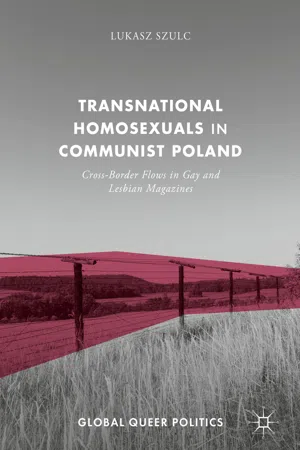
Transnational Homosexuals in Communist Poland
Cross-Border Flows in Gay and Lesbian Magazines
- English
- ePUB (mobile friendly)
- Available on iOS & Android
eBook - ePub
Transnational Homosexuals in Communist Poland
Cross-Border Flows in Gay and Lesbian Magazines
About this book
This book traces the fascinating history of the first Polish gay and lesbian magazines to explore the globalization of LGBT identities and politics in Central and Eastern Europe during the twilight years of the Cold War. It details the emergence of homosexual movement and charts cross-border flows of cultural products, identity paradigms and activism models in communist Poland. The work demonstrates that Polish homosexual activists were not locked behind the Iron Curtain, but actively participated in the transnational construction of homosexuality. Their magazines were largely influenced by Western magazines: used similar words, discussed similar topics or simply translated Western texts and reproduced Western images. However, the imported ideas were not just copied but selectively adopted as well as strategically and creatively adapted in the Polish magazines so their authors could construct their own unique identities and build their own original politics.
Information
© The Author(s) 2018
Lukasz SzulcTransnational Homosexuals in Communist PolandGlobal Queer Politics10.1007/978-3-319-58901-5_11. Introduction: A Sexual Cold War and Its Myths
Lukasz Szulc1
(1)
London School of Economics and Political Science, London, UK
We live in an age of ‘queer wars ’, Dennis Altman and Jonathan Symons (2016) argue in their recent book entitled, indeed, Queer Wars. This is an age of cultural battles around gender and sexuality in general, and LGBT rights in particular (where LGBT stands for lesbian , gay, bisexual and transgender people ). Altman and Symons (2016, p. 7) elaborate their thesis by explaining that contemporary international debates tend to focus more often on LGBT issues, which ‘come to stand for broader debates about culture, tradition and human rights’. They do not specify when exactly those queer wars broke out, though they do connect the outbreak to the growing visibility of LGBTs and the considerable progress in LGBT rights in the West, beginning in the late 1960s. Those advancements, the authors go on, have provoked a conservative backlash against LGBTs, both within and against Western countries, and have resulted in new forms of polarization in world politics between ‘gay-friendly’ and ‘homophobic’ or, alternatively, ‘decadent’ and ‘decent’ countries, cultures, regions or even entire ‘civilizations’ (Inglehart and Norris 2003). At the international level, the dividing line seems to be rather clear in the discourse and runs between ‘the West’ and ‘the Rest’, where the former category usually implies, in this context, North America, Western Europe , Australia and Israel, and the latter, in Altman and Symons’s words (2016, p. 3), ‘countries struggling with colonial legacies or other forms of social disorder’.
Other authors (e.g. Engeli et al. 2012; Picq and Thiel 2015; Weber 2016) and mainstream media (e.g. Economist 2014; Washington Post 2015) too point to the increasing importance of gender and sexuality, including LGBT-related issues, in world politics in recent decades. Ronald Inglehart and Pippa Norris (2003, p. 63) refer to the controversial thesis of Samuel Huntington (1993) about a clash of civilizations to argue that the ‘true’ clash of civilizations ‘is not about democracy but sex’. Drawing on two waves of World Value Survey (1995–1996 and 2000–2002), the authors assert that it is attitudes towards such topics as abortion , divorce and homosexuality that truly divide what they lump together as ‘Muslim ’ and ‘non-Muslim’ societies. Jasbir Puar (2007, 2013) takes a more critical look at world politics and, instead of searching for a ‘true’ dividing line between civilizations, argues that the rhetoric of a sexual clash of civilizations is used to render the West essentially gay-friendly and the Rest (especially the Middle East , Arabs and Islam ) essentially homophobic. She has coined the term ‘homonationalism ’ to mark the practice of incorporating (some) LGBT rights into national identities of Western countries in order to justify, for example, the US invasions of Afghanistan or Iraq (Puar 2007), or the Israeli occupation of Palestine (Kuntsman 2008; Puar 2011), in terms of saving or protecting LGBTs. Other authors describe similar tendencies in Western European countries, especially in the Netherlands (Bracke 2012; El-Tayeb 2012; Mepschen and Duyvendak 2012) and also in France (Fassin 2010), Germany (Haritaworn and Petzen 2011) and the United Kingdom (Raboin 2013), where LGBT rights have been used primarily against immigrants, once again mostly Arabs and Muslims.
Central and Eastern Europe (CEE) for some time stayed outside of the discourse of queer wars , in which the Rest has normally referred to the Middle East and North Africa as well as other regions of the world formerly colonized by the West. CEE has tended to be perceived as not that radically different from the West, placed somewhere in between the two ‘extremes’ of the ‘First’ and ‘Third’ Worlds (Chari and Verdery 2009), of the ‘West’ and the ‘Orient’ (Wolff 1994); united with the West through the common denominator of whiteness and Christianity (El-Tayeb 2011, p. xx). Or, as Jill Owczarzak (2009, p. 6) puts it, CEE as ‘the West’s intermediary “Other,” neither fully civilized nor fully savage’. This is not to say that CEE and the West have been considered as equal or homologous. The key difference between the two, however, has been understood in temporal rather than spatial (or cultural) terms: haunted by its communist past—where communism is imagined as a backward force, putting on hold economic, political and social advancements—CEE is frequently considered as simply lagging behind the West (Todorova 2005). After the fall of communism in Europe , the narrative goes on, CEE could finally start catching up with the West, transitioning from communism to capitalism and democracy (Kubik 2013) as well as to the Western ideals of norms, values and rights (Kulpa 2014; Kulpa and Mizielińska 2011), under the careful guidance of Western institutions, especially the European Union (EU) (Slootmaeckers et al. 2016). Accordingly, CEE is also conceived as lagging behind the West in terms of LGBT-related issues, ‘probably with a delay of some two or three decades’, as Aleksandar Štulhofer and Theo Sandfort (2005, p. 16) claim, and is expected to gradually adopt LGBT-related legal provisions, the demands growing in importance in the EU accession process since the 1990s (Slootmaeckers and Touquet 2016).
CEE, however, has not straightforwardly followed the trajectory of ‘Westernization ’, or ‘Europeanization ’, and, consequently, it too has recently joined the discourse of queer wars . The strongest divergence from the trajectory can be observed of course in the politics of Russia. After the fall of the Soviet Union in 1991, the country aspired to move towards the West and began to change its conservative stance towards homosexuality accordingly: in 1993, Russia decriminalized male same-sex acts in order to join the Council of Europe (CoE) , and in 1999, it depathologized homosexuality by adopting the World Health Organization ’s classification of diseases, which recognizes homosexuality and bisexuality as normal variations in sexual orientation (Kon 2009, p. 45). This politics shifted again at the beginning of the millennium, when Vladimir Putin rose to power and revived the idea of Russian self-sufficiency as well as its political supremacy in the region and moral superiority over the West. Already in the spring of 2002, a draft law recriminalizing same-sex acts was brought before the State Duma , even though it was quickly turned down (Kon 2009, p. 46). Andrey Makarychev and Sergei Medvedev (2015) demonstrate that the last couple of years have brought even more intensified politics of ‘sexual sovereignty ’ in Russia; they speak of a ‘biopolitical turn’, starting with Putin’s third term as president and marked by the introduction of such infamous laws as those preventing the organization of gay parades in Moscow for the next 100 years (adopted in 2012) and forbidding so-called ‘homosexual propaganda’ (adopted in 2013) (see also Romanets 2017, Stella 2013). Not surprisingly, therefore, Altman and Symons (2016) start their book on Queer Wars by referring to the Russian case, more specifically to the negative reactions of Russian polit...
Table of contents
- Cover
- Frontmatter
- 1. Introduction: A Sexual Cold War and Its Myths
- 1. Global, Eastern and Polish Homosexuals
- 2. Transnationalism in Gay and Lesbian Magazines
- Backmatter
Trusted by 375,005 students
Access to over 1.5 million titles for a fair monthly price.
Study more efficiently using our study tools.
Frequently asked questions
Yes, you can cancel anytime from the Subscription tab in your account settings on the Perlego website. Your subscription will stay active until the end of your current billing period. Learn how to cancel your subscription
No, books cannot be downloaded as external files, such as PDFs, for use outside of Perlego. However, you can download books within the Perlego app for offline reading on mobile or tablet. Learn how to download books offline
Perlego offers two plans: Essential and Complete
- Essential is ideal for learners and professionals who enjoy exploring a wide range of subjects. Access the Essential Library with 800,000+ trusted titles and best-sellers across business, personal growth, and the humanities. Includes unlimited reading time and Standard Read Aloud voice.
- Complete: Perfect for advanced learners and researchers needing full, unrestricted access. Unlock 1.5M+ books across hundreds of subjects, including academic and specialized titles. The Complete Plan also includes advanced features like Premium Read Aloud and Research Assistant.
We are an online textbook subscription service, where you can get access to an entire online library for less than the price of a single book per month. With over 1.5 million books across 990+ topics, we’ve got you covered! Learn about our mission
Look out for the read-aloud symbol on your next book to see if you can listen to it. The read-aloud tool reads text aloud for you, highlighting the text as it is being read. You can pause it, speed it up and slow it down. Learn more about Read Aloud
Yes! You can use the Perlego app on both iOS and Android devices to read anytime, anywhere — even offline. Perfect for commutes or when you’re on the go.
Please note we cannot support devices running on iOS 13 and Android 7 or earlier. Learn more about using the app
Please note we cannot support devices running on iOS 13 and Android 7 or earlier. Learn more about using the app
Yes, you can access Transnational Homosexuals in Communist Poland by Lukasz Szulc in PDF and/or ePUB format, as well as other popular books in Politics & International Relations & European Politics. We have over 1.5 million books available in our catalogue for you to explore.