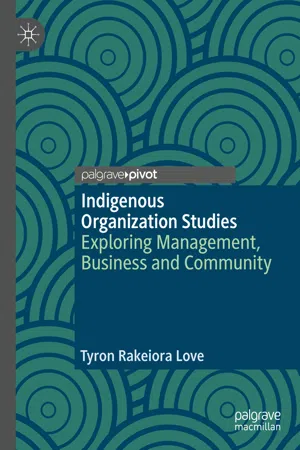
Exploring an emerging area of interest, this book brings together indigenous studies and organization and management research to discuss the complexities of researching indigenous organizations and forms of organizing. Covering various intersections between indigenous peoples, communities, organizations and business enterprises, the author outlines the parameters for researching with an indigenous purpose. A valuable and thought-provoking read for researchers of management, organization, and HRM, Indigenous Organization Studies is a useful methodological tool for undertaking research.
eBook - ePub
Indigenous Organization Studies
Exploring Management, Business and Community
- English
- ePUB (mobile friendly)
- Available on iOS & Android
eBook - ePub
About this book
Information
© The Author(s) 2019
Tyron Rakeiora LoveIndigenous Organization Studieshttps://doi.org/10.1007/978-3-030-01503-9_11. Contemporary Indigenous Organization Studies
Tyron Rakeiora Love1
(1)
UC Business School, University of Canterbury, Christchurch, New Zealand
Tyron Rakeiora Love
Abstract
There is a rich, powerful, and diverse pool of research emerging from university business schools in colonial states looking into indigenous people at work, companies and their impacts on indigenous communities, the structure of tribal entities, indigenous management, indigenous business enterprises, indigenous governance, indigenous leadership, and so on. Drawing from this work, along with insights from the expressive voices of indigenous studies researchers outside business schools and the powerful writings of critical organization studies scholars challenging their mainstream peers, this chapter, in the context of this short book, proposes a new field of research: indigenous organization studies. The purpose of this is to explore indigenous peoples at the centre and at the periphery of managing and organizing and to further consider what workplaces and communities might look like when their organizing principles are based on indigenous knowledges and ways of doing things.
Keywords
Indigenous organization studiesManagementManagingOrganizationOrganizingCommunitiesBusinessEntrepreneurshipLeadershipCritical management studiesOrganization studiesIndigenous studiesIdentityIntroduction
Organizations have been, and continue to be, forces of domination and suppression for indigenous peoples as well as for many other minority peoples around the world. For a considerable period of time colonizers and governments have worked in an orderly fashion to suppress indigenous movements and ways of knowing, to replace people and ideas in coordinated and highly organized ways. But the formation of organizations has also been an important part of indigenous peoples’ collective efforts in the struggle for the recognition of rights through the mobilization of people both within and between nation states (Smith, 1999, 2012). Efforts have led to social movements aimed at bringing about essential change for indigenous and other minority peoples in the pursuit of empowerment and emancipation (Kymlicka, 2014).
Research too has both a problematic and liberating past and present for indigenous peoples and communities. Speaking about research at a recent forum, Linda Tuhiwai Smith (2016) made the biting comment that for indigenous peoples, “research penetrates their bodies and their emotions and their thoughts and … it hurts … research hurts”. For Alaskan Natives, researchers themselves have been likened to mosquitos: “they suck your blood and leave” (Cochran et al., 2008, p. 22). Yet when done ‘right’, research driven by indigenous people and communities can be a powerful endeavour. That’s probably because indigenous research, and the harnessing of knowledges, “are as old as the hills and the valleys, the mountains and the seas, and the deserts and the lakes that indigenous people bind themselves to as their places of belonging” (Cram, Chilisa, & Mertens, 2013, p. 11). Much like organizations, research projects can be offensive and damaging or they can be natural and organic.
Studies on indigenous business, entrepreneurship, leadership, and management—by way of business school research—have offered some interesting and valuable insights over the past few decades (see e.g. Cahn, 2008; Foley, 2005; Haar, Roche, & Brougham, 2018; Henry, Newth, & Spiller, 2017; Julien, Somerville, & Brant, 2017; Peredo, Anderson, Galbraith, Honig, & Dana, 2004; Prendergast-Tarena, 2015; Spiller, Erakovic, Henare, & Pio, 2011). Combined with the inspiring work emerging from indigenous studies (IS) and the stimulating writings of critical management studies (CMS) and organization studies (OS) scholars, I propose a new field of research: indigenous organization studies. The intention with this book is to say some things about it. That is, to say something about the study of organizations and organizing insofar as they have relevance for indigenous peoples and their communities.
The book doesn’t speak on behalf of indigenous peoples; it’s far more abstract than that. It’s about the kind of study or research that is done in university business schools. It considers indigenous people at the centre and at the periphery of managing and organizing, the ongoing life and ‘functioning’ of organizations and the indigenous people within and around them, and what workplaces and communities might look like when their organizing principles are based on indigenous knowledges and ways of doing things. It also encourages conversations between indigenous and non-indigenous peoples and researchers.
Perhaps ironically, this book is wary of research and scholarship, particularly that research fuelled by many governments, universities, and business schools. As I have already canvassed, indigenous scholars and communities have drawn our attention to the fact that ‘research’ has had a bad reputation among indigenous communities for some time now (Smith, 1999, 2012). Readers of this text should not see it as a ‘license to operate’ or as a ‘right to access’ indigenous communities and peoples. What makes research so appalling at times is when indigenous peoples and communities are treated as commodities in the production of knowledge. From the outset, this text is a warning that any predetermined research agendas driven by business schools—without critical engagements with indigenous peoples and communities—are likely to be met with resistance and disdain.
There may be several reasons why you are reading this book and so what follows is a section on who it is for. Given the important role identity plays in indigenous research, two further sections consider identity in doing research as well as the role of the researcher in doing those studies. Towards the end of the chapter the intersection between indigenous and organization studies is touched on to canvas issues and opportunities addressed in the remainder of the text. Finally, as could be expected, there is a conclusion to the chapter.
Who this Book is for
If you are an indigenous person with a passion for indigenous knowledges and peoples and you want to research the kinds of things university business schools study, then this book is definitely for you. Māori peoples (Aotearoa New Zealand); Pacific Peoples (Pacific Islands); First Nations, Métis, and Inuit peoples (Canada); Native American peoples (USA); and Aboriginal peoples (Australia) are likely to find it most useful. Saami peoples (Norway, Finland, Sweden, and Russia) and indigenous peoples from the African and Asian continents may also be interested in the book’s content. Some of the writing in this text may also have relevance for the Mapuche peoples (Chile), the Huichol or Wixáritari peoples (Mexico), and the Kichwa/Quichua/Quechua peoples (Ecuador) as their valuable stories, research discourses, and knowledges are part of the fabric of this book.
This book is for researchers who wish to prioritize indigenous peoples in their studies of organizations and organizing whether they identify as an indigenous person or not. As such, it is a text for organization researchers who are committed to particular research processes so long as those processes are paired with the aspirations of indigenous peoples and grounded in the research discourses of indigenous scholars who have written—often quite critically—about the role organization(s) and research(ers) have played in crafting knowledges and coming up with solutions to everyday problems or opportunities for self-determination.
Parts of this text may be useful in research methods courses run in business schools in colonial and postcolonial countries and territories because the text maintains a healthy-ish respect for established organization and management theories and processes, which often dominate the conversations, whilst tempering those conversations in the pursuit of greater plurality, teasing out their relevance for indigenous organization studies. Academic deans and managers of business and management schools will also find the book useful. In addition, this book is for those who are concerned that indigenous and critical knowledges are not making their way into business school teaching and research curricula.
The book is also relevant for managers, advisors, consultants, and practitioners outside academic institutions. Parts of it will be appropriate for those people who may not be part of any formal research institution but have an interest in the business, management, and entrepreneurial practices of organizations and people and whose activities are loosely or closely intertwined with the interests of indigenous peoples. Increasingly, in colonial societies, organizations are employing indigenous peoples as cultural advisors and consultants. Whilst this text deals with research and theory building processes—that might appear to be academic in nature—it does so only insofar as those processes have relevance for practices and which seek to uncover the complexity of everyday work operations, solving problems and taking advantage of opportunities.
There may be some merit in articulating a hierarchy of research audiences for this text; business schools often maintain the difference between students, junior faculty, senior faculty, and professors. But research hierarchies in business schools have a lot to answer for. These hierarchies have usually determined, either explicitly or implicitly, that particular groups of people are less capable of accomplishing certain tasks. It’s a way of maintaining dependence upon academic systems that I don’t have much time for: ‘student-researchers’ and ‘faculty-researchers’ are researchers, and when it comes to indigenous organization studies, there’s little need to make these kinds of institutional distinctions. We will avoid them as much as possible in this text.
Identity and Doing Research
The question of who should study organizations and processes of organi...
Table of contents
- Cover
- Front Matter
- 1. Contemporary Indigenous Organization Studies
- 2. Theorizing and Its Importance in Indigenous Organization Research
- 3. Methodological Guidelines in Indigenous Organization Research
- 4. People, Place, and Time in the Study of Indigenous Organization
- 5. The Possibilities for Indigenous Organization Studies
- Back Matter
Trusted by 375,005 students
Access to over 1.5 million titles for a fair monthly price.
Study more efficiently using our study tools.
Frequently asked questions
Yes, you can cancel anytime from the Subscription tab in your account settings on the Perlego website. Your subscription will stay active until the end of your current billing period. Learn how to cancel your subscription
No, books cannot be downloaded as external files, such as PDFs, for use outside of Perlego. However, you can download books within the Perlego app for offline reading on mobile or tablet. Learn how to download books offline
Perlego offers two plans: Essential and Complete
- Essential is ideal for learners and professionals who enjoy exploring a wide range of subjects. Access the Essential Library with 800,000+ trusted titles and best-sellers across business, personal growth, and the humanities. Includes unlimited reading time and Standard Read Aloud voice.
- Complete: Perfect for advanced learners and researchers needing full, unrestricted access. Unlock 1.5M+ books across hundreds of subjects, including academic and specialized titles. The Complete Plan also includes advanced features like Premium Read Aloud and Research Assistant.
We are an online textbook subscription service, where you can get access to an entire online library for less than the price of a single book per month. With over 1.5 million books across 990+ topics, we’ve got you covered! Learn about our mission
Look out for the read-aloud symbol on your next book to see if you can listen to it. The read-aloud tool reads text aloud for you, highlighting the text as it is being read. You can pause it, speed it up and slow it down. Learn more about Read Aloud
Yes! You can use the Perlego app on both iOS and Android devices to read anytime, anywhere — even offline. Perfect for commutes or when you’re on the go.
Please note we cannot support devices running on iOS 13 and Android 7 or earlier. Learn more about using the app
Please note we cannot support devices running on iOS 13 and Android 7 or earlier. Learn more about using the app
Yes, you can access Indigenous Organization Studies by Tyron Rakeiora Love in PDF and/or ePUB format, as well as other popular books in Business & Gestione delle risorse umane. We have over 1.5 million books available in our catalogue for you to explore.