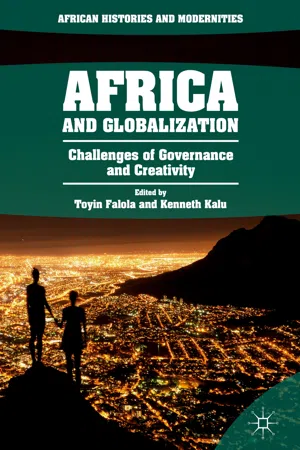
eBook - ePub
Africa and Globalization
Challenges of Governance and Creativity
- English
- ePUB (mobile friendly)
- Available on iOS & Android
eBook - ePub
Africa and Globalization
Challenges of Governance and Creativity
About this book
This book considers the promises and challenges of globalization for Africa. Why have African states been perennially unable to diversify their economies and move beyond export of primary produce, even as Southeast Asia has made a tremendous leap into manufacturing? What institutional impediments are in play in African states? What reforms would mitigate the negative effects of globalization and distribute its benefits more equitably? Covering critical themes such as political leadership, security challenges, the creative sector, and community life, essays in this volume argue that the starting point for Africa's meaningful engagement with the rest of the world must be to look inward, examine Africa's institutions, and work towards reforms that promote inclusiveness and stability.
Information
© The Author(s) 2018
Toyin Falola and Kenneth Kalu (eds.)Africa and GlobalizationAfrican Histories and Modernitieshttps://doi.org/10.1007/978-3-319-74905-1_11. Introduction: Africa in a Globalized World
Kenneth Kalu1 and Toyin Falola2
(1)
Global Management, Ted Rogers School of Management, Ryerson University, Toronto, ON, Canada
(2)
Department of History, University of Texas at Austin, Austin, TX, USA
Kenneth Kalu
Emerging from several decades of colonial exploitation , most African states struggled to develop modern state institutions and economic systems throughout the twentieth century . Because European colonial administrations failed to set up efficient and development-oriented governance institutions in the African colonies, postcolonial African states began their journey of statehood on very weak foundations, which were characterized by the preponderance of institutions designed to promote exploitation and predation.1 This means that most African states have been plagued by weak political and economic systems , with crisis , poverty and underdevelopment becoming almost permanent narratives on the continent . Perhaps one of the greatest mistakes of Africa’s postcolonial leaders was their failure to effectively dismantle the colonial institutions that thrived on exploitation and treated Africans as subjects instead of citizens . The wholesale retention of these colonial structures meant that political independence was more symbolism than substance. The threads of exploitation, with disdain for the average African citizen by political leaders and formal government structures , as well as the imposition of European education , languages and aspects of European culture, meant that the change in government from European colonial masters to the African elite did not lead to a change in paradigm.
It is pertinent to acknowledge at the outset that Africa is not a single country, but a conglomeration of fifty-four different countries with remarkable differences in language, history , culture, colonial heritage and governance systems. However, these countries share a lot, largely based on several centuries of systemic exploitation from the era of the Atlantic slave trade to the period of colonial rule . In effect, despite the unique characteristics of each country, Africa, especially sub-Saharan Africa , can indeed be subjected to uniform analysis in terms of governance arrangements and broad economic systems . While it may be wrong to make sweeping generalizations about the entire continent, it is also important to acknowledge, as did Crawford Young, that Africa “lends itself to a broadly comparative approach, owing to similarities among the countries on numerous fronts.”2
In most cases, African economies have not moved away from dependence on primary produce, which was a principal characteristic of the colonial economy. From Nigeria to Angola , and from Cameroon to Côte d’Ivoire, the extraction and export of primary produce remains the dominant economic activity for most of the continent, alongside the supply of cheap labor. There is nothing wrong with this, but the major problem it creates is a lack of economic diversification. Most of Africa’s natural resource-exporting countries have no other viable sectors, and many countries add little or no value to the natural resources before export. This means there is virtually little or no industrial processing of the primary commodities before export . This economic model has exacerbated Africa’s vulnerability to external shocks, as the demand for these primary commodities is derived from their use as raw materials for the production of consumer goods in other countries. In effect, cocoa, copper, cobalt, crude oil and practically all of Africa’s commodities are demanded not for their sake, but for the sake of the final products that such commodities help to produce.
In the economic sphere, Africa has performed badly when compared with the rest of the world. The World Bank reports that for the first time in world history Africa is now home to the largest number of poor people in the world.3 With the remarkable economic growth and development , and the burgeoning structural transformation which began since the late 1990’s, many countries in Southeast Asia have been able to move a good proportion of their citizens out of poverty . On the other hand, economic growth has been minimal in Africa, and there has been very little structural transformation to expand the continent’s economic base and improve its social systems.
An analysis of Africa’s share of exports of global merchandise shows that the continent controls an insignificant percentage of world trade . It stood at a disappointing 1.2% in 2014, while Asia’s share was 33.3% during the same period.4 This picture is more disconcerting when it is considered that Africa is home to 16.3% of the world population, yet it controls a depressing 1.2% of world export. Africa’s performance in the global creative sector is even worse, as the continent controls less than 1% of export of creative goods and services . A United Nations Conference on Trade and Development (UNCTAD) report shows that no African country featured in the top twenty exporters of global creative goods in 2015.5 In recent years, the creative sector has been driven largely by technology —an area that cannot be considered one of Africa’s strengths. Consequently, the continent lags behind in most measures of economic performance, and there is no sign that indicates African countries are on track towards a better economic performance .
Globalization
There has been a significant increase in global trade since the beginning of the 21st century . Countries that are able to produce for the global market have taken advantage of this, and have consequently achieved better economic performance . Like every other region of the world, Africa has been part of the global system, albeit on a different scale and for different reasons. Prior to the current trend of an increasing flow of goods and services , Africa was integrated into the global economy through the Atlantic slave trade . The exploitation of Africa and Africa’s labor at this time and the continent’s subsequent encounters with European powers during the era of colonialism provided the initial platforms for Africa’s interactions with the rest of the world. These encounters—from the Atlantic slave trade to colonialism—defined the mode and nature of Africa’s integration into the global economic system . Consequently, the continent has not been an equal partner with the rest of the world in appropriating the benefits accruable from globalization . Indeed, given its mode of integration into the global system, it can only derive disproportionately low benefits from globalization, if it receives any net benefits at all.6
While the slave trade and forced migration have been abolished, the economic system of extraction set up during colonial rule remains in place. As Africa remains at the base of the value chain with its stock of primary produce, much of the surplus from world trade goes to the industrialized nations . This is because they acquire Africa’s raw materials at low prices and in return export finished goods back to the continent at considerably higher prices.
The literature contains several possible explanations for Africa’s inability to diversify its economy and to play more a more active and profitable role in global commerce. Whether it is the legacy of the institutional conditions of extraction and exploitation foisted on the continent by colonial powers ,7 or the rapacity and poor...
Table of contents
- Cover
- Front Matter
- 1. Introduction: Africa in a Globalized World
- Part I. Africa’s Adaptation to Globalization
- Part II. Governance and Creativity
- Back Matter
Trusted by 375,005 students
Access to over 1.5 million titles for a fair monthly price.
Study more efficiently using our study tools.
Frequently asked questions
Yes, you can cancel anytime from the Subscription tab in your account settings on the Perlego website. Your subscription will stay active until the end of your current billing period. Learn how to cancel your subscription
No, books cannot be downloaded as external files, such as PDFs, for use outside of Perlego. However, you can download books within the Perlego app for offline reading on mobile or tablet. Learn how to download books offline
Perlego offers two plans: Essential and Complete
- Essential is ideal for learners and professionals who enjoy exploring a wide range of subjects. Access the Essential Library with 800,000+ trusted titles and best-sellers across business, personal growth, and the humanities. Includes unlimited reading time and Standard Read Aloud voice.
- Complete: Perfect for advanced learners and researchers needing full, unrestricted access. Unlock 1.5M+ books across hundreds of subjects, including academic and specialized titles. The Complete Plan also includes advanced features like Premium Read Aloud and Research Assistant.
We are an online textbook subscription service, where you can get access to an entire online library for less than the price of a single book per month. With over 1.5 million books across 990+ topics, we’ve got you covered! Learn about our mission
Look out for the read-aloud symbol on your next book to see if you can listen to it. The read-aloud tool reads text aloud for you, highlighting the text as it is being read. You can pause it, speed it up and slow it down. Learn more about Read Aloud
Yes! You can use the Perlego app on both iOS and Android devices to read anytime, anywhere — even offline. Perfect for commutes or when you’re on the go.
Please note we cannot support devices running on iOS 13 and Android 7 or earlier. Learn more about using the app
Please note we cannot support devices running on iOS 13 and Android 7 or earlier. Learn more about using the app
Yes, you can access Africa and Globalization by Toyin Falola, Kenneth Kalu, Toyin Falola,Kenneth Kalu in PDF and/or ePUB format, as well as other popular books in History & African History. We have over 1.5 million books available in our catalogue for you to explore.