eBook - ePub
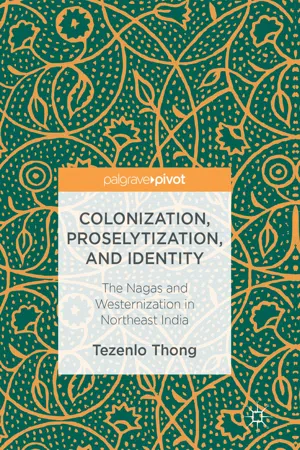
Colonization, Proselytization, and Identity
The Nagas and Westernization in Northeast India
- English
- ePUB (mobile friendly)
- Available on iOS & Android
eBook - ePub
Colonization, Proselytization, and Identity
The Nagas and Westernization in Northeast India
About this book
This book examines the formation of identity of the Nagas in northeast India in light of the proselytizing efforts by the Americans and the colonization by the British in their search for control over areas inhabited by the Nagas which were perfect for tea plantations. The author explores the westernization of Naga culture, its effect on the Naga Nationalist movement, and how it has led to the formation of modern Naga identity. As a unique indigenous group, the colonization of the Naga people offers fresh insights into our understanding of the processes and effects of colonization in India, as well as its long-term negative effects, particularly with regards to the preservation of traditional beliefs and customs.
Information
© The Author(s) 2016
Tezenlo ThongColonization, Proselytization, and Identity10.1007/978-3-319-43934-1_11. Introduction
Tezenlo Thong1
(1)
Aurora, Colorado, USA
Abstract
Westernization, also described as homogenization or universal uniformity, is a global phenomenon. It is transforming societies even where Western colonization did not occur. Where colonization did take place, the change is rapid and irreversible. The former Naga Hills, where Christianity, colonialism, and commerce once occurred under the British and the Americans, is a case in point.
Keywords
The NagasPure traditionalistSemi-traditionalistWesternizationCivilizationModernizationS. E. Peal, a fellow of the Royal Geographical Society, toured widely what is called Northeast India today and wrote extensively on the region’s “aboriginal races.” He visited the former Naga Hills in 1865 and 1883 and made the following observation: “‘Progress’ is in the air everywhere, and we shall soon lose much of the material out of which their past histories might have been recovered” (1894: 11). The visits and the subsequent remark took place early in the colonial history of the Nagas. To be precise, the span of time between Peal’s last visit and the first British invasion of the Naga Hills is only a mere 50 years. In addition, by this time, the American Baptist missionaries who were already working in the plains of neighboring Assam had only just started their mission enterprise in the Naga Hills, particularly among the Ao Nagas. However, ominous signs of visible change already taking place alarmed the visiting observer.
Similarly, in a monograph released in 1921, British administrator John Henry Hutton felt concerned at the remarkable rapidity at which the Naga culture and society were being transformed. He wrote, “Old beliefs and customs are dying, the old traditions are being forgotten, the number of Christians or quasi-Christians is steadily increasing, and the spirit of change is invading and pervading every aspect of village life” (1969: vii). As a colonial administrator, Hutton is careful not to blame the British colonialism but faulted the American missionaries and believed that the rapid pace of transformation was due to “the seed of conversion…which missionaries bring” (1969: viii). It may be noted here that the first American missionaries set foot in what is now called Nagaland in 1872.
Keeping in mind that Western Christianity has been a formidable force in westernizing non-Western cultures around the world, one wonders if Hutton’s remark about the missionaries would still have been the case if the Nagas were being converted to Christianity not by Western missionaries but by the Mar Thoma Syrian Church or the Eastern Orthodox Church. After all, when Western missionaries first arrived in India, they forcibly converted native Christians to Western Christianity because the former did not fit the mold of “normal” or Western Christianity (Benton 2002). In relation to the Nagas, Christianity has been one of the primary westernizing agents. Later, in separate chapters, I will provide a more elaborate account on this assertion.
Fast-forward to today, the pace of westernization or “importation of Western models” (to use Bertrand Badie’s words) among the Nagas is fast and unprecedented. To make my point on the rapid change that the Nagas have undergone, I will describe here a contemporary Naga family. The mother of the family is in her mid-60s. Like everyone her age, she grew up practicing traditional indigenous religion but converted to Christianity as a young woman. Her parents, however, did not. She is the first of seven children and never went to school, partly because she was the oldest child and chiefly because she was female. Instead of sending her to school, her parents decided to make her work in order to support her younger siblings, especially the boys, to receive education. She married a high school–educated man whose schooling was interrupted because the Naga nationalist army forcibly recruited him and many other youngsters like him to fight against India’s occupation of Nagaland.
This hardworking woman had a singular wish and aspiration: to send all her children to college. To this end, she and her husband worked hard and sent all their six children to school, all of whom eventually finished or attended college. One of her children has a doctorate degree and another has a master’s. This diligent woman, who has never traveled beyond her state and speaks only her native language, has a son who married a woman from another country and has three children born in three different countries. These unprecedented changes have occurred within a short span of time. This example of remarkable change, one could argue, is exceptional. Although not the norm, it is not so extraordinary among the contemporary Nagas.
To make the case further, I will share a story of another family, which is more representative of a typical contemporary Naga family. An average Naga household consists of parents and six or seven children. This family, however, has ten children in addition to one who died early. Like every Naga family, all the children attended school. All the male children attended college and two have master’s degrees. The father of the family has a middle school education and retired as an elementary school teacher. The mother received basic education and is literate in vernacular literature. Significantly, all the ten children have migrated away from their village of birth for want of nontraditional employment opportunities. Not only have the children migrated away from rural to urban areas, most of them also have married spouses from outside of their village. Migration and intermarriage were not forbidden but unthinkable to their parents’ generation and the generations before. Additionally, no one has chosen to engage in subsistence agriculture. Everyone has abandoned the traditional means of livelihood and has moved on to adopt a modern lifestyle.
In both the cases mentioned earlier, the grandparents and their generation were “pure traditionalists” who led a much localized life. They hardly traveled beyond their village in their entire lives. They never went to Western-style school, and they converted to Christianity at a much older age. In fact, some never converted. Their means of livelihood was subsistence and barter economy. Except for salt, they remained economically self-sufficient. The parents and their generation, on the other hand, were “semi-traditionalists.” Although in both cases the husbands served as elementary school teachers, their wives were agriculturalists. So the families’ source of support came from both cash-based economy and subsistence economy. Their dependence on manufactured goods, however, had increased dramatically. They traveled farther than their parents did but never beyond their state. They married within the community and settled down in their place of birth. They, too, led a localized life. They could read and write in their vernacular language with a minimum ability in English.
The children, that is, the present generation, however, are “modernists” who have almost abandoned the traditional way of life. They can also be termed “antitraditionalists” because most people belonging to this generation have the belief that the old is backward and outmoded. In fact, many Christians have the misconception that traditional costumes and practices are not conducive for Christian living and should be given up entirely. Unlike their parents, and like their counterparts in the West, most of them spent the first 20+ years of their lives attending Western-style schools. They have professional, master’s, and doctorate degrees conferred by Western-style universities. Many of them studied outside of their state and some even overseas. English is their official or working language. Most of them have migrated away from rural to urban areas and have married spouses outside of their communal groups including from another country. They depend almost entirely on cash economy and are alien to traditional lifestyle and subsistence economy. These brief case studies provide a snapshot of the pace of westernization among the contemporary Nagas.
Now, is there any causal connection between Western colonization/proselytization and contemporary events and changes taking place among the Nagas? To put it differently, is the West still responsible for the continued westernization being experienced by the Nagas and other non-Western cultures? My goal in this book is to problematize the causal relationship between colonialism/proselytization and westernization among the Nagas in Northeast India.
Two key factors, among other things, responsible for the rapid westernizing of the Nagas are Christianity and education. The unprecedented migration for want of nontraditional employments among the contemporary Nagas can be attributed to the introduction of education. The introduction of Western-style education is not simply about literacy. With it came Western values, ideas, and models. As such, the rigorous pursuit of a Western-style education among the Nagas has led to an exodus of young educated Nagas from rural to urban areas in search of employment opportunities, which has further resulted in abandoning traditions. In any agrarian society, like the Naga society, land is primary and indispensable. It is essential not only for livelihood but also for the development and continuity of tradition and identity. One cannot grow the size of the land; neither can one move it. Therefore, “people must live in one settlement from generation to generation” (Zhang 2011: 369). Living around a certain area of land for generations gives rise to the development of a complex system of tradition and ensures its continuity. The continuity is “ensured by passing down shared traditions, customs, language and social norms or culture from generation to generation” (Mukhim 2006: 183). Migration results in discontinuity and cessation of the long evolved ways of living.
The relocation has also led to intermarriage among the Nagas of different tribes. Intermarriage in itself is not a problem or malicious. Intermarriage coupled with relocation has led to an erosion of cultural practices, for example, the loss of native languages. In the past, intermarriage rarely happened, but when it did, such marriage inevitably led to learning an additional Naga language, especially the language of the spouse, because the practice was to settle down within the community and not move away. In contrast, today, those who migrate to urban areas adopt a lately found language known as “Nagamese”. It is a pidgin or contact language, a mixture of mostly Hindi (an Indian national language) and Assamese (a neighboring state language).
“Nagamese” is often referred to as a “bazaar” (market) language because the language emerged in the context of business transactions with non-Naga traders and service providers who came to the Naga Hills with the invading British force and continued to do so after the Indian political independence. In other words, this new language originated because of the inroads of a westernized monetary market and the intrusion of manufactured goods into the Naga society. Nagamese is spoken but not written. It is a shallow language, deeply lacking in vocabulary. As such, to be able to speak Nagamese with any profundity of thought, one has to be knowledgeable in Assamese, Hindi, or English. In which case, most listeners will not understand what is being said unless they are also equally well versed in these languages. Thus, in spite of these limitations, Nagamese, alongside English, has gained prominence and is widely spoken among the Nagas today. The consequence of which is the gradual demise of native languages.
For the Nagas, the importance of a native language and its relation to self-identity cannot be overemphasized. A language, in other words, is key to cultural identity. For example, a person’s cultural identity or communal connection can be easily identified by the language they speak. Even when speaking in English or Nagamese, a person’s tribal or communal distinctiveness is easily identifiable because of the accent with which they speak. However, as more and more Naga people begin to give up their native languages and adopt English or Nagamese, this unique aspect of the culture is vanishing.
Who Are the Nagas?
Having provided succinctly the state of the Nagas today, a brief description of the people is in order here, especially for readers who may not have much knowledge about who the Nagas are. A unified or common Naga identity as a nation is not only a westernized idea but also a Western construct, which I will discuss in detail in Part II of the book. The blanket term “Nagas” is used to refer to a group of people living mostly in the mountainous terrains of what was called the Naga Hills during the British colonial period. Undoubtedly, the Nagas share a common culture, but they also vary remarkably, especially in their languages. Thus, the concept of the Nagas as an ethnic group and the Naga homeland is an idea that is still evolving. Having said that, the Nagas have every right to construct or reconstruct their political and cultural identity like any modern nation-states. As such, I use the term “Nagas” in the way that most contemporary Nagas envision and aspire themselves to be politically, culturally, and geographically.
The Naga-inhabited homeland encompasses two nation-states, namely India and Myanmar (formerly Burma). It is a landlocked country surrounded by China on the northwest, Myanmar on the east, and India on the southwest. In India, they live in four different states: Arunachal Pradesh, Assam, Manipur, and Nagaland. The Naga people in Myanmar live in the provinces of Kachin and Sagaing. In all but the state of Nagaland, the Naga people are vastly outnumbered by other ethnic groups in their respective homelands. This description of the Nagas and their homeland, obviously, is a modern construct, and I will later revisit this subject in Part II of the book.
The 2011 census record shows the population of Naga people in the state of Nagaland to be 1,980,602. There are no statistics available separately for other Naga groups in Assam, Arunachal Pradesh, and Manipur at this time. In Myanmar, there are 23 Naga tribes living in 229 villages with an estimated population of 500,000. The entire Naga population is estimated to be around three million (Thong 2014), although some estimate the total Naga population to be approximately four million. As mentioned earlier and may be reiterated again, the number of Naga tribes, languages, and population is fluid. For example, some Naga tribes, such as Chakhesang (Chakro-Kheza-Sangtam) and Zeliangrong (Zeme-Liangmai-Rongmei) that were considered “one” tribe for decades, are now reverting back to separate tribes. Coupled with this fluidity or evolutionary state of formation is a lack of available statistics.
What Is Westernization?
Scholars have employed various terms and phrases in an effort to describe westernization, some of which include modernization (Gocek 1996), forced hybridization, cultural homogenization, world unification (Badie 2000), uniformity of lifestyles, and the worldwide standardization of lifestyles (Latouche 1996). Westernization is used here to mean “the influen...
Table of contents
- Cover
- Frontmatter
- 1. Introduction
- 1. The Colonization and Proselytization
- 2. The Pursuit of Naga Ethnic and Political Identity
- Backmatter
Trusted by 375,005 students
Access to over 1.5 million titles for a fair monthly price.
Study more efficiently using our study tools.
Frequently asked questions
Yes, you can cancel anytime from the Subscription tab in your account settings on the Perlego website. Your subscription will stay active until the end of your current billing period. Learn how to cancel your subscription
No, books cannot be downloaded as external files, such as PDFs, for use outside of Perlego. However, you can download books within the Perlego app for offline reading on mobile or tablet. Learn how to download books offline
Perlego offers two plans: Essential and Complete
- Essential is ideal for learners and professionals who enjoy exploring a wide range of subjects. Access the Essential Library with 800,000+ trusted titles and best-sellers across business, personal growth, and the humanities. Includes unlimited reading time and Standard Read Aloud voice.
- Complete: Perfect for advanced learners and researchers needing full, unrestricted access. Unlock 1.5M+ books across hundreds of subjects, including academic and specialized titles. The Complete Plan also includes advanced features like Premium Read Aloud and Research Assistant.
We are an online textbook subscription service, where you can get access to an entire online library for less than the price of a single book per month. With over 1.5 million books across 990+ topics, we’ve got you covered! Learn about our mission
Look out for the read-aloud symbol on your next book to see if you can listen to it. The read-aloud tool reads text aloud for you, highlighting the text as it is being read. You can pause it, speed it up and slow it down. Learn more about Read Aloud
Yes! You can use the Perlego app on both iOS and Android devices to read anytime, anywhere — even offline. Perfect for commutes or when you’re on the go.
Please note we cannot support devices running on iOS 13 and Android 7 or earlier. Learn more about using the app
Please note we cannot support devices running on iOS 13 and Android 7 or earlier. Learn more about using the app
Yes, you can access Colonization, Proselytization, and Identity by Tezenlo Thong in PDF and/or ePUB format, as well as other popular books in Politics & International Relations & World History. We have over 1.5 million books available in our catalogue for you to explore.