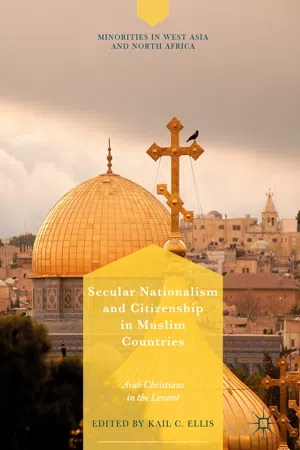
eBook - ePub
Secular Nationalism and Citizenship in Muslim Countries
Arab Christians in the Levant
- English
- ePUB (mobile friendly)
- Available on iOS & Android
eBook - ePub
About this book
This edited volume examines the importance and significance of the Christian population in the Middle East and North Africa from the rise of Islam to present day. Specifically, the authors focus on the contributions of Christians to Arab politics, economy, and law. Using the current plight of Christians in the Muslim world (Iraq, Syria, Lebanon, Palestine, and Egypt), the contributors analyze the origins of the crises and propose recommendations and strategies to foster religious freedom, human rights, and an inclusive political system that ensures equality of citizenship for all communities to participate fully in their societies.
Information
© The Author(s) 2018
Kail C. Ellis (ed.)Secular Nationalism and Citizenship in Muslim CountriesMinorities in West Asia and North Africahttps://doi.org/10.1007/978-3-319-71204-8_11. Introduction
Kail C. Ellis1
(1)
Arab & Islamic Studies, Villanova University, Villanova, PA, USA
Kail C. Ellis
The chapters in this volume are by an international team of academics, diplomats, journalists, policy institute scholars, NGO members, and the military from the Middle East, Europe, and the United States. The authors examine the importance of Christian history and presence in the Mashreq counties of the Middle East (Iraq, Syria, Lebanon, Palestine, and Egypt), from the rise of Islam to their contributions to Arab politics. Using the current status of Christians to focus their scholarship, the authors analyze the origins of the crises facing not only Christians and other vulnerable groups, but of all the peoples in the region, regardless of religion or belief. They also propose recommendations and strategies to foster religious freedom, human rights, and an inclusive political system that ensures equality of citizenship for all communities to participate fully in their societies.
The struggle for secular nationalism in the title stands in contrast to religious nationalism, which is the relationship of nationalism to a particular religious belief, dogma, or affiliation that can lead to the politicization of religion. Secular nationalism asserts the right of citizens to be free from religious rule and of governments that impose religion or religious practices upon their people. The Arab Christians of the subtitle are the volume’s focus and reflects the volume’s emphasis on full citizenship as a remedy for the problems facing Christians and other communities in the Middle East.
Christians have been an integral part of the Middle East for over two millennia. Eastern Christians made formative contributions to the theological development and richness of early Christianity. With the arrival of Islam they came under Muslim rule, but demographically they were the majority in many places until well into the eleventh century.1 They contributed to the development of the arts, sciences, philosophy, and literature of what has come to be known as the Islamic Golden Age of the mid-seventh to mid-thirteenth centuries. They share the same history and a large part of the cultural heritage of the Muslim majority population. The only important difference, which has had numerous social and cultural consequences, is their adherence to the Christian religion. As Christians gradually diminished in number, Christian history, presence, and witness, as if frozen in time, was largely forgotten or neglected, both in the cultures they had a large part in shaping and in the West. Numerical decline is only a partial reason for the disappearance of Christians from serious scholarship on the Middle East. According to Paul S. Rowe, “Christians have long been viewed as the object of other actors. For some, they were products of Muslim societies that imposed upon them the debatably restricted or protected status of ahl al-dhimmah. For others, they were the appendages of external forces determined to use them as devices of their interests. The concerns of such external forces only contributed to Christians’ portrayal as vehicles of imperialism.”2
In an insightful article, “Recent Perspectives on Christians in the Modern Arab World,” L.C. Robson cites several reasons why scholars of the modern Arab world largely avoided the topic of Christians. Among these reasons is that Islam was traditionally viewed as central to the definition of the region; therefore, secular scholars in the West and Arab historians in the Middle East were reluctant to engage in research on Arab Christian communities out of concern that the topic would inevitably raise questions about sectarianism and communal politics that they wished to avoid. Consequently, most scholars presented Arab Christians “as essentially marginal, appearing either as hapless victims of Muslim domination or as agents of the Western powers with which they had religious and political connections.”3 Robson cites Ussama Makdisi’s conclusion that the reluctance of scholars to research the religiously sensitive topic of Christians, “perhaps in the interests of putative national unity, has allow[ed] the void to be filled with scholarship obsessed with the idea of perpetual hostility between Christians and Jewish minorities and an oppressive monolithic Muslim majority.”4 Only in the last several years have scholars sought to rectify this scholarly gap by exploring the ways in which Middle Eastern Christians function in their societies.5 Anthony O’Mahony, a well-known scholar of Christianity in the Middle East, objects to the conventional characterization of the Middle East as “the Muslim World.” Using this concept and phrase, he contends, automatically renders the ancient Christian community as “alien.”6
Referring to Christians and other vulnerable communities as “minorities ” poses another challenge. In common usage, the term “minority ” is associated with inferiority, weakness, and subordination. The term serves to emphasize the marginal status of these communities, despite numerous instances of dominant and powerful minorities ruling over nations, such as Saddam Hussein’s Iraq and the Assads of Baathist Syria.7
Nevertheless, the term “minority ” can have multiple meanings. Besides its reference to a group’s relative size, in the context of the Arab Middle East it also connotes an identity that is “ascribed” (i.e., assigned by others). When it refers to a group’s religious identity, ipso facto it establishes the group’s relationship to the state through confessional criteria, and reinforces sectarian behavior and interactions that can lead to political expectations and demands for privileges or, alternatively, to frustration or alienation.8 The anthropologist Seteney Shami maintains that “minority ,” with its connotations of inferiority and exclusion from the body politic, leads to constructing a “majority” that is alleged to represent the nation. He cautions, “Even if the debate focuses on positive aspects such as minority rights, tolerance or diversity, or the privileging of a certain social group, the minority-majority pairing is a dichotomy that asserts the (often unwelcome) interruption of the allegedly homogenous or harmonious national community by a group that it is ‘out of place.’”9
Another example of the use of the term “minority ” to dominate a population is given by Benjamin T. White in his study The Emergence of Minorities in the Middle East: The Politics of Community in French Mandate Syria. During the French Mandate, “minority ” was used to solidify French control of Syria, by “reinforcing religious divisions by distributing seats to representative bodies on religious communal grounds; by extending legal autonomy in matters of personal status to communities which had not previously been autonomous; and by granting territorial autonomy to certain religiously defined groups.” According to White, “This policy adhered to the colonial theories of Marshal [Hubert] Lyautey, whose principle of association as opposed to assimilation had been developed in Morocco. Personal status law was crucial to French efforts to divide Syria’s communities religiously.”10
White argues that the contemporary use of the term is not useful in describing the place of “minorities ” in relation to the wider society. He claims, “there was no articulated concept of ‘minority’ prior to the modern period because minorities did not exist.” Rather, Islamic law placed all non-Muslims in a subordinate place, not because they were minorities but because they were non-Muslims, with no reference to number or ethnic identity. Since the term carries too much ideological baggage, White says it should be discarded as an analytical category.11
Developing the Concept of “Minority” and Ottoman Reforms
The concept of “minority ” developed from the ahl al-dhimmah status or “protected” status of the Christian and Jewish communities in the Ottoman Empire. It had its origin in the Islamic tenet that the prophetic tradition culminated from Judaism and Christianity and that the adherents of those religions, people with revealed books (ahl al-kitāb), had their place in Islamic society as “protected” communities (ahl al-dhimmah). In return—and as a mark of their submission—these communities were expected to pay the jizya (the root meaning of which is compensation, whereby they ratify the compact that assures them protection). It was a per capita yearly tax on able-bodied males of military age as a substitute for military service. However, dhimmis who chose to join military service were exempted from payment, as were those who could not afford to pay. Gradually, dhimmi protection was extended to other select religious communities.
After the conquest of Constantinople in 1453, the Ottomans developed the millet system to deal with their newly acquired sizable Christian communities that allowed them to choose their religious leaders, collect taxes, use their language, and have their personal laws and own courts. Although the system was built upon the foundation of the ahl al-dhimmah, by creating a structure of limited autonomous communities under their own religious leaders as a way to deal with religious diversity and coexistence, the millet system de facto separated these communities from their societies, paved the way for the introduction of the political ideology of European nationalism into the empire, and designated them as “minorities .” As noted by White, the personal status laws of the Ottoman millet system were ready-made for adoption by the French Mandate to differentiate Syria’s religious and ethnic communities, and were critical to maintaining French control of that country.
Although the millet system granted limited autonomy to non-Muslim communities, its primary function was to enable the Ottomans to rule a diverse population. The empire remained intensely Muslim. According to Ussama Makdisi, the “millet system reinforced the emphasis on religion in a profoundly unequal political and social order. At the top of this ‘empire of difference’ sat the ‘shadow of God on earth,’ the Sultan, whose rule was legitimated by his supposed upholding of Islam, his defense of the realm against infidels, and his stamping out of heresy within it.”12 Although Ottoman Muslim supremacy was deeply imbued within the ideological, political, and legal terrain of the empire, for Makdisi, the issue “is not that it [the empire] was ‘tolerant’ or ‘intolerant’… Rather, the point that needs to be made is that the empire witnessed centuries of coexistence in which different Muslim and Christian and Jewish communities, and the ecclesiastical leaderships of different communities, accepted the fact that they were bound to live side by side—to literally coexist—for the foreseeable future.”13
The French Revolution and the Napoleonic wars that spread the revolutionary principles of liberty, equality, and fraternity were the first powerful manifestations of European nationalism, which found its expression in the rational faith in a common humanity and liberal progress. As an ideology based on the premise that the individual’s loyalty and devotion to the nation-state surpasses individual or group interests, European nationalism implicitly identified the state or nation with the people. Whereas previously for the different nationalities of Christendom as well as for those of Islam there was but one civilization—Christian or Muslim, and one language of culture, Latin (or Greek) or Arabic (or Persian), the principles of European nationalism were that each nationality should form an autonomous state.14
When European nationalism was introduced into the Ottoman Empire in the mid-to-late nineteenth century, it met a diverse population that had no previous experience of the separation of politics from religion. Although nationalism was a new concept, Albert Hourani has noted that “Christians could support such ideas without the hesitation of Muslims, whether Arab or Turkish, because they did not possess that deep and final loyalty to the empire, as the shield of Sunni Islam, which almost all Muslims had, and which was indeed the cause of their hesitations.”15 Thus the concept of nationalism was readily received in the religiously heterogeneous millet communities and provided the basis for numerous and competing nationalist movements. Nationalism also enabled the European powers to position themselves as protectors of the interests of the millet communities, giving them an inroad to interfere in the Ottoman Empire along religious lines. By the turn of the twentieth century, as noted by Benjamin White, nationalist movements within the empire had all but destroyed the previous notion of religious coexistence.16 Reinforcing the emphasis on religion in a profoundly unequal political and social order, the millet system provided fertile ground for the political ideology of European nationalism. The growing national consciousness, coupled with a rising sense of ethnic nationalism, made nationalistic thought one of the most significant Western ideas imported to the Ottoman Empire.
Beginning from the late eighteenth century to the mid-to-late nineteenth century, the Ottoman Empire faced the challenges of defending itself ...
Table of contents
- Cover
- Front Matter
- 1. Introduction
- Part I. Christian Cultural and Intellectual Life in the Islamic Middle East: A Shared History
- Part II. Human Rights, Combating Persecution, and the Responsibility to Protect
- Part III. The Arab Spring, the Shia/Sunni Divide, and Their Impact on Regional and Geopolitical Tensions
- Back Matter
Trusted by 375,005 students
Access to over 1.5 million titles for a fair monthly price.
Study more efficiently using our study tools.
Frequently asked questions
Yes, you can cancel anytime from the Subscription tab in your account settings on the Perlego website. Your subscription will stay active until the end of your current billing period. Learn how to cancel your subscription
No, books cannot be downloaded as external files, such as PDFs, for use outside of Perlego. However, you can download books within the Perlego app for offline reading on mobile or tablet. Learn how to download books offline
Perlego offers two plans: Essential and Complete
- Essential is ideal for learners and professionals who enjoy exploring a wide range of subjects. Access the Essential Library with 800,000+ trusted titles and best-sellers across business, personal growth, and the humanities. Includes unlimited reading time and Standard Read Aloud voice.
- Complete: Perfect for advanced learners and researchers needing full, unrestricted access. Unlock 1.5M+ books across hundreds of subjects, including academic and specialized titles. The Complete Plan also includes advanced features like Premium Read Aloud and Research Assistant.
We are an online textbook subscription service, where you can get access to an entire online library for less than the price of a single book per month. With over 1.5 million books across 990+ topics, we’ve got you covered! Learn about our mission
Look out for the read-aloud symbol on your next book to see if you can listen to it. The read-aloud tool reads text aloud for you, highlighting the text as it is being read. You can pause it, speed it up and slow it down. Learn more about Read Aloud
Yes! You can use the Perlego app on both iOS and Android devices to read anytime, anywhere — even offline. Perfect for commutes or when you’re on the go.
Please note we cannot support devices running on iOS 13 and Android 7 or earlier. Learn more about using the app
Please note we cannot support devices running on iOS 13 and Android 7 or earlier. Learn more about using the app
Yes, you can access Secular Nationalism and Citizenship in Muslim Countries by Kail C. Ellis in PDF and/or ePUB format, as well as other popular books in Politics & International Relations & Comparative Politics. We have over 1.5 million books available in our catalogue for you to explore.