This book addresses some of the most pressing questions of our time: Is democracy threatened by globalisation? Is there a legitimacy crisis in contemporary democracies? Is the welfare state in individual countries under pressure from global trends? What are the implications of high-level migration and rising populism for democracy? Does authoritarianism pose a challenge?
The volume builds on a cross-cultural study of democracy conducted by the Transformation Research Unit (TRU) at Stellenbosch University in South Africa for nearly twenty years. Three of the countries studied – South Africa, Turkey and Poland – receive individual attention as their respective democracies appear to be the most vulnerable at present. Germany, Sweden, Chile, South Korea and Taiwan are assessed in their regional contexts. Further insights are gained by examining the impact on democracy of the global screen culture of Television and the Internet, and by pointing out the lessons democracy should learn from diplomacy to fare better in the future. The book will appeal to both students and practitioners of democracy as well as the general reader.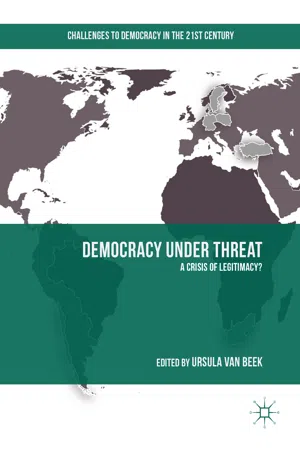
- English
- ePUB (mobile friendly)
- Available on iOS & Android
eBook - ePub
About this book
Information
© The Author(s) 2019
Ursula van Beek (ed.)Democracy under ThreatChallenges to Democracy in the 21st Centuryhttps://doi.org/10.1007/978-3-319-89453-9_11. Globalization, Populism and Legitimacy in Contemporary Democracy
Dieter Fuchs1 and Hans-Dieter Klingemann2
(1)
Department of Social Sciences, University of Stuttgart, Stuttgart, Germany
(2)
Berlin International—University of Applied Sciences, Berlin, Germany
Is democracy under threat? In the past several years, this question has caused an intense and controversial debate. Larry Diamond (2015) as well as Steven Levitsky and Lucian Way (2015) speak of a “democratic recession,” Nancy Bermeo (2016) calls it “democratic backsliding,” while Roberto Foa and Yascha Munck (2017) name it “deconsolidation.” Arch Puddington and Tyler Roylance (2017) see the nature of the challenge to democracy as “the dual threat of populists and autocrats.” The authors differentiate between an internal challenge for democracy caused by populists and an external challenge for democracy caused by the autocrats.
Most of these analyses are descriptive and are conducted on global scale. Puddington (2017: 3) presents an aggregate analysis of changes of political regimes based on various Freedom House indicators for the period of 2007–2016. The results show a substantive democratic decline in all respects. However, these descriptive and global analyses do not answer two important questions. First, what causes the challenges facing contemporary democracy? Major proposals relate to societal development and to technological and demographic change in particular. However, the most significant and consequential of them all is the challenge of globalization (Kriesi 2013: 1–2). According to many authors, globalization has fundamentally changed the conditions under which nation state democracies function. If the institutional mechanisms and actions of the relevant political actors do not process these challenges adaptively, a crisis of legitimacy may result. This crisis of legitimacy, in turn, provides the arguments for populists and autocrats to challenge democratic rule in general. Second, it may well be that globalization hides different developmental trajectories in different countries and regions. In our analysis, we operate on the premise that the conditions for a successful adaptation to these challenges vary widely across countries and regions. To test this assumption, this volume presents empirical studies for such different regions as Western and Eastern Europe , Latin America, South Africa and East Asia.
This introductory chapter presents, in four steps, a theoretical framework for the empirical analysis of the relationship between globalization, populism and the legitimacy of democracies. In a first step, we discuss the concept of globalization and the impact of globalization on nation state democracies. In a second step, we discuss the phenomenon of populism, the challenge of the autocrats and its consequences for democracy. In a third step, we develop the concept of the legitimacy of democracies. In the process, we distinguish between objective and subjective legitimacy. In the fourth and final step, we draw some conclusions and discuss the conditions for a successful adaptation to the challenge of globalization and the specific challenges of the populists and autocrats.
The Concept of Globalization and the Impact of Globalization on Democratic Nation States
Modern democratic theory has long taken for granted that democratic nation states exercise control over factors that determine societal developments within their territories. Part of this assumption is that the fate of a national community lies, above all, in its own hands (Held 2006: 290). It is on this premise that a central democratic mechanism is grounded: citizens can hold rulers to account for the results of their decisions and actions by voting them back into or out of office. According to a number of theorists of globalization and democracy, this basic premise has become obsolete (Held 2006; Held et al. 1999; Zürn 1998; Archibugi 2008; Habermas 2001, 2012). What, then, is globalization according to these theorists and what is its impact on democratic nation states?
The most common definitions of globalization originate from David Held. A recent one reads as follows: “Globalisation denotes a shift in the spatial form of human organisation and activity to transcontinental or interregional patterns of activity, interaction and the exercise of power. It involves a stretching and deepening of social relations and institutions across space and time …” (Held 2006: 293). Jürgen Habermas (2001) defines globalization similarly: “It [the concept] characterises the increasing scope and intensity of commercial, communicative, and exchange relations beyond national borders. […] The term is just as applicable to the intercontinental dissemination of telecommunications, mass tourism, or mass culture as it is to the border-crossing risks of high technology and arms trafficking, the global side-effects of overburdened ecosystems, or the supranational collective network of governmental or non-governmental organisations. But the most significant dimension is economic globalisation, whose new quality can hardly be doubted […]” (2001: 65–66).
The spread and concentration of cross-border communications and relations of exchange such as business and financial transactions have far-reaching and problematic consequences for nation states. First, problems emerge outside nation states that nonetheless have an impact within nation states. Second, the governments of other nation states take decisions that have serious implications for one’s own nation state. Yet these decisions are not legitimized by the citizens and the government cannot be held to account for them. Third, globalization gives rise to transnational actors such as multinational corporations and international organizations such as the WTO, the IMF and the World Bank. The consequences of these three developments are, according to Held et al. (1999): “First, the locus of effective political power can no longer be assumed to be national governments – effective power is shared, bartered, and struggled over by diverse forces and agencies at national, regional and international levels. Second, the idea of a political community of fate – of a self-determining collectivity – can no longer meaningfully be located within the boundaries of a single nation alone. Some of the most fundamental forces and processes which determine the nature of life-chances within and across political communities are now beyond the reach of nation-states” (1999: 103). In a later publication, Hel...
Table of contents
- Cover
- Front Matter
- Part I. Theoretical Aspects and Overview
- Part II. Critical Cases
- Part III. Regional Aspects
- Part IV. Global Aspects
- Part V. Conclusions
- Back Matter
Trusted by 375,005 students
Access to over 1.5 million titles for a fair monthly price.
Study more efficiently using our study tools.
Frequently asked questions
Yes, you can cancel anytime from the Subscription tab in your account settings on the Perlego website. Your subscription will stay active until the end of your current billing period. Learn how to cancel your subscription
No, books cannot be downloaded as external files, such as PDFs, for use outside of Perlego. However, you can download books within the Perlego app for offline reading on mobile or tablet. Learn how to download books offline
Perlego offers two plans: Essential and Complete
- Essential is ideal for learners and professionals who enjoy exploring a wide range of subjects. Access the Essential Library with 800,000+ trusted titles and best-sellers across business, personal growth, and the humanities. Includes unlimited reading time and Standard Read Aloud voice.
- Complete: Perfect for advanced learners and researchers needing full, unrestricted access. Unlock 1.5M+ books across hundreds of subjects, including academic and specialized titles. The Complete Plan also includes advanced features like Premium Read Aloud and Research Assistant.
We are an online textbook subscription service, where you can get access to an entire online library for less than the price of a single book per month. With over 1.5 million books across 990+ topics, we’ve got you covered! Learn about our mission
Look out for the read-aloud symbol on your next book to see if you can listen to it. The read-aloud tool reads text aloud for you, highlighting the text as it is being read. You can pause it, speed it up and slow it down. Learn more about Read Aloud
Yes! You can use the Perlego app on both iOS and Android devices to read anytime, anywhere — even offline. Perfect for commutes or when you’re on the go.
Please note we cannot support devices running on iOS 13 and Android 7 or earlier. Learn more about using the app
Please note we cannot support devices running on iOS 13 and Android 7 or earlier. Learn more about using the app
Yes, you can access Democracy under Threat by Ursula van Beek in PDF and/or ePUB format, as well as other popular books in Politics & International Relations & Comparative Politics. We have over 1.5 million books available in our catalogue for you to explore.