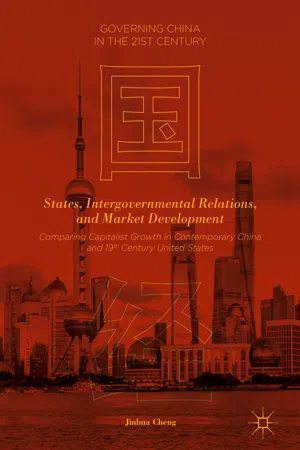
eBook - ePub
States, Intergovernmental Relations, and Market Development
Comparing Capitalist Growth in Contemporary China and 19th Century United States
- English
- ePUB (mobile friendly)
- Available on iOS & Android
eBook - ePub
States, Intergovernmental Relations, and Market Development
Comparing Capitalist Growth in Contemporary China and 19th Century United States
About this book
This book is a theoretical and empirical analysis of institutional foundation of long-term economic growth from the perspective of state-market and central-local relations. The book argues that, in order to safeguard sustainable market development, it is necessary to centralize certain functions of the state to overcome local predatory governmental rulings, and to decentralize others to increase local governmental market incentives, simultaneously. This institutional approach is conceptualized as "Dual Intergovernmental Transformation for Market Development" (DITMD). This book develops the DITMD model through an in-depth empirical comparison on contemporary China and the 19th-century United States.
Information
© The Author(s) 2019
J. ChengStates, Intergovernmental Relations, and Market DevelopmentGoverning China in the 21st Centuryhttps://doi.org/10.1057/978-1-137-58357-4_11. Introduction
Jinhua Cheng1
(1)
KoGuan Law School, Shanghai Jiao Tong University, Shanghai, China
This book is about institutional foundation of long-term economic growth from the perspective of state-market relations. In this regard, there is so much to talk about and people have talked so much about it.1 To make this study new, the book focuses on a narrow question, that is, how to resolve the so-called fundamental state-market dilemma through intergovernmental transformation, and answers it with a detailed historical comparison on capitalist growth in the nineteenth-century United States and contemporary China. This introductory chapter will define the problem of the fundamental state-market dilemma, briefly describe existing solutions, present the book’s major argument, say a little bit about the comparability of the two cases discussed, and outline the organization of the book.
1.1 The Fundamental State-Market Dilemma
To discover fundamental reasons for market development and economic growth in modern societies, a careful examination on the role of the state is necessary. With respect to the state-market relationship, there is a widely accepted recognition that (1) institutions matter in sustaining markets (North 1990; Weingast 1995; the World Bank 2002; Menard and Shirley 2005; Greif 2006; Acemoglu and Robinson 2012) and (2) the state matters in shaping institutions (North 1990; Olson 1993; the World Bank 1997; Barzel 2002; Fukuyama 2011 and 2014).
However, beyond this recognition, there is a puzzle in understanding the appropriate scope and strength of the state in safeguarding markets, as has been expressed by the following writers:
One cannot have the productivity of an industrial society with political anarchy. But while such a state is a necessary condition for realizing the gains from trade, it obviously is not sufficient. A state becomes the inevitable source of struggle to take control of it in the interests of one of the parties…If you want to realize the potential of modern technology you cannot do with the state, but you cannot do without it either. (Douglass C. North 1984: 259–260)
The fundamental political dilemma of an economic system is this: A government strong enough to protect property rights and enforce contracts is also strong enough to confiscate the wealth of its citizens. (Barry R. Weingast 1995: 1)
But the mere fact of market failure, and other problems of inequality and insecurity, does not mean that only the state can – or should – resolve these problems. The state’s coercive authority within its boundaries gives it unique strengths in seeking to address these concerns, but also unique weaknesses. (The World Bank 1997: 25)
There is unfortunately no institutional guarantee that the system as designed will always check tyrannical power yet allow exercises of state authority when the need arises. (Francis Fukuyama 2011: 7)
To develop markets and thus achieve long-term economic growth, the state shall be strong and active enough, but not too strong or active either. This is the fundamental state-market dilemma, which is the central question to be addressed in this book.The state faces a delicate dilemma. It can facilitate institutional change and validate it through its political support and sanction. But its helping hand can easily become an iron fist of coercion and oppression when the institution it endorses works against the will of the people. (Ronald Coase and Ning Wang 2012: 52)
The fundamental state-market dilemma arises from the paradox that while the state is necessary to execute coercive powers in order to safeguard market transactions, the ruler of the state and its agents, like other players in the market place, are self-interested and tend to utilize these powers for their own interests either directly or ultimately.
On the one hand, markets are benefiting from the execution of the state’s coercive powers in safeguarding economic transactions in that opportunistic behaviors are prevalent. For this reason, “the state is a response to the Hobbesian dilemma, that it is in every individual’s interest both to make a contract and then, at the first advantageous opportunity, to break it” (Levi 1981: 435). In addition, the role of the state is particularly critical in developing economies, transitional economies, and common markets for their respective contextual specificities. In developing economies, market-friendly institutions either do not exist or are immature, and therefore, the state is necessary to play a creative role in building institutional infrastructures for market development. In transitional economies, certain economic institutions do exist but usually are not friendly to the market, and therefore, the state is even more imperative to play a destructively creative role in transforming the existing institutions to market-friendly institutions (Stiglitz 1996). In common markets, economic transactions tend to be more impersonalized, professionalized, and complicated than those in local markets, and therefore, the state is particularly mandated to play a role in enforcing contracts as a third-party enforcer (North 1981, 1990; Barzel 2002).
On the other hand, however, the ruler of the state is predatory in nature. Usually, there is a gap between the two types of welfare acquired from the execution of the state’s coercive powers: (1) the revenues (and illegitimate rents) submitted to the ruler and (2) the total welfare surplus obtained. The difference between these two is the residual welfare, which is the seed for future investments and sustainable growth. When most of the residual welfare is returned to private actors and their investment incentives are guaranteed, accumulative growth is predictable. But, if most of the residual welfare is grabbed by the ruler, economic growth tends to be stagnant or even worse, at least in the long run.
As self-interested players, both the ruler and private actors are contending for a higher ratio of the residual welfare for themselves. Like other players, “all rulers are predatory in the sense that they, as much as they can, design property rights and policies meant to maximize their own personal power and wealth” (Levi 1981: 438). But, it is not a fair combat. The ruler holds a naturally advantageous position as a legitimate owner and enforcer of the state’s coercive powers.
Obviously, the fundamental state-market dilemma significantly challenges the development of markets and thus economic growth in the long run. In some scenarios, the state is too weak to provide necessary institutions for development (Fukuyama 2004; Acemoglu and Robinson 2012). In other situations, the ruler grabs too much of the residual welfare and therefore future investments are significantly constrained (North 1990). In short, institutional solutions are required to balance the state’s coercive powers in order to sustain market development. As Pranab Bardhan (2016: 866) remarks, it’s time to “call for a strong but limited government.”
1.2 Existing Solutions: Decentralization and Significant Others
Then the question is how to build up a strong but limited government. Theoretically, an intergovernmental transformation through decentralization could be a good institutional solution to overcome the aforementioned state-market dilemma. In particular, Barry Weingast and his colleagues develop the model of “market-preserving federalism” (MPF) to illustrate how MPF regimes are capable of limiting “the degree to which a political system can encroach on markets” (Montinola et al. 1995: 55; also see Weingast 1995, 2009; Qian...
Table of contents
- Cover
- Front Matter
- 1. Introduction
- 2. Decentralization for Economic Growth: A Critical Review
- 3. Dual Intergovernmental Transformation for Market Development
- 4. Federalism and the Rise of the Corporate Economy in the Nineteenth-Century United States
- 5. Central-Local Relations and the Rise of the Corporate Economy in Contemporary China
- 6. DITMD Versus MPF: Conclusion and Implications
- Correction to: States, Intergovernmental Relations, and Market Development
- Back Matter
Trusted by 375,005 students
Access to over 1.5 million titles for a fair monthly price.
Study more efficiently using our study tools.
Frequently asked questions
Yes, you can cancel anytime from the Subscription tab in your account settings on the Perlego website. Your subscription will stay active until the end of your current billing period. Learn how to cancel your subscription
No, books cannot be downloaded as external files, such as PDFs, for use outside of Perlego. However, you can download books within the Perlego app for offline reading on mobile or tablet. Learn how to download books offline
Perlego offers two plans: Essential and Complete
- Essential is ideal for learners and professionals who enjoy exploring a wide range of subjects. Access the Essential Library with 800,000+ trusted titles and best-sellers across business, personal growth, and the humanities. Includes unlimited reading time and Standard Read Aloud voice.
- Complete: Perfect for advanced learners and researchers needing full, unrestricted access. Unlock 1.5M+ books across hundreds of subjects, including academic and specialized titles. The Complete Plan also includes advanced features like Premium Read Aloud and Research Assistant.
We are an online textbook subscription service, where you can get access to an entire online library for less than the price of a single book per month. With over 1.5 million books across 990+ topics, we’ve got you covered! Learn about our mission
Look out for the read-aloud symbol on your next book to see if you can listen to it. The read-aloud tool reads text aloud for you, highlighting the text as it is being read. You can pause it, speed it up and slow it down. Learn more about Read Aloud
Yes! You can use the Perlego app on both iOS and Android devices to read anytime, anywhere — even offline. Perfect for commutes or when you’re on the go.
Please note we cannot support devices running on iOS 13 and Android 7 or earlier. Learn more about using the app
Please note we cannot support devices running on iOS 13 and Android 7 or earlier. Learn more about using the app
Yes, you can access States, Intergovernmental Relations, and Market Development by Jinhua Cheng in PDF and/or ePUB format, as well as other popular books in Política y relaciones internacionales & Negocios internacionales. We have over 1.5 million books available in our catalogue for you to explore.