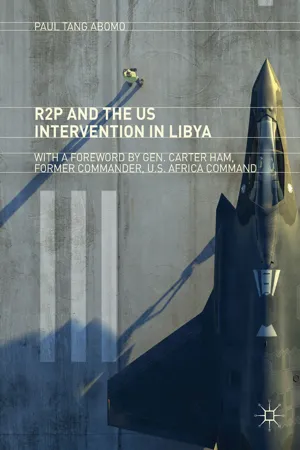
This book argues that the Responsibility to Protect (R2P) the Libyan people played an important role in the U.S.'s decision to act, both in terms of how the language of deliberation was framed and the implementation of the actual intervention once all preventive means had been exhausted. While the initial ethos of the intervention followed international norms, the author argues that as the conflict continued to unfold, the Obama administration's loss of focus and lack of political will for post-conflict resolution, as well as a wider lack of understanding of ever changing politics on the ground, resulted in Libya's precipitation into chaos. By examining the cases of Rwanda and Darfur alongside the interventions in Kosovo, Iraq and Afghanistan, the book discusses how these cases influenced current decision-making with regards to foreign interventions and offers a triangular framework through which to understand R2P: responsibility to prevent, react and rebuild.
- English
- ePUB (mobile friendly)
- Available on iOS & Android
eBook - ePub
R2P and the US Intervention in Libya
About this book
Information
© The Author(s) 2019
Paul Tang AbomoR2P and the US Intervention in Libyahttps://doi.org/10.1007/978-3-319-78831-9_11. Introduction
Paul Tang Abomo1
(1)
Political Science, Hekima Institute of Peace Studies and International Relations, Nairobi, Kenya
Paul Tang Abomo
On April 6, 1994, Rwandan President Juvenal Habyarimana’s plane was shot down. Soon after, there were reports that massive ethnic-based violence was unfolding, and the only way to stop it was the presence of an outside military force. Officials in Washington and New York , including then-head of peacekeeping operations Kofi Annan , ignored these highly credible reports. Some 800,000 Tutsis and moderate Hutus were massacred in less than four months in the worst genocide since the Holocaust (Gourevitch 1999; Dallaire 2003). President Bill Clinton’s administration knew Rwanda was being engulfed by genocide in April 1994 but ignored the information to justify its inaction. Senior officials chose not to use the word “genocide” publicly because the president had already decided not to intervene. The president later apologized for his failure (Power 2002, 385–390).
Almost two decades later, on February 15, 2011, the arrest by the Libyan internal security forces (Jihaz al-Amn al-Dakhili) of Mr. Fathi Terbil , a well-known lawyer and human rights defender, sparked a mass protest in Benghazi , Libya . Security forces loyal to Muammar Gaddafi fired on crowds peacefully protesting more than 40 years of political brutality and dictatorship. The protests escalated into rebellion across the country. When demonstrations began, the Gaddafi government responded with systematic attacks by air and ground forces against peaceful protesters. In a speech, Gaddafi promised to chase down the protesters and cleanse the country “house by house” (UN Human Rights Council 2011; Landler and Bilefsky 2011). The USA intervened in a NATO -led military intervention to prevent government forces loyal to Gaddafi from committing genocide against their own people. In a dramatic change from US foreign policy in 1994, the US-led NATO coalition orchestrated the overthrow of the Gaddafi regime, citing as its rationale the Responsibility to Prevent crimes in Libya as well as overarching humanitarian concerns. What explains this change in foreign policy, from inaction to military intervention ? Why did the USA intervene in Libya?
I argue that the “Responsibility to Protect” (R2P ) the Libyan people from large-scale massacre was the driving force behind US intervention in the Libyan civil war. The purpose of this book is to assess the degree to which the evolving norm of the R2P affected US response to mass killings and military intervention in Libya in 2011. R2P is not a formula for military intervention per se. It is a continuum that encompasses a range of responses that include early warning, prevention, and post-conflict reconstruction. Recourse to armed intervention comes only as a last resort (ICISS 2001; Welsh 2012). At the core of this norm is the presumption that individuals have rights that trump states’ claims to immunity against external interference (Deng 1996; Weiss 2004).
On numerous occasions, President Obama had called on Qaddafi to stop killing peaceful protesters and even threatened to use force to achieve that goal. This was a clear signal that the USA would not stand idle while Qaddafi was slaughtering innocent civilians. The debate leading to his decision to act was triggered by the military assessment given by Director of National Intelligence James R. Clapper , who told the members of the Senate Armed Services Committee that the situation on the ground gave advantage to forces loyal to Qaddafi, and that the latter would prevail in the long run. President Obama’s decision to intervene came after a two-hour meeting at the White House . It was prompted by the quickly deteriorating situation on the ground, the call by the Arab League and the African Union and, most decisively, internal pressure from the “dream team ” of genocide prevention— Samantha Power , Susan Rice , and Hillary Clinton. UN Ambassador Susan Rice and National Security Council aide Samantha Power insisted that the USA had the R2P civilians and to prevent another massacre. Up until Clapper’s assessment, Mrs. Clinton was skeptical of the need for military intervention . But the sweeping victory of the Libyan forces and the imminence of an attack on Benghazi convinced her otherwise. She joined the league of top aides that were trying to convince the president to use force.
Samantha Power is an avid R2P advocate; her book on the issue, A Problem from Hell, so affected Obama that he invited her to join his Senate staff as a foreign policy fellow. She also briefly served in his campaign’s foreign policy brain trust (Moran 2011). She lobbied him to endorse R2P in the speech he delivered when he accepted the Nobel Peace Prize in 2009, but he declined (Goldberg 2016). She was the first to suggest military intervention to prevent humanitarian atrocities in Libya . Susan Rice , after being a member of Bill Clinton’s National Security team when it failed to stop the Rwandan genocide in 1994, strongly endorsed R2P in 2009. She later expressed regret for not doing enough to prevent the Rwandan genocide (Boteach 2012; Rice 2009). Hillary Clinton, during her first presidential campaign, promised to implement R2P and “adopt a policy that recognizes the prevention of mass atrocities as an important National Security interest of the United States , not just a humanitarian goal” (Clinton 2008). The three women were supported by Ben Rhodes . They were later joined by Senator John Kerry , who said that “the memory of Rwanda , alongside Iraq in ’91, made it clear” that the USA had to act in conjunction with the international community . Senator Joseph Lieberman , a Connecticut independent, and Senator John McCain , Republican of Arizona, also supported intervention in Libya. But the final push came from the “dream team ,” including Clinton, Power, and Rice .
This book is divided into nine chapters. Chapter 2 offers an historical background of the R2P from its conception to its birth and adoption at the World Summit of 2005 and its reformulation in 2009 as well as the theoretical challenges it poses to the understanding of security today. It further makes an extensive presentation of R2P in its three components: the Responsibility to Prevent , the Responsibility to React , and the Responsibility to Rebuild . Chapter 3 deals with the theory and methods used to assess the impact of R2P in the decision to intervene. Since R2P is a norm , constructivism offers a better approach that helps us situate the debate within the context of international relations theories. Constructivism argues that material capabilities matter, but the extent to which they matter depends on norms, ideas , beliefs, and shared expectations. These collective meanings set the standard of what is appropriate and acceptable behavior in international politics. R2P and human rights norms have radically transformed the purpose of military intervention. The chapter ends with the methods and sources used to assess the degree to which R2P influenced the US decision to intervene in Libya .
Chapter 4 gives an overview of the goals of US military intervention in the last quarter of century in Rwanda, Kosovo, Afghanistan , Iraq , and Darfur . It argues that except for Kosovo , where humanitarian goals rank second on the agenda, the US government has taken few steps along to deter mass atrocities. On the contrary, the USA has always been ready to act, even unilaterally, when US core vital interests were at stake. They have not hesitated to use their military might to protect their people, homeland, allies, and core interests. When there has been a clash between National Security objectives and normative goals, the choice is clearl...
Table of contents
- Cover
- Front Matter
- 1. Introduction
- 2. The Responsibility to Protect: The History of a Growing Norm
- 3. Theory and Methods
- 4. US Foreign Policy in the Context of Humanitarian Intervention
- 5. Historical Context of US-Libyan Relations (Prior to 2011)
- 6. R2P Norm of “Prevention” in US Foreign Policy Toward the Libyan Civil War
- 7. R2P Norm of “Reaction” in US Foreign Policy Toward the Libyan Civil War
- 8. R2P Norm of “Rebuilding” in US Foreign Policy Toward the Libyan Civil War
- 9. General Conclusion: R2P After Libya
- Back Matter
Trusted by 375,005 students
Access to over 1.5 million titles for a fair monthly price.
Study more efficiently using our study tools.
Frequently asked questions
Yes, you can cancel anytime from the Subscription tab in your account settings on the Perlego website. Your subscription will stay active until the end of your current billing period. Learn how to cancel your subscription
No, books cannot be downloaded as external files, such as PDFs, for use outside of Perlego. However, you can download books within the Perlego app for offline reading on mobile or tablet. Learn how to download books offline
Perlego offers two plans: Essential and Complete
- Essential is ideal for learners and professionals who enjoy exploring a wide range of subjects. Access the Essential Library with 800,000+ trusted titles and best-sellers across business, personal growth, and the humanities. Includes unlimited reading time and Standard Read Aloud voice.
- Complete: Perfect for advanced learners and researchers needing full, unrestricted access. Unlock 1.5M+ books across hundreds of subjects, including academic and specialized titles. The Complete Plan also includes advanced features like Premium Read Aloud and Research Assistant.
We are an online textbook subscription service, where you can get access to an entire online library for less than the price of a single book per month. With over 1.5 million books across 990+ topics, we’ve got you covered! Learn about our mission
Look out for the read-aloud symbol on your next book to see if you can listen to it. The read-aloud tool reads text aloud for you, highlighting the text as it is being read. You can pause it, speed it up and slow it down. Learn more about Read Aloud
Yes! You can use the Perlego app on both iOS and Android devices to read anytime, anywhere — even offline. Perfect for commutes or when you’re on the go.
Please note we cannot support devices running on iOS 13 and Android 7 or earlier. Learn more about using the app
Please note we cannot support devices running on iOS 13 and Android 7 or earlier. Learn more about using the app
Yes, you can access R2P and the US Intervention in Libya by Paul Tang Abomo in PDF and/or ePUB format, as well as other popular books in Política y relaciones internacionales & Derechos civiles en la legislación. We have over 1.5 million books available in our catalogue for you to explore.