This book presents a much-needed discussion on ethnic identification and morphosyntactic variation in San Francisco Chinatown—a community that has received very little attention in linguistic research. An investigation of original, interactive speech data sheds light on how first- and second-generation Chinese Americans signal (ethnic) identity through morphosyntactic variation in English and on how they co-construct identity discursively. After an introduction to the community's history, the book provides background information on ethnic varieties in North America. This discussion grounds the present book within existing research and illustrates how studies on ethnic varieties of English have evolved. The book then proceeds with a description of quantitative and qualitative results on linguistic variation and ethnic identity. These analyses show how linguistic variation is only one way of signalling belonging to a community and highlight that Chinese Americans draw on a variety of sources, most notably the heritage language, to construct and negotiate (ethnic) identity. This book will be of particular interest to linguists - particularly academics working in sociolinguistics, language and identity, and language variation - but also to scholars interested in related issues such as migration, discrimination, and ethnicity.
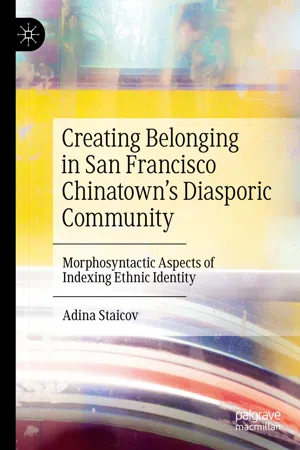
eBook - ePub
Creating Belonging in San Francisco Chinatown’s Diasporic Community
Morphosyntactic Aspects of Indexing Ethnic Identity
- English
- ePUB (mobile friendly)
- Available on iOS & Android
eBook - ePub
Creating Belonging in San Francisco Chinatown’s Diasporic Community
Morphosyntactic Aspects of Indexing Ethnic Identity
About this book
Information
Subtopic
Études sur la communication© The Author(s) 2020
A. StaicovCreating Belonging in San Francisco Chinatown’s Diasporic Communityhttps://doi.org/10.1007/978-3-030-24993-9_11. Introduction
Adina Staicov1
(1)
Writing Center, Hiroshima University, Hiroshima, Japan
Adina Staicov
Sometimes when I walk around Chinatown I forget that I’m in America. (Sun, second-generation Chinese American, male)
The opening quote reflects experiences of members of a diaspora community navigating between mainstream society and their ethnic and cultural heritage community. In a diaspora setting, issues of ethnicity are potentially heightened as individuals try to negotiate their identiti(es), and allegiances, in relation to both communities. Such local acts of identity construction can further be complicated by ties to the country of origin. Together, the aforementioned factors add to the complex web of an individual’s ethnic identity. The reciprocal relationship between ethnic identity construction and linguistic practices, particularly linguistic variation, is also at play in the Chinese American diaspora community of San Francisco Chinatown1; a community in which first- and second-generation Chinese Americans draw on their linguistic repertoire to signal belonging to or distance from the mainstream Anglo-American or the Chinese American community.
San Francisco Chinatown, the oldest and one of the largest Chinese diaspora2 communities in North America, provides fertile grounds for the investigation of language and ethnic identity. Tracing its origins back to the mid-nineteenth century, today’s Chinatown still represents an ethnic enclave, a space that allows Chinese Americans of all generations to remain in contact with Chinese culture. The neighbourhood itself is thus another factor influencing ethnic identity as well as linguistic practices.
1.1 Language Variation in Chinatown
Despite a growing body of literature on variation in speakers of Chinese ancestry, Chinese American linguistic practices are still relatively unchartered territory. Chinese Americans are perceived as culturally and linguistically highly assimilated,3 and Asian Americans, in general, have long been considered not to have their own variety of English (Wong 2010: 5). I will not try to argue here that an ethnically distinct variety of English or “ethnolect” does exist in Chinatown but want to show that specific morphosyntactic variables are a resource that is employed to index (ethnic) identity.
In traditional sociolinguistic studies on the correlation between macrosocial categories, such as ethnicity, and linguistic variation (e.g. Labov 1966; Trudgill 1972), social categories were perceived as fixed and stable. Such an essentialist approach, however, can lead to an oversimplification of “the multivalent and multimodal nature of identities as well as the nuanced ways in which these identities are indexed and negotiated linguistically” (Wong and Hall-Lew 2014: 27). To avoid this oversimplification, I took a constructivist perspective that conceptualises ethnicity and ethnic identity as being constantly (re-)negotiated in relation with all the different social groups to which an individual claims membership. In addition, I discuss how linguistic variables are used to index social meaning through stylistic practices.4
Identity is another concept that is closely intertwined with linguistic variation. Linguistic identity research aims to uncover how speakers use features to index their identity and how hearers use those features to infer information about the speakers (Joseph 2004: 24). Language functions as the mediator between individual and social identity, and linguistic features bind these two types of identities together (Tabouret-Keller 1998: 317). There is ample evidence of the strong correlation between social groups and linguistic features (e.g. Labov 1966, 1972; Lakoff 1975, 2000; Tannen 1990; Milroy 1987; Milroy and Milroy 1992), to which Joseph (2004: 38) adds that:
(1) group identities are sometimes manifested primarily through shared linguistic features, and (2) these features are not necessarily fixed in a given individual, whose knowledge of his language always includes a wide range of features (so that he can understand speakers from outside his group) which in some cases he can deploy actively, for example in the case of linguistic accommodation.
My discussion shows how Chinese Americans in San Francisco make use of such “shared linguistic features” to (co-)construct their “group identities” and membership in a diaspora setting. Drawing on original, interactive speech data5 collected in San Francisco Chinatown (see Sect. 2.6), I illustrate how the construction of ethnic identiti(es) relates to morphosyntactic variation in English across different communicative settings and with different interlocutors. Quantitative linguistic and discursive instantiations of identity construction are then localised within the sociolinguistic constraints of different generations of Chinese Americans.
In my analysis of the interview data, I was guided by three overarching questions: (1) What role does language play for the indexing of ethnic identity in a diaspora community like San Francisco Chinatown? (2) How do Chinese Americans construct ethnic identity discursively? and (3) Do first- and second-generation speakers differ in their use of their linguistic repertoires in English (especially with regard to morphosyntactic variation)?
The variety of English spoken in the Chinatown community is likely influenced by the widely spoken heritage language, Cantonese, and by varieties of first-generation immigrants’ learner or accented Englishes. Close contact to these varieties provides the different generations of Chinese Americans with a broad linguistic repertoire they can employ to index belonging to or distance from their ethnic background. In addition to the realisation of specific linguistic features, speakers attitudes towards the different languages used in the community interacted with their sense of belonging and identification with both the host and the heritage communities.
The second question helped uncover the potential for ethnic identity construction, both through linguistic variation vis-à-vis different interlocutors (in the quantitative analysis of morphosyntactic variables in in-group and out-group speech) and through open identity negotiations in discourse (in the qualitative analysis of interview and discussion data). While linguistic variation could be observed, ethnic identity seemed to play a lesser role in triggering the use of non-standard features. Rather, participants seemed to follow a traditional sociolinguistic pattern in that women used fewer and men more non-standard features. Ethnicity was a more important factor in the discursive construction of identity. For most participants, ethnic identity strongly correlated with the use of the heritage language. In the second generation, in particular, being able to speak the heritage language was an important prerequisite for identifying as Chinese American. Taking into account that many second-generation participants did not consider themselves fluent in Cantonese, this observation showed the symbolic value of the heritage language.
With an ethnographic approach to the community in mind, the third question afforded the investigation into different socio-historic and sociolinguistic realities of first- and second-generation speakers. Individual and collective experiences helped shape different linguistic repertoires and a stronger ethnic orientation that is reflected in a speaker’s use of morphosyntactic variables. Socio-historic developments were particularly relevant in the second generation, where older speakers had experienced a change in American society from anti-Chinese to more inclusive. While this aspect might not have been traceable in linguistic variation, it was an important factor in creating a sense of belonging to Chinatown; this was highlighted in many conversations I had with older participants.
Based on the above research questions, I formulated hypotheses (i)–(iii), which were tested using both quantitative and qualitative methodologies:
- (i)First-generation speakers show higher ethnic identity indices compared to the second generation. Within the second generation, older speakers have higher indices.
- (ii)First-generation speakers show higher frequencies of non-standard variants and variations are less affected by social variables.
- (iii)While both older and younger second-generation speakers show morphosyntactic variation, interlocutor effect and positive ethnic orientation will be stronger for older second-generation speakers.
1.2 Some Considerations on Language and Ethnic Identity
Linguistic variation in a diaspora setting like San Francisco Chinatown can be influenced by and interact with a number of different factors. To discuss linguistic practices in the Chinese American community, I drew specifically on the notions of ethnicity, identity, and transnationalism. As Chinatown is the result of migration, the presence or absence of ties to the country of origin can affect language choice and impact an individual’s ethnic orientation in various ways. The aforementioned concepts become salient in the construction and negotiation of (ethnic) identity and are likely reflected in an individual’s linguistic choices. In addition to these broader notions, people’s connection to their own, as well as the mainstream social group, can interact with ethnic identity and language variation. By drawing on specific linguistic strategies (see Sect. 4.1), individuals can index belonging to or distance from the different social groups that constitute their social environment.
Considering that Chinat...
Table of contents
- Cover
- Front Matter
- 1. Introduction
- 2. San Francisco Chinatown: Introducing the Community
- 3. Ethnolinguistic Variation in North America
- 4. Ethnic Identity and Morphosyntactic Variation in San Francisco Chinatown
- 5. Constructing Chinese Americanness in San Francisco Chinatown
- 6. Conclusion
- Back Matter
Trusted by 375,005 students
Access to over 1.5 million titles for a fair monthly price.
Study more efficiently using our study tools.
Frequently asked questions
Yes, you can cancel anytime from the Subscription tab in your account settings on the Perlego website. Your subscription will stay active until the end of your current billing period. Learn how to cancel your subscription
No, books cannot be downloaded as external files, such as PDFs, for use outside of Perlego. However, you can download books within the Perlego app for offline reading on mobile or tablet. Learn how to download books offline
Perlego offers two plans: Essential and Complete
- Essential is ideal for learners and professionals who enjoy exploring a wide range of subjects. Access the Essential Library with 800,000+ trusted titles and best-sellers across business, personal growth, and the humanities. Includes unlimited reading time and Standard Read Aloud voice.
- Complete: Perfect for advanced learners and researchers needing full, unrestricted access. Unlock 1.5M+ books across hundreds of subjects, including academic and specialized titles. The Complete Plan also includes advanced features like Premium Read Aloud and Research Assistant.
We are an online textbook subscription service, where you can get access to an entire online library for less than the price of a single book per month. With over 1.5 million books across 990+ topics, we’ve got you covered! Learn about our mission
Look out for the read-aloud symbol on your next book to see if you can listen to it. The read-aloud tool reads text aloud for you, highlighting the text as it is being read. You can pause it, speed it up and slow it down. Learn more about Read Aloud
Yes! You can use the Perlego app on both iOS and Android devices to read anytime, anywhere — even offline. Perfect for commutes or when you’re on the go.
Please note we cannot support devices running on iOS 13 and Android 7 or earlier. Learn more about using the app
Please note we cannot support devices running on iOS 13 and Android 7 or earlier. Learn more about using the app
Yes, you can access Creating Belonging in San Francisco Chinatown’s Diasporic Community by Adina Staicov in PDF and/or ePUB format, as well as other popular books in Langues et linguistique & Études sur la communication. We have over 1.5 million books available in our catalogue for you to explore.