eBook - ePub
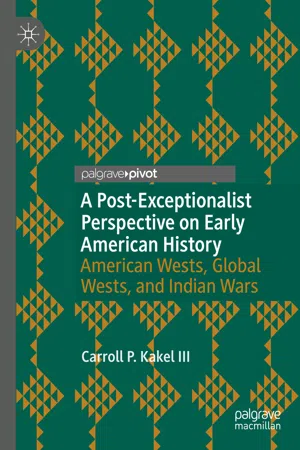
A Post-Exceptionalist Perspective on Early American History
American Wests, Global Wests, and Indian Wars
- English
- ePUB (mobile friendly)
- Available on iOS & Android
eBook - ePub
A Post-Exceptionalist Perspective on Early American History
American Wests, Global Wests, and Indian Wars
About this book
This book argues that early American history is best understood as the story of a settler-colonial supplanting society—a society intent on a vast land grab of American Indian space and driven by a logic of elimination and a genocidal imperative to rid the new white settler living space of its existing Indigenous inhabitants. Challenging the still strongly held notion of American history as somehow exceptional or unique, it locates the history of the United States and its colonial antecedents as a central part of—rather than an exception to—the emerging global histories of imperialism, colonialism, and genocide. It also explores early American history in an imperial, transnational, and global frame, showing how the precedent of the North American West and its colonial trope of Indian wars were used by like-minded American and European expansionists to inspire and legitimate other imperial-colonial adventures from the late-nineteenth through the mid-twentieth centuries.
Information
© The Author(s) 2019
C. P. Kakel IIIA Post-Exceptionalist Perspective on Early American Historyhttps://doi.org/10.1007/978-3-030-21305-3_11. Introduction: Explaining Early America
Carroll P. KakelIII1
(1)
Johns Hopkins University, Baltimore, MD, USA
Carroll P. KakelIII
Other histories are implicated in American history, and the United States is implicated in other histories.
Thomas Bender (‘Introduction: Historians, the Nation, and the Plenitude of Narratives’, in Rethinking American History in a Global Age, ed. Thomas Bender, Berkeley, CA: University of California Press, 2002, 6.)
Abstract
The book’s Introduction briefly discusses the historical problem of understanding the history of early America, a problem which has been complicated by the still strongly held notion (in both public perception and in some academic circles) of an American historical exceptionalism. It sketches recent historiographical developments and scholarly trends, and it introduces historian David Day’s notion of a supplanting society. It presents the book’s main idea: early American history is a central part of—rather than an exception to—the emerging global histories of imperialism, colonialism, and genocide. It also presents its main argument: early American history is best understood as the story of a supplanting society, a society intent on a land grab of Indigenous space and driven by a logic of elimination and a genocidal imperative to rid the new settler living space of its existing Indigenous inhabitants.
Keywords
ImperialismColonialismGenocideFrontierViolenceEarly AmericaIn popular culture and American political rhetoric, the notion of American exceptionalism—the idea that the United States is a chosen land with a special destiny and mission which set it apart from the rest of the world—is omnipresent in American public life. With the end of World War II and the onset of the Cold War, exceptionalist American history became a controlling theme in contemporary US history writing, in a country which had long conceived of itself in exceptionalist terms and yearned for proof of its own uniqueness.1 This exceptionalist reading of the United States saw American history as outside world history, immune from general historical tendencies, and exempt from the historical forces governing all other nations.2 As a special case, the United States, in this view, was excluded from the normal patterns and laws of history. In many ways, the legacies of nationalism and exceptionalism, to be sure, ‘still haunt the study of American history’.3
In the case of early American history, specifically, the exceptionalist paradigm has placed the United States outside an historical continuum of violent national projects of territorial expansion, racial cleansing, and settler colonization that have been very much a prominent feature of the rise and history of Western civilization. Exceptionalist American history has portrayed an American continental land empire as ‘western expansion’, and it has reduced brutal colonial rule to an ‘unacknowledged theme’ in early American history.4 It has, in short, ignored, minimalized, or downplayed the hard truths and unpleasant realities of American settler colonialism . The extreme violence toward Indian peoples that accompanied the colonization of the North American continent has become ‘at once the most familiar and overlooked subject in American history’, a ‘violent encounter with the indigenous inhabitants’ whose ‘true magnitude remains unacknowledged even today’.5 Despite an outpouring of scholarship in recent decades, however, historians have ‘failed to reckon with the violence upon which the continent [and the American nation] was built’.6
In a recent widely-noted review essay, historian Paul A. Kramer issued a compelling call for a ‘post-exceptionalist history’ of the United States, a history which would challenge and correct the larger effort—in popular history, political culture, and much scholarly history—to set America and its history apart. As Kramer rightly notes, despite a wave of ‘anti-exceptionalist’ criticism by some scholars, ‘exceptionalism’ remains ‘wired into the historical analysis of the United States’. In particular, he observes, not a few historians—operating strictly within the traditional boundaries of ‘national history’—are still teaching and/or writing ‘exceptionalist history’ or are using explanatory frameworks ‘which do its work’.7 This long essay is offered up as an initial contribution to Paul Kramer’s call for a post-exceptionalist history of the United States, focusing on the history of early America in its colonial, revolutionary, and early republic phases.
This study lies at the intersection of three US history fields: early American history, American western history, and American Indian history.8 Within the field of early American history, scholarship focuses on different chronological periods: colonial North America, 1607–1763; the American revolutionary era, 1763–1789; the early American republic, 1789–1848; the Civil War era, 1848–1865; and Reconstruction and the Gilded Age, 1865–1896. In each of these fields, scholars have challenged the inherited master narrative, offering a richer and more complex view of the early American past.
Viewing Frederick Jackson Turner’s frontier thesis as an interpretive straightjacket, and seeking a more balanced view of the western past, a group of American historians writing in the 1980s and 1990s launched the New Western History.9 Recent scholarship—what has been called the New Indian History—rightly emphasizes Indian agency (instead of mere victimhood). Rather than passive objects, American Indians were active participants in shaping their own histories—histories centered on stories of resistance, adaptation, and survival.10 Departing sharply from the norms of American historiography, an Indigenous history of North America is also emerging—part of a global Indigenous paradigm based on concepts of Indigenousness, sovereignty, colonization, and decolonization.11
Across the various historiographies, a new, younger generation of historians emerged to begin to challenge the exceptionalist frame of much post–World War II American history writing. While some of this scholarship finds its way into trade books aimed at a wider audience, much of it takes the form of conference papers, articles in professional journals, book chapters, and scholarly monographs intended for fellow academics. Slowly and not without controversy, to be sure, a ‘non-exceptionalist’ (and, in some cases, ‘anti-exceptionalist’) history of the United States has begun to come into view. But as yet, as historian Daniel T. Rodgers notes, an ‘overarching conceptual framework for a non-exceptionalist history of the United States is not yet in place’.12
This study also lies at the intersection of three emerging transnational and global history fields: imperial studies, settler-colonial studies, and genocide studies. While these are three distinct fields, they also overlap due to the intimate relations between these three particular global phenomena. As we are discovering, there was no period of human history, or part of the world, which was not affected by the phenomena of imperialism, colonialism, and genocide. The field of imperial studies examines empires in world history.13 From its roots in Native American and Indigenous studies, the emerging field of settler-colonial studies explores settler colonialism as a distinct social and historical formation (from colonialism).14 An offshoot of the longer standing discipline of Holocaust studies, the new field of genocide studies focuses on attempted destruction of human groups through the ages.15
In historiographic terms, historians have used three competing paradigms to explain the history of early America.16 In the classic east-west version, American history began in the English colonies of the Atlantic seaboard and spread westward across the vast North American continent. In recent years, so-called Atlantic historians have contextualized early American history as part of an interdependent Atlantic World of Europe, Africa, and the Americas.17 Using a continental paradigm, other historians have embraced a continental view which sought to restore American Indian peoples to the story of early America—placing the Native North American West alongside the Settler North American East.18 Taken together, Atlantic and continental histories challenge the older, traditional version of early American history. Like all historical paradigms, however, each of these approaches has its own limitations.
In his thought-provoking book Conquest: How Societies Overwhelm Others, historian David Day introduces the concept of a ‘supplanting society’ to explain world history and to interrogate the individual histories of empires and nations. Over the long term, he observes, the history of the world has been a history of wave after wave of people intruding on the lands of others—a continuous tale of territorial loss and acquisition, ‘an ongoing jostling for living space’. In some cases, the intrusion aimed at securing military advanta...
Table of contents
- Cover
- Front Matter
- 1. Introduction: Explaining Early America
- 2. Neo-European Wests: Frontiers of Empire, 1607–1754
- 3. America’s First West: The Trans-Appalachian West, 1754–1815
- 4. America’s Farther West: The Trans-Mississippi West, 1815–1890
- 5. The Global West: Other Wests and Indian Wars, 1890–1919
- 6. The Global West: Other Wests and Indian Wars, 1919–1945
- 7. Conclusion: Understanding Early America
- Back Matter
Trusted by 375,005 students
Access to over 1.5 million titles for a fair monthly price.
Study more efficiently using our study tools.
Frequently asked questions
Yes, you can cancel anytime from the Subscription tab in your account settings on the Perlego website. Your subscription will stay active until the end of your current billing period. Learn how to cancel your subscription
No, books cannot be downloaded as external files, such as PDFs, for use outside of Perlego. However, you can download books within the Perlego app for offline reading on mobile or tablet. Learn how to download books offline
Perlego offers two plans: Essential and Complete
- Essential is ideal for learners and professionals who enjoy exploring a wide range of subjects. Access the Essential Library with 800,000+ trusted titles and best-sellers across business, personal growth, and the humanities. Includes unlimited reading time and Standard Read Aloud voice.
- Complete: Perfect for advanced learners and researchers needing full, unrestricted access. Unlock 1.5M+ books across hundreds of subjects, including academic and specialized titles. The Complete Plan also includes advanced features like Premium Read Aloud and Research Assistant.
We are an online textbook subscription service, where you can get access to an entire online library for less than the price of a single book per month. With over 1.5 million books across 990+ topics, we’ve got you covered! Learn about our mission
Look out for the read-aloud symbol on your next book to see if you can listen to it. The read-aloud tool reads text aloud for you, highlighting the text as it is being read. You can pause it, speed it up and slow it down. Learn more about Read Aloud
Yes! You can use the Perlego app on both iOS and Android devices to read anytime, anywhere — even offline. Perfect for commutes or when you’re on the go.
Please note we cannot support devices running on iOS 13 and Android 7 or earlier. Learn more about using the app
Please note we cannot support devices running on iOS 13 and Android 7 or earlier. Learn more about using the app
Yes, you can access A Post-Exceptionalist Perspective on Early American History by Carroll P. Kakel III in PDF and/or ePUB format, as well as other popular books in History & Historiography. We have over 1.5 million books available in our catalogue for you to explore.