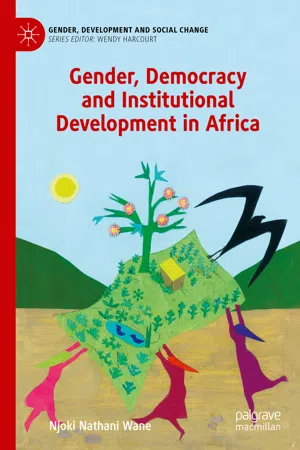
This book analyses African foundations of gender, education, politics, democracy and institutional development by stimulating theoretical discourses. It offers a discursive framework on ways to examine the conceptualizations of African social development and a critical discourse on debunking the misconceptions that are attached to African location in the global arena. The volume challenges the danger of minimizing and oversimplifying the role of Africa in the international space. This will be ideal for researchers, students and scholars in the areas of African and gender studies, development, politics and education.
- English
- ePUB (mobile friendly)
- Available on iOS & Android
eBook - ePub
Gender, Democracy and Institutional Development in Africa
About this book
Information
© The Author(s) 2019
Njoki Nathani WaneGender, Democracy and Institutional Development in AfricaGender, Development and Social Changehttps://doi.org/10.1007/978-3-030-11854-9_11. Introduction
Njoki Nathani Wane1
(1)
University of Toronto, Toronto, ON, Canada
Abstract
Most foreigners who set foot on African soil fall in love with the continent. They are spellbound by the natural beauty of Africa and its deep tradition. Though currently besieged by innumerable political and economic challenges, Africa is a proud continent that contributed to the rise of civilizations. Colonialism in Africa was like a nuclear war or a holocaust. It devastated the continent and continues to linger, becoming the worst nightmare in the history of Africa. Despite some sincere efforts by international organizations and foreign countries to mitigate its woes, Africa continues to stutter in the quagmire of poverty, and her voice remains underrepresented in the international political landscape. Regardless, the true picture of Africa is not lost. This book is one more effort to carry forward the viable past into the future. If Africa has to be launched in a meaningful development endeavor, both Africans and foreigners need to understand what existed in the past and what lessons we can take for the future. The introduction provides highlights of the book such as the fundamentals of African traditional philosophies and the current upheavals in governance of post-colonial African states.
Introduction
Most foreigners who set foot on African soil fall in love with the continent. They are spellbound by the natural beauty of Africa and its deep tradition. Though currently besieged by innumerable political and economic challenges, Africa is a proud continent that contributed to the rise of civilizations. Colonialism in Africa is like a nuclear war or a holocaust. It devastated the continent and continues to linger, becoming the worst nightmare in the history of Africa. The direct colonialism that disrupted the “life-as-usual” situation in Africa persisted in its corroding effect through educational, cultural, economic, and political colonization. Despite some sincere efforts by international organizations and foreign countries to mitigate its woes, Africa continues to stutter in the quagmire of poverty, and her voice remains underrepresented in the international political landscape. Epistemologically, Africa’s contribution to a universal generation and application of knowledge is not acknowledged or well taken.
Regardless, the true picture of Africa is not lost. African and other concerned scholars are articulating their resolution to see this bleak picture shine brighter and brighter. Ours is one more effort to carry forward the viable past into the future. If Africa has to be launched in a meaningful development endeavor, both Africans and foreigners need to understand what existed in the past and what lessons we can take for the future. Many have contempt when Africa’s proud past is retold. However, for Africans, understanding and glorifying the past are the beginning of regaining dignity and indicative of possible comeback. It is important for everyone to realize that Africans had once enjoyed a peaceful and thriving civilization in the past, which also shows that they have the potential to do so now and in the future. This knowledge boosts the self-worth and self-confidence of young people of African descent, which are very vital in their learning.
When African people and their descendants around the world start to see themselves as part of a long history of civilization in which they have been part, they will be awakened to the fact that they are where they are for a reason. They can still feel the connection to their ancestors, to the next generation, and to humanity in general. They can continue to see themselves as originators and fashioners of civilization. The history of slavery and colonialism is a challenge set to test our humanity, and we can overcome it by reclaiming our humanness, our love, and our vision to a better future. This book was written to help everyone see Africa and Africans in a new light, to embrace Africa and Africans as an asset, and to seek their knowledge and wisdom in the new world order. In order to take the readers through a different mental and physical map of Africa, in each chapter, we raise different issues and explain facts and perspectives.
In the second chapter, Ahmed examines the fundamentals of African traditional philosophies. He argues that “African philosophies are the foundations of African societies in as much as they are overarching principles governing everyday life of the African … [they] are the common thread which connects African peoples with their African roots”.
In the third chapter, Akena explains that the social, political, and economic spectrum of the modern global era is deeply manufactured in favor of the more developed countries. With reference to Africa, he continues to explain, the media has largely contributed significantly in portraying the continent of Africa with cynicism. Consequently, facets such as preventative diseases wrecking mayhem, famine, wars, HIV/AIDS, illiteracy, piracy, and failed states have become common features through which Africa is portrayed. The objective of his chapter is to lay bare the motives behind the negative depictions by arguing that such negativity in depiction needs to be situated within a historical context. This however is not to negate the fact that there are challenges with which the continent is struggling. To debunk the biased depiction therefore, the chapter acknowledges the current upheavals in governance of post-colonial African states and argues for the emulation of some forms of ancient government practices not only to show African potentials but also to create a roadmap for a strong united states of Africa to usher in peace, stability, and sustainable development.
In the fourth chapter, Alberta Akrong advances the position that the continent of Africa cannot be discussed without mentioning its historical travel and trading activities. Trade has been and is still an integral part of the people of the land dating back to pre-colonial times and even to the period of medieval Europe. Trading activities were conducted both on land and by water ways, and these events contributed to making the continent accessible to reach resources—both human and material. She argues that on the one hand this historical pursuit seems to be the genesis to access creation into Africa’s hinterland through the support of livelihood creation, business and profit-making, commodity exchanges, settlements formation, and empire building, while on the other hand it somehow facilitated the further success of European domination of Africa. It was obvious that the European success of penetration and eventual take-over of Africa were because they could easily access the trade route passes for the slave raid activities and raw materials collection to the trading ports for eventual shipment from out of the continent.
In Chap. 5, Njoki Wane provides an overview of African indigenous knowledge and its centrality in indigenizing education. She argues that a discussion of African indigenous knowledge as a transformational project does not take place in a vacuum but rather within the context of a history of colonialism, imperialism, neo-colonial, post-colonial, and anti-colonial discursive frameworks. In this discussion, she acknowledges the ethnic and cultural diversity and the historical contingencies and specificities of African peoples. She also acknowledges that some common elements in African indigenous knowledge systems can be found in diverse or variant forms among indigenous peoples of the world. The chapter is based on an on-going research into African past. The project opens a window onto African peoples, their educational and philosophical thought. Often misrepresented, seldom understood, and frequently ignored, the land mass of 12 million square miles or 31 million square kilometers is one of the largest continents on planet Earth. Its peoples, comprising many hundred ethnic groups, speak more than 2000 languages and regional varieties of a language or dialect. One major conclusion of this work is the need to acknowledge and recognize the multiple and collective origins of knowledge. Her research indicates that this conversation is critical, as it impacts on the forms of knowledge, which are legitimated within the academy. Therefore, for any meaningful learning and teaching to take place, it is necessary for educators to rethink or reimagine how indigeneity may be infused within the Eurocentric curriculum.
In the sixth chapter, Solomon discusses what science is in the African context. He says not only science is part of a cultural activity but also science itself is an African culture. He gives examples of the different African sciences to drive home the point that Africa has primacy in the scientific world and has a lot of potential to shape its future.
In the seventh chapter, Fabris and Wane search literature to consider the lives of women in ancient Africa. An Internet search for women in Africa uncovers the usual litany of despair in Africa, but what of the herstories of African women? Black feminists, all women of color, have started to recover stories of pride, hard work, self-defense, and rulership. As usual they have also been met with skepticism from Westerners, especially men. As women around the world push for a better society, we welcome stories that show ways in which ancient women often had a more central role in society. What would a world with many women in positions of power look like?
The purpose of Chap. 8 is to unearth the centrality of spirituality in the lives of African peoples. Spirituality has been one of the main pillars for Africans. As Wane et al. (2007) have stated elsewhere, the culture of African people was rooted in their spirituality, and they saw their spirituality as a springboard to everything that they did. African people’s spirituality was nourished through their everyday practice and in particular the evocation of the Creator’s name. For instance, Wane recalls while growing up in a rural area, her mother used to call on the name of the Creator, Mwene Nyaga, at dawn and later in the evening as the last frames burnt out and everyone was in their beds ready to sleep. According to Wane, the morning evocation was to give thanks to the Creator for having protected the family throughout the night and for having given every member of the family another day to witness the wonders of the world. In the evening, Wane states, her mother would give thanks for the day’s blessings. The chance to witness spiritual rituals is a unique phenomenon found throughout ancient African societies. Throughout these rituals, what was emphasized was the quality of relationship developed between communities and the relationship between individuals and the world or environment. The need to cultivate an attitude of caring, respect, and harmony was not spoken but implicitly inferred.
Chapter 9 frames a discussion on the application of ancient African philosophy in a twenty-first-century classroom and its relevance to curriculum on leadership training in a Eurocentric institution. The students discuss the transformative value of the course on classroom relations and perceptions of leadership skills and practice. The course validates communalism and intergenerational interdependence and concurrently deconstructs competition and opposition as endemic to successful leadership practice.
The contributors have revisited existing sources of knowledge and through robust analyses have shed new light on earlier findings. They have drawn on previously unwritten sources of proverbs, everyday practices, and common sense to deliver untapped knowledge. Knowing ancient Africa through the lens of conscious Africans delivers on the objectives of this project.
© The Author(s) 2019
Njoki Nathani WaneGender, Democracy and Institutional Development in AfricaGender, Development and Social Changehttps://doi.org/10.1007/978-3-030-11854-9_22. African Traditional Philosophies
Ahmed Ali Ilmi1
(1)
University of Toronto, Toronto, ON, Canada
Ahmed Ali Ilmi
Abstract
African traditional philosophies are multiple bodies of living comprehensive knowledges which encapsulate holistic ways of knowing. In its cosmological sense, it’s the common thread which connects African peoples with their African roots. It encompasses an intergenerational ancestral connection between the living, the dead, and the unborn. It is a moral and ethical communal existence which is built upon notions of collective social responsibility to one’s clan, family, and community, their ancestors, and the Creator. From a spiritual point of view, it is about giving thanks to the Creator, to the ancestors, and to the environment. In essence, African philosophies are an everyday embodiment of Wisdom as a being who is connected to a greater purpose in life. In this chapter, I will articulate my understanding of what constitutes African philosophies as well as provide synopses of the current contemporary debates on Africa philosophies. I will then highlight the dis-positioning of African philosophies within Eurocentric institutions. I will conceptualize the foundation of African philosophies. After that I will engage in a discussion about African communalism.
Introduction
African traditional philosophies are multiple bodies of living comprehensive knowledges which encapsulate holistic ways of knowing. As such, they are social constructs which enable members of a community to think in and through specific cultural norms wherever they are raised. African philosophies are the foundations of African societies in as much as they are overarching principles governing the everyday life of Africans. In its cosmological sense, it’s the common thread which connects African peoples with their African roots. It encompasses an intergenerational ancestral connection between the living, the dead, and the unborn. It is a moral and ethical communal existence which is built upon notions of collective social responsibility to one’s clan, fami...
Table of contents
- Cover
- Front Matter
- 1. Introduction
- 2. African Traditional Philosophies
- 3. Ancient Governance in Africa
- 4. Trade, Routes Trade, and Commerce in Pre-colonial Africa
- 5. African Indigenous Education
- 6. The Spirit of African Indigenous Science
- 7. Women and Gender Relations in Africa
- 8. The Science of African Spirituality
- 9. Centering African Women’s Leadership Course: A Conversation
- 10. Conclusion: Continuity and Futurity—Ancient Africa Survives
- Back Matter
Trusted by 375,005 students
Access to over 1.5 million titles for a fair monthly price.
Study more efficiently using our study tools.
Frequently asked questions
Yes, you can cancel anytime from the Subscription tab in your account settings on the Perlego website. Your subscription will stay active until the end of your current billing period. Learn how to cancel your subscription
No, books cannot be downloaded as external files, such as PDFs, for use outside of Perlego. However, you can download books within the Perlego app for offline reading on mobile or tablet. Learn how to download books offline
Perlego offers two plans: Essential and Complete
- Essential is ideal for learners and professionals who enjoy exploring a wide range of subjects. Access the Essential Library with 800,000+ trusted titles and best-sellers across business, personal growth, and the humanities. Includes unlimited reading time and Standard Read Aloud voice.
- Complete: Perfect for advanced learners and researchers needing full, unrestricted access. Unlock 1.5M+ books across hundreds of subjects, including academic and specialized titles. The Complete Plan also includes advanced features like Premium Read Aloud and Research Assistant.
We are an online textbook subscription service, where you can get access to an entire online library for less than the price of a single book per month. With over 1.5 million books across 990+ topics, we’ve got you covered! Learn about our mission
Look out for the read-aloud symbol on your next book to see if you can listen to it. The read-aloud tool reads text aloud for you, highlighting the text as it is being read. You can pause it, speed it up and slow it down. Learn more about Read Aloud
Yes! You can use the Perlego app on both iOS and Android devices to read anytime, anywhere — even offline. Perfect for commutes or when you’re on the go.
Please note we cannot support devices running on iOS 13 and Android 7 or earlier. Learn more about using the app
Please note we cannot support devices running on iOS 13 and Android 7 or earlier. Learn more about using the app
Yes, you can access Gender, Democracy and Institutional Development in Africa by Njoki Nathani Wane in PDF and/or ePUB format, as well as other popular books in Politique et relations internationales & Développement durable. We have over 1.5 million books available in our catalogue for you to explore.