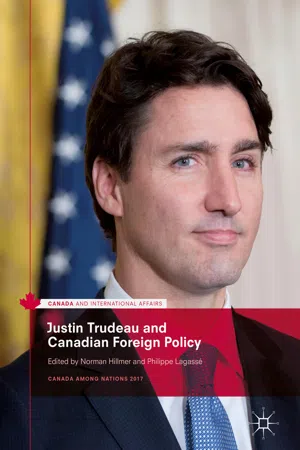
Two elections lie at the heart of this book. Justin Trudeau’s Liberals won power in October 2015, and they entered office fully clothed in pledges to remake Canada and at the same time remake the country’s place among nations. During Trudeau’s first six weeks as prime minister, his widely publicized trips to meetings of the G20 in Turkey, the Asia-Pacific Economic Cooperation (APEC) Summit in Manila, the Commonwealth prime ministers’ conference in Malta, and the COP21 climate talks in Paris furnished him with what one commentator called “a new, worldly, political shield” at home and a dashing image abroad.1 Liberal internationalism was in the saddle and Trudeau its glamorous ambassador to the global community. On the eve of another election, when Donald Trump startled his way to the United States presidency in November 2016, the Economist magazine’s cover Canadianized the Statue of Liberty, which was pictured with a smile, a maple leaf hat, and a hockey stick. The accompanying editorial purred that Trudeau’s Canada was the exception to a depressing international company of “wall-builders, door-slammers and drawbridge-raisers.”2
Trudeau was labelled the anti-Trump by the Washington Post and the German newspaper Die Welt 3 and almost universally elsewhere, but he acted with disciplined politeness when he turned his face towards the new American president. Trump too had his big promises, including a vow that American alliances and trade agreements would be scrutinized and repudiated if they did not meet his approval. Canadian interests, most prominently those tied up in the North American Free Trade Agreement (NAFTA), were directly on the line. All Ottawa governments look southwards, but the prime minister and his ministers and officials now fanned out all over the United States to make the case that Canada was too important to the United States for the ties between the two countries to be allowed to deteriorate. It was as if the fate of Canadians depended on the successful wooing of Trump’s America.4
Justin Trudeau’s election triumph brought Prime Minister Stephen Harper’s near-decade-long Conservative government to an end. The Trudeau victory was not preordained, and the suspicion was that his carload of promises were a luxury that only the leader of the third party in the House of Commons could afford, since it was unlikely that he would have to form a government that would have to implement them. In the first half of an unusually (for Canada) lengthy electoral campaign, the social democratic New Democratic Party (NDP) was thought to have a much better chance of displacing Harper, and for a while there appeared the possibility that the Conservatives might cling to power after all. During the closing weeks of the campaign, however, voters opposed to the Conservatives coalesced around the Trudeau Liberals. Although future studies of the 2015 election may offer a more nuanced explanation, the Liberals had apparently succeeded in convincing voters, including many who often did not participate in the democratic process, that Trudeau was best placed to oust the Conservatives. “Real Change,” the overarching Liberal message aimed directly at the unpopular Harper, propelled the Liberals to a commanding 184 seats in the House of Commons, as against 99 for the Conservatives and only 44 for the NDP.
The Trudeau electoral platform was laced with progressive policy promises and not so subtle suggestions that a Trudeau government would dismantle Harper’s legacy. The Liberals talked of renewing Canadian leadership in the world, notably by confronting climate change and reengaging with the United Nations and peacekeeping operations. A new government would implement the United Nations Declaration on the Rights of Indigenous Peoples (UNDRIP), end the Canadian military’s combat mission in Iraq, welcome thousands of Syrian refugees, reinvest in development assistance to the “world’s poorest countries,” and reexamine Canada’s approach to international trade.5 Harper had shunned the world, and Trudeau would counter his blinkered vision.
Canada Among Nations 2017 is an assessment of Trudeau’s first two years of international policies. The book begins with three overview articles that revolve around the very high expectations that the prime minister fostered and with which he must now live. Roland Paris applauds Trudeau’s fierce defence of economic and security interests, vocal promotion of openness and inclusion, and skilful handling of the relationship with the United States. But in his potential, Paris warns, lurks the danger that Trudeau will fail to meet his own call for global leadership. Kim Richard Nossal does a tally of promises made and promises kept in a mid-term report card that gives passing marks to the government’s management of the politics and process of foreign policy. His conclusion is that the pledges of 2015 are not weighing the government down. Jerome Klassen and Yves Engler, on the other hand, deliver a scathing indictment of the prime minister’s leadership, which they argue raised unrealistic hopes for “socially-progressive and liberal values, worldwide.” Trudeau’s cheerleading for a transcendent politics, international and otherwise, is for them an illusion or, worse, a lie. Klassen and Engler claim that, as the globe plummets into disorder, the Trudeau government stubbornly maintains Canada’s allegiance to Washington, militarism, and the imperialism of corporate capitalism.
Creating distance from Stephen Harper was not as easy as it looked. Trudeau has undoubtedly shifted the rhetoric away from his predecessor’s combative insistence that international amity had to be subordinated to a righteous struggle against the evils of a dangerous world.6 In foreign policy tone is not nothing, but continuity with the recent past defines a good deal of Trudeau international policy. “What a splendid job Justin Trudeau is doing in carrying out Stephen Harper’s foreign policy,” contended John Ibbitson, Harper’s biographer, in March 2017. Trudeau had promised his Canada would be “a caring country committed to doing its share, and he’s kept his word. Canada is indeed doing it share—the same share that it contributed under the Conservatives.”7
International trade was at the top of the Harper agenda, and it has remained there under Trudeau. The Liberal government embraced the Conservatives’ Canada-European Union Comprehensive Economic and Trade Agreement (CETA) and looked towards a remodeled Trans-Pacific Partnership (TPP), which struggled to survive without Trump, who dismissively walked away from it early in his presidency.8 Trudeau’s trade ministers have elaborated a progressive approach to trade, with an emphasis on environmental protections, worker rights, and an equitable sharing of the benefits of trade. Meredith Lilly’s chapter stipulates, however, that those same progressive elements were already present in the CETA, TPP, and Canada-Korea Trade Agreement texts worked out by the previous government. Lilly also points out how difficult it is to humanize trade in negotiations with a protectionist Trump administration and a China that desires free trade without an overlay of Western values. It is hard to be a progressive without willing partners.
Indigenous voters rushed to Trudeau because he made an eloquent case that their causes were his. Speaking to the UN General Assembly in September 2017, the prime minister declared that Canada had been built on the ancestral land of Indigenous peoples, but without “the meaningful participation of those who were there first.” Their experience had been “mostly one of humiliation, neglect, and abuse.” Canada had campaigned and voted against the 2007 United Nations Declaration on the Rights of Indigenous Peoples, Trudeau lamented, but his government was proudly on a path of reconciliation with First Nations, Métis nation, and Inuit peoples. The Declaration was its guiding light.9
Trudeau’s good intentions are easier to express than apply, and, as in so much, his vocabulary about Indigenous peoples gives rise to hopes that are almost impossible to fulfil. Sheryl Lightfoot’s analysis recognizes the ways in which Trudeau has woven the UN Declaration on the Rights of Indigenous Peoples into his ambitions for global leadership, but at the same time makes abundantly clear the extraordinary complexities of Indigenous politics in Canada. Lightfoot is pessimistic, concluding that the government “is engaged in a difficult dance. It has promised to adopt and implement the UNDRIP, yet it is cognizant of the scope of structural changes to do so, and so it remains hesitant—even resistant—to making real change.” The talk is remarkably different, but the substance “is quite consistent with the Harper government.”
Jennifer Pedersen’s chapter is another example of the difficulty in matching human rights aspirations with government practice. Her subject is Canada’s lucrative arms export industry and, specifically, the sale of Canadian-made light-armoured vehicles (LAVs) to Saudi Arabia. The LAV deal, worth $15 billion over 15 years and generating 3,000 jobs at the General Dynamics plant in Southwestern Ontario, was concluded by the Conservatives in 2014. It became controversial for the Trudeau government in 2016, after the Saudis carried out a mass execution of 47 dissidents. The Liberals refused to turn away from their Conservative inheritance. They tied themselves in knots with implausible assertions that the contract could not be cancelled, simultaneously declaring that their hearts bled for the victims of Saudi violence, some of whom were on the wrong end of weapons made in Canada. NDP members of Parliament were themselves in a delicate position, since one of them held the House of Commons seat where the General Dynamics plant was housed. They chose to concentrate their fire on the Liberals’ lack of transparency and oversight. The government meanwhile piled poor communication skills on top of its hypocrisy.
In the Liberals’ more open door to China, surely a break with the recent past was evident. Where the Harperites had been wary, Trudeau was almost giddy, to the extent that one well-placed observer accused him and his colleagues of being “smitten with the dynamic, entrepreneurial and innovative China that dominates the business pages, while remaining largely silent about the China that tramples human rights at home and intimidates rivals abroad.”10 Trudeau visited China, as his father had done as prime minister. Ottawa set...